Rankevra Blog
Competitor SEO Analysis: A Repeatable System That Ships
September 24, 2026
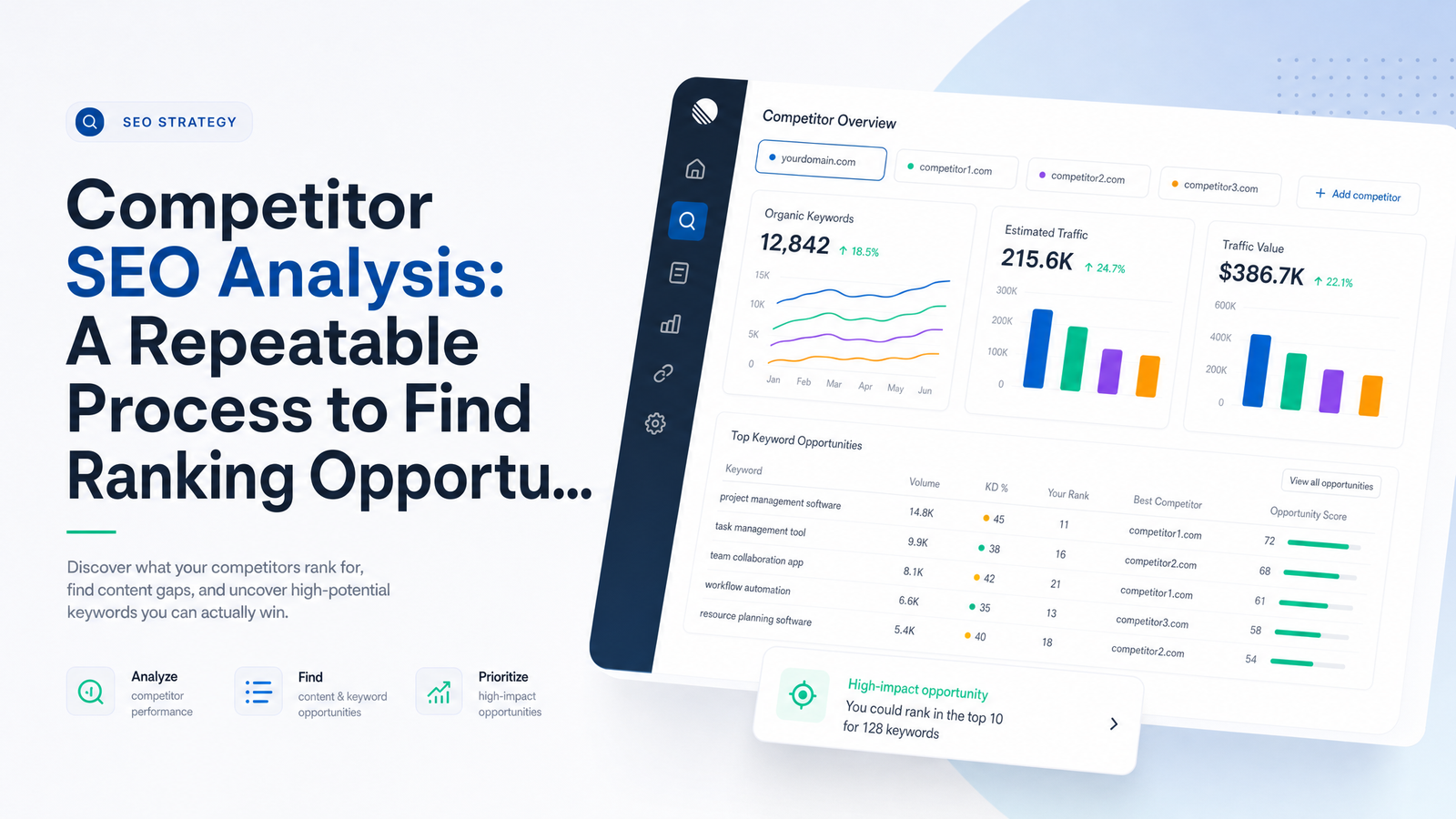
Most competitor SEO analysis dies in a spreadsheet. Someone pulls keyword gaps, screenshots a few SERPs, writes "they have more content than us" in a doc, and three months later nothing has shipped. The research wasn't wrong — it just never turned into a decision.
The fix is treating competitor SEO analysis as a fixed process run on a fixed cadence, one that always outputs a ranked list of actions instead of a pile of observations. That means separating who you compete with in the market from who you actually compete with in the SERP and in AI answer boxes, then converting every gap you find into something specific enough to brief, assign, and publish.
Business Competitors Are Not SERP Rivals
The company you pitch against in sales calls is rarely the site outranking you on Google. A regional service business might compete for customers against two other local firms, but in the search results for "how to choose a [service]," they're up against a national directory, a media publisher, and three SaaS tools with content teams ten times their size.
This distinction matters because it changes where you spend effort. Analyzing your known business competitors tells you about their pricing and positioning. Analyzing your SERP rivals tells you what Google — and increasingly what an AI answer engine pulling from search results — considers the best available answer for a given query. Conflating these two different research projects is the first reason competitor SEO analysis efforts stall.
To find true rivals, don't start with a list of names. Start with your priority keywords and pull the actual ranking pages for each one, including domains that show up in AI Overviews or answer-engine citations if you can see them. Do this across 15-20 keywords representing your core topics, not just your homepage terms. Patterns emerge fast: the same three or four domains keep appearing, and they're often not who you expected.
Run the Audit on a Fixed Cadence, Not Ad Hoc
A one-off competitor audit is a snapshot of a moving target. Rankings shift, rivals publish new pages, and technical issues get fixed or introduced on both sides. Treat competitor SEO analysis as a recurring operation — monthly for fast-moving, competitive niches, quarterly for stable ones — and keep the same structure each cycle so results are comparable period over period.
Each cycle should answer four fixed questions:
- Which rivals gained or lost visibility on our tracked keyword set since last cycle?
- What new pages did they publish, and what topics do those pages cover?
- Where do they rank and we don't, or where do they outrank us despite similar content?
- What technical or structural advantages might explain the gap — page speed, internal linking, schema, content depth?
Running the same four questions on a schedule turns analysis from a project into a system. It also means you catch a rival's content push or technical improvement within weeks, not the following year when you happen to notice their traffic climbed.
This is the part of competitor SEO analysis that's mechanical and repetitive — crawling rival domains, logging rank changes, flagging new pages — and it's exactly what a platform like Rankevra is built to automate, so the cadence runs on its own instead of depending on someone remembering to do it.
Keyword Gaps: Find What They Rank For That You Don't
Keyword gap analysis is the most familiar piece of this process, but it's often done too shallow. Pulling a list of terms a rival ranks for and you don't is step one; the useful work is filtering that list down to what's actually worth acting on.
Prioritize gap keywords where the rival page is thin, outdated, or narrowly focused — that's a signal you can beat it with a more complete page rather than just a longer one. Deprioritize gaps where the ranking page belongs to a domain with dramatically more authority and the topic isn't central to your business; chasing every gap keyword regardless of fit is how teams end up with fifty briefs and no clear priority.
Group the remaining gaps by topic cluster rather than treating each keyword as its own project. If five gap keywords all relate to one subtopic your site never covered, that's a single new page or pillar section, not five separate articles competing with each other.
Content Depth Gaps: The Difference Between Matching and Missing
Ranking on the same keyword as a rival doesn't mean you're covering the same ground. Content depth gap analysis looks at what a top-ranking page actually includes — subtopics addressed, questions answered, data or examples cited, format used — and compares it line by line against your own page targeting that term.
Common depth gaps look like this: a rival's guide answers six related questions your page ignores, includes a comparison table where yours has prose, or covers a use case specific to a customer segment you never mention. None of these show up in a keyword gap report because you're both "ranking" for the head term — the gap is in completeness, not presence.
Depth gaps are usually higher-leverage fixes than net-new pages, because you're improving a page that already has some authority rather than starting from zero. They're also the gaps most likely to matter for AI answer engines, which tend to pull from pages that comprehensively address a topic rather than pages that merely mention the target keyword.
Technical and Structural Signals Worth Checking
Content isn't the only lever. Before concluding a ranking gap is purely about content quality, rule out technical explanations, since these are cheaper to fix and often ignored in favor of writing new pages.
Check page speed and Core Web Vitals on the rival's ranking page versus yours — a meaningful gap here can explain a ranking difference even when content is comparable. Look at internal linking: rivals that rank well for a topic cluster usually link heavily between related pages, reinforcing topical relevance in a way a single isolated article can't replicate. Check whether they're using structured data — FAQ schema, product schema, review markup — that gives their pages richer SERP real estate. And check crawlability basics: orphaned pages, broken internal links, or thin indexation can suppress a page's ranking potential regardless of content quality.
Bundling technical checks into the same audit cycle as content and keyword gaps stops the two teams — technical SEO and content — from working off separate, unsynced findings.
Turning Gaps Into a Ranked Action List
This is the step most competitor SEO analysis processes skip, and it's the one that actually matters. Every gap you've found — keyword, depth, or technical — needs to convert into a discrete action with enough specificity that someone can execute it without re-doing the research.
A ranked action list orders these by expected impact and effort, not by the order you discovered them. A depth gap on a page already ranking on page one, fixable with a content update, usually outranks a net-new page targeting a low-volume gap keyword. A technical fix affecting an entire template outranks a single-page content edit if it touches dozens of URLs at once.
For content actions specifically, the output shouldn't be "write about X." It should be a brief: target keyword, the subtopics and questions the rival covers that you don't, the format that's winning in the SERP, and the internal links that should point to the new or updated page. Vague gaps don't get scheduled; specific briefs do.
This gap-to-brief conversion is where most manual processes lose momentum — someone has to translate a spreadsheet row into an assignment, and that translation work keeps getting deprioritized. Automating it, so every identified gap arrives already formatted as a brief ready for a writer or an AI drafting step, is one of the core things Rankevra does — closing the distance between "we found a gap" and "a page is published against it."
Building Topical Authority From the Same Data
Topical authority isn't built by hitting individual keywords — it's built by covering a topic cluster more completely than any single rival does. The gap analysis above, run across every keyword in a cluster rather than one at a time, tells you exactly which subtopics are covered by at least one rival and missing from your site entirely.
Map your existing pages against that full subtopic list and you'll usually find coverage holes — not because anyone chose to skip them, but because content got created keyword-by-keyword rather than cluster-by-cluster. Closing those holes, and linking the resulting pages together around a pillar page, is what shifts a site from ranking for scattered terms to being treated as an authority on the topic — which also improves your odds of being cited in AI-generated answers, which tend to draw from sites that demonstrate broad, connected coverage rather than isolated pages.
Frequently Asked Questions
What is competitor SEO analysis?
Competitor SEO analysis is the process of identifying which domains actually outrank you in search results and AI answers for your target keywords, then examining their content depth, keyword coverage, and technical setup to find specific, actionable gaps. It differs from general competitive research because it focuses on SERP behavior rather than business positioning.
How is a SERP rival different from a business competitor?
A business competitor is who you compete against for customers, while a SERP rival is whoever actually ranks above you for your target keywords, and the two lists often barely overlap. Identifying SERP rivals requires pulling actual ranking pages for your priority keywords rather than assuming your known competitors are also your search rivals.
How often should I run a competitor SEO analysis?
Monthly works best for competitive, fast-changing niches, while quarterly is sufficient for more stable industries. The key isn't the exact frequency but running the same fixed set of checks each cycle so results are comparable and new gaps get caught within weeks rather than discovered accidentally months later.
What's the difference between a keyword gap and a content depth gap?
A keyword gap is a term a rival ranks for that you don't rank for at all, while a content depth gap exists when you both rank for the same keyword but the rival's page covers more subtopics, questions, or detail. Depth gaps are often higher priority to fix because you're improving an existing ranking page rather than starting from zero.
Can competitor analysis help with AI Overviews and AI answer citations?
Yes — pages that comprehensively address a topic, with connected coverage across a cluster and clear structure, are more likely to be pulled into AI-generated answers than pages that simply mention a keyword. Running content depth analysis against the pages currently cited in AI answers reveals what completeness bar you need to clear.
Why do most competitor SEO audits fail to produce results?
Most audits stop at documenting gaps in a spreadsheet instead of converting each gap into a specific, assignable brief with a target keyword, subtopics to cover, and format guidance. Without that conversion step, findings sit unread while rankings continue to shift.
Competitor SEO analysis fails when it produces observations instead of shipped fixes — a spreadsheet of gaps nobody turned into a page, a brief, or a technical ticket. Rankevra closes that loop by tracking rival rankings on a fixed cadence, flagging keyword and content depth gaps as they appear, converting each one into a ready-to-use content brief, and publishing the resulting page — so the analysis ends in something live, not something filed away.
Keep reading
- Structured Data Testing: The 2026 Validator WorkflowStructured data testing isn't a one-time check. Learn which validator to use, why passing tests don't guarantee rich results, and how to monitor at scale.
- Content Prioritization SEO: A Scoring Model That WorksA weighted scoring model for content prioritization SEO — decide which pages to fix, refresh, build, or prune, with explicit thresholds you can run today.
- Hreflang Implementation Debugging: A Symptom-First GuideHreflang implementation broken but Search Console shows no errors? Diagnose wrong-country rankings, traffic drops, and migration damage step by step.