Rankevra Blog
Technical SEO Audit Services: 2026 Pricing & Buyer's Guide
July 21, 2026
Most content about technical SEO audit services is written by the agencies selling them — so pricing gets buried and a $99 crawl export gets dressed up as a five-figure engagement. This guide skips the sales pitch: what a legitimate audit includes, real 2026 pricing across tiers, and an honest framework for deciding whether you need an agency, a freelancer, software, or a mix of all three.
What a Technical SEO Audit Service Actually Delivers
A technical SEO audit diagnoses the mechanical problems that stop search engines from crawling, indexing, and ranking your pages — separate from content quality or link-building. The technical SEO audit meaning is narrower than "SEO audit": it's not about keyword gaps or content depth, it's about whether Google can find, render, and understand your pages at all.
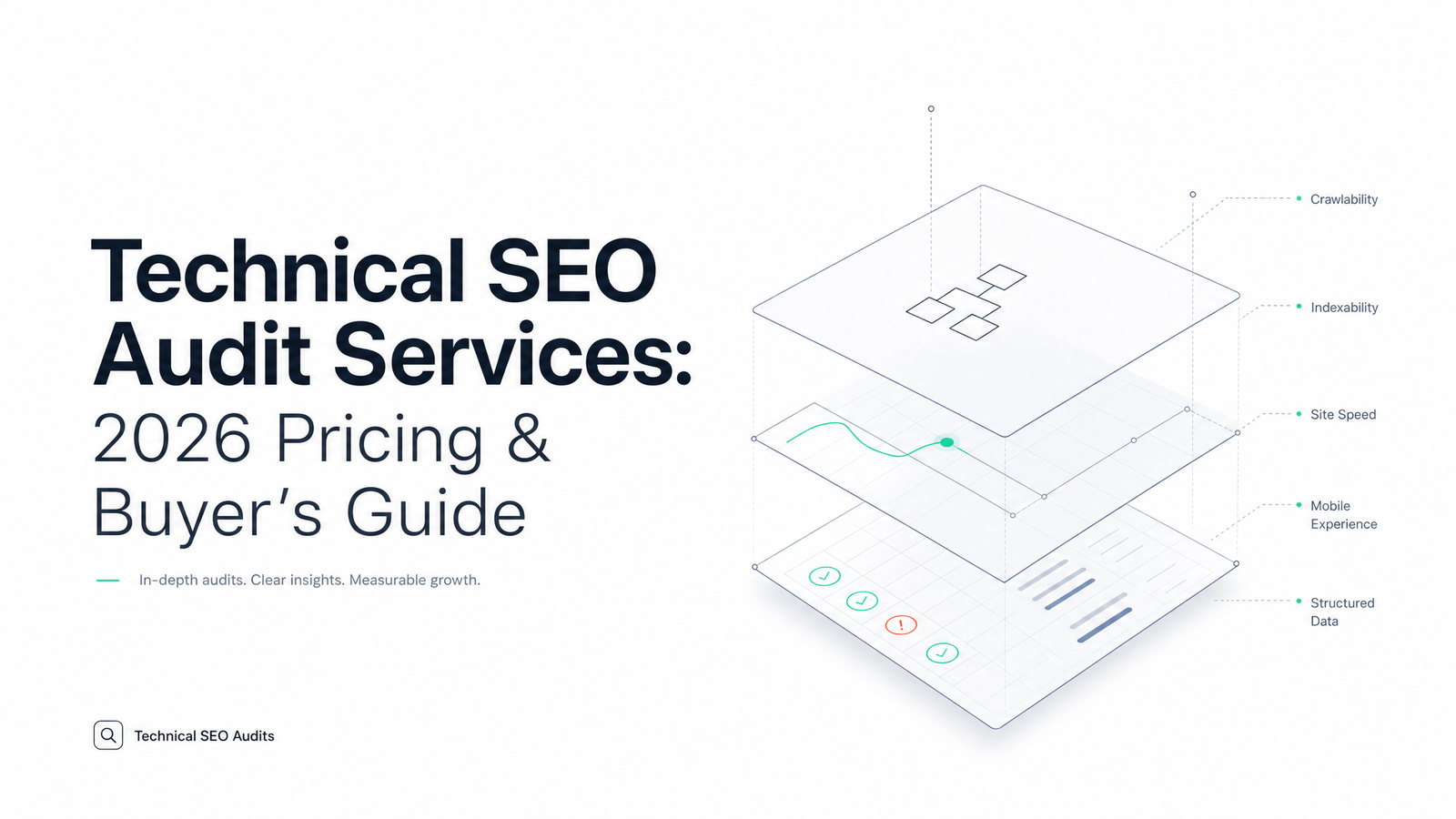
A real audit examines crawlability, indexation status, site speed and Core Web Vitals, structured data, internal linking, and site architecture — the plumbing beneath your content strategy. Skip this layer and even great content can underperform because bots can't reach it or users bounce before it loads.
The deliverable matters as much as the scope. A prioritized findings report ranks issues by impact and effort — "fix this broken canonical tag on 40,000 pages first, this alt-text gap later" — with clear next steps. A raw data dump, by contrast, is just an exported crawl spreadsheet from a tool like Screaming Frog with no interpretation. Agencies and freelancers charge for the analysis and prioritization layer, not the crawl itself; check that distinction before paying anyone.
What Should Be In Scope (and What Gets Skipped)
Compare any quote against a real technical SEO audit checklist. What does a proper audit cover?
- Crawlability and robots.txt — blocked resources, disallowed sections, crawl traps
- Indexation — orphaned pages, index bloat, noindex misfires, XML sitemap accuracy
- Core Web Vitals and page speed — LCP, INP, and CLS across templates, not just the homepage
- Structured data / schema markup — validation errors, missing markup types for the content
- Internal linking and site architecture — depth, orphan pages, link equity distribution
- Canonicalization — duplicate content signals, cross-domain canonicals, parameter handling
- JavaScript rendering — whether critical content and links are visible to crawlers after render, not just in raw HTML
- Log file analysis — how Googlebot actually spends its crawl budget, versus how you assume it does
Cheaper, automated-only services routinely skip the last two. JavaScript rendering checks require simulating a crawler's rendered view, and log file analysis needs access to and interpretation of server logs — both take real expertise, so they're the first things cut from a $300 package. If a quote doesn't mention either, ask directly whether they're included. For a deeper walkthrough of what a proper audit tool checks and how to run one yourself, see this breakdown of site audit tools.
How Much Do Technical SEO Audit Services Cost?
Technical SEO audit pricing in 2026 splits into three broad tiers, and the gap between them is really about depth of interpretation, not access to better tools.
Basic / automated tier: $300–$1,000. Usually a tool like Ahrefs Site Audit or Semrush Site Audit run and handed over, sometimes with light annotation. Fast and fine for a first pass on small sites, but it rarely includes log file analysis or nuanced JavaScript rendering checks.
SMB / professional tier: $1,000–$5,000. A consultant or small agency combines automated crawls with manual review — checking rendered JavaScript output, validating schema against Google's actual requirements, and writing a prioritized action plan tied to your CMS and dev resources. Expect a few days of analyst time baked into this price.
Enterprise tier: $5,000–$30,000+. Reserved for large or complex sites — e-commerce catalogs with millions of URLs, publishers, or heavily JavaScript-rendered platforms. This tier typically includes full log file analysis, crawl budget modeling, cross-team stakeholder workshops, and migration-specific audits.
What drives price within each band: site size, tech stack complexity (headless CMS, client-side rendering), whether pricing is hourly or project-based, and how much custom reporting or stakeholder alignment is required. A 200-page brochure site and a 200,000-page marketplace aren't the same audit, even if both get called "technical SEO audit."
Agency, Freelancer, Software, or DIY: How to Choose
There's no universal right answer — it depends on site size, urgency, budget, and existing in-house technical capacity.
Hire an agency or specialist consultant when: you're planning a site migration and need dedicated pre- and post-migration audits, you run an enterprise JavaScript-heavy platform where rendering issues are subtle, or you're in a compliance-heavy industry where stakeholder sign-off and formal documentation matter. These scenarios justify the $5,000+ price tag because the cost of getting it wrong — lost rankings after a migration — dwarfs the audit fee. If you go this route, vet carefully; a neutral guide to vetting local SEO agencies walks through the right questions to ask before signing anything. If a migration is the trigger, a dedicated site migration checklist is worth reviewing alongside any audit scope.
Use software or go DIY when: your site is small to mid-sized, you need answers in days rather than weeks, and someone on your team can act on prioritized findings without hand-holding. This is the technical SEO audit vs. software decision point — traditional services take 1–4 weeks partly for manual analyst review and report-writing; software surfaces the same categories of issues in minutes and updates continuously instead of going stale.
Freelancers sit in between: often cheaper than agencies, sometimes more responsive, but quality varies enormously and there's no team backup if they disappear mid-project. If you hire a technical SEO consultant independently, ask for a sample report and confirm they cover log files and rendered JavaScript, not just a crawler export.
How Rankevra Fits Into the Picture
Rankevra is built for the middle ground most businesses actually live in: not enterprise-scale complexity requiring a $20,000 engagement, but more than a one-off crawl export can solve. It runs the same core categories a professional audit covers — crawlability, indexation, Core Web Vitals, structured data, and internal linking — but continuously, not as a single snapshot that goes stale within weeks of a content update or template change.
Instead of a raw data dump, Rankevra generates prioritized fixes explained in plain language, so non-technical marketers and site owners can act on findings without translating consultant jargon into dev tickets. It's a practical automated SEO audit tool for teams who want agency-grade findings without agency turnaround or invoices — and it works alongside occasional specialist help for rare complex migrations or JS-rendering edge cases. For Core Web Vitals specifically, which trips up more sites than any other category, this deep dive on what matters in 2026 pairs well with Rankevra's ongoing monitoring. Where crawl budget waste is suspected, log file analysis for SEO explains how to diagnose it directly. For the full execution checklist once findings are in hand, the complete 25-step SEO checklist for 2026 covers the rest of the work beyond the audit itself.
Frequently Asked Questions
How much does a technical SEO audit service cost?
Pricing in 2026 ranges from $300–$1,000 for basic automated reports, $1,000–$5,000 for professional SMB-level audits with manual review, and $5,000–$30,000+ for enterprise engagements involving large sites or complex migrations. The price mainly reflects analyst time spent interpreting data, not access to crawling tools themselves. Site size, tech stack complexity, and hourly versus project pricing all shift where you land in that range.
What's the difference between a technical SEO audit and a general SEO audit?
A technical SEO audit focuses narrowly on crawlability, indexation, site speed, structured data, and architecture — the mechanics that let search engines access and understand your pages. A general SEO audit is broader, also covering content quality, keyword targeting, and backlink profile. Technical issues are usually addressed first because they can block the impact of content or link work entirely.
Can I do a technical SEO audit myself instead of paying for a service?
Yes, for most small to mid-sized sites, software-driven self-audits cover the same core categories a paid service checks — crawlability, indexation, Core Web Vitals, and schema — without the 1–4 week wait or four-figure invoice. The main cases where DIY falls short are complex JavaScript-rendered platforms, large-scale migrations, and situations requiring detailed log file analysis. For most other situations, a capable audit tool paired with a prioritized checklist gets you comparably far.
How long does a professional technical SEO audit take?
Professional audits typically take one to four weeks, depending on site size and whether the engagement includes manual review, log file analysis, and stakeholder workshops. Basic automated audits can be turned around in days since they lean on crawler output with light annotation. Enterprise audits with custom reporting and cross-team alignment sit at the longer end of that range.
What should be included in a technical SEO audit report?
A legitimate report includes prioritized findings across crawlability, indexation, Core Web Vitals, structured data, internal linking, canonicalization, and JavaScript rendering — ranked by impact and effort, not just listed. It should explain why each issue matters and what to fix first, not just export raw crawl data. Reports that skip rendered JavaScript checks or log file analysis are usually the cheaper, thinner version of the service.
Is a cheap or free technical SEO audit worth it?
A cheap or free audit is worth it only as a first-pass diagnostic, not a substitute for a prioritized action plan. These reports are usually raw crawler exports without interpretation, and they commonly skip JavaScript rendering checks and log file analysis entirely. Use them to spot obvious issues, then decide whether the findings justify a deeper professional or software-driven audit.
Professional audits run $500 to $15,000-plus and take one to four weeks to land in your inbox — useful for complex migrations, but slow and expensive for everyone else. Rankevra runs the same core checks — crawlability, indexation, Core Web Vitals, schema, and internal linking — continuously, for a fraction of what a single one-time audit costs. Run a free audit and see exactly where your site stands today.
Keep reading
- Content Decay SEO: How to Detect It and Fix It for GoodLearn to detect content decay SEO issues early, rule out false positives, and build a refresh pipeline that scales — plus how to automate the whole loop.
- Headless CMS SEO: Fixing the Gaps Generic Tools MissHeadless CMS SEO breaks in three predictable places: rendering, metadata, and sitemaps. Here's the diagnostic framework to find and fix each gap.
- Google Algorithm Update Recovery: A Diagnostic FrameworkA step-by-step google algorithm update recovery framework: confirm the cause, segment the damage, benchmark against winners, and set a real timeline.