Rankevra Blog
Backlink Monitoring Tool: What Continuous Tracking Requires
July 29, 2026
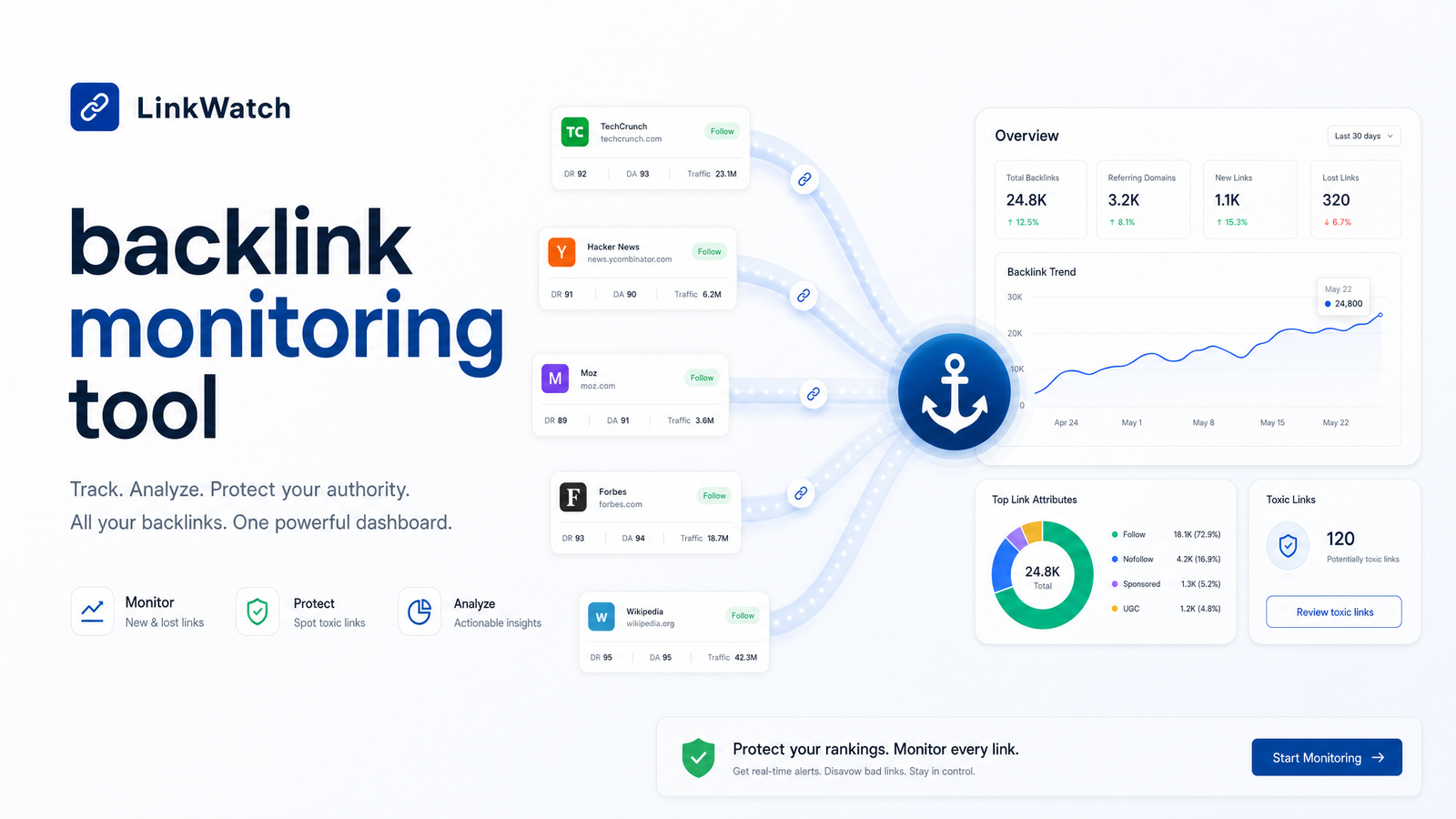
Most people who search for a "backlink monitoring tool" already own one — they just run it once a quarter, screenshot the report, and forget it exists until rankings slip. That's a static snapshot, and it can't tell you when a high-authority link disappears the week after you took the screenshot.
Continuous backlink monitoring is different: tracking your link profile as it changes — daily or weekly — so you catch losses while they're still recoverable, spot toxic patterns before they compound, and see where competitors are earning links you haven't touched yet. Here's what that actually requires, and where a one-time checker stops being enough.
What a Backlink Monitoring Tool Actually Does (and What It Isn't)
A one-time backlink checker answers a single question: what links do I have right now? You plug in a domain, get a list of referring domains, anchor text, and an authority score, and that's it. It's useful for a quick competitive snapshot, but it has no memory — it can't tell you what changed since last month.
A true backlink monitoring tool keeps a running history of your link profile and compares each new crawl against the last one. It's built around change detection: new links appearing, old links disappearing, and shifts in the quality of your referring domains over time. That distinction — snapshot versus timeline — separates a backlink tracking tool from a backlink checker, even when the underlying data source looks similar.
This matters because SEO decisions are almost always about trends, not single data points. A monitoring tool that logs weekly or daily changes lets you answer "did I lose something valuable?" instead of just "what do I have?" — the question that actually protects rankings.
The Three Things Worth Monitoring: New, Lost, and Toxic Links
Effective monitoring boils down to tracking three categories, each with a different action attached.
New links. Discovery here isn't vanity metric-watching — it tells you what's working. If content just picked up five referring domains after an industry roundup mention, that's a signal to build more in that format or topic. Track new and lost links side by side to connect content decisions to link outcomes instead of guessing.
Lost links. This is where most manual processes fail. A valuable backlink can disappear — a redesign drops it, a blog gets taken down, an editor swaps a citation — and if you're not checking weekly, you might not notice for months, by which point the ranking impact has already shown up. Lost backlink alerts solve this: the moment a monitored link disappears, you get a notification with enough context (source URL, anchor text, date last seen) to decide whether it's worth chasing. Recovery options include contacting the site owner, checking if the content moved rather than vanished, or redirecting your own equivalent content to capture residual value if the source page is now defunct.
Toxic links. This category causes the most anxiety, often for the wrong reasons. Toxic backlink detection should flag patterns — sudden spikes from unrelated foreign-language domains, clusters of thin sites that look like a private blog network (PBN), or link velocity jumping unnaturally fast. Not every low-authority or nofollow link belongs here; plenty of nofollow links are normal parts of a healthy profile.
How Often You Actually Need to Check (and Why Real-Time Isn't Always Necessary)
The honest answer to "how often should you check backlinks" depends on the size and volatility of your link profile, not on chasing real-time data for its own sake.
For most sites, a weekly automated crawl is the right baseline — frequent enough to catch a lost link before it costs you a ranking position, infrequent enough to avoid noise from low-value churn. Sites with aggressive link-building campaigns or exposure to negative SEO (competitive niches, high-value commercial keywords) can benefit from daily monitoring on their most important pages specifically, rather than the whole domain.
Monthly reviews work fine for smaller or more stable sites with naturally low link velocity — a local business picking up a handful of links a quarter doesn't need daily alerts. Quarterly is really only appropriate for a competitor benchmarking pass, not your own site's core monitoring.
The point of automating backlink monitoring isn't to obsess over every fluctuation in real time — it's to make sure nothing important slips through unnoticed between the checks you'd otherwise do manually and inconsistently.
Should You Disavow What You Find? The Current Guidance
Current guidance is clear: most links a toxic backlink detection system flags don't need to be disavowed. Google's own systems, including SpamBrain, are largely built to identify and discount spammy or manipulative links automatically, without site owner intervention. Disavowing was designed as a narrow tool for specific situations — a manual action notice in Google Search Console tied to unnatural links, or clear evidence of a targeted negative SEO campaign — not a routine response to every low-quality link a crawler surfaces.
Treating every flagged link as a disavow candidate creates two problems. First, it burns time on a task that usually produces no measurable ranking benefit, since Google is already discounting the link's influence. Second, over-aggressive disavowing has its own risk: a bloated disavow file can occasionally strip out links that were doing no harm, for no gain.
The practical rule: reserve the Google disavow tool for links tied to an actual manual action, or a clear, sustained pattern that looks like a deliberate attack rather than background web noise. Everything else can usually sit in a "monitored, not acted on" list — visible, tracked, and revisited if a pattern intensifies, but not touched by default.
Watching Competitor Backlinks Without a Separate Subscription
Competitor backlink monitoring answers a question your own link data can't: where are rivals winning links you haven't earned yet? That might be a resource page listing every tool in your category except yours, a journalist covering your competitor's launches but not yours, or a niche directory you didn't know existed.
The workflow doesn't need to be complicated or expensive. Running the same monitoring cadence against two or three core competitors — tracked alongside your own link profile — surfaces recurring link sources you can realistically target, and flags when a competitor suddenly picks up a batch of links worth investigating (sometimes a signal of a successful campaign, a PR placement, or a content asset worth studying). The key is doing this inside the same system you already use for your own links, rather than paying for a second tool just to peek at competitor referring domains.
Why Backlink Monitoring Shouldn't Live in a Separate Tool
Backlink data is most useful sitting next to the rest of your SEO signals, not isolated in its own dashboard. A lost link is far more meaningful when you can immediately check whether the page it pointed to also dropped in rank tracking that week. A spike in toxic-looking links matters more if it correlates with a technical issue an audit tool just flagged on the same pages. Reporting to clients or stakeholders is cleaner when backlink changes, ranking movement, and site health all appear in one dashboard instead of three logins.
This is the case for treating backlink monitoring software as one module of broader SEO workflow automation rather than a standalone purchase. If you're already evaluating rank tracking tools, building an SEO reporting dashboard, or running a site audit tool, backlink monitoring belongs in that same conversation — it's one layer of a connected system, not a separate line item.
Rankevra combines automated new/lost/toxic backlink alerts, competitor link tracking, rank tracking, site audits, and reporting in one workflow, so you're not stitching together data from four subscriptions to answer one question: is my link profile getting stronger or weaker this month? If you're tired of manually re-running backlink reports and copying numbers into a spreadsheet, it's worth seeing what an automated, connected version of that process looks like. Try Rankevra and put backlink monitoring on autopilot alongside the rest of your SEO stack.
Frequently Asked Questions
What's the difference between a backlink checker and a backlink monitoring tool?
A backlink checker gives you a one-time snapshot of your current referring domains, while a backlink monitoring tool tracks that profile continuously and alerts you to changes — new links, lost links, and toxic patterns — over time. The checker answers "what do I have now?"; the monitoring tool answers "what changed, and does it matter?"
How quickly should I try to recover a lost backlink?
Ideally within days of the loss, since valuable links are easier to recover or replace before the associated ranking drop sets in. Lost backlink alerts that fire in near real time give you the best shot at contacting the site owner, checking for a content move, or redirecting equivalent content before the damage compounds.
Do I need to disavow every toxic link a monitoring tool flags?
No — most flagged links don't need disavowing, since Google's systems, including SpamBrain, already discount the influence of spammy links automatically. Reserve the disavow tool for links tied to an actual manual action in Search Console or a clear, sustained negative SEO pattern, not routine low-quality mentions.
How often should I actually review my backlink profile?
Weekly is a solid baseline for most sites, since it catches lost links before they affect rankings without generating alert fatigue over minor churn. High-competition or high-risk sites can justify daily checks on priority pages, while smaller, stable sites can review monthly.
Can I monitor competitor backlinks with the same tool I use for my own?
Yes — competitor backlink monitoring works best run on the same cadence and inside the same system as your own link tracking, so you can directly compare where rivals are earning links you're missing. This avoids paying for a separate subscription just to check competitor referring domains.
Does losing backlinks always cause a ranking drop?
No — losing a low-authority or low-relevance link often has no measurable effect on rankings. The links worth worrying about are high-authority, topically relevant ones pointing at pages that already rely on that link equity to rank, which is why monitoring should prioritize value over raw link count.
Keep reading
- Crawl Budget Optimization: A Diagnostic Framework for 2026Learn whether crawl budget optimization actually applies to your site, how to diagnose crawl waste in GSC, and a prioritized fix list for 2026.
- Multilingual SEO Strategy: Skip the Hreflang TrapA practical multilingual SEO strategy that treats hreflang as insurance, not a growth lever — plus how to automate audits, content, and tracking per locale.
- Will Google Penalize AI Content in 2026? The Real AnswerDoes AI content detection SEO actually affect rankings? Here's what Google's spam policies and the March 2026 core update really show.