Rankevra Blog
Open Source AI Content Generator: The Honest Breakdown
July 31, 2026
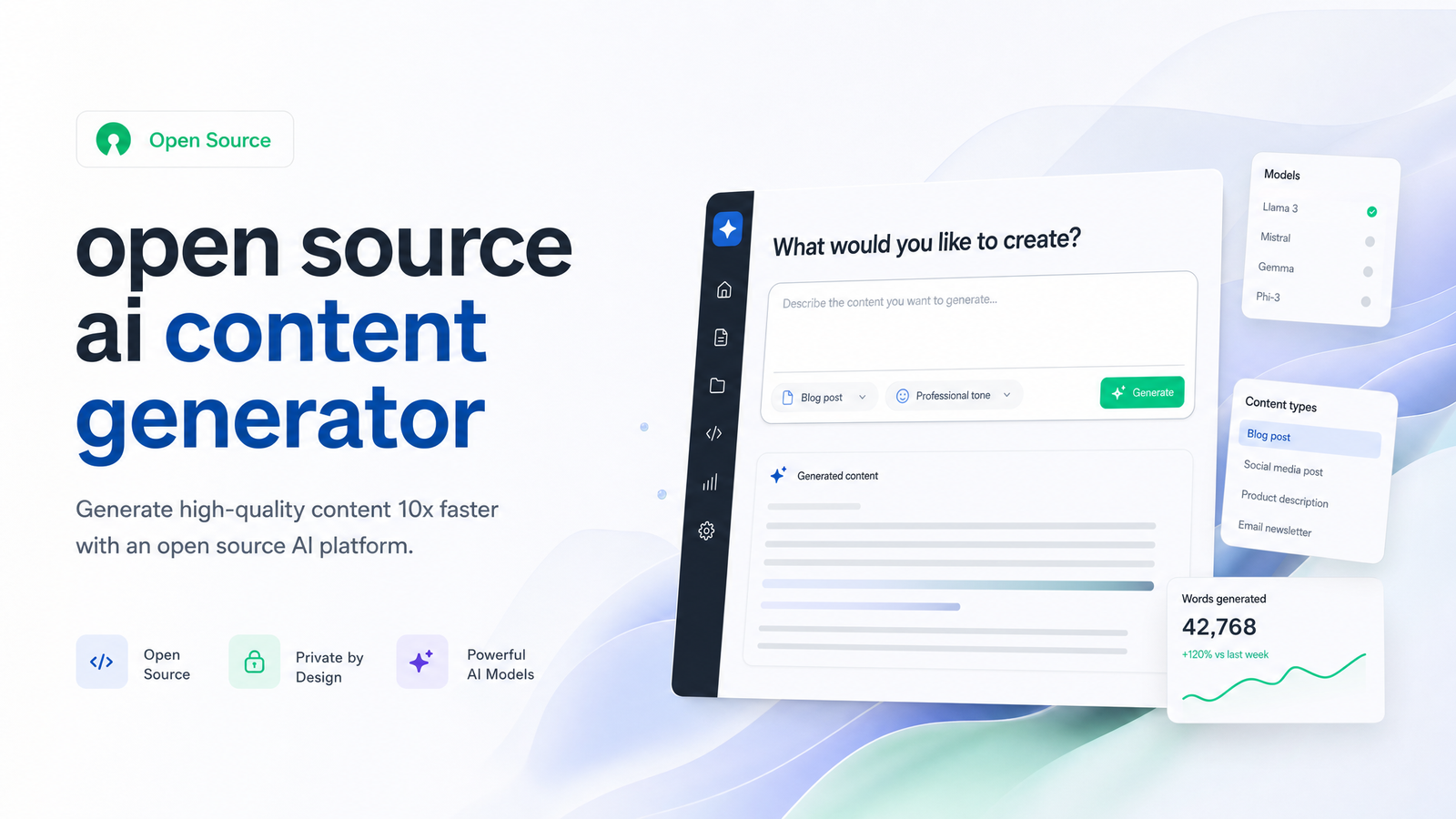
Search for "open source AI content generator" and you'll get dry model comparison charts with no SEO context, or thin marketing pages pushing a specific tool. Neither answers what most content teams actually want to know: could going open source replace the paid AI and SEO tools they're already using, and what would they give up? This article tries to answer that honestly.
What People Actually Mean by "Open Source AI Content Generator"
The phrase gets used loosely. There are really three different things hiding under one search term.
First, there's the open-weight base model — the neural network, like Llama or Mistral, whose weights you can download and run yourself. "Open weight" is more accurate than "open source" here, since most of these models don't release full training data or code, just the trained weights you can use, modify, and self-host. This layer does the actual language generation.
Second, there's the runtime — software like Ollama, LocalAI, or GPT4All that lets you load and run those weights on your own machine or server, usually with a command line or lightweight UI. The model does nothing without one of these.
Third, there's the full content application — a writing interface, templates, maybe SEO fields, built on top of an open or closed model. Most "open source AI content generator" tools people find in directories are actually this third category, and many aren't even open source themselves; they just use an open-weight model under the hood.
Knowing which layer you're evaluating matters, because "free and open source" claims usually apply to one layer, not the whole stack needed to produce publish-ready content.
The Open Source Tools and Models People Are Actually Using
On the model side, the field is genuinely strong. Meta's Llama models are the most widely adopted open-weight LLM for content writing, with a large fine-tune ecosystem. Mistral produces smaller, efficient models that punch above their size class on modest hardware. DeepSeek has released competitive models, including strong coding and reasoning variants, and Qwen (Alibaba) has become a serious contender for multilingual content generation. Older projects like GPT-NeoX helped establish the open LLM space early on and still matter historically, even if less commonly deployed today.
None of these models is a content generator on its own — you need a runtime to serve it. Ollama has become the default choice for developers who want to pull a model and start generating text locally with minimal setup. LocalAI offers an OpenAI-compatible API layer, useful for swapping a self-hosted model into tools built for OpenAI's API without rewriting integrations. GPT4All targets non-technical users who want a chat-style interface without a server or GPU cluster. For custom builds, Hugging Face Transformers is the underlying library most fine-tuning and inference pipelines run on, and it's worth knowing since most open source AI writing tools for blogs are wrappers around it in some form.
Worth a mention: Stable Diffusion belongs to this same open ecosystem, but for images, not text — relevant if your content workflow includes generating visuals alongside written content.
Why Teams Consider Going Open Source
The advantages are real. The most obvious is cost at scale: once a model runs on your own hardware, there's no per-seat license and no per-token fee, which matters for teams generating high volumes of content. If you're publishing hundreds of articles a month, an open source ai content generator free of ongoing usage fees can look dramatically cheaper than a metered SaaS tool, on paper.
Privacy is the second real advantage. If you're generating content involving proprietary data, unreleased product details, or sensitive legal/medical information, a genuinely self hosted ai writing tool means nothing leaves your infrastructure. For regulated industries or agencies handling client-confidential material, that alone can justify the setup cost.
Third is control. Open weights let you fine-tune a model on your own writing samples, brand voice, or niche vocabulary in a way most closed SaaS platforms don't allow. If your brand has a distinct tone that generic AI writers keep flattening, fine-tuning an open source llm for content writing is a legitimate path to something closer to your voice.
Where Open Source Breaks Down for SEO Content at Scale
This is where most "open source vs. paid" comparisons stop short, and it's the part that actually matters for content teams.
Running a model locally or on your own servers means running infrastructure. Decent generation quality generally requires a real GPU, and running larger models well often means renting cloud GPU instances — reintroducing the recurring cost you were trying to escape, just shifted from an API fee to an infrastructure bill. Add the ongoing work of updating models, patching runtimes, and re-testing outputs after every update, and "free" starts looking more like "free plus a part-time job."
Even once generation works, a raw open source ai content generator has no concept of SEO. Ollama or LocalAI will produce fluent text, but won't research target keywords, structure headers around search intent, insert internal links, or build in experience and expertise signals search engines increasingly weigh. These are real open source ai content limitations that don't show up in model benchmarks but show up immediately in a content calendar.
There's also no bridge from generated text to a live page. A self-hosted model gives you a text file or API response — it doesn't push content to your CMS, format it, or tell you whether it performed after publishing. Most ai content generation tools for seo that are actually usable end-to-end bundle generation with publishing and tracking; raw open source stacks require you to build or buy every one of those connections separately.
Finally, there's the quality-control burden. Unreviewed AI output — open source or not — carries real risk of factual errors, generic phrasing, or thin content that won't hold up against a proper optimization pass. Someone still has to read, fact-check, and structure every piece before it's safe to publish, and that review time doesn't disappear just because generation was free.
Self-Hosted Model vs. Managed AI SEO Platform: How to Decide
There's no universally right answer — it depends on team shape.
If you have in-house engineering capacity, steady (not spiky) publishing volume, strict data residency requirements, and time to maintain infrastructure, self-hosting can work. Teams with a developer comfortable running Ollama or LocalAI, monitoring GPU usage, and scripting basic SEO checks around the output can make a self-hosted setup pencil out, especially at very high content volumes where API costs would otherwise be brutal.
If you're a lean marketing or content team without dedicated engineering support, publish inconsistently or in bursts, and need audits, on-page optimization, and rank tracking connected to whatever gets produced, a managed platform is the more realistic choice. The self hosted ai writing tool vs saas decision often comes down less to "which is cheaper" in isolation and more to "what's my team's actual hourly cost of building and babysitting infrastructure versus paying for a workflow that already works." Teams looking for a genuine open source alternative to jasper ai often discover the open source route solves generation but re-creates every other problem a tool like Jasper was handling for them.
Where a Tool Like Rankevra Fits
Rankevra isn't trying to be another open-weight model or a competitor to Llama or Mistral — it sits at a different layer entirely. The gap this article has been building toward is the one between "a model can write text" and "a team can run SEO content at scale," and that gap is mostly workflow, not generation quality.
Rankevra automates the connective tissue: auditing a site for technical issues, generating SEO-structured content with keyword targeting and internal linking built in, publishing it directly to your CMS, and tracking how it ranks afterward — all in one ai seo content workflow instead of five disconnected tools glued together with scripts and spreadsheets. That's the piece a raw model, a runtime, and a chat interface simply don't provide, no matter how good the underlying LLM is.
For teams that decided the GPU costs, maintenance overhead, and missing SEO logic aren't worth the tradeoff, automating seo content publishing end-to-end is the practical alternative — not because open source doesn't work, but because most teams aren't actually trying to run infrastructure. They're trying to rank.
The real question isn't which open source model to pick. It's what your team needs automated end-to-end so content actually gets published, optimized, and tracked without manual glue work. If that's where you are, it's worth seeing the full audit-to-publish-to-rank-tracking workflow in action — Rankevra is built to show you exactly that in one sitting, no infrastructure required.
Frequently Asked Questions
Is there a truly free open source AI content generator?
Yes, in the sense that models like Llama, Mistral, and Qwen can be downloaded and run without license fees, and runtimes like Ollama, LocalAI, and GPT4All are free to use. However, "free" only covers the software — you still need hardware or cloud GPU capacity to run larger models well, which carries a real cost once you scale beyond casual use.
What's the difference between an open source AI model and an open source AI content generator tool?
An open source AI model, like Llama or Mistral, is just the trained neural network that generates text when given a prompt. An AI content generator tool is a full application — often built on top of one of these models — that adds a writing interface, templates, and sometimes SEO features; many tools marketed this way aren't fully open source themselves, even if the underlying model is.
Can open source AI models write SEO-optimized content out of the box?
No, raw open source models generate fluent text but have no built-in understanding of keyword targeting, header structure, internal linking, or E-E-A-T signals. Turning generic output into SEO-ready content requires additional prompting, structure, and review — logic that dedicated SEO content tools build in but base models don't include.
What hardware do I need to self-host an AI content generator?
Smaller models can run on a modern consumer GPU with 8–16GB of VRAM, while larger, higher-quality models typically need enterprise-grade GPUs or rented cloud GPU instances. The hardware requirement scales directly with model size and desired output quality, which is why many teams end up paying for cloud compute even after choosing a "free" open source model.
Is open source AI content safe to publish without editing?
No, unreviewed AI-generated content — open source or otherwise — carries a real risk of factual errors, generic phrasing, and structural gaps that hurt SEO performance. Every piece should go through human fact-checking and an optimization pass before publishing, regardless of which model produced it.
How do open source AI content generators compare to tools like Rankevra?
Open source generators handle only the writing step and leave auditing, SEO structuring, publishing, and rank tracking for you to build or buy separately. Rankevra covers that entire workflow in one platform — audit, content generation, publishing, and rank tracking — which is the layer most self-hosted open source setups don't address at all.
Keep reading
- Ecommerce Category Page SEO: Fix Thin Content &Ecommerce category page SEO framework: diagnose thin content, faceted filter bloat, and cannibalization with one triage sequence that scales.
- Log File Analysis SEO: From Raw Data to Ranked FixesAdvanced log file analysis SEO: verify Googlebot, segment AI crawlers, and turn crawl anomalies into a prioritized fix list — without manual parsing.
- Content Gap Analysis Automation: From Report to Ranked PageLearn how AI automates content gap analysis end-to-end — from data pull to published, ranking page — without spreadsheets or tool-switching.