Rankevra Blog
Duplicate Content SEO: A Framework to Find and Fix It
September 17, 2026
What Duplicate Content Actually Means in 2026 (and What It Doesn't)
Duplicate content, in the technical sense, is any block of substantive text that appears at more than one URL — verbatim or with only trivial variation. It's not a moral failing, it doesn't get your site blacklisted, and it's not a "duplicate content penalty."
Google has been explicit: there is no algorithmic penalty for duplicate content unless it's paired with manipulative intent, like deliberately scraping and republishing content to game rankings.
That doesn't mean duplicate content SEO is a non-issue. It costs you in three quieter ways. First, ranking signals — links, engagement, relevance — get split across near-identical URLs instead of consolidating behind one. Second, crawl budget gets wasted as bots repeatedly fetch pages that don't need separate indexing. Third, topical authority gets diluted because Google can't tell which version represents your best answer to a query, so it may rank an outdated or thin variant instead.
So does duplicate content hurt SEO? Yes — through dilution and confusion, not punishment. That distinction changes how you should prioritize fixes: you're not doing damage control, you're doing signal consolidation.
The Three Sources of Overlap — and Why They Need Different Fixes
Most guides treat duplicate content as one problem with one fix: "add a canonical tag." In practice, duplicate content SEO problems come from three structurally different sources, each demanding a different diagnosis and remedy.
- Parameter duplication is technical — URLs multiply because of tracking codes, filters, or session IDs, not duplicate copy.
- Syndicated content is editorial and sometimes legal — you've deliberately allowed the same article to live on two domains.
- Scaled or programmatic content is structural — templates generate hundreds or thousands of pages sharing so much boilerplate they read as near-duplicates even though no two are byte-identical.
Treating all three with the same fix is why so many "we added canonicals everywhere" projects underperform.
Parameter & Session Duplication (Tracking Tags, Sort/Filter, Session IDs)
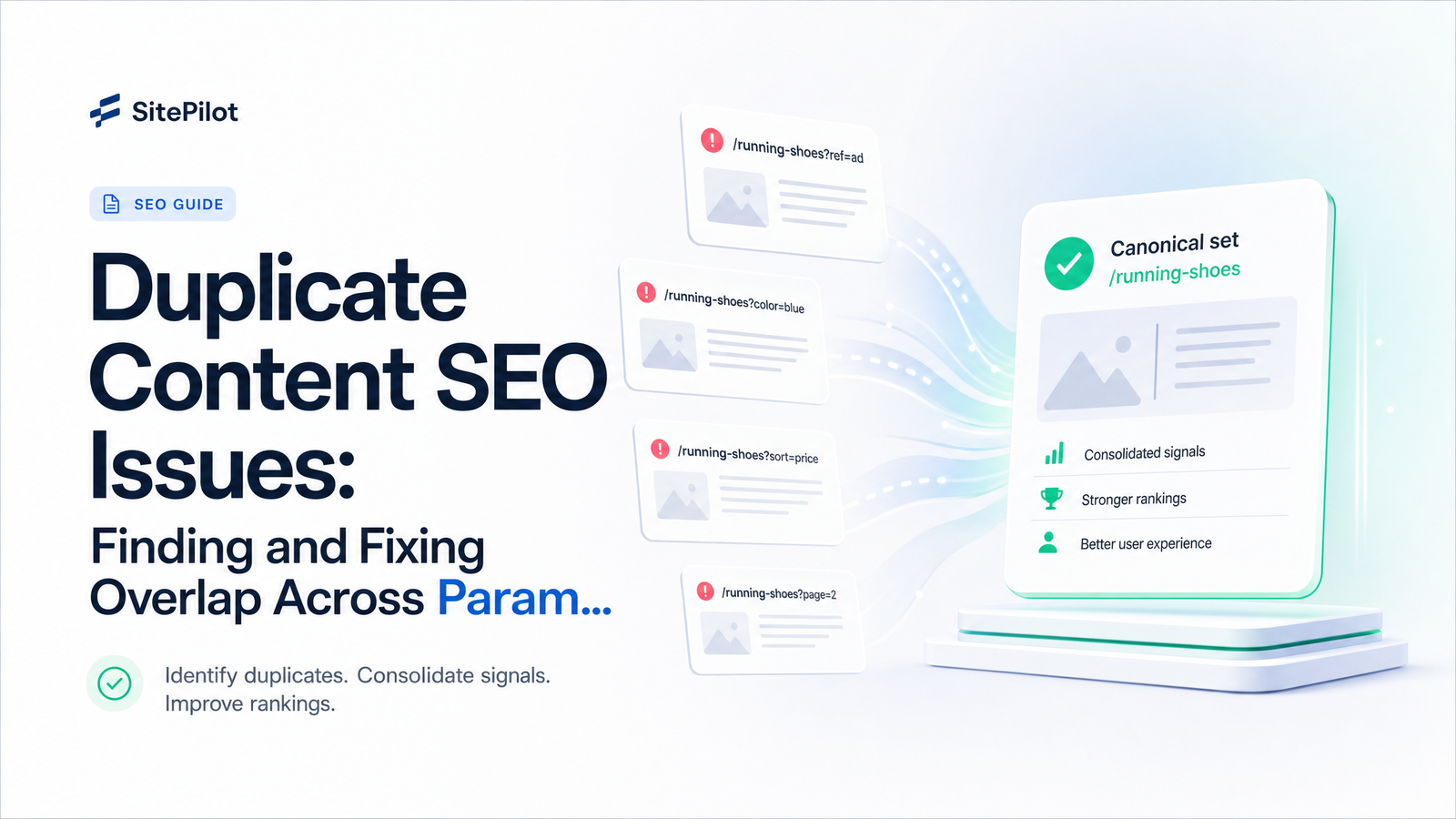
Faceted navigation, UTM-tagged links, and session IDs are the most common source of duplicate content on mid-size and large sites. A single product page can generate dozens of indexable variants once you combine sort order, filter combinations, and tracking parameters — ?sort=price, ?utm_source=newsletter, ?sessionid=8827 — all serving essentially the same content at different URLs.
Search Console's URL Parameters tool, which once let you tell Google which parameters to ignore, is now deprecated and officially not working — Google handles this algorithmically instead. That means you need to bake the signal directly into the site: self-referencing canonical tags on the preferred URL, and disallow rules in robots.txt for parameters that should never be crawled (session IDs, for example).
A quick diagnostic: pull indexed URLs containing ? from Search Console's Page indexing report, then check whether each canonical tag points back to the clean, parameter-free version. If it doesn't — or is missing — you've found your leak.
Syndicated Content (Guest Posts, Partner Feeds, PR Distribution)
Syndication duplication is different because you chose it — licensing an article to a partner, submitting a press release, or letting a guest post run elsewhere while keeping a copy. The content is identical by design, so the fix is about protecting attribution, not structure.
Cross-domain canonical tags work when your syndication partner is cooperative: they add a canonical tag on their copy pointing back to your original URL. This is the cleanest outcome, worth requesting before signing any content syndication agreement.
It doesn't work when the partner won't add the tag, uses a CMS that strips custom markup, or republishes with heavy edits. In those cases, fall back on a prominent link to the original with the publish date, or negotiate a delay so your version gets indexed first. Should syndication worry you? Generally no, provided the original is indexed first and either a canonical tag or a clear backlink establishes the source — Google says it can typically identify the originating domain even without perfect tagging, but don't rely on that alone.
Scaled & Programmatic Content (Templated Pages, AI-Generated Variants)
Programmatic pages — city-by-city landing pages, product comparison grids, "best X for Y" variants — are duplicate content risks not because of copy-pasting, but because the template does almost all the work while unique content per page stays thin. Swap "plumbers in Austin" for "plumbers in Tulsa" on a page that's 90% shared boilerplate, and Google's near-duplicate detection can flag the pattern even though no two pages are byte-identical.
AI-assisted generation makes this worse when used to fill template variables rather than genuinely differentiate each page — wording varies but substance doesn't, exactly what near-duplication algorithms are built to catch. The fix isn't canonical tags; it's structural rewriting — ensuring each page carries a meaningfully unique data point, local detail, or use case the template alone can't produce. The programmatic SEO playbook covers scaling pages without tripping into duplicate-content territory.
How to Find Duplicate and Near-Duplicate Content Across Your Site
Before choosing a fix, confirm the scope. A practical duplicate content checker workflow combines four sources:
- Site search operators —
site:yourdomain.com "exact phrase from a key paragraph"surfaces every indexed URL carrying that text, the fastest gut-check for a suspected duplicate. - Content-hash or similarity crawling — fingerprinting page content (not just titles or meta tags) catches near-duplicates that exact-match checks miss, which matters most for templated and syndicated content.
- Search Console's Page indexing report — the "Duplicate without user-selected canonical" and "Duplicate, Google chose different canonical than user" statuses point directly at URLs where your canonical signal isn't honored.
- Log files — confirm bots are actually spending crawl budget on the duplicate cluster rather than assuming it from indexing data alone; a log file analysis shows whether parameter URLs are being hit repeatedly.
If what you're finding is different pages targeting the same keyword rather than literal content overlap, that's a related but separate problem — see the cannibalization audit guide instead.
Matching the Fix to the Cause: Canonical, Redirect, Noindex, or Rewrite
Once you know the source, the fix should follow from it, not from habit. Google ranks signal strength as 301 redirect > canonical tag > sitemap inclusion — the more permanent and visible the signal, the more Google trusts it.
- 301 redirect — use when the duplicate URL has no reason to exist independently, such as retired parameter patterns or merged near-duplicate pages.
- Canonical tag — use when both URLs need to stay live for functional reasons (a filtered product view, a syndicated partner copy) but only one should be authoritative for ranking.
- Noindex — use when a page must exist for users but shouldn't compete for rankings, such as internal search results pages or thin session-specific views that can't be redirected without breaking functionality.
- Rewrite — use when duplication is structural, as with programmatic pages; no tag fixes thin templating, only genuinely differentiated content does.
The comparison people ask about most is canonical vs. 301 redirect: a redirect physically sends users and bots to the new URL and consolidates signals almost entirely; a canonical tag lets both URLs persist but tells Google which one to index and rank — weaker, but necessary when the duplicate must stay accessible. If you've gone the canonical route and want to confirm it's implemented correctly, the canonical troubleshooting guide covers failure modes a basic audit tends to miss — conflicting signals, cross-domain issues, and canonical chains among them.
On timing: fixing duplicate content without losing rankings requires patience. Google re-crawls and re-clusters duplicate groups on its own schedule, not immediately on fix deployment — expect anywhere from a few days for a well-linked, frequently-crawled page to several weeks for lower-priority URLs. If a canonical tag is live but rankings haven't shifted, the fix likely hasn't been re-evaluated yet, or a conflicting signal (like an XML sitemap still listing the non-canonical URL) is undermining it.
Why Manual Duplicate-Content Audits Break Down at Scale
A spreadsheet tracking duplicate URLs works fine the week you build it. It stops working once your site keeps changing — new campaign parameters added by marketing, a new syndication partner onboarded by the content team, another batch of programmatic pages published by a template no one flagged for review. Each event creates new duplicate clusters that a one-off crawl won't catch until the next audit cycle, by which point crawl budget has already been wasted and ranking signals have already split.
An automated site audit tool solves this by re-crawling continuously and flagging new duplicate or near-duplicate clusters as they appear, rather than waiting for a quarterly review to surface them.
Frequently Asked Questions
Does Google penalize you for duplicate content?
No, not in the sense of an algorithmic penalty applied purely for having duplicate pages. Google's systems instead choose one version to show and may waste crawl budget or split ranking signals across the rest, which lowers performance without being punitive — unless the duplication is paired with deliberate manipulation, like mass content scraping.
How do I find duplicate content on my own website?
Combine a site search operator with an exact phrase from a suspect page, a content-hash crawl that catches near-duplicates rather than only exact matches, and the Page indexing report in Search Console, which flags "Duplicate without user-selected canonical" URLs directly. Cross-checking with log files confirms whether the duplicates are actually being crawled and wasting budget.
Can syndicating my article to another site hurt my SEO?
It can, but usually only if your version isn't indexed first or if no signal identifies you as the source. Getting your syndication partner to add a cross-domain canonical tag pointing back to your original, or securing a clear attribution link and an indexing head start, protects your rankings in nearly all cases.
Should I use a canonical tag or a 301 redirect for duplicate pages?
Use a 301 redirect when the duplicate URL serves no independent purpose and should disappear entirely, consolidating nearly all ranking signal to the destination. Use a canonical tag when both URLs need to stay live — such as a filtered product view or a syndicated copy — but only one should be treated as authoritative.
Why hasn't my duplicate content issue resolved after I added a canonical tag?
Google re-evaluates duplicate clusters on its own crawl schedule, which can take days to several weeks depending on how frequently the page is crawled. It's also common for a conflicting signal — an outdated XML sitemap entry, an internal link still pointing to the non-canonical URL, or a missing self-referencing canonical — to undermine the fix even after it's technically live.
Do AI-generated or programmatic pages automatically count as duplicate content?
Not automatically, but they're high-risk by design because templates produce pages that share most of their structure and wording. They cross into duplicate or near-duplicate territory when the unique content per page is too thin to differentiate it from the template, which requires rewriting or richer differentiation rather than a canonical tag.
Manually tracking duplicate URLs across parameters, syndication partners, and programmatic templates in a spreadsheet works until the site outgrows it — and most sites outgrow it fast. Rankevra runs continuous automated audits alongside rank tracking, surfacing new duplicate clusters as they form instead of waiting for the next manual crawl to find them.
Keep reading
- SEO Content Refresh Strategy: Update, Rewrite, or MergeA data-backed SEO content refresh strategy: diagnose decay, score priority, and decide whether to update, rewrite, or merge each underperforming post.
- Best Tool for Backlink Analysis in 2026: A Use-Case GuideThe best tool for backlink analysis depends on your job: Ahrefs, Semrush, Majestic, Moz, or an AI SEO platform. Here's how to pick in 2026.
- AI Overview SEO: How to Get Cited by Google's AI OverviewsLearn how Google AI Overviews actually select sources, why featured snippet tactics don't work, and the checklist to get your pages cited.