Rankevra Blog
Programmatic SEO: How to Scale Pages Without Getting
July 28, 2026
Type "programmatic SEO" into any search bar and you'll find two camps: people promising Zillow-scale traffic from a spreadsheet, and people quoting Google's spam policies like a warning label. Both are partially right. Programmatic SEO can generate enormous organic traffic — and it can also get a domain deindexed in a single core update. The difference isn't the technique. It's execution.
This guide covers how programmatic SEO actually works mechanically, and exactly where Google draws the line between pages that deserve to rank and pages caught by its scaled content abuse policy.
What Is Programmatic SEO?
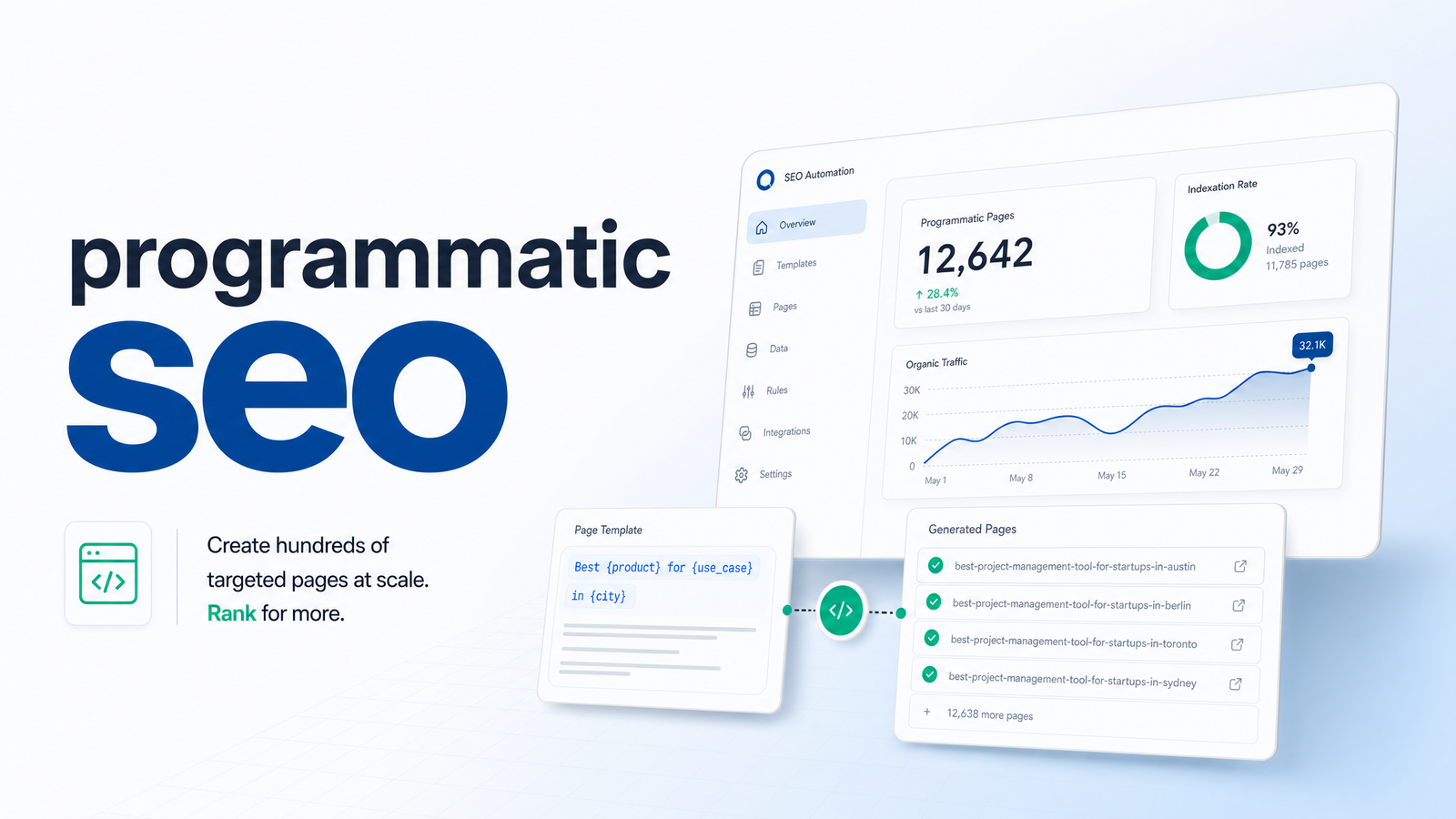
Programmatic SEO combines a page template, a structured data source, and automation to produce many pages at once, each targeting a slightly different long-tail query. Instead of writing one article at a time, you build a system that generates hundreds or thousands of pages from a dataset — one page per city, product, currency pair, or zip code.
The pattern is everywhere once you know what to look for. Zillow doesn't hand-write a page for every property listing; it runs address, price, and photo data through a template. TripAdvisor's "things to do in [city]" pages follow the same logic — one template, populated with attraction data for thousands of destinations. Wise (formerly TransferWise) runs currency converter pages for every currency pair combination, each answering a specific, real query like "USD to EUR exchange rate" with live data.
What separates programmatic SEO from ordinary content publishing is scale through structure. A blogger writes "10 Things to Do in Lisbon." A programmatic system writes that page for every city in a database, automatically, using the same layout and logic each time. Both can rank. Only one scales.
How Programmatic SEO Actually Works
Stripped down, every legitimate programmatic SEO build follows the same sequence.
1. Query pattern discovery. Identify a repeatable search pattern — not one keyword, but a family sharing structure, like "[service] in [city]" or "[product A] vs [product B]." This is long-tail keyword territory, worth doing properly rather than guessing; a structured long-tail keyword research workflow will surface the query variants and volume patterns that justify building a template. It also pays to run a keyword gap analysis against competitors already ranking for these patterns — if TripAdvisor or a niche competitor already owns a query family with strong pages, that tells you whether it's worth entering.
2. A structured data source. Programmatic SEO needs a dataset with consistent fields — property details, pricing tables, review counts, location attributes, conversion rates. Without structured data, there's nothing to populate a template with.
3. Page template design. This is the part most teams underinvest in. The template defines what data appears, in what order, with what surrounding context, commentary, and internal links. A weak template just drops data into a shell. A strong one is designed like a content brief, similar to how an AI content brief generator defines the non-negotiable elements of a good page before a word is written.
4. Automated generation. Software merges the data source with the template to produce the page set. This is where automation earns its reputation for speed — and where quality control has to be built in, not bolted on afterward.
5. Publishing and indexing. Pages go live, get submitted for crawling, and get monitored. This last step is where most pSEO strategies quietly fail, because nobody keeps checking the pages once published.
Where Programmatic SEO Goes Wrong: Scaled Content Abuse
In March 2024, Google rebranded what used to be called "spammy automatically generated content" into a broader policy called scaled content abuse. The update also formalized SpamBrain's role in detecting it at scale. The policy defines scaled content abuse as producing many pages — by any method, automated, human, or a mix — where the primary purpose is manipulating search rankings rather than helping users.
Two words matter more than any others: primary purpose. Google isn't targeting automation or volume — it's targeting intent and value. A thousand pages generated from a template are fine if each one answers a real query with real substance. A thousand pages are a liability if they exist purely to capture traffic with nothing behind them.
Common failure patterns:
- Thin template-swap pages — the same few sentences with a city or product name swapped in, no unique data or insight per page.
- Translated duplicate variants — machine-translating one page into dozens of language versions with no localization of substance, just wording.
- Filler category pages — auto-generated combinations (every product × color × size) that produce technically unique URLs with essentially no unique content.
These patterns are also the classic definition of doorway pages — built to rank for a query and funnel visitors elsewhere, without independent value. Google has penalized doorway pages for years; scaled content abuse is that same concept applied to AI-era production speed. If your build could be described as "hundreds of pages that all say the same thing with different nouns," that's the risk profile leading to a programmatic SEO penalty.
The Standard That Separates Ranking Pages From Penalized Ones
The practical question isn't "is this automated?" It's "would this page satisfy someone who landed on it directly, with no other page to compare it to?" That single test filters out most bad pSEO before it ships.
A programmatic page that clears the bar typically has:
- Unique data or insight per page — not just a different city name, but different numbers, context, and conclusions drawn from that specific data point. Wise's converter pages work because the exchange rate, fees, and comparison data genuinely differ page to page.
- Multiple data sources feeding the template, not one thin field. Combining pricing data with reviews, location context, and availability creates a page that's harder to replicate and more useful than one built from a single spreadsheet column.
- Content that would hold up for a human visitor, not just a crawler — explanatory text, context, and answers to obvious follow-up questions, not just a data table with a headline. A deeper content optimization framework is worth applying even to templated pages, because the principles that make one article rank apply across a thousand variants of it.
- Solid internal linking and site architecture connecting each page to related pages, category hubs, and higher-level guides, so the page set reads as an organized resource rather than an orphaned pile of URLs. Getting this structure right is exactly what a proper SEO site architecture blueprint is for — it turns thousands of programmatic pages into a navigable hierarchy instead of a flat spam farm.
Pages that meet these standards build topical authority by collectively covering a subject area with depth. Pages that don't burn crawl budget on URLs Google has no reason to keep indexed.
Building and Monitoring Programmatic SEO at Scale
A working programmatic SEO workflow has two distinct phases, and most failures happen because teams only plan for the first.
Phase one is the build. Prepare the structured dataset, design the template and content brief, generate the pages, and publish them with proper metadata, canonical tags, and internal links already in place.
Phase two is the maintenance, and it never ends. At scale, you need to continuously check for:
- Technical health — broken templates, missing metadata, crawl errors that multiply across every page built from the same base.
- Duplicate or near-duplicate content — a real risk when templates produce pages that only differ by a data field. Auditing for this properly, including correct use of canonical tags between similar pages, is covered in this canonical tags and duplicate content diagnostic guide — essential reading before you scale past a few hundred URLs.
- Rank tracking across the entire page set, not a sample, since a template flaw can quietly tank rankings across thousands of pages before anyone notices a pattern.
This is exactly where manually juggling separate audit tools, a CMS, and a spreadsheet-based rank tracker breaks down. Checking a hundred pages by hand is tedious; checking ten thousand is impossible. This is the gap Rankevra is built to close — automated audits, AI-driven content generation, and rank tracking running as one connected workflow, so quality control scales at the same rate as page count instead of lagging behind it.
Is Programmatic SEO Right for Your Site?
Before building anything, run a quick self-assessment.
Do you have structured, repeatable data — pricing, locations, product specs, comparisons — that naturally varies from page to page? If your "data" is really just one idea reworded, programmatic SEO isn't the right approach; regular content marketing is.
Can each page add genuine value beyond swapping a name into a sentence? If the honest answer is no, that page set is a liability, not an asset.
Do you have the capacity to monitor quality and technical health across the full set on an ongoing basis? Whether programmatic SEO is safe for your site depends less on the technique and more on whether you can sustain it. A short checklist — unique data per page, multiple sources, human-first value, internal linking, and continuous monitoring — should guide the decision before a single template gets built.
Frequently Asked Questions
Is programmatic SEO still effective in 2026 or does Google penalize it?
Programmatic SEO is still effective in 2026 — Google doesn't penalize automation or scale itself, only pages whose primary purpose is manipulating rankings rather than serving users. Sites like Wise and TripAdvisor continue to rank programmatic pages because each one delivers unique, useful data. The risk is specifically thin, template-swapped pages, not the pSEO model overall.
What's the difference between programmatic SEO and regular content marketing?
Regular content marketing produces individual pieces written one at a time around a topic or keyword. Programmatic SEO produces many pages at once by merging a structured dataset with a page template, targeting a family of related long-tail queries rather than one keyword. The output method and scale differ; the quality bar for ranking shouldn't.
How many pages does it take before Google considers something 'programmatic'?
There's no fixed page count that triggers scaled content abuse classification — Google evaluates intent and value, not volume. A hundred thin pages can be flagged just as easily as ten thousand. The determining factor is whether each page offers genuine, unique value, not how many pages exist.
What kind of data sources work best for programmatic SEO pages?
The strongest data sources are structured, specific, and ideally proprietary or hard to replicate — pricing data, location attributes, review aggregates, availability, or performance metrics. Combining multiple data sources per page (not just one field) produces more defensible, unique content than relying on a single spreadsheet column.
Can small businesses use programmatic SEO, or is it only for sites like Zillow and TripAdvisor?
Small businesses can use programmatic SEO effectively, provided they have repeatable structured data relevant to their niche — service areas, product variants, or local comparisons, for example. The technique scales down as well as up; what matters is data quality and per-page value, not company size.
How do I know if my programmatic pages are at risk of a scaled content abuse penalty?
Check whether each page would satisfy a visitor who landed on it directly with no other context — if not, or if pages mainly differ by a swapped name or location with no unique data, they're at risk. Auditing for duplicate and near-duplicate content across the page set is one of the clearest early warning signs of exposure.
Programmatic SEO rarely fails for lack of ideas or data — it fails from lack of ongoing quality control once hundreds or thousands of pages are live and nobody's checking them individually. Rankevra runs automated audits, AI-driven content generation, and rank tracking as one connected workflow, so thin or duplicate pages get caught before they become a deindexing problem instead of after. If you're planning a programmatic build, Rankevra is built to keep quality control scaling right alongside your page count.
Keep reading
- Does Core Web Vitals Affect SEO? The Direct AnswerDoes Core Web Vitals affect SEO? Yes—but as a tiebreaker, not a dominant factor. Here's what Google confirms, what INP changed, and how to check your scores.
- SEO-Friendly Content Generator: A Buyer's FrameworkWhat actually makes an SEO friendly content generator work: E-E-A-T, intent match, and a 5-part checklist to vet output before you publish.
- SEO Reporting Dashboard: What to Include and How to Build ItLearn what a modern SEO reporting dashboard needs, why metric dumps fail, and the 5-step process to build one — plus where automation fits.