Rankevra Blog
Hreflang Setup Guide: Fix International SEO for Good
September 4, 2026
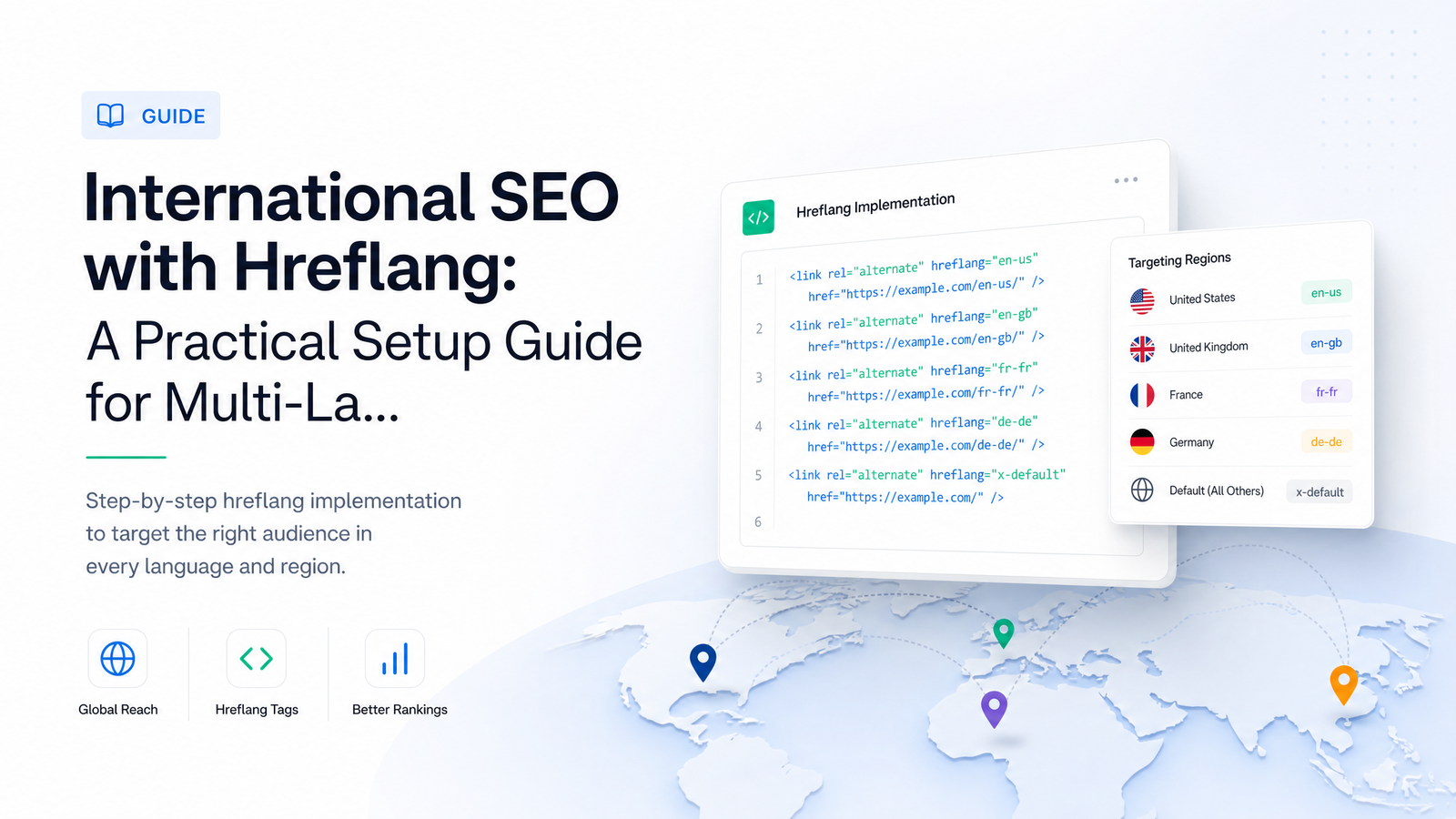
International SEO problems rarely announce themselves clearly. A visitor in France lands on your English homepage, Google Search Console's International Targeting report fills with errors nobody can decode, and the hreflang tags you set up at launch quietly stop working after a migration. This hreflang setup guide treats the attribute as what it really is: a cluster of interdependent signals, not a tag you paste once and forget.
Most explanations cover hreflang syntax in isolation, as if writing the tag correctly is the hard part. It isn't. The hard part is reciprocity — every URL in a language/region set has to point back to every other URL, and to itself, or the entire set can be discarded. This guide walks through implementation, syntax, x-default, common failure points, and how to validate the setup on an ongoing basis rather than just at launch.
What Hreflang Actually Does (and What It Doesn't)
Hreflang is an annotation that tells Google which URL to serve to users based on their language and, optionally, their region. It is a signal, not a directive — Google treats it as a strong hint, but it can and does override hreflang when other signals (canonical tags, redirects, content quality) disagree with what the annotation claims.
Two misconceptions cause most of the confusion. First, hreflang doesn't detect a page's language for you — it doesn't scan content and infer that a page is in Spanish. You're declaring the language, and if the declaration doesn't match the actual content, Google can disregard it. Second, hreflang has no direct effect on rankings. It doesn't make a page rank higher; it determines which version of a page — among several near-duplicates — shows up for a given searcher. According to Google Search Central's documentation on localized pages, using a language-specific subdomain or URL structure doesn't automatically tell Google who the page is for — hreflang is what makes that targeting explicit.
Get this framing right before you touch implementation. Hreflang meaning is often oversold as a ranking lever when its real job is routing: matching the right URL to the right visitor and preventing duplicate-content confusion across locales.
The Three Implementation Methods — and Which One Fits Your Site
There are exactly three valid hreflang implementation methods, and picking the wrong one for your site's scale is a common source of long-term maintenance pain.
HTML link tags live in the <head> of each page, using rel="alternate" with an hreflang attribute pointing to each language/region variant. This is the right default for most sites — a handful of locales, content managed through a CMS, and a team that can maintain templates centrally. The hreflang HTML tag method is easy to inspect (view source, done) but scales poorly once you're managing dozens of locale combinations, since every page needs the full set repeated.
XML sitemap entries move the same annotations into your sitemap instead of page markup, grouping URLs and their alternates in one place. This is the better choice for large sites — thousands of URLs across many locales — because it keeps page weight down and centralizes the whole cluster in a file you can generate programmatically. If your sitemap already has structural issues, hreflang errors will compound them, so confirm your sitemap is clean first; see XML Sitemap Errors: Diagnose and Fix Every Type Fast if you're not confident yours is.
HTTP headers are for non-HTML resources — PDFs, and other files where there's no <head> to put a tag in. You set the Link header with the same rel="alternate"; hreflang="x" syntax. This method is narrow but essential if you're localizing downloadable content.
Whichever method you pick, use only one per URL set — mixing HTML tags and sitemap entries for the same cluster invites contradictions Google has to arbitrate, which is exactly the kind of ambiguity that gets the whole set ignored.
Building a Correct Hreflang Cluster: Syntax, Codes, and Reciprocity
Correct hreflang syntax combines an ISO 639-1 language code with an optional ISO 3166-1 country code, separated by a hyphen: en-US, en-GB, fr-CA. Both code sets are formalized under the broader BCP 47 language tag standard, which is what Google actually validates against. Language-only tags (en, fr) are valid and often preferable when you're not distinguishing by country — adding a country code you don't need just narrows your targeting for no benefit.
A basic HTML implementation for an English/French pair looks like this:
<link rel="alternate" hreflang="en" href="https://example.com/en/" />
<link rel="alternate" hreflang="fr" href="https://example.com/fr/" />
<link rel="alternate" hreflang="x-default" href="https://example.com/" />
Two structural rules matter more than getting the codes exactly right, and they're where most implementations quietly fail.
Self-referencing: every page in the cluster must include a hreflang tag pointing to itself, alongside tags for all its alternates. Omitting the self-reference is a common oversight that makes the set incomplete.
Return tags (reciprocity): if Page A declares Page B as its French alternate, Page B must declare Page A back as its English alternate. Hreflang return tags are non-negotiable — Google explicitly requires confirmation in both directions, and a one-way link is treated as invalid and typically ignored entirely rather than partially honored. This is the mechanic that makes hreflang a "cluster": one broken return tag doesn't just weaken that pair, it can invalidate the whole set of annotations across every locale referencing it.
X-Default: When You Need It and How to Assign It Correctly
X-default is optional, but recommended for any site serving more than one locale, and it solves a specific problem: what to show a visitor whose language or region doesn't match any of your defined alternates. Without it, Google has to guess.
The x-default hreflang value should point to one of two things: a language/region selector page, or a genuine global/default page not tied to any specific locale. It should not point to a duplicate of one specific country or language version dressed up as the fallback — assigning, say, your U.S. English page as x-default implicitly (and incorrectly) treats it as the default experience for the entire rest of the world.
As a hreflang fallback page, x-default is single-assignment: one URL per cluster, referenced from every other page in the set, following the same self-reference and reciprocity rules as any other entry. Search Engine Journal's breakdown of common hreflang mistakes notes that incomplete sets — including a missing or misapplied x-default — are among the most frequent audit findings, precisely because it's the entry teams forget to update when adding a new locale.
Where Hreflang Breaks: Canonical Conflicts and Other Silent Failures
The most damaging failure mode in any hreflang setup is a mismatch with canonical tags. If Page A's hreflang cluster claims Page B as its Spanish alternate, but Page B's canonical tag points somewhere else entirely, Google treats that as a conflicting signal and will often disregard the hreflang annotation for the pair rather than try to resolve the contradiction. This is a hreflang canonical conflict, and it's silent — nothing errors loudly, pages just stop being served correctly to international users. The mechanics of canonical resolution are covered in depth in Canonical Tag Troubleshooting: 5 Failures Basic Audits Miss, which is worth reading alongside this guide rather than duplicating here.
Beyond canonical mismatches, a few other hreflang errors account for most real-world breakage:
- Non-200 targets — a hreflang tag pointing to a URL that 404s, redirects, or is blocked by robots.txt. Google won't follow a broken or redirected reference, so that locale effectively drops out of the cluster.
- Noindex pages in the set — if one alternate is marked noindex, Google can't serve it, which undermines the value of the whole annotation for that locale.
- Missing return tags — covered above, but worth repeating as a distinct failure category because it's the single most common cause of "hreflang not working" reports.
- Wrong or malformed codes — using a country code where a language code was intended, or inventing codes that don't exist in ISO 639-1/3166-1.
Semrush's rundown of hreflang errors covers several of these patterns with examples if you want a second reference point on what "invalid" looks like in the wild. Treat hreflang problems as part of your broader technical SEO backlog rather than a one-off fix — see How to Fix Technical SEO Issues: A Priority Action Plan for how to prioritize this kind of issue against everything else competing for engineering time.
Validating Your Setup and Keeping It Correct Over Time
The only reliable way to validate hreflang at scale is Google Search Console's International Targeting report, which flags missing return tags, malformed codes, and inconsistent language declarations directly. Former Google Search Advocate John Mueller has repeatedly pointed to this report as the first place to check when international pages aren't being served correctly — it's built specifically to surface the reciprocity failures that are invisible from viewing source on a single page. Our Google Search Console Tips That Actually Drive Action article covers how to read this report alongside GSC's other diagnostic tools.
Third-party crawlers that map full hreflang clusters (rather than one page at a time) are the practical complement to GSC, since they can show you the reciprocity graph across your whole site at once — which page points where, and which links are one-directional.
The part teams consistently underestimate: hreflang needs continuous re-validation, not a one-time check. A content migration that changes URL slugs, a new locale added without updating existing pages' alternates, or a redirect introduced during a redesign can all quietly break return tags that were working fine a month earlier. Nobody notices until international traffic drops or the wrong-language complaints start again. Treat hreflang audit work the way you'd treat any other recurring technical check — see Site Audit Tool: What It Checks and How to Use One for what a proper recurring audit should cover beyond hreflang alone.
Hreflang isn't a launch task you complete once. It's a maintenance obligation that grows with every locale, every migration, and every content update — and it fails silently, which is what makes it dangerous. Rankevra automates that ongoing validation: catching broken return tags, canonical conflicts, and non-200 hreflang targets continuously, instead of waiting for someone to notice traffic dropped in a market you thought was covered.
Frequently Asked Questions
Does hreflang directly improve my rankings?
No. Hreflang doesn't affect how well a page ranks — it determines which language or regional version of a page Google serves to a given searcher when multiple versions exist. Improving international rankings still depends on the usual factors: content quality, links, and technical health of each localized page.
Do I need an x-default tag if I only have two language versions?
No, x-default is optional, but it's still recommended even with just two versions. Without it, visitors whose language doesn't match either version have no defined fallback, and Google has to guess which page to show them.
Can I use hreflang without canonical tags?
Technically yes, but it's not advisable — canonical tags and hreflang need to agree, and skipping canonicals removes a signal Google uses to resolve which URL is authoritative within a locale. Mismatches between the two are one of the most common reasons hreflang gets ignored entirely.
Why is Google still showing the wrong language version even though I added hreflang tags?
The most common cause is broken reciprocity — a missing return tag, a canonical pointing elsewhere, or a target URL that doesn't return a 200 status. Any of these can cause Google to discard the annotation for that page pair rather than partially honor it, so check the International Targeting report in Search Console first.
Should small sites with only 2-3 languages bother with hreflang, or is a language switcher enough?
A language switcher helps human visitors but does nothing for search engines — it doesn't tell Google which URL to serve for which language or region. Even with just two or three locales, hreflang is worth implementing because it directly prevents duplicate-content confusion and wrong-locale serving in search results.
How long does it take for Google to recognize new or updated hreflang tags?
There's no fixed timeline — it depends on how quickly Google recrawls the affected URLs, which can range from days to several weeks. You can check recognition progress through the International Targeting report in Search Console rather than guessing based on elapsed time.
Keep reading
- XML Sitemap Errors: Diagnose and Fix Every Type FastA diagnostic guide to XML sitemap errors: why they happen, whether they block indexing, and a repeatable checklist to fix them before traffic drops.
- Keyword Cannibalization: Find It, Fix It, Prevent ItLearn how to detect keyword cannibalization, tell real conflicts from harmless overlap, and choose the right fix — merge, redirect, or canonicalize.
- Ecommerce Category Page SEO: The Index/Merge/Block FrameworkEcommerce category page SEO doesn't need a blanket noindex rule. Use the Index/Merge/Block framework to decide which filter URLs deserve to rank.