Rankevra Blog
Keyword Research Tool Amazon: Free Method + Next Steps
July 19, 2026
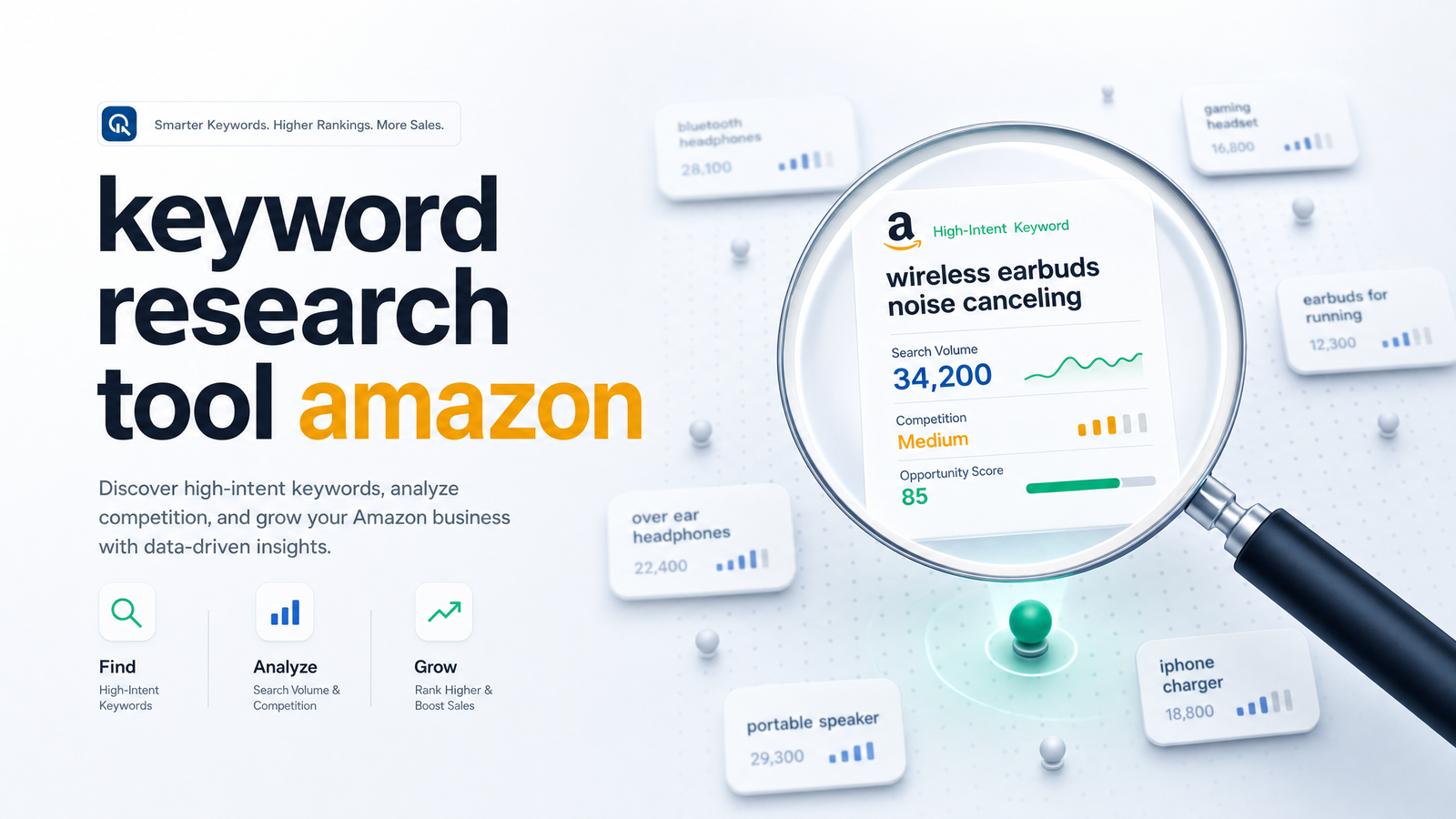
"Keyword Research Tool Amazon" Actually Means Two Different Things
Search "keyword research tool amazon" and you'll get a confusing mix: affiliate roundups of paid Amazon-seller software next to generic keyword-tool listicles. The phrase covers two unrelated searches.
The first meaning is software for people who sell physical products on Amazon and need to optimize listings — titles, bullet points, backend search terms — to rank inside Amazon's own search engine. This is where Helium 10 and Jungle Scout live.
The second meaning, and the one this article covers, is using Amazon itself as a free data source for keyword and content research aimed at ranking on Google. You're not selling anything on Amazon — you're mining its search bar, category pages, and reviews for the real language buyers use, then turning that into blog posts, comparisons, and buying guides for your own site.
If you have an actual Amazon storefront, the dedicated deep-dive on Helium 10's keyword research tool covers that use case properly. Everyone else, keep reading: this is the amazon keyword research tool workaround that costs nothing but a browser tab.
How to Turn Amazon Into a Free Keyword Research Tool
Amazon has no official "keyword research tool" the way Google Keyword Planner is one. What it has is a search engine sitting on hundreds of millions of real purchase-intent queries, visible to anyone willing to dig manually. Here's how to use Amazon for keyword research without paying for anything.
Mine the autocomplete. Type a broad product or topic term into Amazon's search bar and note every suggestion that appears. This is amazon autocomplete keyword research at its simplest, surfacing modifiers real shoppers attach to a term — "for sensitive skin," "for beginners," "under $50," "vs" comparisons. Repeat with your seed term plus each letter of the alphabet appended ("running shoes a," "running shoes b"...) to force out suggestions autocomplete doesn't show by default. It's tedious but exhaustive, and it's the closest thing to a free amazon keyword research tool you'll find.
Read "customers also search for" and "customers also bought." These modules reveal adjacent intents and products people consider alongside your seed term — useful for related content angles and internal linking opportunities.
Follow the category breadcrumbs. Every product page shows a breadcrumb trail through Amazon's category structure, reflecting how a huge slice of shoppers mentally organize a market. Subcategory names and Best Sellers section headers make excellent topic-cluster seeds — already grouped by theme, which does half your clustering work for you.
Read the Q&A section. The customer questions-and-answers block on product pages is a goldmine of unfiltered buyer confusion: "does this work with X," "is this safe for Y," "how long does Z last." Each one is a candidate blog post title or FAQ entry, phrased exactly as a real person types it.
Read reviews, especially 3-star ones. Five-star reviews are marketing copy in disguise; 3-star reviews explain, in shoppers' own words, what a product does well and where it falls short — exactly the language you want for comparison content or addressing objections in a buying guide.
Do this across five or six seed terms in your niche and you'll walk away with dozens, sometimes hundreds, of long-tail phrases — more specific than anything a generic keyword tool spits out, because they're pulled directly from commerce behavior.
Where Amazon-Sourced Keywords Fall Short
Amazon is not a substitute for a real keyword research tool. It shows you that people search a phrase — never how often. There's no volume metric, no trend line, no way to distinguish a phrase fifty people type a month from one fifty thousand type. Autocomplete suggestions are ranked by Amazon's own commercial and personalization signals, not frequency, so a phrase appearing first isn't necessarily the most searched.
Amazon also tells you nothing about Google. A phrase can be common in Amazon's search bar and have near-zero volume on Google, or vice versa, because the platforms serve different intents — one is pre-purchase browsing on a shopping site, the other spans informational, navigational, and transactional queries across the web. There's no difficulty score, no competitiveness read on Google's results, and no way to track rank once you publish.
Everything Amazon surfaces is filtered through commerce. Even Amazon keyword research for content marketing will skew heavily toward buyer-intent and product-comparison language, under-representing the informational, how-to, and definitional queries that make up a large share of organic search demand. Amazon is a language source, not a demand-validation source — pair every phrase with a real search tool, whether Google Keyword Planner for volume ranges or Google Trends for directional demand, before committing a content brief to it.
When You Actually Need Amazon Seller Software Instead
If your goal is getting your own product listing to rank inside Amazon's search results — not writing blog content — the manual method above isn't built for that job. That requires backend search-term optimization, listing-level keyword tracking, and competitor ASIN analysis, exactly what dedicated keyword research tool for amazon sellers software exists to do.
This is the Helium 10 and Jungle Scout category — tools built to reverse-engineer Amazon's A9/A10 algorithm, pull estimated search volume for Amazon (not Google) queries, and manage listing copy at scale. If that's your situation, the full breakdown of what Helium 10's keyword tool actually does will serve you better, since it's a genuinely different discipline from website SEO.
From Raw Keyword List to Ranked Page: What Comes Next
A spreadsheet of Amazon-sourced phrases isn't traffic — it's a starting point. Here's the workflow that turns amazon as a keyword research source into published, ranking content.
Validate demand. Cross-check your raw list against a tool with actual volume data. Discard phrases with negligible interest and flag rising demand using Trends data as a directional signal.
Cluster by topic and intent. Group surviving phrases into themes rather than treating each as a separate article. A dozen Amazon-derived variations on "best X for sensitive skin" usually belong under one comprehensive page, not a dozen thin ones. This is where a repeatable keyword clustering process pays off — it turns a scattered keyword list into genuine topical authority instead of disconnected posts.
Brief and draft. Turn each validated cluster into a content brief specifying target intent, buyer-language phrases pulled from Amazon reviews and Q&A, and the structure the page needs. A content strategy template keeps this consistent as your list of clusters grows.
Publish and track rank. The page goes live, then you monitor performance against the exact phrases that started the process — including long-tail variants Amazon surfaced that a standard keyword tool would never have suggested.
That's normally four or five separate tools stitched together: a keyword source, a volume checker, a clustering spreadsheet, a writing tool, a CMS, and a rank tracker. Rankevra collapses that chain into one system — you feed in raw keyword ideas (Amazon-sourced or otherwise), it clusters them, drafts the content, publishes it, and tracks rank movement over time, closing the loop instead of leaving you to reconcile five different exports. For a broader look at how this fits into a full traffic strategy, see what actually drives organic traffic growth going into 2026.
Frequently Asked Questions
Is there an official Amazon keyword research tool?
No. Amazon doesn't publish a standalone keyword research tool the way Google offers Keyword Planner. What exists is Amazon's own search bar, autocomplete, category structure, and review data — all minable manually for free — plus third-party paid tools like Helium 10 and Jungle Scout built for Amazon sellers optimizing listings.
Can I use Amazon to find keywords for my blog or website, not just product listings?
Yes, and it's one of the better free sources for buyer-intent language. Autocomplete, "customers also search for" modules, category breadcrumbs, product Q&A, and reviews all reveal real phrases shoppers use, translating well into blog posts, comparisons, and buying guides — provided you validate the phrases against real search volume data afterward.
What's the difference between researching keywords on Amazon vs. using Google Keyword Planner?
Amazon shows commerce-specific language with no volume, competition, or ranking data attached — it tells you what people type, not how often. Google Keyword Planner shows actual search volume ranges and competition metrics for Google itself, covering informational and navigational queries Amazon never surfaces. The two are complementary, not interchangeable.
Do I need a paid tool like Helium 10 if I just want content ideas, not Amazon listings?
No. Helium 10 and similar tools optimize how a product ranks inside Amazon's own search results, not to help you find blog or website content ideas. If your goal is website SEO, the free manual method — autocomplete, categories, Q&A, reviews — covers content research needs without that cost.
How accurate is Amazon's autocomplete for search volume?
It isn't a volume metric at all. Suggestions are ordered by Amazon's commercial and personalization signals, not frequency, so a suggestion appearing first doesn't mean it's the most common query. Treat autocomplete purely as a source of phrasing, then verify actual demand with a dedicated keyword tool or Google Trends.
What should I do with keyword ideas after I find them on Amazon?
Validate each phrase against real search volume data, then cluster related phrases into single comprehensive topics rather than one article per phrase. From there, brief the content, write and publish it, and track how it ranks over time — a workflow Rankevra runs end-to-end instead of requiring separate tools for each step.
Amazon can hand you raw keyword ideas for free, but raw ideas alone don't move a search ranking. Turning them into organic traffic means clustering the list into real topics, briefing and drafting content, publishing it, and tracking performance — usually a chain of four or more disconnected tools. Rankevra does all of it in one place, so the phrases you pulled from an Amazon search bar can end up as a published, ranked page without the manual handoffs in between.
Keep reading
- Tag Management on Google: The Governance GuideTag management on Google explained beyond the install tutorial: GTM structure, permissions, server-side tagging, consent mode, and SEO impact.
- SEO Marketing Tools: The Complete Category Guide (2026)A clear map of every SEO marketing tools category, why stacks sprawl to 6-8 tools, and how AI-driven platforms are consolidating the workflow in 2026.
- SEO Optimisation Tools: Match Them to the Outcome You NeedA no-fluff guide to seo optimisation tools: which categories drive traffic, fix technical issues, or build topical authority — and when to consolidate.