Rankevra Blog
Helium 10 Keyword Research Tool: What It Really Does
July 18, 2026
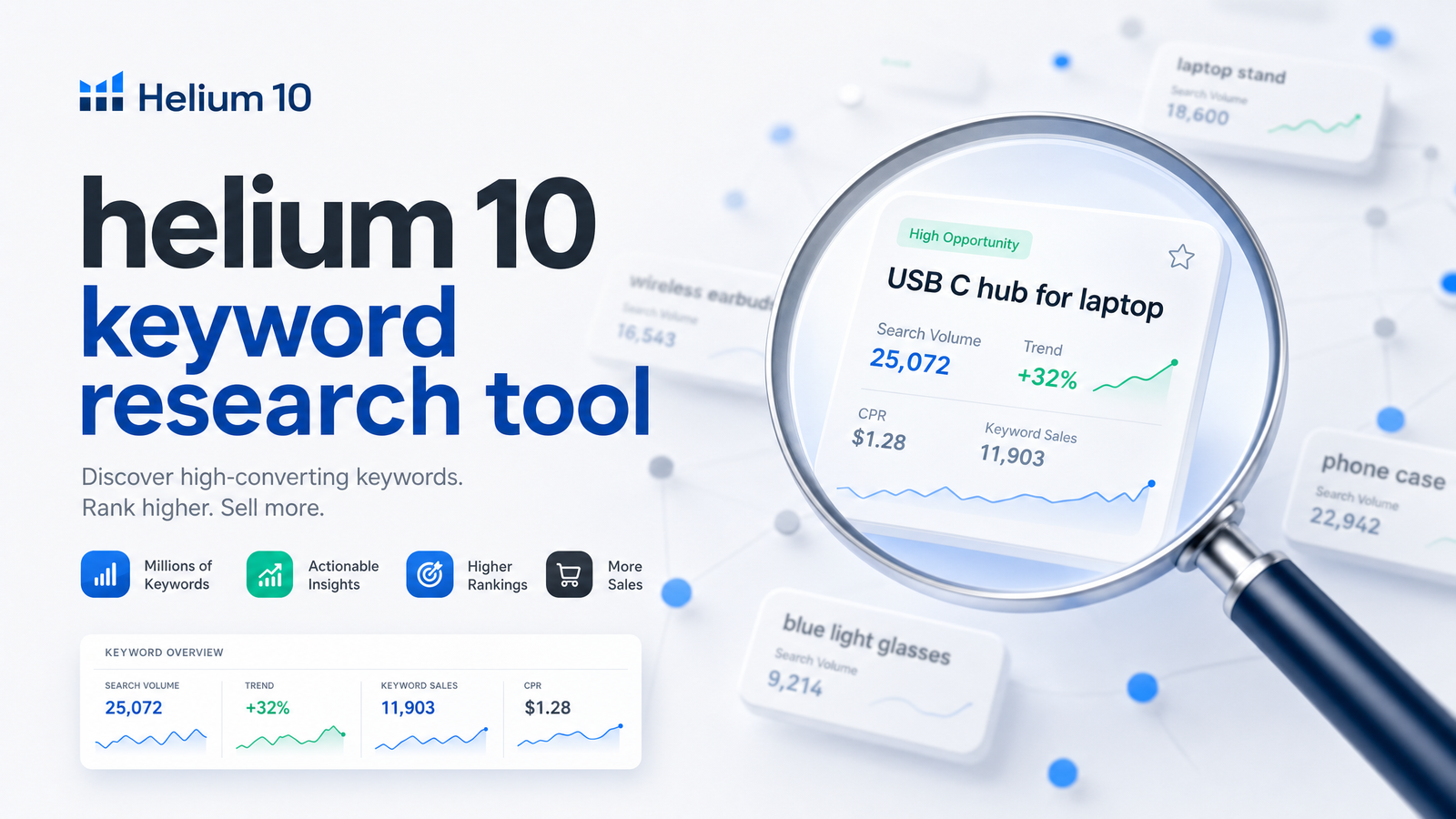
Search for "helium 10 keyword research tool" and you'll mostly find Amazon-seller blogs written to earn affiliate commissions. Almost none ask the one question that matters to a big chunk of searchers: do you sell physical products on Amazon, or are you trying to rank a website? This article answers that honestly, explains what the tool does and costs, and points website owners toward what actually solves their problem.
What Is the Helium 10 Keyword Research Tool?
Helium 10 is a software suite built for Amazon and Walmart sellers who need to optimize product listings, track competitors, and manage inventory. Its keyword research tools sit inside that suite, and the two you'll hear about most are Helium 10 Magnet and Helium 10 Cerebro, with a smaller utility called Misspelinator surfacing common misspellings shoppers use in Amazon's search bar.
Every keyword suggestion, volume number, and ranking insight Helium 10 produces is scoped to Amazon's (and to a lesser extent Walmart's) marketplace search engine — not Google. If you're managing a website, blog, or SaaS product and landed here because "keyword research tool" is what you searched, this is your sign to keep reading before signing up for a plan that solves the wrong problem. Helium 10 is, plainly, an Amazon keyword research tool first and foremost, built for FBA sellers optimizing listings, not marketers trying to rank pages on Google.
How Magnet and Cerebro Actually Work
Magnet works the way most keyword tools do at a surface level: enter a seed term (say, "stainless steel water bottle"), and it returns thousands of related search terms people actually type into Amazon's search bar, each with estimated monthly search volume. What's specific to Magnet is the Magnet IQ Score, a proprietary metric estimating how likely a keyword is to convert into an Amazon sale based on historical performance data — a purchase-intent signal calibrated entirely for marketplace shopping behavior, not someone researching a topic.
Cerebro works in reverse. Plug in a competitor's ASIN (Amazon's product ID) and Cerebro pulls back every keyword that product currently ranks for, along with estimated rank position and search volume. This reverse ASIN search is genuinely useful for Amazon sellers doing competitive listing research — it tells you which search terms drive traffic to a rival product so you can decide whether to compete on the same terms.
Used together, Helium 10 Magnet and Cerebro give sellers a fairly complete picture of Amazon search demand and competitor keyword strategy. What neither tool does is tell you anything about Google search intent, SERP features, backlink profiles, or how a webpage ranks against other webpages — because that's simply not the data they're built on.
Helium 10 Pricing in 2026
Helium 10 retired its old Starter plan, raising the effective entry point for serious keyword work. As of 2026, the structure looks roughly like this:
- Free plan: Limited access to Magnet and Cerebro with capped searches per day, useful only for occasional, casual lookups rather than ongoing keyword strategy.
- Platinum plan: The core paid tier most solo sellers land on, unlocking fuller access to Magnet, Cerebro, and listing tools with monthly usage limits on searches and tracked keywords.
- Diamond plan: Aimed at higher-volume sellers, with expanded usage caps, more advanced competitor tracking, and additional automation features layered on top of the same keyword tools.
- Enterprise plan: Custom pricing for larger brands or agencies managing many ASINs, with negotiated limits and dedicated support.
The Helium 10 pricing 2026 structure reflects a broader shift: it's increasingly bundled around full Amazon business management — inventory, PPC, listing optimization — rather than sold as a standalone keyword lookup tool. If keyword data is genuinely all you need, that bundling is where the sticker shock comes from: you pay for PPC automation and inventory forecasting you'll never touch just to get keyword volume numbers. The Helium 10 free plan exists, but its daily search caps make it impractical for anything beyond spot-checking a handful of terms.
Where Helium 10 Falls Short for Website and Google SEO
Here's the core distinction almost nobody spells out: Amazon keyword data vs Google keyword data aren't the same data at all. Amazon search volume reflects how many people typed a term into Amazon's product search bar with a wallet already in hand. Google search volume reflects a completely different mix of intents — informational questions, comparison research, navigational lookups — most of which never touch a "buy now" mindset. A keyword can be enormous on Amazon and barely register on Google, or the reverse.
So, is Helium 10 good for SEO? For Amazon listing SEO, yes — that's its actual job. For website SEO, the honest answer is no, not because the tool is poorly built, but because it wasn't designed for the problem. Consider what's structurally missing if your goal is Helium 10 for website SEO:
- No content creation workflow — Magnet gives you a keyword list, not a brief, an outline, or a draft.
- No Google rank tracking — Helium 10 tracks Amazon organic and sponsored positions, not your position on Google's SERP.
- No technical SEO auditing — there's no crawler checking your site for broken links, slow pages, missing meta tags, or indexation issues.
- No publishing pipeline — nothing connects keyword research to actually getting a page live on your CMS.
Amazon Brand Analytics (ABA), which Helium 10 pulls some of its data from, reports metrics like click share and conversion share for search terms within Amazon's own ecosystem — again, marketplace behavior, not Google ranking factors. Tools like Jungle Scout compete directly with Helium 10 in the same Amazon-seller space, reinforcing that this entire product category answers a different question than "how do I rank on Google."
If You're Not Selling on Amazon: What to Use Instead
If your actual goal is growing organic traffic to a website, blog, or SaaS product, you need a Helium 10 alternative for website SEO — something built around Google's search engine rather than Amazon's. The right keyword research tool for websites doesn't just hand you a spreadsheet of search terms; it connects keyword discovery directly to content briefs, publishing, technical fixes, and rank tracking, so you're not manually stitching together four subscriptions.
This is the gap Rankevra is built to close. It's an AI SEO tool designed for website owners, marketers, and content teams who want keyword research to feed straight into content creation and publishing, with technical audits and Google rank tracking running in the same loop — no exporting keyword lists into one tool, briefs into another, and rankings into a third spreadsheet.
If you want to go deeper on the website-side keyword workflow, this guide to keyword clustering for topical authority walks through how to group Google-facing keywords into a repeatable content structure — the equivalent of what Cerebro does for Amazon competitors, but built for SERPs instead of ASINs. And if AI-assisted content creation is part of your evaluation, this piece on AI content and SEO addresses the ranking risk questions directly.
For general strategy on what's actually moving organic traffic right now, this roundup on organic traffic growth in 2026 is a useful next read once your keyword foundation is in place. Since technical health underpins everything else, this explainer on what a site audit tool checks shows how automated audits catch crawl, speed, and indexation issues that keyword research alone won't surface.
Other established players in the Google-side keyword space — Google Keyword Planner, Ahrefs, and Semrush — are worth knowing too, though none bundle content creation and publishing the way an all-in-one AI SEO workflow does.
How to Decide Which Type of Tool You Actually Need
Before committing to a subscription, run this quick keyword research tool comparison against your actual business model:
- You manufacture or resell physical products through Amazon or Walmart → Helium 10 (or Jungle Scout) is the right category of tool. Magnet and Cerebro will genuinely help you find high-converting listing keywords and reverse-engineer competitors.
- You run a website, blog, SaaS product, or service business trying to rank on Google → you need a website-facing keyword and SEO platform, not a marketplace tool. This is the Amazon SEO vs website SEO fork in the road, and getting it right upfront saves months of chasing the wrong metrics.
- You do both → you'll likely need two separate tools, because the data, metrics, and workflows genuinely don't overlap enough for one platform to serve both well.
If you land in that second category, the fix isn't finding a better Amazon tool — it's switching categories entirely.
Frequently Asked Questions
Is Helium 10 a good keyword research tool for regular website SEO?
No — Helium 10 is built around Amazon and Walmart marketplace search data, not Google search data, so its keyword volumes, intent signals, and competitor insights don't transfer to website SEO. It's strong for Amazon listing optimization, but lacks Google rank tracking, technical auditing, and content publishing features a website needs.
What's the difference between Helium 10 Magnet and Cerebro?
Magnet expands a single seed keyword into thousands of related Amazon search terms with volume and an IQ Score estimating purchase intent. Cerebro works in reverse, taking a competitor's ASIN and revealing every keyword that product currently ranks for on Amazon, making it a reverse ASIN search tool for competitive research.
How much does Helium 10 cost in 2026?
Since the Starter plan was retired, the entry-level paid tier is Platinum, followed by Diamond for higher-volume sellers and custom Enterprise pricing for larger brands or agencies. A limited free plan exists but caps daily searches too tightly for regular keyword strategy work.
Can I use Helium 10 for Google SEO instead of Amazon?
Not effectively — Helium 10's search volumes and intent scores are calibrated to Amazon's marketplace search engine, which behaves very differently from Google's. Using Amazon keyword data to plan Google-facing content will produce misleading volume expectations and miss actual search intent.
What's a good alternative to Helium 10 if I don't sell on Amazon?
Rankevra is built specifically for website owners and marketers, connecting keyword research directly to content creation, publishing, technical audits, and Google rank tracking in one workflow. It's designed to be the equivalent of Helium 10's all-in-one convenience, but scoped to Google rankings instead of Amazon listings.
Does Helium 10 have a free plan for keyword research?
Yes, but it's limited to a small number of daily searches through Magnet and Cerebro, which works for occasional spot-checks but not for ongoing keyword research or content planning. Sellers who need consistent access typically move to the Platinum plan or higher.
If growing organic traffic on a website — not an Amazon listing — is the actual goal, Rankevra is built to be the Helium 10 equivalent for websites: keyword research, content creation, publishing, and rank tracking, all in one place.
Keep reading
- Content Decay SEO: How to Detect It and Fix It for GoodLearn to detect content decay SEO issues early, rule out false positives, and build a refresh pipeline that scales — plus how to automate the whole loop.
- Headless CMS SEO: Fixing the Gaps Generic Tools MissHeadless CMS SEO breaks in three predictable places: rendering, metadata, and sitemaps. Here's the diagnostic framework to find and fix each gap.
- Google Algorithm Update Recovery: A Diagnostic FrameworkA step-by-step google algorithm update recovery framework: confirm the cause, segment the damage, benchmark against winners, and set a real timeline.