Rankevra Blog
Schema Markup for SEO in 2026: What Still Works
September 9, 2026
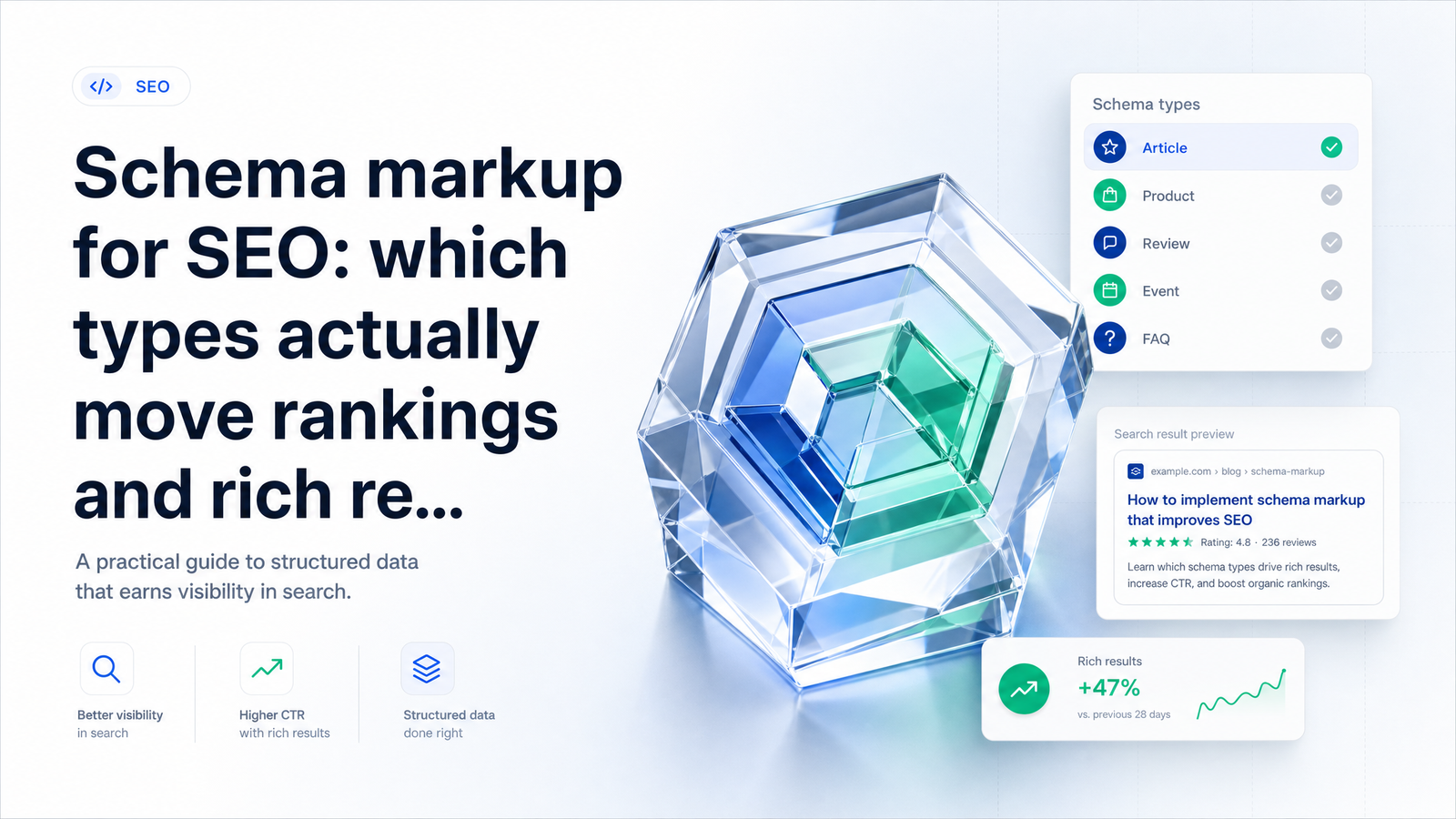
Schema Markup Isn't a Ranking Factor — Here's What It Actually Does
Google has said it plainly, repeatedly, in its own developer documentation: structured data is not a ranking signal. Adding schema markup to a page will not push it up the results for a target keyword. So if you're asking "is schema markup a ranking factor," the honest answer is no — and any guide that tells you otherwise is selling something.
What schema does do is help Google's systems parse page content more reliably, and — separately — makes a page eligible for certain visual treatments in the search results: star ratings, product prices, breadcrumb trails, article carousels. That eligibility isn't guaranteed even with perfect markup; Google decides case by case whether a rich result is shown. Comprehension is one layer, presentation is another. Schema earns you a shot at better-looking, higher-CTR listings. It does not earn you a better position.
That's still a meaningful reason to implement it well. A page with a star rating or price snippet routinely pulls a higher click-through rate than a plain blue link in the same position. But treat it as a CTR and clarity lever, not a rankings lever, and you'll stop making decisions based on the wrong expectation.
What Changed in 2026: FAQ and HowTo Are Gone
If you've heard conflicting claims — "schema is dead" from one camp, "schema matters more than ever" from another — both are reacting to the same event: Google's steady narrowing of which schema types actually generate rich results. FAQ rich results were officially removed from Google Search on May 7, 2026, with Search Console reporting and API support for the FAQPage type following into retirement over subsequent months. HowTo rich results went the same way earlier — Google pulled those back in 2023.
The pattern behind both removals is consistent: both were saturated with abuse. Sites stuffed pages with FAQ markup unrelated to the visible content, purely to inflate search real estate with extra blue links and expandable snippets. Google's response, per its own documentation, was to restrict eligibility first (limiting FAQ rich results to a narrow set of authoritative government and health sites in 2023) and then remove the feature outright once the abuse didn't clean itself up. Structured data rich results on Google now trend toward a shorter, better-policed list.
So what do you do with FAQ markup already sitting on your site? Don't panic-strip it. If your content is genuinely structured as questions and answers — an actual FAQ section, not markup bolted onto a listicle — leaving the JSON-LD in place causes no harm. Google's guidance confirms unused or non-eligible structured data doesn't penalize a page; it's simply inert now, ignored for rich-result purposes. Stop investing further engineering time into FAQ or HowTo markup, and double-check that any FAQ schema still on the page mirrors visible, on-page Q&A content — not padding.
The Schema Types Still Worth Implementing in 2026
With FAQ and HowTo off the table, the practical question is which schema types that get rich results are still worth your team's time. Prioritize based on page type and business model:
- Product, Offer, and AggregateRating — the strongest ROI for ecommerce. Together they unlock price, availability, and star-rating snippets directly in search results, one of the more reliable CTR boosts still available through structured data.
- Article, BlogPosting, and NewsArticle — relevant for publishers and content-driven sites. These support eligibility for Top Stories and article-style search features, and help search engines correctly attribute headline, author, and publish date.
- BreadcrumbList — low effort, still functional. It replaces a raw URL string in search results with a clean navigational path, improving scannability even if the CTR lift is modest.
- Organization — feeds knowledge panel data and brand identity signals; worth implementing site-wide once, not per page.
- LocalBusiness — essential for any business with a physical location or service area; powers map-pack-adjacent details like hours, address, and phone.
- VideoObject — unlocks video thumbnails and key-moment markers in results, increasingly valuable given how much search real estate video now occupies.
- Recipe and Event — narrower but still fully supported for the site types they apply to, producing some of the richest visual snippets left in Google Search.
Implement JSON-LD schema for SEO purposes on the page types where these actually apply — don't blanket every template with every type just because you can. A schema audit that maps page templates to relevant types is far more useful than a checklist of all 30-plus schema.org objects.
Schema and AI Overviews: What's Proven vs. Hype
The claim repeated across SEO vendor blogs — that structured data makes a page some multiple more likely to be cited in AI Overviews — deserves real skepticism. The frequently cited "3.2x more likely" figure has no traceable, verifiable source; it circulates as an assumed fact without an underlying study anyone can point to. Treat it as marketing shorthand, not evidence.
Google's own position on AI Overviews and AI Mode is that no special schema markup is required for a page to be cited. What actually correlates with AI citation is the same thing that's always mattered: clear, well-structured content — direct answers, sensible headings, unambiguous entities — that a language model can extract cleanly, with or without JSON-LD wrapped around it. Schema can reinforce that clarity by disambiguating entities and confirming structure, but it's a supporting signal at best, not an input AI Overviews specifically query.
The honest, unglamorous takeaway: if you're optimizing for AI-citation share, spend the bulk of your effort on writing clear, well-organized content that directly answers the query, and treat schema markup as secondary reinforcement, not a citation hack.
Implementation Basics: Format, Validation, and Common Mistakes
Use JSON-LD for schema markup for SEO, not Microdata or RDFa. Google explicitly recommends JSON-LD because it's a self-contained script block that doesn't require weaving attributes through your HTML — easier to implement, audit, remove, or update without touching page markup.
Validate everything before you ship it. Google's Rich Results Test tells you whether a page is eligible for a rich result and flags errors against Google's own requirements, while the general Schema.org validator checks against the broader vocabulary spec, even for types Google doesn't currently surface as rich results. Run both — they catch different classes of problems.
The single most common and costly mistake is marking up content that isn't actually visible on the page: a FAQ schema block listing questions that don't appear anywhere in the rendered content, or a rating that doesn't correspond to a real, visible review count. This doesn't trigger a ranking penalty in the algorithmic sense, but it does violate Google's structured data spam policies, and the consequence is losing rich-result eligibility — sometimes site-wide — until it's fixed. Schema markup validation should always include a manual check: does every markup claim match something a human visitor can actually see?
Keeping Schema Current Without Manual Re-Audits
Here's what makes schema maintenance genuinely difficult: Google isn't done narrowing this list. FAQ and HowTo won't be the last types to lose rich-result eligibility, and the review cycle keeps shifting every few months as Google tightens spam policy enforcement. Manually re-checking your JSON-LD against the latest developer documentation after every core update doesn't scale past a handful of pages — and most content teams have a lot more than a handful.
This is exactly the kind of recurring technical maintenance that benefits from automation rather than a quarterly manual sweep. An ongoing site audit workflow that checks structured data validity alongside crawlability, indexation, and other technical health signals catches schema drift before it costs you a rich result — and fits naturally into a broader technical SEO priority framework rather than treating markup as an isolated task.
Rankevra builds this into its automated audit and fix workflow: it flags outdated or ineligible schema, validates JSON-LD against current requirements, and keeps structured data aligned as Google's supported types shift — without you re-learning the deprecation list every quarter. If you're managing SEO yourself and don't want schema babysitting added to your task list, try Rankevra and let the audits run in the background.
Frequently Asked Questions
Is schema markup still worth implementing after the FAQ deprecation?
Yes, for the page types where eligible rich results still exist. FAQ and HowTo are gone, but Product, Article, BreadcrumbList, Organization, LocalBusiness, and Video schema all still produce visible rich results in Google Search. The deprecations narrowed the list; they didn't end structured data's usefulness.
Which schema types actually produce visible rich results in Google Search right now?
Product with Offer and AggregateRating, Article/BlogPosting/NewsArticle, BreadcrumbList, Organization, LocalBusiness, VideoObject, and Recipe or Event where applicable. These cover pricing and rating snippets, article carousels, breadcrumb trails, knowledge panel data, and video thumbnails respectively.
Does adding schema markup improve keyword rankings?
No. Google has stated structured data is not a ranking factor; it affects rich-result eligibility, click-through rate, and machine comprehension of the page — not position in search results. A page can have flawless schema and still rank poorly if the underlying content and authority signals are weak.
Should I remove FAQ schema I already have on my site?
Not necessarily. If the markup reflects genuine, visible Q&A content on the page, leaving it causes no harm since unused structured data isn't penalized. Remove or refactor it only if it was added purely to chase the now-defunct rich result, or if it doesn't match visible content — that mismatch risks a spam-policy issue independent of the deprecation.
Does schema markup help pages get cited in AI Overviews?
There's no verified evidence that it does. Google says no special schema is required for AI Overview or AI Mode citation, and the widely repeated "3.2x more likely" statistic has no traceable source. Clear, well-structured, directly-answering content matters far more for AI citation than markup does.
Keep reading
- E-E-A-T SEO: A Checklist for Scaling Content With AIA practical E-E-A-T SEO checklist for teams scaling content with AI — what triggers scaled content abuse, and how to gate every page before it publishes.
- How to Improve Core Web Vitals: A Measure-Fix-Verify LoopLearn how to improve Core Web Vitals with a repeatable measure-diagnose-fix-verify loop covering LCP, INP, and CLS — no developer required.
- Linkback Checker: How to Verify a Single Backlink Went LiveA linkback checker workflow for verifying one link at a time: live status, dofollow, anchor text, and indexation — manual steps plus automation.