Rankevra Blog
E-E-A-T SEO: A Checklist for Scaling Content With AI
September 9, 2026
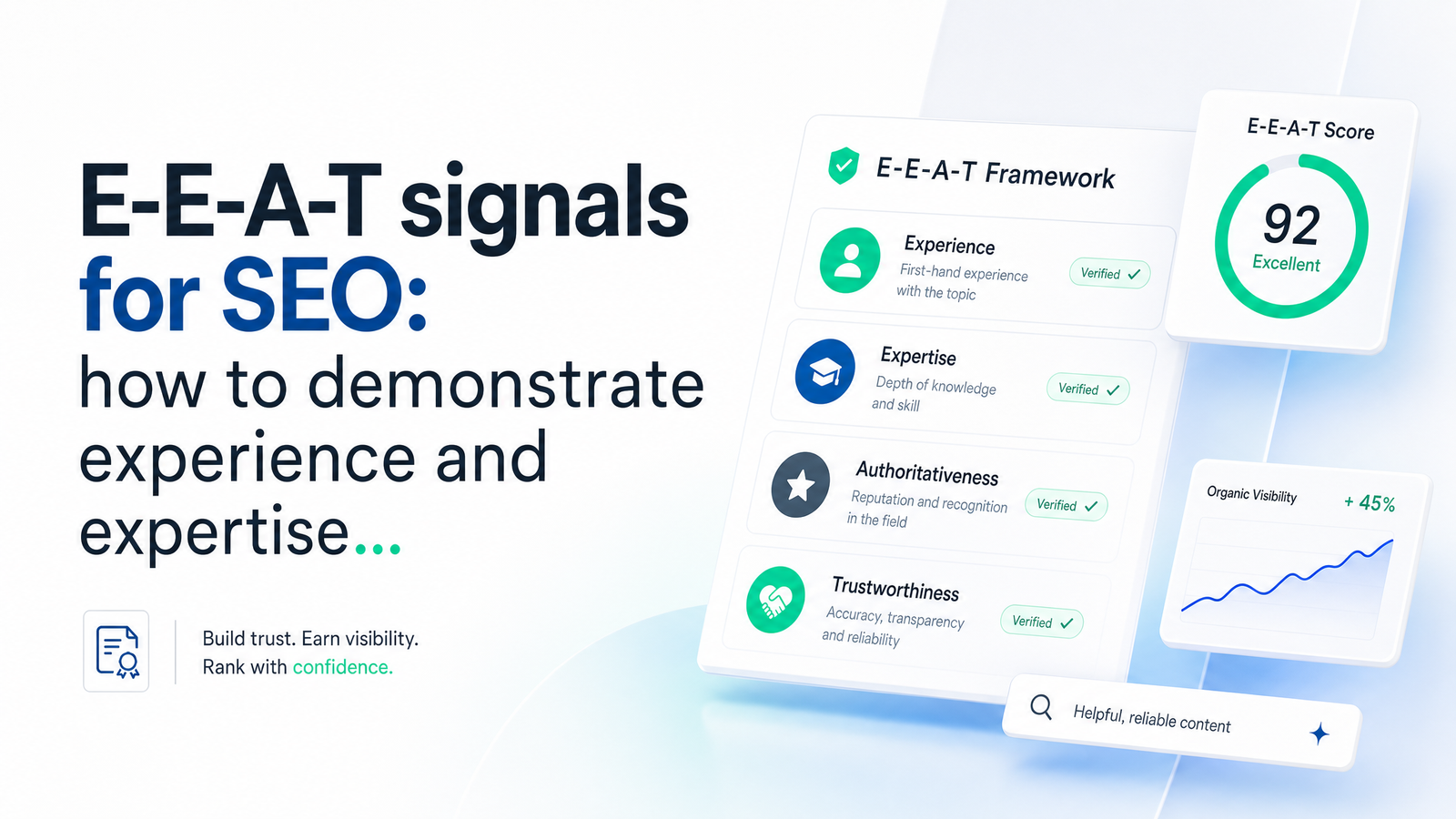
Most explanations of E-E-A-T stop at the acronym. This one is for teams already running AI in their publishing pipeline who need to know exactly what to check before a page goes live — not a philosophy, but a set of gates.
What E-E-A-T Actually Means (and What It Doesn't)
E-E-A-T stands for Experience, Expertise, Authoritativeness, and Trust — the framework Google's human quality raters use, laid out in the Search Quality Rater Guidelines, to judge whether a page deserves a high or low quality score.
Here's the part that trips people up: E-E-A-T isn't a direct ranking factor the way page speed or a title tag is. Google doesn't compute an "E-E-A-T score" and slot it into the algorithm. Instead, rater guidelines shape how Google's engineers train and evaluate the systems that do rank pages — including the Helpful Content System, built to reward content that seems genuinely useful and demote content produced mainly to attract search clicks.
The four pillars, in plain terms:
- Experience — has the creator actually used the product, visited the place, lived the situation being described?
- Expertise — does the creator have the knowledge or skill the topic requires?
- Authoritativeness — is this source recognized, by others, as a go-to voice on the subject?
- Trust — is the information accurate, is the site secure and transparent, and would you rely on it for something that matters?
Trust sits at the center — Google's documentation treats it as the most important of the four, since a page can show experience and expertise and still fail if the information itself is inaccurate or the site feels unreliable. This distinction — quality framework versus ranking factor — matters most the moment AI enters your workflow, because the pillars easiest to fake are exactly the ones raters are trained to spot.
Why AI Content Raises the E-E-A-T Bar
Google has been direct: using AI to help produce content is not, by itself, a violation. What gets penalized is low-quality, low-effort content, regardless of how it was made. A hand-written page can still fail the guidelines if it's thin, generic, or written only to rank. An AI-assisted page can still pass if it's accurate, original, and genuinely useful.
That said, AI and E-E-A-T interact in a specific, predictable way: AI is good at expertise-adjacent language — it can summarize, structure, and explain — but it cannot manufacture experience. It hasn't used the product, tested the tool, or lived through the outcome. When a team runs pure AI output straight to publish, the experience pillar is usually the first thing missing, and it's often what raters and readers notice fastest, since generic "overview" content reads the same regardless of topic.
Current guidance on Google Search Central's AI content policy reinforces this: reward quality, not detect authorship. The Google Quality Rater Guidelines Explained (E-E-A-T, YMYL, 2026) breakdown confirms rater instructions score content on effort and value, not on whether an AI touched the draft. So the practical question for a scaling team isn't "will Google penalize AI content" — it's "does this page carry the same first-hand detail and verification a human-only page would have had."
Scaled Content Abuse: The Line You Can't Cross
Google's scaled content abuse policy is defined precisely: the violation is generating many pages primarily to manipulate search rankings, "no matter how it's created" — automated tools, human writers, publishing services, or combinations of all three. As People-First Content guidance puts it, the method of production was never the target — the intent and value were.
Volume alone doesn't trigger a penalty, and hand-written content isn't automatically safe. The practical test is intent and value: does each page exist because it answers a real query with real substance, or because a keyword list said it should? A hundred pages published in a week can be fine if each has a distinct purpose, original detail, and a human check behind it. Ten pages can be a problem if they're templated filler with nothing new to say.
This is where the connection to E-E-A-T becomes concrete. Named authorship, verifiable sourcing, and first-hand detail are the signals that a page wasn't manufactured on autopilot — they're your evidence trail against a scaled-abuse read. As Google's Scaled Content Abuse Policy Explained lays out, AI-assisted content with a real human review step, credited authorship, and factual verification sits outside the policy's target — enforcement aims at unreviewed, mass-produced pages with no editorial layer, not at AI-assisted teams doing the work properly. If you're scaling via templated or programmatic pages, the boundary is the same but the fixes look different — covered separately in Programmatic SEO: How to Scale Pages Without Getting flagged.
The 4-Signal Checklist: Proving E-E-A-T on Every Page
Treat this as a gate every page passes through before publish, regardless of whether the first draft came from a person or a model.
1. Named, credentialed author with a real bio. A byline with a full name, a short bio establishing relevant background, and a link to a bio page or LinkedIn profile. Author credentials for SEO purposes aren't decorative — they're the fastest signal a rater or reader uses to judge whether expertise is plausible. Anonymous or generic "Team" bylines are a weak signal on any topic, and a disqualifying one on YMYL content.
2. First-hand detail or original data. At least one element AI cannot invent: a screenshot from actual use, a specific number from your own testing, a detail only someone who did the thing would know, a quote from an internal expert. This is the single highest-leverage fix for AI-drafted content, because it's the exact gap raters are trained to notice.
3. External citations to authoritative sources. Claims — especially numbers, dates, or anything YMYL-adjacent — link out to a primary or recognized source rather than resting on the model's unverified output. This also protects against AI hallucination, which is a trust failure, not just an accuracy one.
4. Transparent sourcing and disclosure. Where content is AI-assisted, editorial policy or methodology is disclosed somewhere on the site. Where data is used, its origin is stated. This isn't a legal requirement in most jurisdictions, but it directly supports the trust pillar and gives raters and readers a reason to believe what they're seeing.
Run every page through those four checks and you're addressing experience, expertise, authoritativeness, and trust with something concrete — not a vague instruction to "be an expert."
Where This Fits in an AI-Scaled Publishing Workflow
The checklist above only works if it happens before publish, not as a cleanup pass after something already underperforms. That's a sequencing problem: audit and draft generation can be fast and largely automated, but the E-E-A-T gate — author assignment, fact verification, sourcing, first-hand detail injection — needs to be a required step the pipeline can't skip, not an optional polish step a busy team quietly drops when volume ramps up. The mechanics of building that gate into a cadence — how many pages per week, what QA checkpoints look like, how review scales with output — are covered in more depth in Building a Content Publishing Workflow That Scales Safely.
This is precisely the gap Rankevra is built to close. Instead of stitching together a separate audit tool, a separate AI writer, and a separate publishing step — where the human review layer is the first thing to get cut under deadline pressure — Rankevra runs audit-to-publish as one workflow with a review checkpoint built in by default. Technical issues get flagged, drafts get generated against your topical map, and a human sign-off step sits between draft and publish rather than being bolted on afterward. Scale doesn't have to mean stripping out oversight; it just means oversight has to be structural, not optional.
Frequently Asked Questions
Does using AI to write content hurt my E-E-A-T or rankings?
No — using AI to draft content is not itself a ranking penalty. Google's guidance is explicit that low-quality, low-effort content is scored poorly regardless of whether a human or an AI produced it, so the risk comes from thin or unverified output, not from AI involvement.
Is E-E-A-T an official Google ranking factor?
Not directly. E-E-A-T is a framework from Google's Search Quality Rater Guidelines used to train and evaluate ranking systems like the Helpful Content System, rather than a factor plugged directly into the algorithm. It shapes what gets rewarded, but there's no standalone "E-E-A-T score."
How many AI-assisted articles can I publish before it's considered scaled content abuse?
There's no fixed number — Google's scaled content abuse policy targets intent and value, not volume. Pages made primarily to manipulate rankings are the violation, "no matter how it's created," so a high page count with genuine value and human review can be safe while a low page count of templated filler can still be flagged.
Do I need a named author with credentials on every page, even a blog post?
Yes, in general — a named author with a real bio is one of the fastest, cheapest signals of expertise and accountability, and its absence is a weak signal even on low-stakes content. It becomes essentially mandatory on YMYL topics, where anonymous or vague authorship is a clear trust failure.
What's the fastest way to add real experience signals to an AI-drafted article?
Insert at least one detail AI cannot invent: original data from your own testing, a screenshot from actual use, or a quote from someone who did the thing being described. This single addition addresses the experience pillar, which is the one AI struggles hardest to fake on its own.
How is E-E-A-T different for YMYL (money/health) topics versus regular content?
YMYL topics — those affecting health, finances, safety, or major life decisions — are held to a stricter trust standard because inaccurate content carries higher real-world risk. That means named credentialed authors, verified sourcing, and cited authoritative references move from "best practice" to essentially required on these pages.
The checks that actually protect rankings — named authorship, verification, sourcing, first-hand detail — are exactly the steps teams quietly drop once they're publishing at speed. Rankevra builds those checks into the pipeline itself, so every page moves through audit, draft, and human review by default, not as an afterthought.
Keep reading
- Schema Markup for SEO in 2026: What Still WorksSchema markup for SEO in 2026: which types still earn rich results after FAQ's removal, what's hype for AI Overviews, and how to stay current.
- How to Improve Core Web Vitals: A Measure-Fix-Verify LoopLearn how to improve Core Web Vitals with a repeatable measure-diagnose-fix-verify loop covering LCP, INP, and CLS — no developer required.
- Linkback Checker: How to Verify a Single Backlink Went LiveA linkback checker workflow for verifying one link at a time: live status, dofollow, anchor text, and indexation — manual steps plus automation.