Rankevra Blog
Schema Markup for SEO in 2026: What Still Works
September 19, 2026
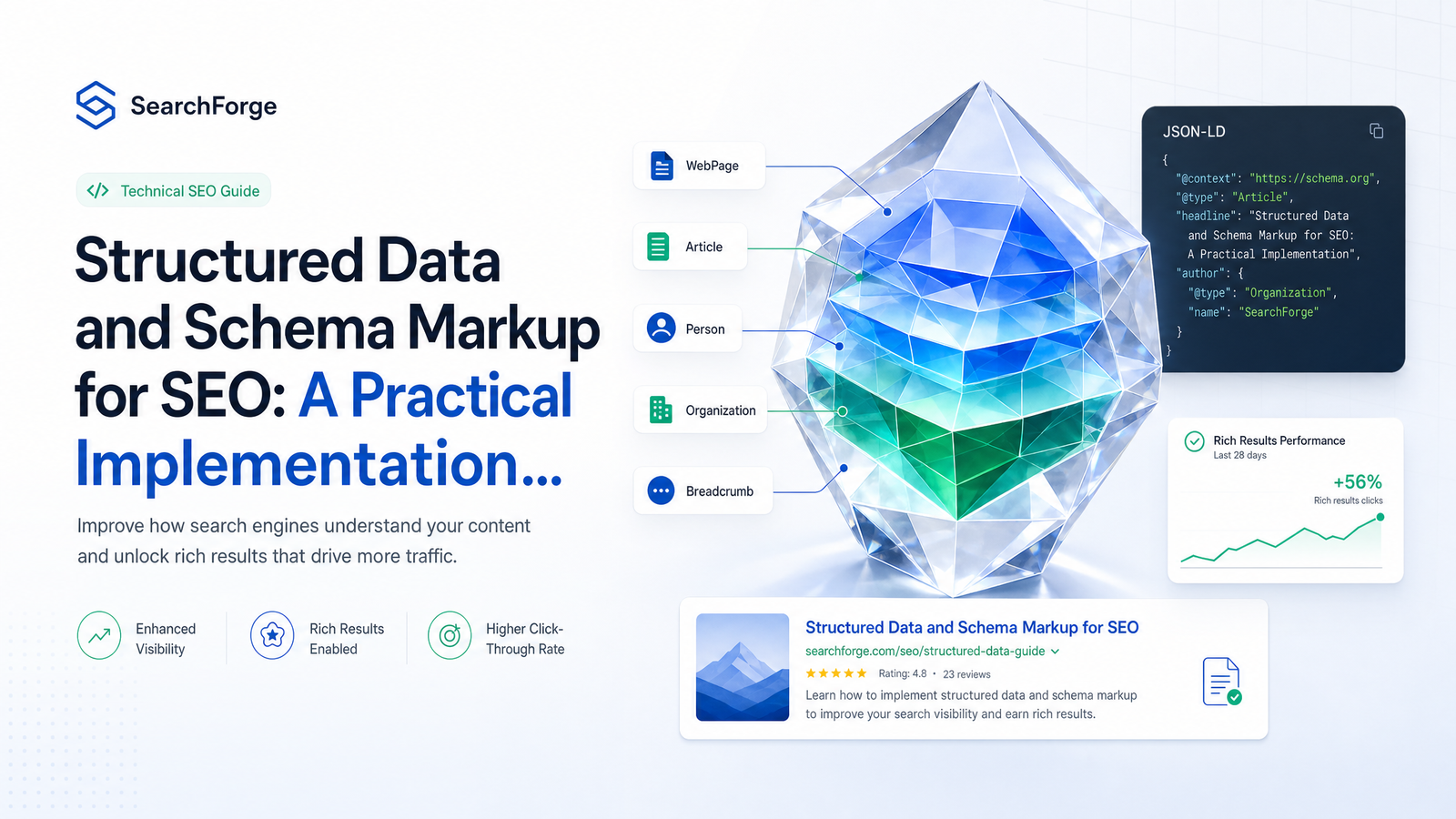
Schema markup for SEO has quietly become one of the most misunderstood parts of technical optimization. Half the guides still floating around the web were written before Google's 2025–2026 deprecation wave, pointing readers toward FAQPage and HowTo implementations that no longer do anything for visibility. This article covers what's actually true in 2026: what schema markup does and doesn't do, which types still earn rich results or AI citations, and a lean workflow for implementing, validating, and maintaining it without babysitting every template on your site.
What Schema Markup Actually Does (and Doesn't Do) for SEO
Schema markup is code — usually written in JSON-LD — that labels the content on a page using a shared vocabulary from Schema.org, so search engines can identify what a piece of content actually is: a product, a review, an event, an organization. "Structured data" is the broader term for this labeled information; schema markup is the implementation of it using Schema.org's specific vocabulary.
Here's the misconception that wastes the most reader effort: schema markup is not a ranking factor. Google's own Search Liaison, Danny Sullivan, has said directly that adding structured data does not improve where your pages rank — a point Safari Digital's breakdown of the ranking-factor debate lays out clearly. What schema does is make you eligible for certain enhanced search features and give search engines a clearer, more confident read on what your content represents. Think of it as an eligibility and comprehension layer, not a lever you pull to climb rankings. Skip it entirely and your rankings won't drop. Implement it well and you may unlock a rich result, a knowledge panel connection, or clearer entity recognition — none of which is guaranteed, and none of which substitutes for the content and technical fundamentals that actually move rankings.
Which Schema Types Are Still Worth Implementing in 2026
This is where currency matters most. Google's structured data documentation went through a significant retirement wave across 2025 and into 2026, and Relevant Audience's rundown of the removals documents the specifics: seven schema types lost their rich result treatment in 2025, and FAQPage rich results were retired on May 7, 2026, following HowTo's earlier deprecation. If you're still marking up FAQ blocks or step-by-step guides expecting a search snippet, that effort is now dead weight — it won't cause an error, but it also won't earn you anything visually in results.
What's still worth your time in 2026:
- Product — pricing, availability, and review snippets on ecommerce pages remain one of the most reliably rewarded schema types, directly influencing shopping-related rich results.
- Review / AggregateRating — star ratings in search results still depend on this markup and still move click-through rate.
- Recipe — recipe carousels and rich results are intact and continue to reward detailed, accurate markup.
- Event — date, location, and ticket information still populate event rich results in relevant queries.
- LocalBusiness — supports map pack and local knowledge panel accuracy, tying directly into local search visibility.
- Organization — reinforces brand entity data that feeds knowledge panels and how AI systems identify who's behind a piece of content.
- Article / Author — supports authorship and publication signals that matter more, not less, as content trust becomes a differentiator.
- BreadcrumbList — still renders breadcrumb trails in search results and helps clarify site structure.
- VideoObject — still supports video rich results and thumbnail previews across traditional and video-focused search surfaces.
The pattern across the survivors is straightforward: they attach to content types where Google, and increasingly AI systems, benefit from verified, structured facts — prices, ratings, dates, locations, identities. FAQPage and HowTo were casualties of low-quality, over-applied markup that cluttered results without adding real value, and Google decided the trade-off wasn't worth it anymore.
How to Implement Schema Markup Step by Step
Start with format: JSON-LD is the format Google recommends and the one worth standardizing on, over microdata or RDFa. It lives in a self-contained script block, usually in the page's <head>, separate from your visible HTML — easier to template, easier to update, and far less likely to break when someone edits page copy.
A practical structured data implementation guide, condensed:
- Place the JSON-LD block in the
<head>or before the closing</body>tag. Either works technically; consistency across your CMS templates matters more than the specific location. - Match markup to visible content exactly. If your Product schema claims a price or rating that isn't visibly shown on the page, that's a policy violation, not just a technical error — Google requires parity between structured data and what a visitor actually sees.
- Fill required properties first, then recommended ones. Each schema type on Schema.org lists required fields (the minimum for eligibility) and recommended fields (which improve richness and accuracy). Skipping required fields is the single most common reason rich results never appear.
- Template it, don't hand-code it per page. For any site beyond a handful of pages, schema needs to be built into your CMS templates so every new product, article, or location page inherits correct markup automatically, pulling from the same fields that populate the visible page.
- Keep one schema type per entity, nested where appropriate. A product review page might reasonably combine Product and Review schema, but avoid stacking unrelated or redundant types on the same page — it invites validation errors and dilutes clarity.
This work is one piece of a much larger technical SEO picture. If you're tackling a backlog of issues beyond schema, a priority action plan for technical SEO is worth working through alongside this checklist so you're fixing the highest-impact problems first.
Validating Schema and Avoiding Common Errors
Schema markup validation should happen before you publish and on a recurring basis afterward — not just once at launch. Google's Rich Results Test remains the primary tool for checking whether a specific URL's markup is eligible for a rich result, and Search Console's Enhancements reports show structured data errors at scale across your whole site, flagging exactly which pages have broken or incomplete markup.
The most common structured data errors worth watching for:
- Mismatched content — schema claims something (a price, an author, a rating) that doesn't match what's visibly on the page.
- Missing required fields — the markup validates as syntactically correct JSON-LD but is missing a field Google requires for rich result eligibility.
- Markup on noindexed pages — schema on a page blocked from indexing is simply ignored, wasting the effort entirely.
- Stale data after CMS or template changes — a developer updates a page template, a field mapping breaks, and every page using that template silently starts serving incomplete or incorrect schema until someone notices in Search Console.
That last one catches most teams off guard, because it's invisible until rich results quietly disappear weeks later. Running periodic structured data checks as part of a broader site audit process catches this before it costs you visibility, rather than after.
Schema Markup's Growing Role in AI Search
Does schema markup help with AI Overviews? The honest answer is: indirectly, but meaningfully. Structured data for AI Overviews and other LLM-based search experiences functions less as a ranking input and more as a trust and disambiguation signal — it helps AI systems confirm facts (who wrote this, what does this product cost, is this business real and where is it located) rather than guess at them from unstructured prose. John Mueller has addressed this directly, describing schema markup's role with LLMs as more nuanced than a simple ranking or citation boost — closer to a verification aid than an inclusion guarantee, as covered in Search Engine Roundtable's writeup of his comments.
Organization and Author schema carry particular weight here, since AI systems increasingly need to attribute claims to a verifiable source. This is a fast-moving area, and if you want the deeper mechanics of how AI Overviews source and cite content, that deserves its own dedicated treatment beyond what fits here.
Keeping Schema Markup Accurate at Scale
The hardest part of schema markup for SEO isn't the initial implementation — it's keeping it accurate as your site grows, your CMS templates change, and Google revises its guidelines again, as it just did with FAQ and HowTo. Schema breaks silently. Nobody gets an alert when a template update drops a required field or when Google retires a type your whole content library was built around.
A practical schema markup checklist for website owners should include: auditing structured data on new templates before launch, re-validating after any CMS update, tracking Search Console's Enhancements reports monthly, and re-checking your schema type choices whenever Google announces a documentation change. Doing that manually across dozens or hundreds of templates is exactly the kind of repetitive, easy-to-neglect task that erodes SEO gains over time — not through one big mistake, but through slow, unnoticed decay.
This is precisely the gap Rankevra is built to close. Instead of manually re-checking templates every time a developer ships a change or Google revises its structured data guidelines, Rankevra's AI workflow can automate schema audits, detect validation errors, and generate corrected JSON-LD as part of the same system that already handles your technical audits, content creation, and publishing. Schema stops being one more thing on your list and becomes one more thing that's already handled — explore how at Rankevra.
Frequently Asked Questions
Is schema markup necessary for SEO, or can I skip it?
Schema markup isn't required for a page to rank, since it's not a ranking factor — you can skip it without penalty. But skipping it means giving up eligibility for rich results like star ratings, product pricing, and breadcrumbs, plus clearer entity recognition for AI-driven search, so it's worth implementing wherever it's genuinely applicable.
What's the difference between schema markup and structured data?
Structured data is the general concept of organizing page content into a labeled, machine-readable format. Schema markup is the specific implementation of that using the shared vocabulary defined by Schema.org, most commonly written in JSON-LD.
Can schema markup hurt my SEO if I implement it wrong?
Yes, indirectly — mismatched or inaccurate markup (claiming a price, rating, or fact not visible on the page) violates Google's structured data guidelines and can get that markup ignored or the page manually actioned. It won't tank your organic rankings outright, but it can cost you rich result eligibility and, in more serious cases, trigger a spam action for misleading markup.
Do I need a developer to add schema markup, or can I use a plugin?
Many CMS platforms and SEO plugins can generate basic schema (Organization, Article, Product) without custom development, which works fine for straightforward templates. More complex or highly customized sites typically need a developer, or an automated tool, to ensure markup stays templated correctly and matches visible content as pages scale.
Why did my FAQ rich results disappear from Google Search?
Google retired FAQPage rich results on May 7, 2026, as part of a broader deprecation wave that also removed HowTo and several other schema types the previous year. The markup itself doesn't cause errors, but it no longer produces any visual rich result in search, so the disappearance is expected and not a sign of a technical problem on your site.
How often should I check my site's structured data for errors?
Check monthly at minimum through Search Console's Enhancements reports, and immediately after any CMS or template update. Sites with frequent publishing or template changes benefit from automated, continuous monitoring rather than periodic manual checks, since errors introduced by a template change can silently affect every page using it.
Keep reading
- SEO for AI Overviews: Winning Citations, Not Just RankingsSEO for AI Overviews requires new tactics. Learn why ranking #1 no longer guarantees citations and how to earn visibility across AI search engines.
- E-E-A-T SEO in 2026: The Auditable Framework That WorksE-E-A-T SEO explained with concrete, checkable proof points—not vague advice. Learn what to build for Experience, Expertise, Authority, and Trust in 2026.
- SEO Data Silos: The Hidden Cause of Bad Rank TrackingSEO data silos quietly distort rank tracking, cause false cannibalization alerts, and waste hours. See how a unified dashboard like Rankevra fixes it.