Rankevra Blog
SEO Data Silos: The Hidden Cause of Bad Rank Tracking
September 19, 2026
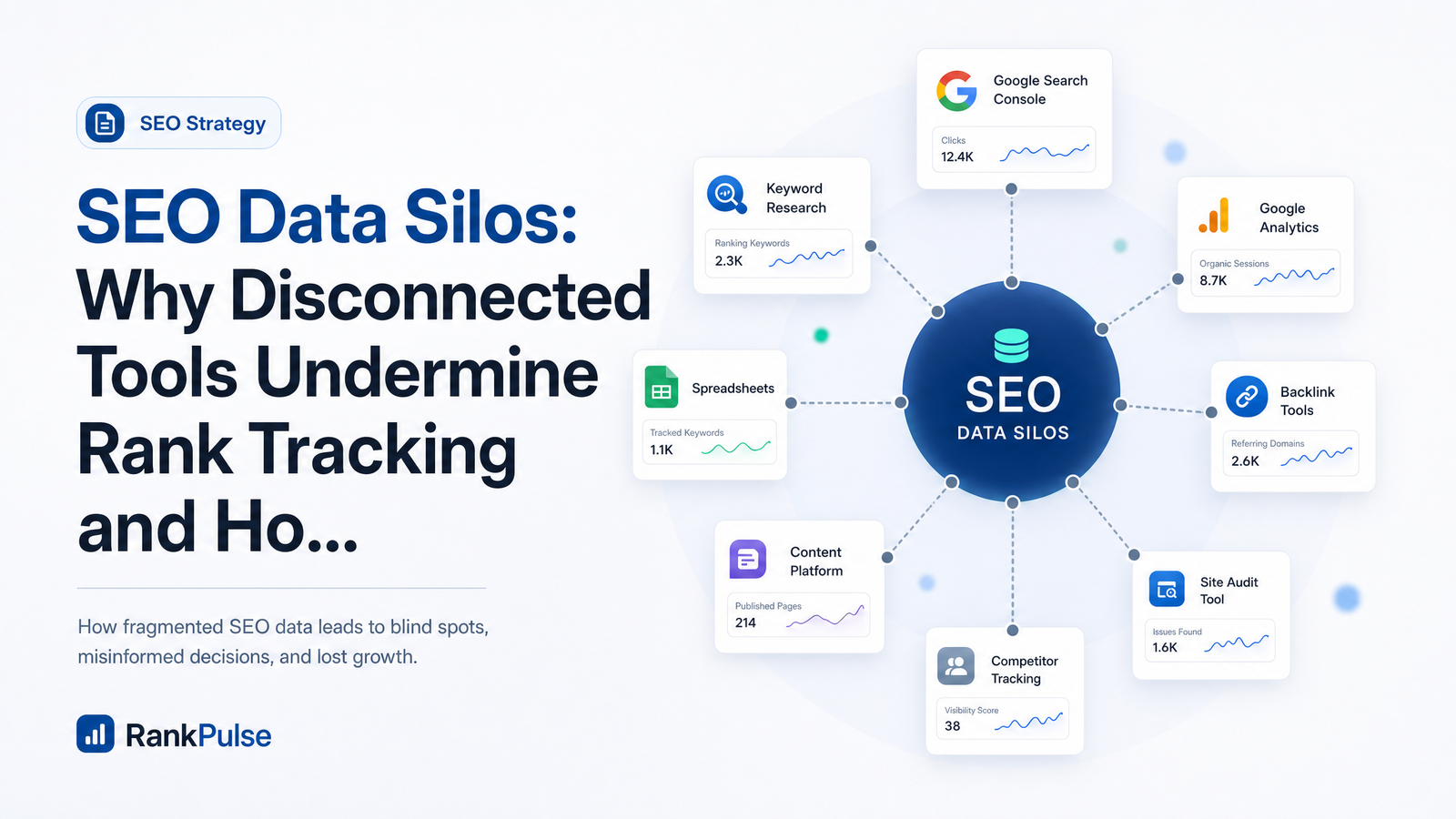
When Your Rank Tracker and Your Gut Disagree
Your rank tracker says a key page dropped six positions this week. You brace for the traffic hit — except GA4 shows sessions holding steady, and Google Search Console shows impressions climbing for that same query. Which number goes in the client report?
Most SEOs treat this as a glitch — a tracker bug, a stale cache, "give it a few days." It isn't. It's a symptom of SEO data silos: your rank tracker, analytics, crawler, and CMS each hold a partial, disconnected view of reality, and none can validate what the others know. Disconnected tools don't just fail to share data — they produce contradictory numbers, and every contradiction erodes rank tracking accuracy and the confidence of everyone reading your reports. This article breaks down how that happens, what it costs, and what actually fixes it.
What an SEO Data Silo Actually Is (and Why the Stack Creates Them)
A silo isn't simply "using more than one tool" — most teams run several tools by necessity. A silo forms when each tool holds data that no other tool in the stack can see, cross-check, or reconcile against a shared reference point. Your rank tracker doesn't know what your crawler found yesterday. Your crawler doesn't know which URLs your CMS just republished. Your analytics platform doesn't know which keyword your content team mapped to which page. Each system is internally consistent and externally blind.
This happens structurally, not by accident. As MarTech's breakdown of integrated marketing data explains, most tools are built to solve one job well, not to cross-reference the rest of a stack — they weren't designed with shared data models in mind. In SEO, this shows up as tool sprawl: a rank tracker with its own crawler and SERP sampling schedule, a technical audit tool with a different crawler entirely, GSC reporting Google's own sampled and aggregated data, and GA4 measuring sessions through yet another attribution model. Each uses different crawl frequencies, different geographic and device sampling, and different logic for mapping keywords to URLs. Stacked together, disconnected SEO tools quietly guarantee your numbers won't agree.
The scale of this is bigger than most teams realize. The Tool Sprawl Report 2026 found the average SaaS marketing team runs on 14 disconnected tools, with significant duplicated work and underused functionality across the stack. SEO teams are a microcosm of that same sprawl — rank tracker, crawler, GSC, GA4, a CMS, maybe a separate content or reporting layer, all operating as islands.
Four Ways Data Silos Quietly Undermine Rank Tracking
1. Phantom rank drops from mismatched SERP sampling. Your rank tracker might check positions from a fixed set of data-center IPs, a specific device, and a specific locale, once a day. Google's actual SERP is personalized, volatile, and varies by real user location and device. A tracker showing a drop may simply be sampling a SERP state most real users never saw. This is one of the most common sources of rank tracking errors — not because the tracker is broken, but because "position" is a sampled estimate, not a fixed fact, and every tool samples differently.
2. Traffic-vs-ranking mismatches from unreconciled URL sets. Rank trackers usually track a keyword against whatever URL currently ranks — but GA4 and GSC report traffic against the URLs Google actually served, which can shift after a redirect, content update, or canonical change. If tracker and analytics aren't reconciled against the same URL set, you'll see rankings apparently falling while sessions rise, simply because the ranking URL and the traffic-earning URL have quietly diverged.
3. False cannibalization alerts from disconnected crawl and keyword data. Many audit tools flag "duplicate" or "cannibalizing" pages based purely on crawled content similarity, with no visibility into which URL is actually ranking for which query. Meanwhile your rank tracker maps keywords to URLs independently, using its own snapshot. When these systems don't share one keyword-to-URL mapping, the audit tool screams "duplicate content" on two pages that, per actual ranking data, aren't competing for the same query at all. Chasing these phantom conflicts wastes real remediation hours.
4. Broken cause-and-effect on technical fixes. You ship a fix — a crawl budget improvement, a canonical correction, a fixed redirect chain — documented in your audit tool. Weeks later, rankings move. But because the audit tool and rank tracker don't share timestamps, URLs, or event logs, you can't prove the fix caused the improvement. This exact conflict — audit and log data disagreeing on what Google actually crawled and when — is detailed in this reconciliation framework for GSC crawl stats versus log files, which shows how granular the mismatch can get even between two Google-adjacent data sources.
The Real Cost: Slower Decisions, Wasted Hours, Lost Trust
These aren't cosmetic annoyances — they're operational costs. Industry silo-marketing research consistently finds marketers cite data silos as one of the biggest barriers to turning data into actionable decisions, and the Tool Sprawl Report 2026 points to substantial duplicated hours and low utilization across bloated marketing stacks — a pattern that maps directly onto SEO teams juggling a rank tracker, a crawler, GSC, and GA4 as separate systems.
Translate that into a week: hours exporting CSVs from four platforms, aligning them by hand in a spreadsheet, and reconciling naming conventions before a single insight gets extracted. That's time not spent on strategy, content, or fixes. Then there's the trust cost — when a client sees the rank tracker say "down" while GA4 says "up" in the same meeting, SEO reporting inconsistency becomes the story, not actual performance. Confidence in the whole function erodes, and every future report gets scrutinized harder. And there's a speed cost: when an algorithm update hits, teams stuck reconciling spreadsheets respond days slower than teams working from consistent, already-unified data. SEO tool consolidation isn't just a budget-line simplification — it's a decision-speed advantage.
What a Unified Dashboard Actually Fixes
Not every "all-in-one" tool solves this. Plenty of dashboards just embed widgets from separate tools side by side — a rank tracker panel next to a GA4 iframe next to a crawl report — with no shared identifiers underneath. That's aggregation, not unification, and it doesn't eliminate a single one of the four failure patterns above, since each widget still pulls from its own isolated dataset.
A genuinely unified SEO data layer ties audit findings, keyword/rank data, content records, and crawl data to the same URL and keyword identifiers, inside one data model. That single source of truth means a ranking movement, a technical fix, and a content edit can be traced along one cause-and-effect chain instead of three disconnected timelines. If a page's canonical changes, the rank tracker, crawler, and content record all update against the same URL reference — no manual reconciliation required. If you're building this kind of system yourself, this guide to structuring an SEO reporting dashboard walks through what genuinely needs to be included, and in what structure, for the numbers to actually reconcile.
The practical test: can you click on a ranking change and see, in the same system, the exact crawl event, content edit, or technical fix that preceded it — without exporting anything? If not, you're still looking at a dashboard wrapped around silos.
How Rankevra Closes the Loop
Rankevra is built around this exact principle: audits, content, publishing, and rank tracking share one connected workflow instead of four disconnected tools bolted together. An audit surfaces a technical issue tied to a specific URL; the fix and the resulting content edit are logged against that same URL; and rank tracking for the keywords mapped to that URL updates in the same data layer — so when a ranking shift happens, you can trace it back to the exact change that caused it, without cross-referencing spreadsheets.
This closes the handoff points where silos typically form. There's no export-and-reimport step between "crawler found an issue" and "content team fixed it." There's no separate keyword-to-URL mapping living in your rank tracker that disagrees with the mapping your audit tool uses. Because it's an AI SEO platform built to automate SEO workflow end-to-end — audit, content generation, publishing, and rank tracking — the same identifiers persist through every stage, which is precisely what eliminates phantom drops, false cannibalization flags, and unprovable "did this fix even work" moments. If you're evaluating rank trackers as part of tightening this workflow, this guide to choosing a rank tracker in 2026 is a useful next stop — and if technical debt is your current bottleneck, this technical SEO action plan helps you prioritize fixes you can now actually attribute.
If your reporting keeps sparking the "which number is real" conversation, the structural fix isn't another export template — it's collapsing the handoffs that create the discrepancy in the first place. Rankevra is built to do exactly that: one workflow for audits, content, publishing, and rank tracking, so your data finally agrees with itself.
Frequently Asked Questions
Why do my rank tracker numbers not match Google Search Console?
Rank trackers and GSC measure fundamentally different things: trackers take periodic, sampled snapshots from fixed locations and devices, while GSC reports Google's own aggregated, delayed data across real user impressions. Differences in sampling window, geography, device mix, and keyword-to-URL mapping logic mean small discrepancies are normal, not a bug. Large or persistent gaps usually point to a URL mapping mismatch rather than either tool being "wrong."
Is using multiple specialized SEO tools always worse than one platform?
Not inherently — specialized tools can be excellent at their specific job. The problem isn't the number of tools; it's whether they share data and identifiers. A multi-tool stack works fine as long as the tools reconcile against the same URLs and keywords, which is rare without deliberate integration.
How do data silos cause false cannibalization alerts?
Audit tools typically flag cannibalization based on crawled content similarity, while rank trackers map keywords to URLs from a separate, independent snapshot. When these systems don't share one keyword-to-URL mapping, the audit tool can flag pages as competing for a query they aren't actually ranking for, creating a false positive that wastes remediation time.
What's the difference between a dashboard that aggregates tools and a truly unified SEO platform?
An aggregating dashboard just displays separate tool widgets side by side, each still pulling from its own isolated dataset — the discrepancies remain, just visually closer together. A truly unified platform ties audits, rank data, content, and crawl data to the same URL and keyword identifiers in one data layer, so you can trace a ranking change back to its actual cause without exporting anything.
How much time do SEO teams actually lose reconciling data between tools?
Industry research on tool sprawl points to the average SaaS marketing team running on around 14 disconnected tools, with significant duplicated hours spent reconciling and re-entering data across them. For SEO teams, this typically shows up as recurring weekly hours spent exporting CSVs and manually aligning rank tracker, GSC, GA4, and crawl data before any analysis can begin.
Can a unified dashboard fully replace tools like GSC or GA4?
No — GSC and GA4 remain primary sources for Google's own impression and traffic data and shouldn't be discarded. A unified dashboard's job is to connect and reconcile that data with your rank tracking, crawl, and content records against shared identifiers, not to replace Google's native reporting outright.
Keep reading
- SEO for AI Overviews: Winning Citations, Not Just RankingsSEO for AI Overviews requires new tactics. Learn why ranking #1 no longer guarantees citations and how to earn visibility across AI search engines.
- E-E-A-T SEO in 2026: The Auditable Framework That WorksE-E-A-T SEO explained with concrete, checkable proof points—not vague advice. Learn what to build for Experience, Expertise, Authority, and Trust in 2026.
- Schema Markup for SEO in 2026: What Still WorksA 2026 framework for schema markup for SEO: which types still earn rich results, what Google deprecated, and how to implement and validate it right.