Rankevra Blog
E-E-A-T SEO in 2026: The Auditable Framework That Works
September 19, 2026
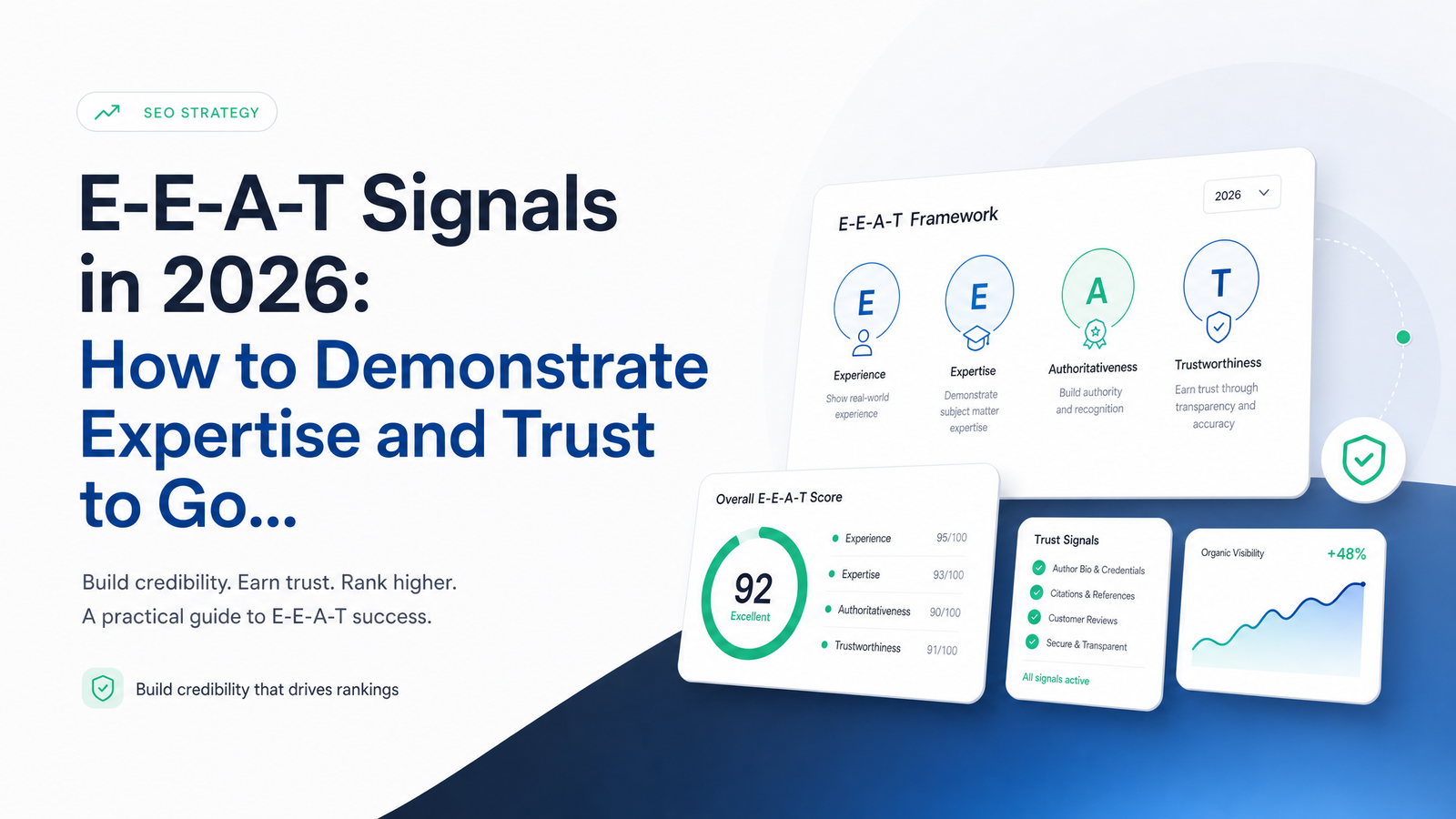
Most explanations of E-E-A-T stop at defining the acronym and telling you to "build trust" — advice nobody can act on. The more useful way to treat E-E-A-T SEO is as an information-governance problem: every signal Google's raters look for maps to a specific, checkable artifact — a schema tag, a byline page, a citation, a changelog entry — that a solo marketer or small content team can actually produce and audit. This article walks through those artifacts one by one.
What E-E-A-T Actually Is (and Isn't) in 2026
E-E-A-T stands for Experience, Expertise, Authoritativeness, and Trust. It comes from Google's Search Quality Rater Guidelines, the document human raters use to evaluate search result quality and provide feedback that helps Google refine its ranking systems. It is not a single score baked into a page, and it is not a direct ranking factor the way page speed or a canonical tag is — Google has been explicit about this.
What it is, according to Google Search Central's own guidance, is a framework for self-assessment, framed around three questions: Who created this content, How was it created, and Why was it created. Those questions sit underneath the Helpful Content System, which folds E-E-A-T-adjacent judgments into broader relevance and quality signals, and underneath SpamBrain, which polices scaled content abuse — mass-produced pages with no real authorship or oversight behind them.
So the honest answer to "is E-E-A-T a ranking factor" is: not literally, but it shapes the signals that do rank you. Sites lacking clear authorship, sourcing, or accountability tend to get swept up by quality systems even when no human rater ever looks at them directly. Treating E-E-A-T as vague marketing advice misses that it's really a proxy for information governance — who's accountable for what's published, and can that be verified.
The Four Signals, Broken Into Auditable Proof
Each letter in E-E-A-T corresponds to a specific artifact you can check for on a page, not a tone or a feeling.
Experience: First-Hand Proof, Not Just Claims
Experience asks whether the creator actually did the thing they're writing about. The proof point is original evidence: first-party data, screenshots from your own testing, photos you took, a case study with real numbers, or a described personal outcome that couldn't have been written by someone who only read about the topic. A recipe writer who says "I made this twice and it needed 10 more minutes" is showing experience; a rewritten summary of five other recipe blogs is not. Original data SEO — publishing a dataset, survey, or benchmark nobody else has — is one of the strongest experience signals because it's inherently unrepeatable elsewhere.
Expertise: Named Authors With Real Credentials
Expertise is about qualification. Its proof point is a named, credentialed author whose byline appears consistently across a coherent body of work on the topic. Author expertise SEO means a bio stating relevant credentials (a license, a role, years of hands-on work), not a generic "content writer at X" tag. Consistency matters: an author writing about tax law should have a visible history of tax-related content, not a single buried article. Structured markup earns its keep here too — Person schema tells search engines, explicitly and machine-readably, who wrote something and how that identity connects across your site. If you haven't implemented this yet, our guide to schema markup that still works in 2026 covers the technical setup.
Authoritativeness: Recognition Beyond Your Own Site
Authoritativeness can't be self-declared — it has to be conferred by others. The proof point is external validation: reputable sites in your niche linking to or citing you, journalists or industry publications mentioning your brand or authors, and backlinks from topically relevant sources rather than generic directories. Topical authority compounds this: a site with deep, connected coverage of a subject looks more authoritative on any single page than a site with one isolated article. Building that depth systematically, rather than opportunistically, is exactly what a content gap analysis framework is for — it identifies where your coverage is thin relative to a genuine authority in the space.
Trust: The Signal That Holds the Other Three Together
Google's guidelines describe trust as the most important member of the group, because impressive experience, expertise, and authority signals are worthless if the underlying information can't be relied upon. Trustworthiness shows up in concrete, verifiable form: accurate claims backed by cited primary sources, transparent disclosure of who's behind the site and how it makes money, a secure and accessible site, and a visible correction policy for when something turns out to be wrong. A Google trust signal isn't a badge you install — it's the sum of accuracy, sourcing, and accountability being checkable by a skeptical reader.
Does AI-Generated Content Hurt E-E-A-T?
No — not inherently. Google stated directly in its guidance on AI-generated content that its ranking systems reward content based on quality, not production method. Appropriate use of automation, including AI, is not against Google's guidelines. The anxiety around "does AI hurt SEO rankings" usually stems from conflating two different things: AI as a drafting tool with human oversight, and AI as a mechanism for mass-publishing unreviewed pages at scale — the latter is what SpamBrain and the scaled content abuse policy target, regardless of whether the abuse involves AI or cheap human labor.
In practice, AI content E-E-A-T comes down to three conditions: a named person reviews and takes accountability for what's published; the piece contributes something not already available elsewhere — original analysis, first-hand experience, genuine synthesis — rather than restating consensus; and the byline and review process are visible on the page, not hidden. AI-assisted drafting meeting those conditions is, per Google's stated position, functionally indistinguishable from content a human typed from scratch. AI drafting with no review, no named accountability, and no added insight is the pattern that gets penalized — and it would have been risky before generative AI existed too.
YMYL Pages Get Held to a Higher Bar
YMYL — Your Money or Your Life — refers to content that could materially affect a reader's health, financial stability, safety, or legal standing: medical advice, investment guidance, legal information, insurance comparisons. E-E-A-T scrutiny here is stricter because the cost of bad information is higher; a wrong recipe substitution is an inconvenience, a wrong dosage recommendation is not.
Practically, YMYL SEO requires deeper review than a hobby blog: subject-matter expert sign-off (not just a general editor), more explicit sourcing of claims to primary research or regulatory guidance, clearer disclaimers about when to consult a licensed professional, and faster correction cycles when guidance changes — tax brackets, medical guidelines, and legal thresholds shift, and outdated YMYL content is a trust liability, not just a staleness problem. Non-YMYL content still benefits from all four signals, but the review bar for a gardening tips page and a debt-consolidation comparison page are not, and should not be, the same.
Turning E-E-A-T Into a Repeatable Process, Not a One-Time Audit
Maintenance is the part most teams skip. A byline that was accurate two years ago references a job the author no longer holds. A statistic cited in 2023 has been superseded. A source link has gone dead. None of this is caught by a one-time audit — it accumulates quietly across every page you've published, and compounds faster the more content and authors you have.
The fix is building E-E-A-T checks into the publishing workflow itself: every piece gets a named reviewer at publish time, every factual claim gets a source logged alongside it, every author profile gets checked for currency on a schedule, and every page gets flagged for review once its cited data ages past a set threshold. Refreshing content on that kind of schedule — deciding what to update, rewrite, or merge — is its own discipline, laid out in our content refresh strategy framework.
This is exactly the operational gap Rankevra is built to close. Instead of running audits, drafting content, checking schema, and tracking rankings across four separate tools, Rankevra's AI workflow handles technical audits, content creation with human-in-the-loop review, publishing, and rank tracking from one system — so E-E-A-T signals stay consistent by default across every new page and author, rather than depending on someone remembering to check.
Frequently Asked Questions
Is E-E-A-T a direct Google ranking factor?
No, E-E-A-T is not a single, direct ranking factor like page speed or a title tag. It's a framework from Google's Search Quality Rater Guidelines that shapes how raters evaluate quality, and those evaluations feed into training systems like the Helpful Content System — so it influences rankings indirectly but isn't a literal score.
What's the difference between Experience and Expertise in E-E-A-T?
Experience means the content creator has personally done or used the thing being discussed — shown through original data, screenshots, or first-hand results. Expertise means the creator has the qualifications or credentials to speak authoritatively on the topic, shown through named bylines, stated credentials, and a consistent body of related work.
Can AI-written content still score well on E-E-A-T?
Yes, provided a named person reviews it, it adds original insight rather than restating existing content, and the review process is visible on the page. Google has stated its ranking systems reward quality regardless of production method, but unreviewed, mass-produced AI pages fall under the scaled content abuse policy.
Do I need an author bio on every page to satisfy E-E-A-T?
You need clear, verifiable authorship on any page where expertise or accountability matters, especially YMYL content, but not necessarily a full bio repeated on every page. A linked byline page with credentials, supported by Person schema, satisfies this more scalably than duplicating a bio block everywhere.
How often should I update content to maintain E-E-A-T signals?
There's no fixed interval — it depends on how fast facts in your topic change — but any page citing statistics, prices, regulations, or rankings should be reviewed at least when that underlying data is known to have shifted. A scheduled content refresh process catches this systematically instead of relying on ad hoc noticing.
Does E-E-A-T matter for small business or niche sites, not just YMYL topics?
Yes, every site benefits from clear authorship, sourcing, and accuracy, even outside YMYL categories. The bar for review depth is lower for a hobby or niche site than for financial or medical content, but the underlying signals — who wrote this, how, and why — are evaluated everywhere.
E-E-A-T isn't a checklist you clear once; it's a production standard that decays the moment you stop maintaining it. Rankevra keeps audits, AI-assisted content creation with human review, publishing, and rank tracking running together, so the signals that prove Experience, Expertise, Authoritativeness, and Trust stay intact as your site — and your author roster — keeps growing.
Keep reading
- SEO for AI Overviews: Winning Citations, Not Just RankingsSEO for AI Overviews requires new tactics. Learn why ranking #1 no longer guarantees citations and how to earn visibility across AI search engines.
- Schema Markup for SEO in 2026: What Still WorksA 2026 framework for schema markup for SEO: which types still earn rich results, what Google deprecated, and how to implement and validate it right.
- SEO Data Silos: The Hidden Cause of Bad Rank TrackingSEO data silos quietly distort rank tracking, cause false cannibalization alerts, and waste hours. See how a unified dashboard like Rankevra fixes it.