Rankevra Blog
Technical SEO Audit Service: Hire One or Automate It?
July 21, 2026
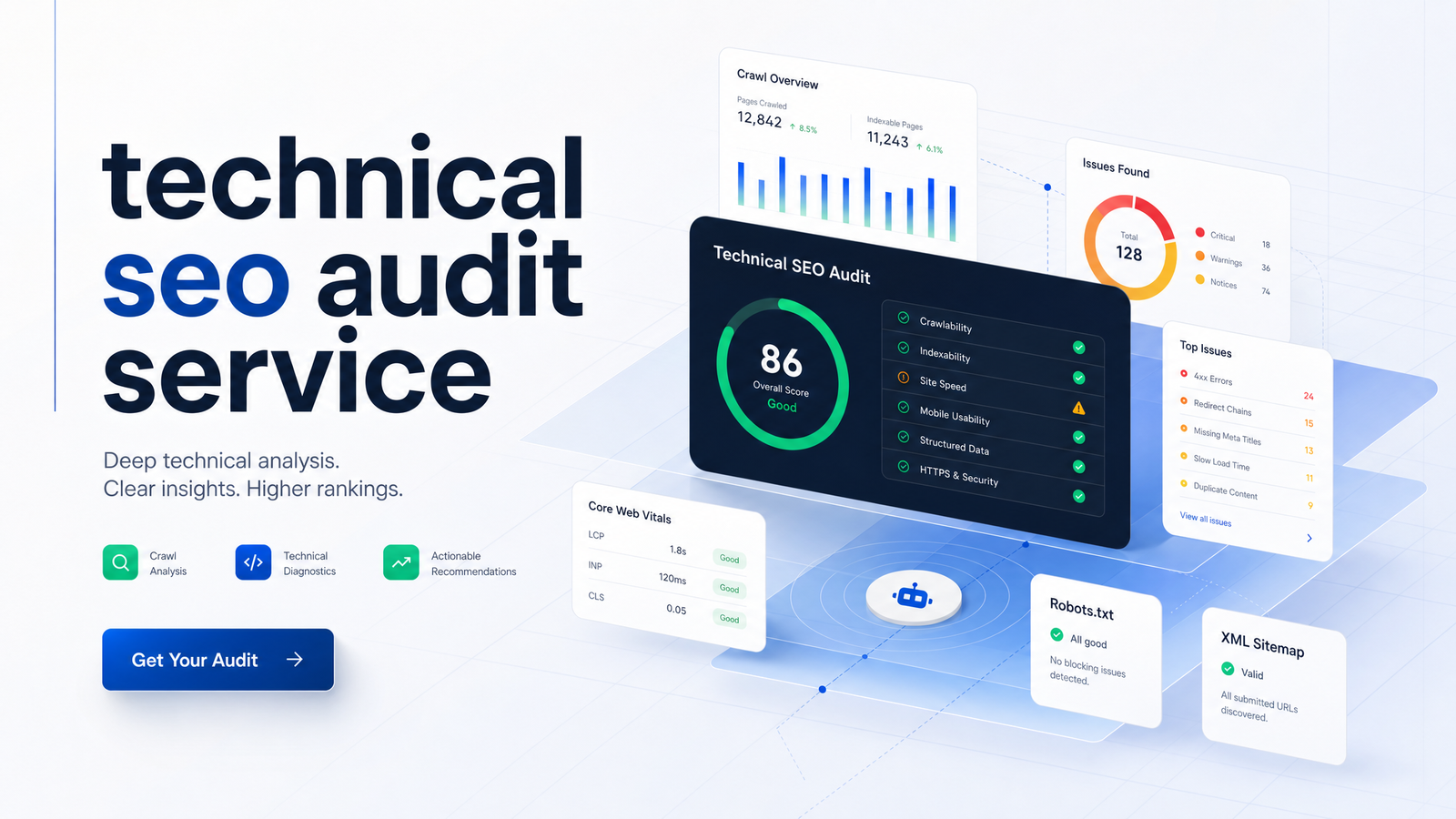
Every website owner eventually asks the same question: is my traffic problem a content problem, or is something technical quietly blocking it? That question usually leads to a search for a technical SEO audit service — and a second, more confusing question about whether paying a human team is even necessary anymore when software can run the same checks continuously.
This isn't another walkthrough of audit steps or a pricing comparison. Those exist already — including our own DIY audit checklist and pricing and buyer's guide. This is the decision layer above both: when does it make sense to hire a technical SEO audit service, when should you do it yourself, and when does an AI-driven platform simply do the job better?
What Is a Technical SEO Audit Service, Exactly?
A technical SEO audit service is a human-delivered engagement — usually from a freelancer or agency — where a specialist crawls your site, reviews crawlability, indexation, Core Web Vitals, and schema markup, then hands you a report of issues ranked by severity. It's distinct from a DIY audit, where you run the checks yourself using free tools and your own judgment, and from audit software, where a platform automates the crawl and analysis but you (or an AI system) still act on the findings.
The defining trait of a "service" is that a person does the diagnostic work and interprets results for you, typically as a one-time project or a recurring retainer. That matters because what you're really paying for isn't the crawl itself — any tool can crawl a site — you're paying for judgment, prioritization, and accountability. The question this article answers is whether that judgment still requires a human, or whether AI-driven platforms have gotten good enough to deliver the same prioritization without the retainer invoice.
Why Technical Issues Quietly Cap Your Growth
Good content doesn't rank if Googlebot can't crawl it, index it, or render it fast enough to satisfy Core Web Vitals. This isn't a minor edge case — technical SEO statistics for 2026 show that a large share of live websites carry unresolved issues around page speed, broken redirects, and missing meta or schema tags, often for months at a time, on active, published, marketed properties leaking authority through problems nobody noticed.
Crawlability issues are especially insidious because they're invisible from the front end. A blocked resource in robots.txt, an orphaned page missing from your XML sitemap, or a redirect chain eating crawl budget won't show up when you read your own site — you'll only see it in Google Search Console or a crawler report, and by then it may have suppressed indexation for weeks. Wasted crawl budget compounds the problem on larger sites, where log file analysis often reveals Googlebot spending its visits on low-value URLs instead of new content.
Core Web Vitals compound the issue further. Slow Largest Contentful Paint or poor Interaction to Next Paint (INP) doesn't just hurt rankings marginally — it affects whether real users stay long enough to convert, and Google has made clear that page experience remains part of ranking systems. A site can publish flawless content every week and still plateau because the technical foundation is capping what that content can achieve.
What a Good Audit Actually Delivers (Briefly)
Whether delivered by a person or a platform, a credible technical SEO audit should produce five things: a crawlability and indexation review (robots.txt, XML sitemap, redirect chains, orphaned pages), a Core Web Vitals assessment, a structured data and schema markup check, an internal linking review, and — critically — a prioritized fix list ranked by impact rather than a flat inventory of problems.
That prioritization step is where most audits either earn their price or fail to. Research on typical audit output, including the 2026 technical SEO checklist from Scalarly, notes that a single audit run can surface dozens of individual findings — far more than any team can realistically fix in one sprint. An audit that hands you an unordered list of 60 issues isn't a deliverable; it's homework. The value is in someone (or something) telling you which five matter this month.
For the full component-by-component breakdown, our DIY audit guide covers the checklist in depth, our Core Web Vitals guide covers speed metrics specifically, and our structured data guide covers schema markup requirements for 2026.
Service vs. DIY vs. AI Software: Which Fits Your Situation
There are three paths here, and each trades cost, speed, and depth differently.
Hiring a technical SEO audit service gets you expert judgment and someone accountable for the recommendations, which matters if your site has unusual complexity — a large e-commerce catalog, multi-region domains, or a migration history full of legacy redirects. The tradeoff is cost and cadence: most engagements are point-in-time snapshots, delivered as a report weeks after the crawl, describing a site that will have already changed by the time you act on it.
Doing it yourself costs the least in cash but the most in time, and depends entirely on how deep your team's technical knowledge goes. Free tools like Google Search Console will surface indexation and crawl errors, but stitching together a PageSpeed report, a separate schema validator, and a manual crawl into one coherent prioritized plan is genuinely difficult without SEO-specific training.
Using an AI-driven platform runs the crawlability, Core Web Vitals, and schema checks continuously rather than once, and increasingly applies the same prioritization logic a specialist would — flagging what's actually suppressing rankings versus what's cosmetic. Our site audit tool guide breaks down what these platforms check and how to read their output.
The honest comparison isn't service vs. software in isolation — it's one-time snapshot vs. continuous monitoring. A one-time engagement answers "what's wrong today." Software answers that question every day, because sites aren't static: new pages get published, CMS updates ship, and third-party scripts get added, each capable of introducing a fresh Core Web Vitals regression or crawl block.
The Case for Continuous, AI-Driven Auditing
A report that was accurate in March can be wrong by June. That's the core weakness of paying for a one-time technical SEO audit service: the moment the crawl finishes, the site keeps changing, and nothing in a PDF report tells you about the redirect chain your dev team introduced last week or the schema markup that silently broke after a template update.
AI-driven platforms close that gap by treating the audit as a running process instead of a project. Rankevra, for example, audits crawlability, Core Web Vitals, and schema on an ongoing basis, then feeds prioritized fixes directly into the same system used for content creation, publishing, and rank tracking — so technical health, content output, and ranking movement are visible in one place instead of four disconnected tools. That matters doubly now that AI crawlers and answer engines are reading and indexing sites alongside Googlebot; a site needs to stay continuously crawlable and well-structured for a growing set of bots, not just one.
This is less a replacement of the audit service model than its evolution. The deliverables haven't changed — crawlability, speed, schema, prioritized fixes — but the delivery mechanism has moved from a quarterly snapshot to an always-on system, which also solves the "stale report" problem that makes stakeholders skeptical of paying for technical SEO in the first place.
How to Decide: A Quick Framework
Before signing a retainer or a software subscription, weigh four factors:
- Site size and complexity — A ten-page brochure site rarely needs a specialist; a 50,000-page catalog with international variants often benefits from at least one expert-led engagement to catch structural issues automation might miss on first pass.
- In-house technical resources — If nobody on your team can read a crawl report or prioritize fixes, either path works, but software only pays off if someone actually implements what it flags.
- Budget cadence — One-time budget favors a single service engagement; ongoing budget favors software that keeps monitoring after the invoice is paid.
- Urgency and change frequency — Sites that publish or update often need continuous monitoring, because every deploy is a chance to reintroduce a fixed issue.
If you're still asking "should I hire a technical SEO audit service" after weighing these, the practical answer is: hire one when you need a second opinion or specialized migration expertise once, and use an AI-driven platform for everything that happens after — which, for most sites, is where the real ranking gains actually come from.
Frequently Asked Questions
What does a technical SEO audit service actually check?
A technical SEO audit service checks crawlability and indexation (robots.txt, XML sitemap, redirect chains), Core Web Vitals performance, schema markup validity, internal linking structure, and crawl budget usage. The output is typically a prioritized list of fixes ranked by ranking impact, not just a flat inventory of every issue found.
How much does a technical SEO audit service cost compared to using software?
A one-time technical SEO audit service engagement typically costs far more upfront than a software subscription, since you're paying for a specialist's time on a single project. Detailed pricing tiers are covered in our pricing and buyer's guide, but the general pattern is that software costs less per month and keeps auditing after the one-time fee would have ended.
How often should a technical SEO audit be done?
Ideally, technical SEO should be monitored continuously rather than audited on a fixed schedule, since new pages, CMS updates, and script changes can introduce issues at any time. If you're relying on periodic manual or agency audits instead, quarterly is a reasonable minimum for active sites.
Can AI tools replace a technical SEO audit service entirely?
For ongoing monitoring of crawlability, Core Web Vitals, and schema, yes — AI-driven platforms now run the same checks continuously and prioritize fixes by impact. Highly complex situations, like large-scale migrations or unusual international setups, can still benefit from one expert-led engagement alongside the automated system.
What's the difference between a technical SEO audit and a full SEO audit?
A technical SEO audit focuses narrowly on crawlability, indexation, site speed, and structured data — the mechanics that determine whether content can rank at all. A full SEO audit adds content quality, keyword strategy, backlink profile, and competitive analysis on top of the technical layer.
How long does a professional technical SEO audit take?
A professional technical SEO audit service engagement typically takes anywhere from a few days to several weeks, depending on site size and how many findings need manual review and prioritization. AI-driven audits complete the same crawlability, speed, and schema checks in a fraction of that time and continue running afterward instead of stopping at delivery.
Instead of booking a one-time audit engagement or locking into a recurring agency retainer, run a free first audit with Rankevra and see continuous crawlability, Core Web Vitals, and schema monitoring paired with AI-driven fixes and rank tracking — all in one platform, without the stale report or the extra invoice.
Keep reading
- Tag Management on Google: The Governance GuideTag management on Google explained beyond the install tutorial: GTM structure, permissions, server-side tagging, consent mode, and SEO impact.
- SEO Marketing Tools: The Complete Category Guide (2026)A clear map of every SEO marketing tools category, why stacks sprawl to 6-8 tools, and how AI-driven platforms are consolidating the workflow in 2026.
- SEO Optimisation Tools: Match Them to the Outcome You NeedA no-fluff guide to seo optimisation tools: which categories drive traffic, fix technical issues, or build topical authority — and when to consolidate.