Rankevra Blog
The Content of a Marketing Strategy: 8 Core Components
July 18, 2026
Search "content of a marketing strategy" and most results give you a listicle about writing a marketing plan from scratch. That's not what this article does. If you already know you need a strategy and just want to know what sections it should contain, here's the direct answer.
What Does 'Content' Mean in a Marketing Strategy?
"Content" here doesn't mean blog posts, videos, or social captions. In this context, the content of a marketing strategy is the set of components — sections, decisions, and data — that the document itself must hold to be useful. Think of it the way you'd think of the "content" of a contract: the clauses it must include, not the paper it's printed on.
That distinction matters because three similar-sounding terms get used interchangeably, and picking the wrong resource wastes time.
A marketing strategy is the high-level rationale: who you're targeting, how you're positioned against competitors, and which channels and mix will get you there. A marketing plan is the operational layer underneath it — the campaigns, budgets, and calendars that execute the strategy over a specific period. And a content marketing strategy is narrower still: it's the plan for one channel (content and SEO) within the broader marketing strategy, not a replacement for it.
So marketing strategy vs. marketing plan is really a question of altitude — strategy sets direction, the plan sets the schedule. And content marketing strategy vs. marketing strategy is a question of scope — one is a subset of the other. If you landed here wanting a document you can fill in section by section, the Marketing Content Strategy Template You Can Fill In Today is the practical companion to this piece. This article stays focused on defining what belongs inside the strategy document itself.
The 8 Core Elements Every Marketing Strategy Document Needs
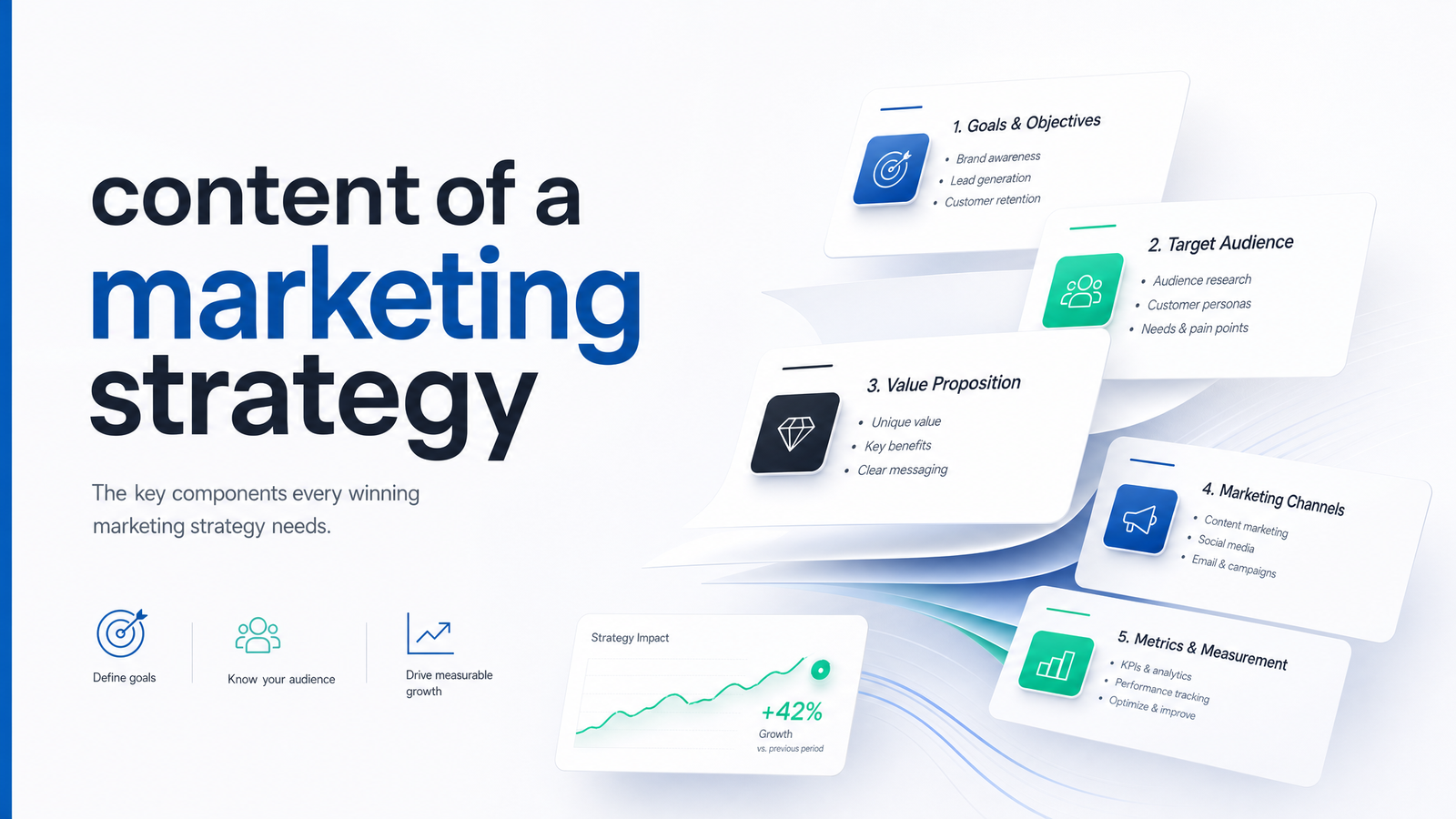
Sources vary slightly on labels, but the components of a marketing strategy converge on the same eight building blocks, echoed in frameworks like Salesforce's marketing strategy guide and Hurree's breakdown of strategy components. Here's what is included in a marketing strategy document, in the order it usually reads.
1. Executive summary. A one-page synthesis of the business context, the core objective, and the headline strategic bet. It exists so a stakeholder who reads nothing else still understands the direction.
2. Market and competitive analysis. A grounded view of market size, trends, and where competitors are winning or leaving gaps. This is what turns a strategy from opinion into something evidence-based.
3. Target audience and personas. Defined segments with real characteristics — needs, buying triggers, objections — not just demographics. Vague personas are one of the most common reasons strategies fail to convert into action.
4. Goals and KPIs. Specific, measurable targets tied to business outcomes, plus the metrics that will prove progress. Without this section, there's no way to know if the strategy is working.
5. Positioning and value proposition. The single clearest statement of why a customer should choose you over the alternative, and the messaging pillars that support it. This section anchors everything downstream, including how content gets framed for search intent.
6. Marketing mix and channels. The channels (organic search, paid, email, social, partnerships) chosen to reach the target audience, and the rationale for prioritizing them over others.
7. Content and SEO plan. How organic visibility and content will support the positioning and goals — covered in depth in the next section, since it's the component most strategies underspecify.
8. Budget and timeline. Resource allocation across channels and a phased rollout schedule. This is where the strategy starts to hand off into the operational marketing plan.
These elements of a marketing strategy document don't need to be lengthy individually, but skipping any one of them tends to create a blind spot later — usually in measurement or audience definition.
Where SEO and Content Fit Inside the Strategy
The content and SEO section is where most strategy documents go thin, because it's the one component that requires ongoing technical and research work rather than a one-time write-up. Getting SEO in a marketing strategy right means treating it as a system, not a paragraph.
Start with a technical and content audit of the existing site — what's indexable, what's ranking, what's broken, and what's cannibalizing itself. This audit is the foundation the rest of the content plan for a marketing strategy gets built on, because you can't prioritize new content or fixes without knowing the current state. A structured site audit tool is the fastest way to get that baseline instead of manually checking pages one by one.
From there, keyword research for a marketing strategy should move beyond a flat list of keywords into topical clusters — groups of related queries organized around a theme, so content reinforces rather than competes with itself. The keyword clustering process is the repeatable method for building those clusters instead of guessing at topics.
Each cluster then needs its search intent mapped — informational, navigational, commercial, or transactional — so content matches what searchers actually want at that stage, which is where search intent optimization comes in. Intent mapping feeds directly into content briefs: the specific instructions (target keyword, intent, structure, on-page requirements) that turn a keyword cluster into an actual page. For a deeper look at how this content-marketing layer connects to SEO growth specifically, see Content Marketing Strategy: An SEO Growth System.
This is also where Rankevra fits as the execution layer for that one component: audit findings identify what to fix, keyword clustering identifies what to write, and intent mapping determines how to write it — three separate jobs that a strategy document usually only gestures at with a single bullet point.
Mistakes That Make a Marketing Strategy Weak
A handful of recurring marketing strategy mistakes explain most underperforming documents.
The most common is no real measurement plan — goals stated without KPIs attached, or KPIs picked because they're easy to report rather than because they connect to revenue. If you can't trace organic traffic or rankings back to pipeline or sales, the strategy has a credibility problem before it's even executed. SEO ROI tracking is built to close exactly this gap for the SEO component.
The second is a vague or generic audience section — personas built from assumptions rather than research, which then produce content and messaging that don't land with anyone specifically. A strategy that describes its audience the same way its competitors describe theirs isn't doing positioning work at all.
The third is treating the document as static. Markets shift, competitors launch, algorithms update — a strategy written once and never revisited becomes a historical artifact rather than a working reference. These marketing strategy document problems usually trace back to one root cause: the document was written to be approved, not to be used.
A fourth, quieter mistake is skipping the audit step before setting SEO goals. Teams set keyword and traffic targets without first checking whether the site is even technically capable of ranking — indexation issues, duplicate content, or slow pages can cap results regardless of how good the content plan is.
Frequently Asked Questions
Is a marketing strategy the same as a marketing plan?
No — a marketing strategy defines the direction (audience, positioning, channels, goals), while a marketing plan is the operational document that schedules the campaigns, budgets, and tactics that execute that direction. Strategy answers "why and where," the plan answers "when and how much."
What's the difference between a marketing strategy and a content marketing strategy?
A content marketing strategy is a subset of the broader marketing strategy, focused specifically on the content and SEO channel rather than the full marketing mix. The marketing strategy sets overall positioning and goals; the content marketing strategy details how content and organic search will support them.
How long should a marketing strategy document be?
There's no fixed page count, but most usable strategy documents run somewhere between 5 and 20 pages — enough to cover all eight components with substance, not so long that it stops being referenced. Length should scale with company complexity, not ambition.
How often should you update the content of a marketing strategy?
Most teams revisit the core strategy annually and review the KPI and content sections quarterly, since search rankings, competitor moves, and channel performance shift faster than positioning does. A strategy that isn't reviewed at least quarterly tends to drift out of sync with actual market conditions.
Do small businesses need a full marketing strategy document?
Yes, though it can be lighter — a condensed version covering audience, positioning, channels, and goals is enough for smaller teams. Skipping the exercise entirely tends to cost more later, since campaigns without a strategic anchor are harder to evaluate or improve.
What comes first: the marketing strategy or the content calendar?
The marketing strategy comes first, because the content calendar is a scheduling tool that executes decisions the strategy has already made — target keywords, audience, and positioning. Building a calendar before the strategy usually produces content that's inconsistent or misaligned with the actual goals.
Once your strategy document is drafted, the SEO and content section is worth stress-testing before you commit budget to execution. Rankevra audits your site, clusters your keyword opportunities, and helps validate that the content component of your strategy is technically sound and search-ready before you build a single content calendar around it.
Keep reading
- Content Decay SEO: How to Detect It and Fix It for GoodLearn to detect content decay SEO issues early, rule out false positives, and build a refresh pipeline that scales — plus how to automate the whole loop.
- Headless CMS SEO: Fixing the Gaps Generic Tools MissHeadless CMS SEO breaks in three predictable places: rendering, metadata, and sitemaps. Here's the diagnostic framework to find and fix each gap.
- Google Algorithm Update Recovery: A Diagnostic FrameworkA step-by-step google algorithm update recovery framework: confirm the cause, segment the damage, benchmark against winners, and set a real timeline.