Rankevra Blog
AI Meta Description Generator: What Actually Gets Used
August 4, 2026
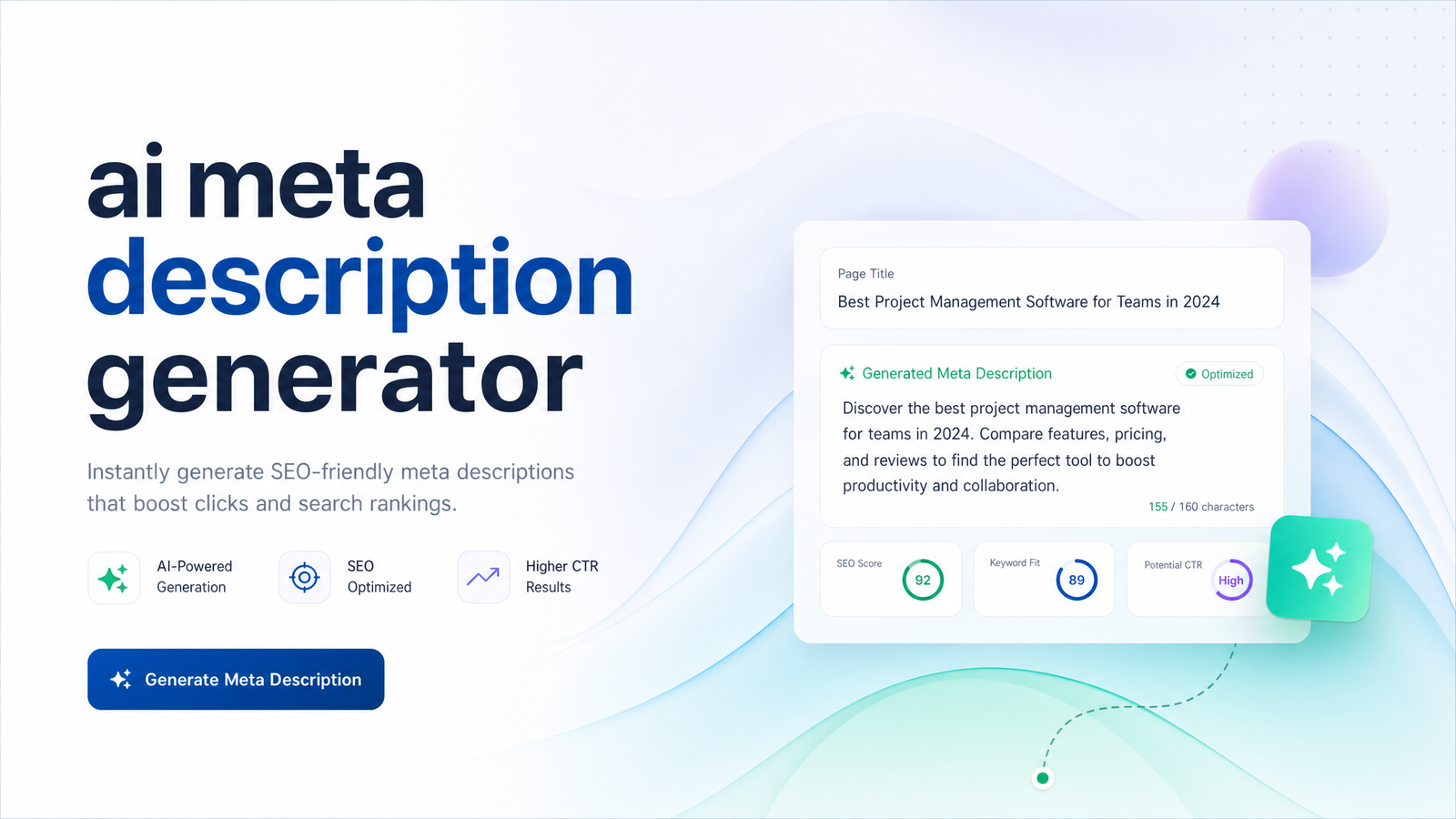
Google rewrites the majority of meta descriptions it displays in search results — including ones written by people, and including ones written by AI. Depending on the study, that rewrite rate sits somewhere between 62% and over 70%. So before you open another tab to try an AI meta description generator, reset the goal: you're not trying to write the "perfect" description. You're trying to write one good enough that Google's algorithm decides not to override it. That distinction is the lens this whole guide uses.
What an AI Meta Description Generator Actually Does
Strip away the marketing language and an AI meta description generator does one narrow job: you feed it a URL, a topic, or a target keyword, and it drafts a short summary-style snippet meant to match what someone searching that term is actually looking for. Under the hood, most tools either scrape the page content and summarize it, or take a prompt (keyword plus intent) and generate text from scratch, then trim it to fit a length target.
That's genuinely useful for speed. It's not a guarantee of a SERP outcome. An AI meta description generator produces a draft — a strong first pass that still needs a length check, a relevance check against the actual page, and in most cases a human skim before it goes live. Treat it as a drafting aid that removes the blank-page problem across dozens or hundreds of pages at once. Treat it as a magic switch that improves rankings on its own, and you'll be disappointed when Google quietly replaces it in the SERP anyway.
Tools that generate meta descriptions with AI at any real scale also need to solve a second, less glamorous problem: checking whether the output is even the right shape. That's where length and pixel rules come in.
The Length and Pixel Rules AI Output Still Has to Follow
Google doesn't truncate meta descriptions by character count — it truncates by pixel width, because the snippet has to fit a fixed-width container in the search results. Character count is just a rough proxy that happens to correlate with pixel width for most fonts and most English text.
As a practical target: aim for roughly 120–158 characters on desktop, and note that mobile snippets tend to display more text before truncating than desktop — sometimes up into the 130–160 character range depending on the query and device. Portent's research (via Search Engine Journal) breaks this down by page type and device, and it's a useful sanity check if you write a lot of descriptions across different content categories.
The catch: two descriptions with the same character count can render at very different pixel widths, because characters like "W" or "M" are wider than "i" or "l". A meta description character limit is a useful shorthand, but a genuine meta description length checker measures actual pixel width, not just letter count. If your AI meta description generator only counts characters and doesn't preview pixel width, you're flying partially blind — you could ship a description that reads as 155 characters but renders wider than Google's container and gets clipped mid-word anyway. This is precisely the gap that separates a basic free tool from one built for production use.
Why Google Rewrites Most Meta Descriptions Anyway (AI or Not)
Here's the uncomfortable data point worth sitting with: Ahrefs' study found Google rewrites meta descriptions somewhere around 62-64% of the time, and — notably — found that length alone doesn't meaningfully change the rewrite probability. A well-sized description gets rewritten almost as often as a poorly-sized one. The Portent data cited by Search Engine Journal puts the rewrite rate even higher, north of 70% in their sample, with mobile and desktop rewrite behavior differing somewhat by page type.
Two triggers show up consistently:
The description is too short, too generic, or too disconnected from the actual page content to answer the query. Google's ranking systems assemble a snippet dynamically from on-page text when they judge that approach better serves the specific search — often pulling the sentence that most directly answers the user's query, even if your meta description was technically well-formed.
The query itself doesn't match what the meta description emphasizes. If someone searches a long-tail, specific phrase and your description is a broad, page-level summary, Google will frequently swap in text pulled straight from the body copy that answers that specific phrase more directly.
Neither trigger is really about who wrote the description. An AI-generated one and a hand-written one face identical odds if they're generic or mismatched to intent. Given that reality, the actual goal isn't "write something so good Google never touches it" — that outcome is statistically uncommon regardless of author. The goal is writing something specific and query-aligned enough that it survives the rewrite decision more often than the generic alternative would.
How to Prompt (or Configure) an AI Generator So the Output Survives
If you're going to generate meta descriptions with AI, the input you give it matters more than the tool's underlying model. A few practical rules:
Feed the tool the actual target query or search intent, not just a broad keyword. "Best hiking boots for wide feet" produces a more survivable description than just "hiking boots," because it lets the AI front-load specificity that matches long-tail search behavior.
Front-load the value proposition in the first 100–120 characters. Since mobile and desktop both risk truncation, the sentence needs to make its point before the cutoff, not build to it.
Avoid keyword-stuffed lists. A description that reads like "Hiking Boots | Wide Feet | Waterproof | Discount | Free Shipping" looks exactly like the generic, low-context text Google's systems are trained to override. A single clear sentence beats a comma-separated keyword dump almost every time.
Keep every description unique per page and make sure it actually reflects what's on that page — not the category, not the homepage boilerplate. Duplicate or copy-pasted descriptions across similar pages are one of the most common findings in a site audit tool scan, and they're an easy signal for Google to deprioritize.
Match the AI meta tag generator's output against the page's actual H1 and opening paragraph. If the description promises something the page doesn't deliver in the first screen of content, that mismatch is exactly the kind of gap Google's rewrite logic is built to catch.
Where Bulk Generation Breaks Basic AI Tools
A free AI meta description generator built as a single web widget works fine for one page. It breaks down the moment you have a real site with hundreds of URLs, and that breakdown shows up in a few predictable ways.
There's no pixel preview, so you're guessing whether a "good" character count actually fits. There's no duplicate detection across the site, so an AI tool generating descriptions one page at a time has no memory of what it wrote for the other 200 pages — you can end up with near-identical output across your whole product catalog without realizing it. There's no publishing step, meaning even a great description sits in a text box until someone manually copies it into a CMS field, page by page. And there's no way to prioritize: a single-page tool treats a high-traffic landing page the same as an orphaned blog post from three years ago, when really you want to fix the pages losing clicks first.
This is the actual answer to "is there a bulk AI meta description generator" — the category exists specifically because one-at-a-time tools don't scale to how real websites are structured. If you're managing a site with meaningful page count, the workflow needs to start from a full inventory of what's missing, duplicate, or too long — which is audit territory, not generator territory.
Fitting Meta Descriptions Into a Full SEO Workflow
Meta description generation isn't really a standalone task — it's a fix applied to findings from a broader audit. A proper crawl surfaces which pages have missing tags, which have duplicates across templated pages, and which are running long enough to get clipped. That's the same audit that should be flagging your canonical tag issues, thin content, and crawl errors — meta descriptions are one line item in a much longer technical SEO priority list, not a separate project.
Google Search Console can help you spot the downstream effect: pages with low click-through rate despite reasonable ranking position are often the ones with a missing or generic meta description, since Google has nothing decent to fall back to when it decides not to write its own.
Rankevra treats this as one pipeline instead of three disconnected steps. The audit identifies every page with a missing, duplicate, or oversized meta description alongside other technical SEO meta tags issues. The AI SEO meta tags generator drafts replacements using each page's actual content and target query, with a live pixel-width check so you can see what will actually render before anything ships. And the publishing step pushes approved descriptions straight to the CMS, instead of leaving you to copy-paste across hundreds of pages — the same kind of guardrailed rollout described in building a content publishing workflow that scales safely. Automated meta description writing only earns its "automated" label if the output actually gets published without manual handling at every step.
Frequently Asked Questions
Does Google actually use AI-generated meta descriptions or does it always rewrite them?
Google uses them some of the time, but rewrites the majority regardless of who wrote them. Ahrefs found a rewrite rate around 62-64%, and Portent's data (via Search Engine Journal) puts it above 70% in their sample. AI authorship doesn't change the odds — generic or query-mismatched text gets rewritten whether a person or a model wrote it.
What's the ideal character length for an AI meta description generator to target?
Roughly 120–158 characters on desktop is a safe target, with mobile often allowing slightly more before truncation. Character count is only a proxy, though — actual truncation happens at a fixed pixel width, so a true length checker measures pixel width, not just letters.
Can an AI meta description generator hurt my SEO if the description doesn't match the page content?
It can hurt click-through rate and trust signals, though it's unlikely to directly hurt rankings. If the description promises something the page doesn't deliver, users bounce faster and Google is more likely to override the tag with its own extracted snippet on future crawls.
Is there a free AI meta description generator that checks pixel width, not just character count?
Most free, single-page web widgets check character count only and skip pixel-width rendering entirely. Tools built for bulk site workflows, like Rankevra, typically include a pixel preview alongside the character count so you can confirm what Google will actually display before publishing.
How is generating meta descriptions with AI different from writing them manually?
The output mechanism differs, but the survival rules don't — both face the same Google rewrite logic based on specificity and query match. The real difference is speed and consistency: AI can draft unique, on-topic descriptions across hundreds of pages in the time it takes to manually write a dozen.
Should every page on my site have a unique meta description, even if Google might rewrite it?
Yes — duplicate meta descriptions are a common site audit finding and a missed opportunity even when Google chooses to rewrite the snippet anyway. A unique, relevant description still improves the odds of being kept, and gives Google better raw material to work with if it decides to write its own.
Meta descriptions are one small, fixable piece of a much bigger technical and content workflow — they don't deserve a separate tool, a separate login, or a separate copy-paste routine. Rankevra runs a free audit that flags every missing, duplicate, or too-long meta description on your site automatically, then generates on-brand replacements and can publish them directly — no widget, no per-page manual work.
Keep reading
- Keyword Cannibalization Prevention: A Pre-Publish ChecklistA planning-stage checklist for keyword cannibalization prevention — catch overlap before a brief is approved, not after the page is published.
- Multi-Location SEO: Scaling Pages Without Duplicate ContentA framework for multi-location SEO: build a canonical shell, hit the right unique-content ratio, and scale location pages without duplicate penalties.
- Mobile-First Indexing Checklist: Fix Content Parity GapsA practical mobile-first indexing checklist covering content, links, schema, images, and tap targets — plus how to automate parity checks with Rankevra.