Rankevra Blog
Keyword Cannibalization Prevention: A Pre-Publish Checklist
September 18, 2026
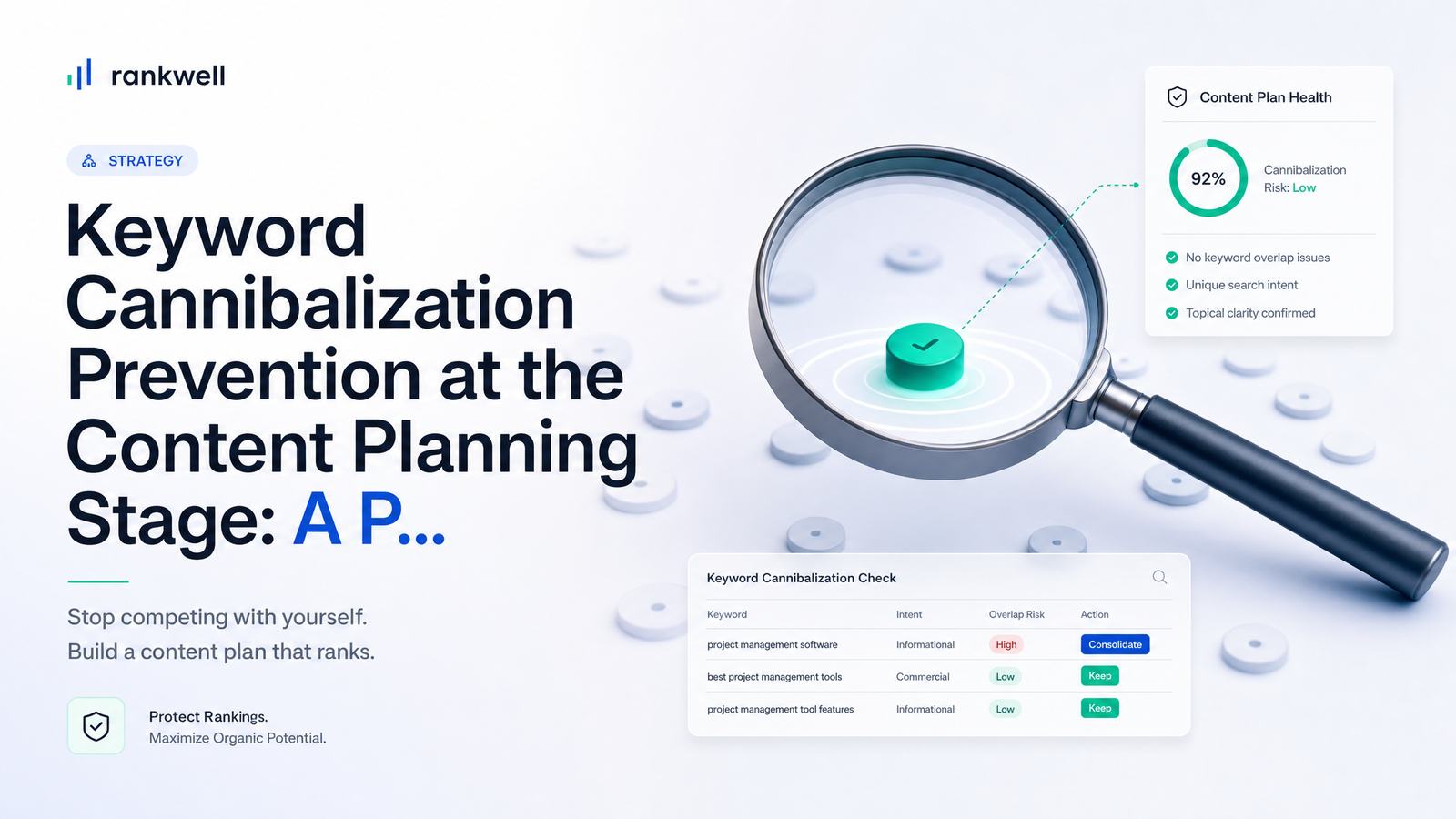
Most advice on this topic starts after the damage is done: two pages are already competing, rankings are already split, and someone has to decide what to merge or redirect. Keyword cannibalization prevention works differently. It happens before a brief is written, before a writer is assigned, before a single word is drafted — at the point where the topic is still just an idea on a content calendar.
That timing shift matters. Once a page is live and indexed, fixing overlap costs rewrites, 301s, and lost link equity. Catching it at the planning stage costs one extra check. This article walks through that check as a repeatable, five-step workflow you can run on every new topic before it's approved.
What Keyword Cannibalization Prevention Actually Means
What is keyword cannibalization, precisely? It's when two or more pages on the same site are built to satisfy the same search intent for the same query, forcing Google to choose between them and often splitting ranking signals. That's a real problem — but narrower than most teams treat it.
The common overreaction is to panic any time two URLs show up for a similar keyword in Search Console. Google has clarified that this isn't inherently a problem. As reported in Google Answers SEO Question About Keyword Cannibalization, John Mueller has confirmed that multiple pages ranking for the same query is a normal, expected outcome of a large site — not automatically a sign of cannibalization. Mueller's broader guidance, as summarized in Keyword Cannibalization: A Practical Guide, leans toward "fewer, stronger pages" as a goal — but only when pages are truly redundant, not merely adjacent in topic.
That distinction reframes the exercise. Prevention isn't about ensuring no two pages ever share a keyword — it's about ensuring no two pages share the same intent. A comparison page and a pricing page can both rank for a brand-plus-competitor term without conflict, because someone searching each phrase might want genuinely different things. The planning question isn't "does this keyword exist elsewhere on our site?" — it's "does a page already exist that would satisfy this exact searcher intent?" Treat it as an intent-mapping problem, not a keyword-uniqueness problem, and the rest of this checklist gets easier to apply correctly.
Why Catching It at the Planning Stage Beats Fixing It After Publishing
The cost asymmetry here is the entire argument for prevention. A page that's already published, indexed, and possibly linked-to elsewhere can't just be deleted without consequence. Fixing cannibalization after the fact usually means: rewriting one page to shift its angle, merging both into a single stronger page and 301-redirecting the loser, or restructuring internal links to signal a clear primary target to Google. Each option takes editorial time, dev or CMS work, and almost always sacrifices some link equity, since redirects and rewrites rarely preserve 100% of the original signal.
Compare that to the cost of prevention: one keyword-to-URL check and one intent comparison, done before the brief goes to a writer. That's minutes, not sprints. Building this into your content planning workflow — rather than your post-publish audit workflow — is simply cheaper at every stage from idea to published page.
If your site already has overlapping pages live and you need a remediation path, that's a separate exercise covered by our companion piece on SEO content gap analysis, which helps distinguish genuine content gaps from existing overlap you need to consolidate. This article assumes you'd rather not get there in the first place.
The Pre-Publish Workflow: 5 Checks Before a Page Gets Written
This is the core of the process: a pre-publish SEO checklist, run in order, for every new topic before it's assigned — five gates a topic has to pass through before it becomes a brief.
Step 1: Build (and Maintain) a Live Keyword-to-URL Map
Every published page should exist as a row in one shared document or system: URL, primary keyword, primary intent, and publish date. This is your single source of truth. Before any new topic is greenlit, someone checks it against this map — not against memory, not against a quick site: search, but against a maintained record. Teams that skip this step rely on individual writers or editors to remember what's already been published, which fails predictably once a site passes a few hundred pages. Keyword mapping for content only works if the map is treated as living infrastructure, updated the moment a new page ships, not rebuilt from scratch during quarterly audits.
Step 2: Run a Search Intent Match Before Approving the Brief
A keyword match on the map doesn't automatically mean conflict, and a keyword miss doesn't automatically mean it's clear. The real check is intent. Pull up the current SERP for the proposed target query and classify it: informational, commercial, transactional, or navigational. Then check that classification against any existing page on your site ranking for the same or an adjacent term. If your existing page is a transactional pricing page and the new topic is a top-of-funnel informational explainer, they can coexist — they're answering different questions even if they share vocabulary. If both are informational explainers answering the same underlying question, that's a real conflict, and the new topic needs to be merged into the existing page's scope rather than spun into a new URL.
Step 3: Differentiate the Angle, Not Just the Title
A different headline isn't differentiation. If a brief's outline, subtopics, and examples would satisfy the same searcher as an already-published page, changing the title doesn't remove the overlap — it just hides it until Google's algorithm finds it anyway. Force real differentiation into the brief: a distinct subtopic, a different funnel stage (awareness vs. decision), or a different format (comparison table vs. narrative guide vs. calculator). Write that differentiation into the brief as an explicit line, not an assumption left to the writer. If you can't articulate the difference in one sentence before writing starts, the two pages likely shouldn't both exist.
Step 4: Cross-Check Against Google Search Console Query Data
Your keyword map shows what you've deliberately targeted; it won't show what you're already ranking for incidentally. Before greenlighting a new topic, pull the query report in Search Console filtered to your existing closest-matching URL and check impressions and clicks for terms adjacent to the proposed topic. If an existing page is already picking up meaningful impressions for the exact phrase you're about to brief, that's a strong signal to expand the existing page instead of creating a competitor to it. Our guide on Google Search Console tips that actually drive action covers the deeper mechanics of reading this data — worth a read if this step isn't already part of your process, since query-level overlap is often invisible until you look at GSC specifically.
Step 5: Lock the Canonical URL and Internal Link Path Before Publishing
Decide, at the brief stage, which URL is meant to be the primary ranking page for the target query, and write the internal linking plan around that decision before the page is published — not after. If a new page is meant to support an existing pillar rather than compete with it, the brief should specify exactly which pages will link to it and with what anchor text, and confirm the new page will point back to the pillar rather than becoming an orphaned parallel entry point. This is also the point to set canonical tags deliberately if there's any risk of near-duplicate URLs generated by filters, parameters, or CMS templates. For the mechanics of building a link structure that reinforces a clear hierarchy rather than diluting it, see our internal linking tool evaluation framework.
Signs Your Planning Process Has a Cannibalization Gap
Some warning signs show up in the process itself, before they ever show up in the pages:
- Multiple briefs get approved in the same month targeting near-identical queries, often because different team members or freelancers proposed them independently.
- There's no shared keyword-to-URL map, or the one that exists hasn't been updated in months.
- Brief templates don't include an intent-check field — writers are told a keyword, not a searcher intent to satisfy.
- Nobody checks Search Console query data before approving new topics, only keyword research tools.
- Internal linking is decided after publishing rather than planned in the brief.
If two or more of these are true, the problem isn't your existing pages — it's the workflow that's about to keep producing duplicate keyword targeting in practice, no matter what the plan says on paper.
Automating the Prevention Check at Scale
Manual keyword-to-URL mapping works fine at low volume. A team publishing four articles a month can plausibly hold the site's existing coverage in their heads or in a small spreadsheet. That breaks down fast once you're publishing weekly across multiple writers, freelancers, or departments — nobody has full visibility into every brief in flight, and the spreadsheet inevitably falls out of date the week it matters most. This is usually also when topical authority planning gets harder: you want to build depth around core topics without quietly duplicating coverage inside your own cluster.
This is the exact gap Rankevra's AI workflow is built to close. Rather than relying on a person to remember or manually check every prior page, Rankevra checks each new brief against your existing site index automatically — flagging keyword and intent overlap before a writer ever starts, and slotting that check directly into a content planning workflow that also handles audits, publishing, and rank tracking in one place.
Running this five-step checklist by hand is entirely doable, and worth doing even if you never automate it. But at scale, doing it manually for every brief becomes the bottleneck itself. Rankevra automates the keyword-to-URL map and the intent check at the planning stage, so every new topic is screened against what's already live before it ever reaches a writer — preventing the conflict instead of scheduling a future audit to fix it.
Frequently Asked Questions
Is it always bad if two pages on my site rank for the same keyword?
No. Google has confirmed that multiple pages from the same site ranking for a query is normal and not inherently a problem, especially on larger sites. It only becomes an issue when both pages are built to satisfy the exact same search intent, splitting ranking signals for no real benefit to the searcher.
How is keyword cannibalization prevention different from a cannibalization audit?
Prevention happens at the planning stage, before a brief is approved, by checking a new topic's keyword and intent against a live map of existing pages. An audit happens after publishing, identifying pages that are already competing and deciding whether to merge, rewrite, or redirect them — a more expensive, reactive process.
What's the fastest way to check if a new topic idea overlaps with an existing page?
Search your own site for the target query and compare the top-matching page's intent against the proposed topic's intent, then confirm against Search Console query data for that URL. If both point to the same intent and query cluster, the topic overlaps rather than fills a genuine gap.
Should I block a new article idea just because a similar keyword already ranks on my site?
Not automatically. Check the intent behind both the existing ranking page and the proposed topic; if they serve different funnel stages or different searcher goals, they can coexist. Only merge or drop the new idea if both pages would genuinely satisfy the same searcher need.
How often should I update my keyword-to-URL map?
Update it every time a new page is published, not on a quarterly or ad hoc schedule. A map that lags behind your actual site content will let overlapping briefs slip through the exact check it's meant to catch.
Can two pages targeting the same keyword ever be the right call?
Yes, when they serve genuinely different intents or funnel stages — for example, an informational guide and a transactional pricing page targeting related terms. The problem isn't shared vocabulary; it's when both pages are built to satisfy the identical searcher intent.
Keep reading
- Multi-Location SEO: Scaling Pages Without Duplicate ContentA framework for multi-location SEO: build a canonical shell, hit the right unique-content ratio, and scale location pages without duplicate penalties.
- Mobile-First Indexing Checklist: Fix Content Parity GapsA practical mobile-first indexing checklist covering content, links, schema, images, and tap targets — plus how to automate parity checks with Rankevra.
- GSC Crawl Stats vs Log Files: A Reconciliation FrameworkReconcile GSC Crawl Stats vs log files with a concrete framework: why 20-40% variance isn't an error, and how to cross-check the two sources field by field.