Rankevra Blog
Building a Content Publishing Workflow That Scales Safely
July 24, 2026
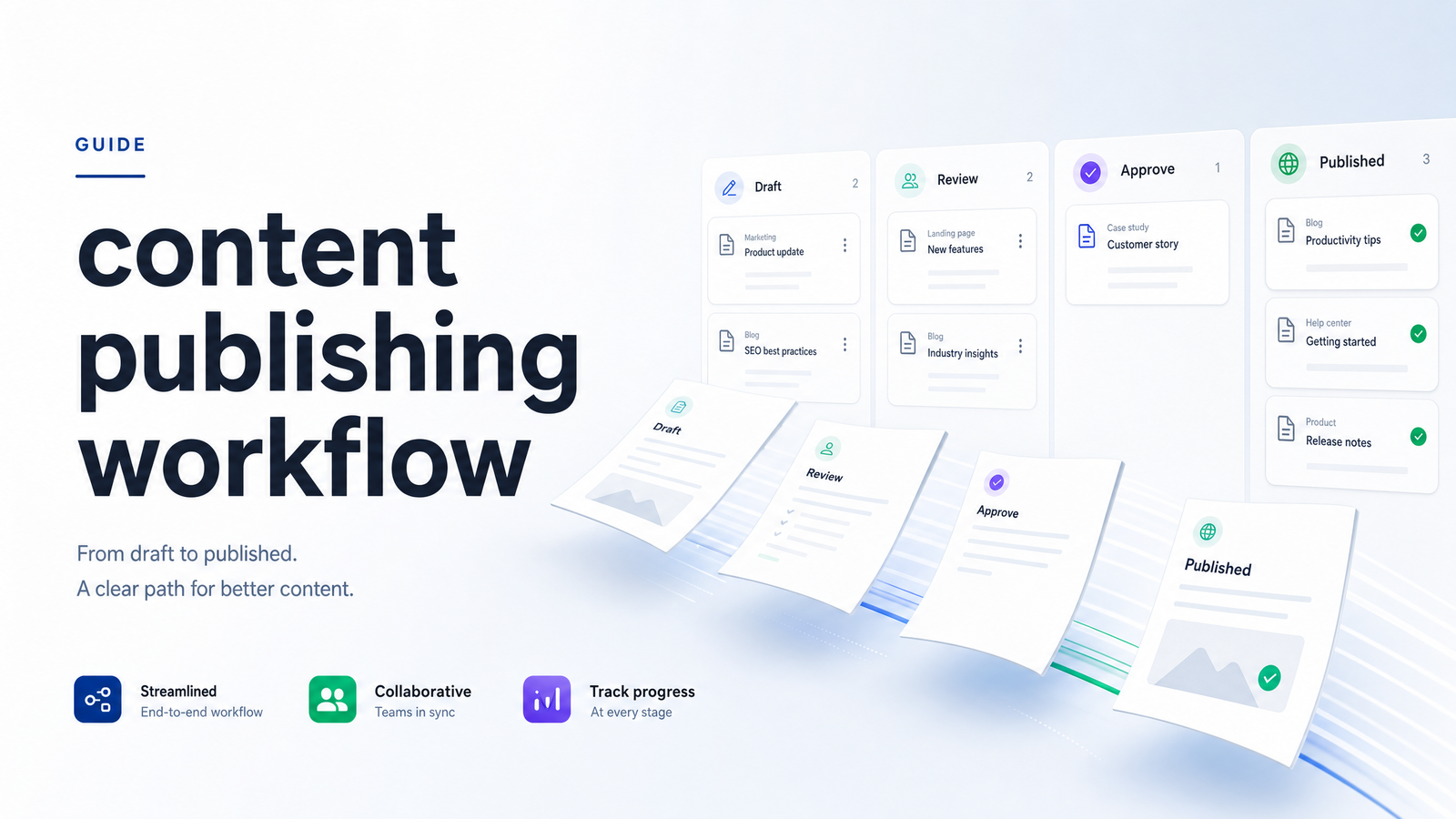
Most teams don't have a content publishing workflow — they have habits scattered across a Google Doc, a Slack channel, a CMS login, and one person's memory of what "usually" happens before something goes live. That works at low volume, but it falls apart at scale, because nobody agreed on where planning ends, drafting starts, and who catches a broken canonical tag before it ships.
A real content publishing workflow is a pipeline, not a checklist: plan, draft, optimize, review, publish, track — six connected stages, each handing specific inputs to the next. Fragmented tool stacks break exactly at those handoffs: the brief never reaches the writing tool, the optimizer's suggestions never reach the CMS, the published page never gets submitted for indexing, and nobody checks whether it ranked. This article walks through each stage, where teams typically lose control of quality or speed, and how to design gates that protect against Google's scaled content abuse policy without slowing publishing to a crawl.
What a Content Publishing Workflow Actually Needs to Do
A content publishing workflow is the repeatable sequence that turns an approved topic into a live, indexed, ranking page, with defined checkpoints at each transition. Plan sets the target. Draft produces the copy. Optimize aligns it with on-page and technical requirements. Review is the human quality gate. Publish gets it live and discoverable. Track measures whether it worked and feeds that signal back into planning.
Treating these as one continuous system, rather than six separate tasks owned by six separate tools, prevents the classic failure modes: content that reads fine but has no schema, pages that publish but sit unindexed for weeks, and drafts approved because nobody was assigned to check them. Topical authority is built by the accumulation of these cycles done consistently, not by any single well-written article.
Stage 1: Brief and Topic Approval
Every workflow should start from an approved keyword and a written brief, not an open-ended "write something about X" request. A brief locks in the target query, search intent, required subtopics, internal linking targets, and competitive gaps before a single sentence gets drafted. Skipping this step is the biggest cause of rework downstream — writers guess at intent, drafts miss the angle, and the piece gets rewritten after it's already "finished."
If you haven't formalized this step, a marketing content strategy template gives you a starting structure for turning topics into briefs on a repeatable cadence. Topics shouldn't be picked at random — a proper keyword gap analysis tells you which queries competitors rank for that you don't, a far stronger input than an internal brainstorm. Topic approval is also where you decide fit: does this page build toward topical authority in a cluster you already own, or is it a one-off that won't compound?
Stage 2: Drafting With AI, Without Triggering Google's Spam Policies
Google's guidance on generative AI content states that the method of production isn't the issue — quality, originality, and helpfulness are. The Search Central blog post on AI-generated content confirms that AI-assisted content can rank exactly like content written entirely by hand, provided it meets the same quality bar. The risk isn't AI drafting itself — it's publishing at volume without adding anything beyond what the model generated. That's what Google's scaled content abuse policy targets: mass-produced pages, on any topic, generated primarily to manipulate rankings rather than to help a reader.
The practical takeaway is that AI drafting needs a checkpoint, not a blind spot. Build the draft stage so that:
- Every AI-assisted draft is generated from an approved brief, not an open prompt, so it starts from real research and a defined angle.
- A human editor adds something the model couldn't — original data, direct experience, a specific example, an opinion — before it moves forward. This is where E-E-A-T signals actually get built, not bolted on afterward.
- Drafts are checked for originality and factual accuracy before optimization begins, not after publishing.
Treat this as a mandatory gate in the pipeline, logged and enforced, rather than a guideline people are trusted to remember under deadline pressure.
Stage 3: On-Page and Technical Checks Before Publishing
This is where most technical SEO debt gets created — quietly, before a page ever goes live. A workflow should automate the checks that don't need human judgment and reserve manual review for the ones that do. Automate: title tag and meta description presence and length, heading structure, internal link suggestions based on existing topical clusters, image alt text, schema markup validity, and canonical tag correctness. Flag for manual review: whether internal links make sense in context, and whether the schema type matches the content's actual purpose.
The deeper framework is covered in the content optimization SEO guide. Schema deserves its own attention — see what structured data actually does in 2026 — because incorrect or missing markup is one of the most common issues discovered only after a page is already indexed. Canonical and indexability problems are just as costly and preventable; the canonical tags and duplicate content diagnostic guide walks through the exact failure patterns to check for before hitting publish, not after.
Stage 4: Editorial Review and Approval Gates
Somewhere between "everything needs three rounds of manual sign-off" and "nothing gets checked at all" is a defined approval gate that scales with risk rather than blanket caution. The gate should confirm three things: factual accuracy (claims, data, quotes), brand voice consistency, and E-E-A-T signals — does the piece demonstrate real expertise, cite credible sources, and read like it was written by someone who understands the topic rather than someone summarizing search results?
Keep this from becoming a bottleneck by making the gate a single defined step with clear pass/fail criteria, not an open-ended review cycle. Content that passes automated technical checks and fits an established topic cluster can move through review faster than a piece breaking into new subject matter or making claims that need verification. The point of the gate isn't to slow every piece down equally — it's to make sure nothing skips human judgment entirely just because deadlines are tight.
Stage 5: Publishing and Indexing
Publishing isn't the finish line — it's the point where discoverability starts. A page sitting live but unindexed for weeks is functionally invisible, a common outcome when publishing and indexing are treated as separate, disconnected steps. Once a page goes live in the CMS, the workflow should immediately update the XML sitemap and submit the URL through IndexNow and Google Search Console rather than waiting for a crawler to find it on its own schedule.
Sitemap hygiene matters more than most teams assume — a bloated or poorly maintained sitemap can slow discovery across the whole site, not just one page. The XML sitemap and robots.txt best practices guide covers the configuration details worth getting right once and then automating. The goal for this stage is simple: minimize the gap between "published" and "indexed," because every day a page sits unindexed is a day it can't rank, get clicked, or contribute to topical authority.
Stage 6: Tracking Rankings and Feeding Results Back Into the Plan
A workflow isn't complete until it closes the loop. Once a page is indexed, rank tracking should confirm whether it's actually appearing for its target query and pull in traffic and engagement data from Search Console. Pages that underperform after a reasonable window — say, low rankings or thin traffic after several weeks — shouldn't just sit there; they should feed back into a refresh queue as a defined input to the next planning cycle, not a task someone remembers eventually.
This is the stage most manual stacks skip entirely, because rank tracking usually lives in a separate tool nobody checks against the original content calendar. Closing that loop turns publishing from a one-way output into a system that gets smarter with each cycle — new briefs get sharper because they're informed by what actually ranked, not just what seemed like a good idea at planning time.
Manual Workflow vs. One Connected Platform
Stitched together manually, this pipeline usually looks like: a brief doc, handed to a writer, whose draft gets pasted into an optimizer tool, then copied into a CMS, published, followed by a manual indexing request, and finally checked — sometimes — against a separate rank tracker weeks later. Every arrow in that chain is a place where context gets lost: the brief's intent doesn't survive the handoff to the writer, the optimizer's suggestions don't make it into the CMS, and indexing or ranking data never makes it back to whoever plans the next brief.
Running all six stages — plan, draft, optimize, review, publish, track — inside one connected system removes those handoff losses entirely. The brief informs the draft directly. The optimizer's checks apply before publishing, not after. Publishing triggers indexing requests automatically. Ranking data flows straight back into the next round of topic decisions. That's the workflow Rankevra is built to run end-to-end — try it on your next article and take it from brief to indexed, tracked page without switching tools in between.
Frequently Asked Questions
What are the stages of a content publishing workflow?
A complete content publishing workflow has six stages: brief and topic approval, drafting, on-page and technical optimization, editorial review, publishing and indexing, and rank tracking. Each stage hands specific inputs to the next, and the workflow only holds together if those handoffs are explicit rather than assumed.
How do you build a content approval workflow for a small team?
Define a single approval gate with clear pass/fail criteria — fact accuracy, brand voice, and E-E-A-T signals — rather than multiple open-ended review rounds. Let content that passes automated technical checks and fits an established topic move through faster, and reserve deeper scrutiny for new subject matter or unverified claims.
Is AI-generated content safe to publish for SEO in 2026?
Yes, according to Google's own guidance, which states that quality and helpfulness determine ranking eligibility, not whether AI assisted in production. The risk is publishing AI drafts at volume without human review, added expertise, or originality — that pattern is what Google's scaled content abuse policy targets.
How often should a content publishing workflow include content refreshes?
Underperforming pages should enter a refresh queue after a defined review window, typically several weeks post-publish, once ranking and traffic data is available. Treat refreshes as a standing input to every planning cycle rather than an occasional cleanup project.
What tools do you need for an automated content publishing workflow?
At minimum, you need a way to manage briefs, an AI drafting tool with human review built in, an on-page optimizer, a CMS, an indexing method like IndexNow or Search Console submission, and a rank tracker. Running these as one connected platform, rather than six disconnected tools, prevents the data loss that happens at each manual handoff.
How fast should a new page get indexed after publishing?
Ideally within days, not weeks — achieved by updating the XML sitemap immediately and submitting the URL through IndexNow and Google Search Console at the moment of publishing. Waiting for organic crawling alone often delays indexing far longer and leaves new pages invisible in search during that gap.
Keep reading
- Subdomain vs Subdirectory SEO: The Real Decision FrameworkSubdomain vs subdirectory SEO, resolved: what Google says, what migration data shows, and a 5-question framework to pick the right structure.
- Answer Engine Optimization: A Platform-by-Platform GuideAnswer engine optimization explained for ChatGPT, Perplexity, and Google AI Mode — with a practical, platform-aware framework to earn citations in 2026.
- SEO A/B Testing: A DIY Framework Using Only GSCLearn SEO A/B testing with just Google Search Console and a spreadsheet — hypotheses, page grouping, significance checks, and when to automate.