Rankevra Blog
Multi-Location SEO: Scaling Pages Without Duplicate Content
September 18, 2026
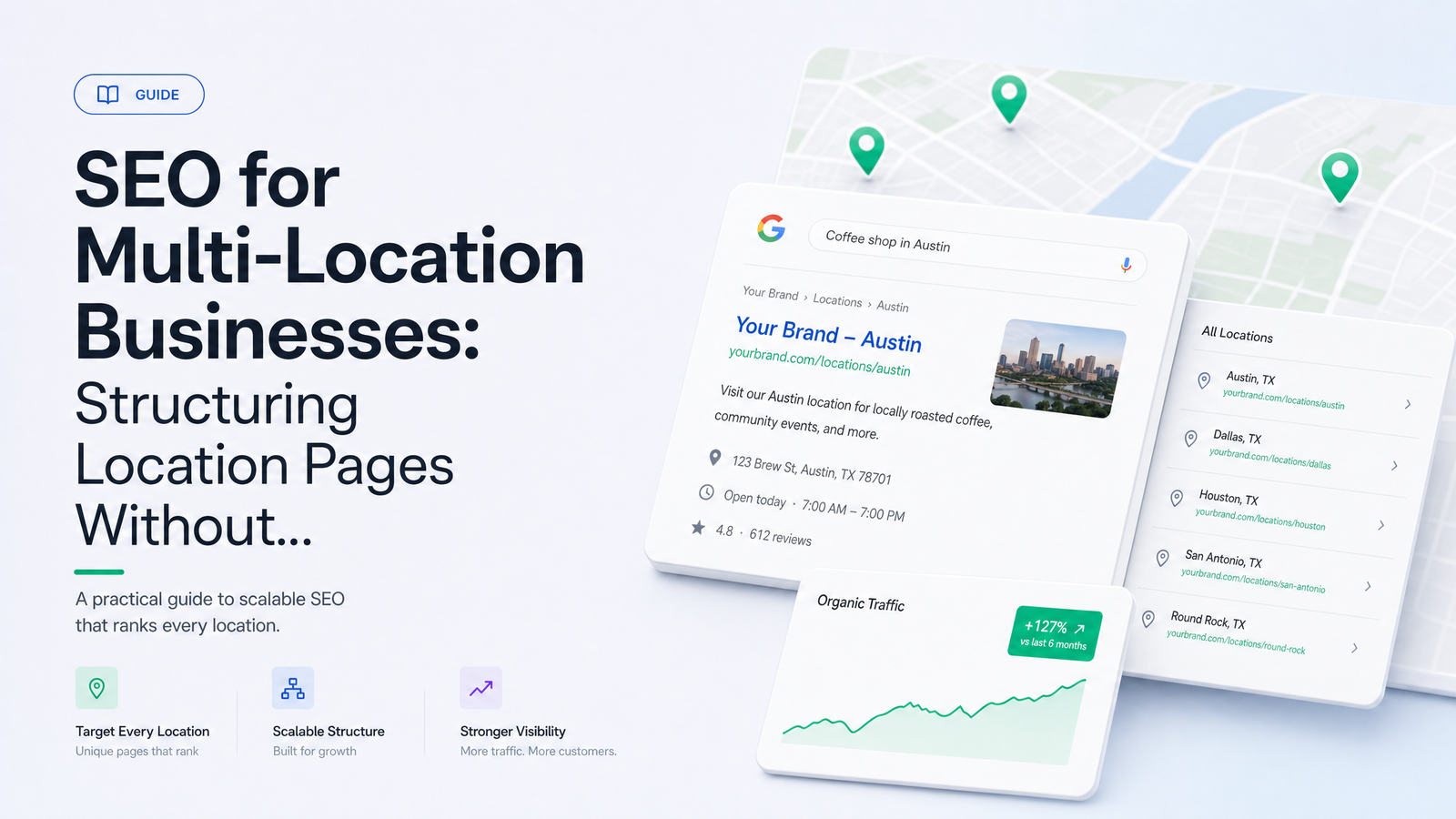
Multi-location SEO fails most often not because teams skip citations or ignore reviews, but because someone built one location page, duplicated it 50 times, and swapped the city name. Google notices. This is a content architecture problem, not a checklist problem — it needs a system, not a copywriter typing faster.
Why Location Pages Get Flagged as Duplicate Content
A business's first location page usually works: clear NAP, hours, services, local color. At scale, trouble starts. Page two copies the template, changes the city and phone number, and ships. By page twenty, only 8–10% of the visible text differs between pages — a headline, an address, maybe one sentence about "serving the greater [City] area."
Search engines evaluate pages relative to each other, not in isolation. When the boilerplate-to-unique ratio skews this heavily toward boilerplate, near-duplicate detection treats the pages as variations of one document rather than distinct answers to distinct queries. The result isn't necessarily a manual penalty — more often it's quiet consolidation, where Google picks one version to rank and ignores the rest, or ranks none of them well because it can't determine which deserves the click.
This is the classic thin content local SEO problem: pages that are live and indexed but carry too little unique substance to earn independent rankings. Duplicate content location pages are usually flagged not because someone copied a competitor, but because a business copied itself, at volume, without a plan for what needed to change per page. The duplicate content framework covers detection mechanics in more depth, but the fix for location pages starts with structure, not sentences.
The Canonical Shell Model: Structure That Scales Without Sameness
Stop thinking of a location page as one document — think of it as two layers: a fixed shell and a required-unique core.
The shell is everything that legitimately should be identical across locations, because inconsistency here would hurt trust and usability rather than help SEO:
- NAP formatting and structure
- Hours-of-operation layout
- Core service list and standardized descriptions
- Schema markup structure
- Navigation, CTAs, and conversion elements
The unique core is what makes each page a genuine answer to a geographically specific query:
- A local narrative — why this location exists, what it serves, what's distinct about operating there
- Named staff or team members at that branch, where applicable
- Community references: neighborhoods, landmarks, local partnerships, events sponsored
- Local proof points — location-specific reviews, case studies, before/after work tied to that market
- Location-specific FAQs addressing that market's actual questions
This is the backbone of any real multi-location content strategy: build one template that defines where the shell ends and the unique core begins, then treat filling the unique core as non-negotiable when publishing any new page. Teams that skip this step aren't saving time; they're building a stack of pages that will need rebuilding once rankings stall. This same discipline is what makes programmatic SEO work at scale for other page types — the template defines structure, not content.
What Percentage of Each Page Actually Needs to Be Unique
There's no certified number Google publishes, but based on how near-duplicate detection behaves, a practical target is that at least 30–50% of a location page's visible text should be genuinely unique — substantively different in content, not just reworded phrasing.
That unique-content percentage should concentrate in elements that carry meaning, not spread thin across the page:
Vary these deliberately:
- The intro paragraph — write it fresh per location, referencing what's actually true there
- Local proof and testimonials — pull reviews specific to that branch, not company-wide quotes
- FAQs — answer questions particular to that market (parking, service area boundaries, local regulations)
- Imagery — real photos of that location, staff, or completed local work, not reused stock photography
Safe to standardize:
- Hours formatting and structure
- Core service descriptions (the "what," not the "why here")
- CTA copy and button structure
- Footer and navigation content
The location page duplicate content ratio problem almost always traces back to teams varying the wrong 10% — swapping a city name into an otherwise identical paragraph — instead of the right 30–40%. A page with a templated hours table and identical CTA but a genuinely distinct intro, testimonials, and FAQ set will out-rank a page that's 90% "unique" phrasing wrapped around zero unique substance.
When to Merge, Canonicalize, or Keep Locations Separate
Not every branch deserves its own page, and forcing one creates the exact cannibalization problem multi-location SEO is supposed to avoid. The decision comes down to whether the location represents a genuinely distinct market or an administrative footnote.
Keep separate pages when:
- The location serves a distinct city, ZIP code cluster, or metro with its own search demand
- There's a physical, staffed presence — a real address customers can visit
- Local proof points (reviews, case studies, staff) genuinely differ from nearby branches
Merge or canonicalize when:
- Two branches sit within the same metro and effectively compete for the same search queries
- A "location" is really a service-area claim with no staffed physical site
- Content differentiation would be artificial — there's nothing distinct to say
This is also where the service area pages vs location pages distinction matters. A location page represents a physical, visitable site with local presence signals. A service-area page represents a zone you serve without a dedicated storefront — think a plumber covering six suburbs from one shop. Building 15 store-front-style location pages for six suburbs served from one van creates duplicate content by design. One honest service-area page outperforms fifteen thin ones.
When overlap is unavoidable — say, two branches eight minutes apart that both technically "serve" a shared suburb — canonicalize the weaker or newer page to the stronger one rather than letting both compete. Getting canonical tags right here is trickier than it looks, and misapplied canonicals are a common source of silent ranking loss; the canonical tag troubleshooting guide walks through the failure patterns worth checking before assuming the tag is working. For a broader view of how these decisions fit inside a full local SEO program, see the 5-layer local SEO audit framework — this article stays focused on page architecture specifically. The distinction between domestic multi-location duplication and international hreflang setups is also worth understanding, since the mechanics differ significantly.
Schema and Internal Linking: Signaling Distinct Entities Correctly
Structure alone doesn't tell search engines each location is a legitimate, separate entity — schema and internal linking do that job.
For markup, each location page should carry its own LocalBusiness schema instance, with the parent brand marked as the parentOrganization and each branch marked with branchOf pointing back to it. This tells search engines explicitly: these are distinct operating entities under one brand, not duplicate representations of the same business. Google's own documentation on LocalBusiness structured data is the authoritative reference for implementing this correctly — worth validating against directly rather than copying a template from a blog post, including this one.
On the linking side, build a location hub page — a single "Our Locations" page linking out to every branch page — and link back from each branch page to the hub and to its geographically nearest neighbors. This gives search engines a clear crawl path that reinforces site structure, and distributes authority from high-traffic pages down to newer or lower-traffic branch pages. Flat or missing location page internal linking is a common reason new location pages take months longer than necessary to index and rank. The internal linking evaluation framework covers how to judge whether your current linking structure is actually doing this job or just present in theory.
Auditing and Scaling Location Pages Without the Manual Grind
Everything above holds up fine at 10 locations. At 100 or 1,000, it breaks — not because the framework is wrong, but because manually auditing every page for boilerplate ratio, checking canonical tags, writing unique intros and FAQs, and verifying schema on each branch isn't sustainable by hand. Someone has to re-audit every page every time services, hours, or staff change, and that workload scales linearly with location count while headcount doesn't.
This is precisely the operational gap Rankevra is built to close. Rankevra runs continuous site audits that flag near-duplicate patterns and thin content across location pages automatically — the same detection logic covered in the duplicate content framework — and pairs it with AI content generation that fills the unique-core sections (intros, local proof points, FAQs) per location without producing find-and-replace copy, then handles publishing directly. It's how you scale location pages using the canonical shell model as an ongoing system rather than a one-time project. Agencies managing this across multiple clients face the same scaling math multiplied by client count; what actually matters in local SEO software breaks down the tooling considerations specific to that context.
If you're managing location pages in the double or triple digits, the audit-fix-publish cycle described in this article isn't something to run manually every quarter. Rankevra automates that entire workflow — audit, content generation, and publishing — so your location pages stay individually rankable as you add markets, instead of degrading into duplicate-content risk the moment you stop watching them closely.
Frequently Asked Questions
How many location pages can I safely create before Google flags them as duplicate content?
There's no fixed number — the risk comes from ratio, not count. A business can have 500 well-differentiated location pages with no duplicate content issues, or 10 pages that trigger consolidation because each is 90% boilerplate with a swapped city name. Focus on unique-content ratio per page rather than a page-count ceiling.
What's the difference between a location page and a service area page for SEO?
A location page represents a physical, staffed, visitable address and should include local proof points specific to that site. A service area page represents a zone served without a dedicated storefront. Building storefront-style location pages for areas you only serve remotely creates artificial duplication.
Can I use the same meta title and description format across all my location pages?
Yes, a consistent format is fine — for example "[Service] in [City] | [Brand]" — as long as the city, and ideally a distinguishing local detail, actually changes per page. The format can be templated; the specific values must be unique and accurate to each location.
Do I need a separate Google Business Profile and schema for each location, or just for the main brand?
Each physical location needs its own Google Business Profile and its own LocalBusiness schema instance, connected to the parent brand via parentOrganization and branchOf markup. A single profile or schema block for the whole brand can't represent multiple distinct addresses correctly.
How much unique content does each location page actually need to avoid a duplicate content penalty?
A practical target is 30–50% genuinely unique visible text, concentrated in the intro, local proof points, testimonials, and FAQs rather than spread thinly across the whole page. Standardized elements like hours formatting, core service descriptions, and CTAs can stay consistent without hurting uniqueness.
Should nearby locations that serve the same city share one page or have separate pages?
If two branches effectively compete for the same searches and lack distinct local proof points, they should share one page or use a canonical tag pointing to the stronger version. Separate pages are justified only when each location represents a genuinely distinct market with its own staff, proof points, and search demand.
Keep reading
- Keyword Cannibalization Prevention: A Pre-Publish ChecklistA planning-stage checklist for keyword cannibalization prevention — catch overlap before a brief is approved, not after the page is published.
- Mobile-First Indexing Checklist: Fix Content Parity GapsA practical mobile-first indexing checklist covering content, links, schema, images, and tap targets — plus how to automate parity checks with Rankevra.
- GSC Crawl Stats vs Log Files: A Reconciliation FrameworkReconcile GSC Crawl Stats vs log files with a concrete framework: why 20-40% variance isn't an error, and how to cross-check the two sources field by field.