Rankevra Blog
Anchor Text Optimization: A Practical Framework for 2026
September 12, 2026
What Anchor Text Optimization Actually Means Today
Anchor text is the clickable words in a hyperlink — the phrase wrapped around an <a href> tag rather than the raw URL. For years, self-serve SEOs treated it as a lever: stuff your target keyword into as many links as possible and watch rankings climb. That era ended with Google's Penguin update, which specifically targeted manipulative link patterns, and anchor text over-optimization has remained a recognizable footprint ever since.
The more useful way to think about anchor text optimization today is as a contextual relevance signal, not a keyword-stuffing lever. Search engines — and increasingly the AI-influenced ranking systems layered on top of core algorithms — use anchor text to understand what a linked page is about and how it relates to the linking page. A link that says "here" tells a crawler nothing. A link that says "technical SEO audit checklist" tells it a great deal, provided that phrasing looks like something a human would actually write.
Anchor text still functions as a ranking signal even in a world of entity recognition, passage indexing, and large language models parsing page content. It's not the blunt instrument it was in 2011, but it's still one of the clearest, cheapest ways to communicate topical relevance — which is exactly why an unnatural pattern of it stands out so clearly to both algorithms and manual reviewers.
The 6 Anchor Text Types You're Actually Working With
Before you can audit or fix anything, you need a shared vocabulary. Every link on the web falls into one of six anchor text types:
- Exact match — the anchor is your literal target keyword ("best project management software"). Highest relevance signal, highest risk when overused.
- Partial match — a variation that includes part of the keyword plus other words ("a solid project management tool for teams"). Reads naturally while still signaling topic.
- Branded anchor text — your company or product name ("Rankevra," "Ahrefs"). The backbone of any natural link profile because it's what people actually type when they reference you.
- Generic — non-descriptive phrases like "click here," "learn more," or "this page." Common in genuine editorial linking and therefore useful camouflage in a healthy profile.
- Naked URL — the raw link (https://example.com/page) pasted as-is, typical of forum posts, citations, and organic mentions.
- Image/other — alt text or surrounding context when the "anchor" is an image rather than text, still parsed for relevance signals.
Every ratio discussion, audit step, and recovery tactic later in this piece refers back to these six categories.
What a Natural Anchor Text Ratio Looks Like
There's no government-issued percentage that guarantees safety, and any guide handing you a rigid formula copied from another agency's deck is asking you to ignore your own niche, competitive set, and link history. That said, patterns across healthy, non-penalized sites are consistent enough to give you a working range.
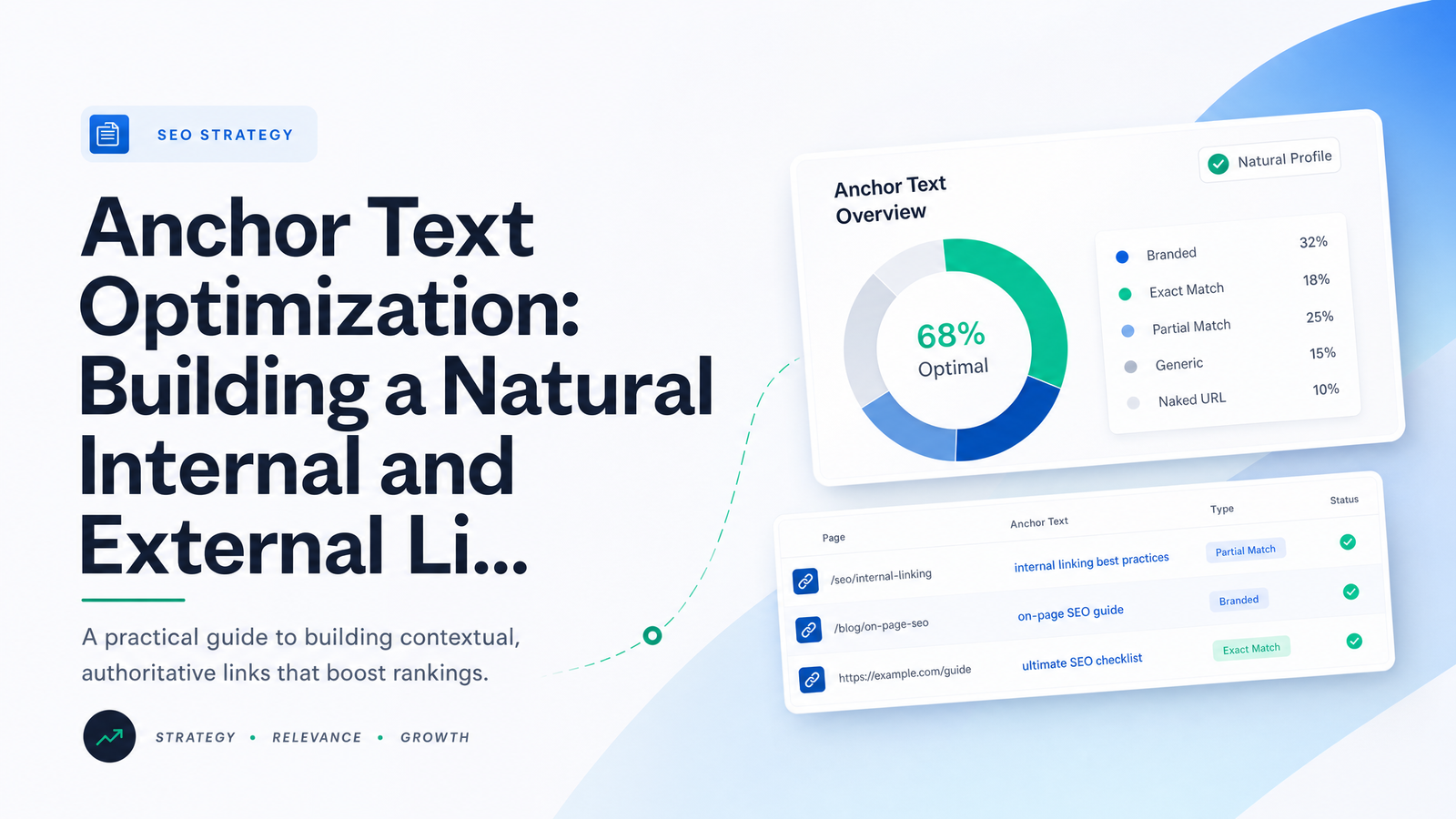
Branded and naked URL anchors typically make up the largest share of a natural anchor text profile — often 50–70% combined for sites with real-world brand recognition. Generic anchors usually contribute another 10–20%. Partial match anchors tend to sit in the 10–20% range too, since they're the most natural way to signal topic without sounding robotic. Exact match is the smallest legitimate share — most resilient profiles keep it under roughly 5–10% of total external links, often lower for competitive commercial terms.
Those numbers are directional, not a checklist. A niche B2B SaaS product with a distinctive name will naturally skew even more branded because people link to it by name. A newer site without brand recognition yet might show a slightly higher partial-match share simply because that's how bloggers describe it before they know the brand. The better move than chasing a universal formula is competitor benchmarking: pull the anchor profiles of three to five sites ranking above you for your target terms, classify their anchors by type, and see where your ratio actually diverges. Context — your industry, your link sources, your brand maturity — beats formula every time.
Internal Links vs. External Links: Different Rules Apply
Anchor text rules aren't uniform across your own site and the links other sites point at you, and conflating the two is where a lot of self-serve SEOs go wrong.
Internal links are entirely within your control, which gives you more tolerance for keyword-relevant anchors — Google understands that a site owner organizing their own content will naturally describe internal pages descriptively. But "more tolerance" isn't "unlimited license." If every internal link to your pricing page uses the identical phrase "affordable project management software," you've recreated the same over-optimization pattern internally that would look manipulative externally. Good internal linking practice calls for varying phrasing across partial match, branded, and natural descriptive anchors, even when you control every instance.
External links — the backlinks other domains build to you — need to look earned, not engineered. A real editor writing about your product links to it by brand name, describes it in their own words, or drops a naked URL. When a large share of your external anchor text is exact match, it signals a paid or manipulated campaign rather than organic mentions — precisely the pattern Penguin was built to catch. That's why external anchor text should skew heavily branded and generic, with partial and exact match reserved for a smaller, more natural minority — and why auditing your backlink profile matters as much as auditing your own site. Tools built for that job, covered in this backlink analysis framework, make the export-and-classify step far less painful than manual spreadsheet pulls.
How to Audit Your Current Anchor Text Profile
A one-off spreadsheet check tells you where you stood the day you ran it — it doesn't tell you whether a link building campaign quietly pushed your exact-match share into risky territory six months later. An anchor text audit needs to be a repeatable workflow, not an event.
- Export every backlink and internal link pointing to your key pages. Ahrefs (or a similar backlink data source) covers external links; a site crawler covers internal ones.
- Classify each anchor into one of the six types above. This is tedious by hand at scale, which is exactly why most teams end up automating it.
- Calculate ratios per page and site-wide. A single page can look fine in aggregate while having a dangerously concentrated anchor pattern from one campaign or one guest post series.
- Flag concentration risk. Any page where exact match exceeds roughly 10–15% of total anchors, or where one specific exact-match phrase repeats across many referring domains, deserves a closer look.
- Cross-check against competitor ratios for the same target keywords, using the benchmarking approach described earlier, rather than judging your numbers in isolation.
- Schedule recurring reviews — quarterly at minimum, monthly if you're actively running link building or content campaigns — so anchor distribution gets monitored continuously rather than rediscovered after a ranking drop.
If the audit also surfaces broader technical debt — redirect chains, orphaned pages, crawl issues feeding into the same URLs — it's worth prioritizing that alongside anchor cleanup; this technical SEO action plan offers a sequencing framework for exactly that kind of triage.
Fixing an Over-Optimized Profile Without Tanking Rankings
An over-optimization penalty typically isn't one single algorithmic slap — it's usually a gradual devaluation of the pages associated with a suspicious pattern, and in more severe cases a manual action visible in Google Search Console. Either way, the trigger is almost always the same: too many links, internal or external, pointing at the same target with the same exact-match phrase, especially when they arrived in a short window or from low-quality sources.
Recovery works best as a series of measured moves, not a single dramatic overcorrection:
- Vary internal anchors first. This is fully within your control and carries zero risk — rewriting internal links to spread exact match, partial match, and branded phrasing across a page's inbound links immediately improves your ratio without touching external relationships.
- Audit and cautiously disavow toxic exact-match backlinks. The disavow tool is a blunt instrument — use it on clearly spammy, low-authority domains with manipulative anchors, not on every exact-match link you find. Disavowing legitimate links can do more damage than the pattern you're trying to fix.
- Earn new branded and natural links to dilute the existing ratio over time. This is slower but more durable — genuine editorial coverage, digital PR, and content worth citing naturally skews branded.
- Avoid overcorrecting by stripping every exact-match anchor site-wide. A small, natural share of exact match is expected and healthy; the goal is proportion, not elimination.
Recovery is gradual by design. Ratios shift over months, not days, and that's actually a good sign — sudden, uniform changes across hundreds of links can look just as manufactured as the original problem.
Keeping It Natural at Scale
All of this is manageable on a 20-page site with a spreadsheet and an afternoon. It falls apart once you're running a content operation with hundreds of pages, an active link building program, and multiple writers each linking internally in their own style. At that scale, manually tracking which anchor phrase you used on which page, six months ago simply isn't realistic — and that's exactly when profiles drift into over-optimization without anyone noticing until rankings soften.
This is also where a content strategy built around genuine topical authority pays off twice over: publishing comprehensive, interlinked content around your core topics — the kind of work covered in this content gap analysis framework — naturally creates more opportunities for varied, contextually earned internal anchors instead of forcing the same three keyword phrases into every link.
Automating the boring, error-prone parts is how growing teams sustain a natural anchor profile without a standing spreadsheet habit. Rankevra's internal linking engine builds anchor variation into the linking process itself — suggesting contextually appropriate, naturally varied anchors as content is published, rather than leaving writers to reuse the same exact-match phrase out of convenience. Paired with continuous audit capabilities that flag anchor concentration risk automatically, it replaces the periodic export-and-classify cycle with ongoing monitoring — read more on how an internal linking tool should actually be evaluated if you're comparing options.
Manual anchor tracking — quarterly Ahrefs exports, a shared spreadsheet, someone's memory of "didn't we already use that phrase" — works fine until your site crosses a few dozen pages, and then it quietly stops working while still feeling like it's under control. Rankevra automates the audit and the internal linking execution together, so anchor distribution gets monitored continuously and over-optimization gets flagged before it becomes a ranking problem, not after.
Frequently Asked Questions
What percentage of exact-match anchor text is safe?
Most resilient link profiles keep exact-match anchors under roughly 5–10% of total external links, with branded and naked URL anchors making up the largest share. There's no universal cutoff — competitive commercial niches often warrant an even lower exact-match share, and the safest benchmark is comparing your ratio against sites currently ranking above you rather than applying a fixed number.
Does anchor text still affect rankings in 2026?
Yes — anchor text remains a contextual relevance signal that search engines use to understand what a linked page is about, even alongside AI-influenced ranking systems that also parse page content directly. It's less of a blunt keyword lever than it was before Penguin, but unnatural anchor patterns are still a recognizable red flag to both algorithms and manual reviewers.
Should internal links use exact-match keywords?
Occasionally, but not exclusively — internal links have more tolerance for keyword-relevant anchors since Google recognizes that site owners naturally describe their own content descriptively. Even so, repeating the identical exact-match phrase across every internal link to a page recreates the same over-optimization pattern internally, so varying phrasing across partial match, branded, and descriptive anchors is still best practice.
How do I fix an over-optimized anchor text profile?
Start with internal anchors, since rewriting them to add variation is fully within your control and carries no external risk. From there, cautiously disavow clearly toxic exact-match backlinks, focus on earning new branded and natural links to dilute the ratio over time, and avoid overcorrecting by eliminating exact match anchors entirely.
How often should I audit my anchor text distribution?
At minimum quarterly, and monthly if you're actively running link building or content campaigns. A one-off spreadsheet check only reflects the moment you ran it, so treating the audit as a recurring workflow — or automating it — is what catches drift before it shows up as a ranking or manual action problem.
What's the difference between anchor text ratio for internal vs external links?
Internal links can lean more heavily on partial match and descriptive anchors since you control the context and Google expects site owners to describe their own pages, though variation still matters. External links need to look earned rather than engineered, so they should skew heavily toward branded, generic, and naked URL anchors, with exact match kept to a small minority to avoid signaling a manipulated link campaign.
Keep reading
- Crawl Budget Optimization: A Diagnostic Framework for 2026Learn whether crawl budget optimization actually applies to your site, how to diagnose crawl waste in GSC, and a prioritized fix list for 2026.
- Multilingual SEO Strategy: Skip the Hreflang TrapA practical multilingual SEO strategy that treats hreflang as insurance, not a growth lever — plus how to automate audits, content, and tracking per locale.
- Will Google Penalize AI Content in 2026? The Real AnswerDoes AI content detection SEO actually affect rankings? Here's what Google's spam policies and the March 2026 core update really show.