Rankevra Blog
Best Backlink Analysis Tool: A No-BS Evaluation Framework
July 23, 2026
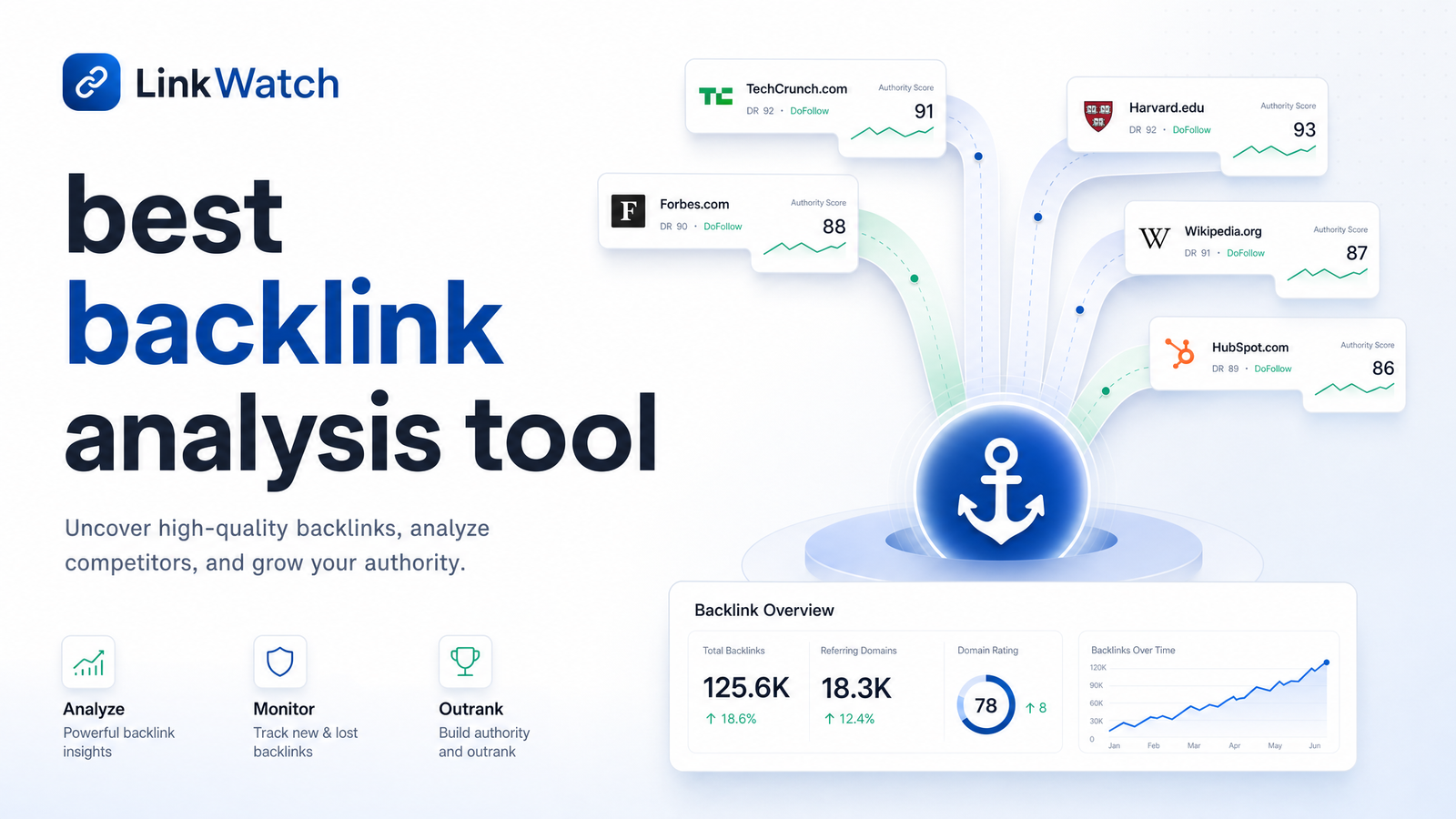
Most articles claiming to name the "best backlink analysis tool" are just rankings of Ahrefs, Semrush, Moz, and Majestic in a different order, with no explanation of why one beat the other. What you need instead is a framework: a set of jobs any backlink tool has to do well, and the metrics that separate real ranking risk from noise. Once you have that, you can evaluate any tool — including ones that don't exist yet — instead of trusting a listicle's opinion.
This guide builds that framework, then applies it honestly to the free-vs-paid decision and shows where backlink analysis fits into a broader SEO workflow, rather than living as yet another disconnected subscription.
What a Backlink Analysis Tool Actually Needs to Do
Strip away the marketing copy, and every credible backlink analysis tool is judged on five jobs. This draws on the core functions outlined in DMA's roundup of backlink analysis tools, and it's a far more useful lens than a feature checklist.
- Find your backlinks. It needs to crawl the web and surface every link pointing to your site, including new and lost links over time — not just a static snapshot.
- Check competitor backlinks. A tool worth paying for lets you pull a competitor's link profile and run a backlink gap analysis: which referring domains link to them but not to you.
- Score authority. It should assign some proxy for link strength, so you can tell a link from a respected industry publication apart from a forgotten directory.
- Analyze anchor text. Over-optimized or spammy anchor patterns are one of the clearest signals of manipulative link building, and a good tool surfaces that distribution automatically.
- Detect toxic links. It should flag link sources likely to be spam, penalized, or actively harmful, so you're not manually eyeballing thousands of rows in a spreadsheet.
Notice that "referring domains" appears throughout this list rather than raw backlink counts. A tool that can't distinguish 200 links from 200 different domains versus 200 links from one spammy site isn't measuring what matters. Keep these five jobs as a scorecard — any backlink checker tool you evaluate should be judged against all five, not just the one or two it markets loudest.
The Metrics That Actually Matter (and the Ones That Don't)
Every platform in this space uses its own scoring system, and that's exactly why confusion sets in. Here's what the major metrics actually mean.
Domain Rating (DR) vs. Domain Authority (DA). These are the two metrics people fixate on most, and the domain authority vs domain rating debate causes unnecessary anxiety. DR is Ahrefs' proprietary 0-100 scale estimating the strength of a site's backlink profile; DA is Moz's equivalent, calculated differently. Neither is a Google ranking factor. They're directional signals for comparing sites within the same tool's ecosystem, not absolute truths to chase for their own sake.
Referring domains vs. raw backlink count. As Neil Patel's comparison of backlink analysis tools points out, the number of unique referring domains linking to you matters far more than total backlink count. Ten links from ten different reputable sites carry more weight than 500 links from one low-quality forum that links to everyone. If a tool's dashboard leads with total backlinks as the headline number, treat that as a vanity metric and dig into referring domains instead.
Anchor text distribution. A healthy profile shows a natural mix — brand names, naked URLs, generic phrases ("click here," "read more"), and only a modest share of exact-match keyword anchors. A profile dominated by identical keyword-rich anchors is a footprint that has historically drawn algorithmic scrutiny.
Spam score and toxicity score. These are typically 0-100 scales estimating how likely a linking domain is to be penalized or associated with link schemes. As Semrush explains in its toxic backlinks guide, these scores are built from signals like domain trust, spammy TLDs, and known Google guidance on link spam — a probability estimate, not a certainty. Trust Flow and Citation Flow (Majestic's metrics) work similarly: Citation Flow estimates link quantity/influence, Trust Flow weights that by the quality of the linking sites, and a big gap between the two is often a red flag on its own.
The takeaway: DR/DA and toxicity scores are useful for triage and comparison, but none should be treated as gospel. They're inputs to a judgment call, not the judgment itself.
How to Judge Backlink Quality, Not Just Quantity
A scary-looking toxicity score doesn't always mean a link is actually hurting you, and a high-DR link doesn't automatically mean it's helping. Backlink quality comes down to a handful of concrete checks you can run against any export.
- Relevance. Does the linking page have any topical connection to your site? A gardening blog linking to a SaaS company is a mild oddity; a payday loan site linking to a hospital is a genuine red flag.
- Dofollow vs. nofollow. Nofollow links don't pass ranking authority the way dofollow links do, but they still contribute to a natural-looking profile and can drive referral traffic — don't dismiss them outright.
- Domain authority thresholds. Backlink Manager's guidance on detecting toxic backlinks suggests treating very low DA/DR domains (often cited around DA 10-15) combined with high spam scores as a strong disavow candidate, while a single low-authority but relevant, real-business link is usually harmless.
- Penalized or de-indexed sources. Check whether the linking domain shows up in Google Search Console or a basic site: search. If a domain has vanished from Google's index entirely, any link from it is worth little and may carry risk.
- Pattern, not single instances. One weird link rarely tanks a site. A cluster of dozens of low-quality, irrelevant, keyword-stuffed-anchor links appearing in a short window is what actually correlates with ranking damage.
Only after running links through this checklist should you consider disavowing toxic backlinks. Google's disavow tool is a blunt instrument — misusing it on links that were actually harmless can strip away authority you didn't need to lose. Reserve it for clear, patterned toxicity, not every yellow flag a dashboard shows you.
Choosing a Tool: Free vs. Paid, and What to Skip
There's no single best backlink analysis tool for every situation — the right pick depends on scale, budget, and how often you need fresh data.
Free tier: Google Search Console and free snapshots. GSC shows you the backlinks Google itself has indexed for your own site, which is genuinely useful and costs nothing, but it won't show competitor backlinks, anchor text breakdowns, or toxicity scoring. Free backlink checker tools from the major platforms typically cap results at a small sample of your top links — enough for a quick sanity check, not enough for a real audit. If you're a solo site owner just confirming you're not sitting on an obvious spam problem, free is enough.
Mid-market paid tools. This is where most freelancers, small agencies, and in-house marketers land. As Neil Patel's roundup notes, pricing across this space commonly runs from roughly $15 to $500+ a month depending on data depth, refresh frequency, and seat count. At this tier you get full referring domain lists, competitor backlink analysis, and reasonably current toxicity scoring — enough to run a real audit and do ongoing backlink monitoring, not just a one-time check.
Enterprise-grade platforms. Larger index sizes, more granular historical data, and API access matter if you're managing dozens of client sites or a large publisher domain. Most single-site owners are paying for scale they'll never use at this tier.
Free tools are fine for spot-checks and a single-domain sanity check; paid tools earn their cost once you need competitor data, historical trend tracking, or manage more than one property. Skip paying enterprise prices for a feature set you could get from GSC and a $15/month tool combined.
Why Backlink Data Alone Isn't Enough — Where It Fits in Your SEO Workflow
A pristine backlink profile doesn't rank a page by itself. Backlink health is one input alongside technical audits, content quality, and rank tracking — and treating it as a standalone problem is exactly how teams end up with four or five overlapping subscriptions: one tool for backlinks, another for rank tracking, another for audits, another for reporting.
That fragmentation is the real cost most "best backlink tool" articles never mention. Every extra login is another dataset you have to manually reconcile before you can tell a boss or client what's actually happening with the site. If you're already comparing this to a broader keyword gap analysis or a free SEO competitor analysis tool, you've probably noticed how often these workflows overlap — competitor backlinks, competitor keywords, and content gaps all describe the same competitive landscape from different angles. Pairing backlink gap analysis with a proper keyword gap analysis gives a fuller picture of where a competitor is actually winning.
This is the gap Rankevra is built to close. Instead of running a backlink checker tool, a separate technical audit crawler, a content platform, and a rank tracker, Rankevra folds backlink monitoring automation into the same AI SEO tool that handles site audits, content publishing, and rank tracking — one dashboard instead of four logins. Link health becomes a signal your automated SEO workflow reacts to, rather than a spreadsheet you check once a quarter and forget. That connection matters for topical authority too: the organic traffic growth strategies that actually work in 2026 treat backlinks, content depth, and technical health as one system, not three separate line items — and if you need to show that system's results to a boss or client, a proper reporting framework makes the case far better than a raw tool export ever will.
Frequently Asked Questions
What's the difference between Domain Authority (DA) and Domain Rating (DR)?
DA is Moz's proprietary 0-100 score estimating a site's ranking strength based on its backlink profile; DR is Ahrefs' equivalent, calculated with a different methodology. Neither is used by Google internally — they're third-party estimates useful for comparing sites within the same tool, not absolute measures of ranking power.
Is a free backlink checker good enough, or do I need a paid tool?
A free backlink checker or Google Search Console is enough for a single-site sanity check, but it won't show competitor backlinks, full anchor text distribution, or reliable toxicity scoring. Paid tools become worthwhile once you need competitor backlink analysis, historical trend data, or manage more than one domain.
How many toxic backlinks does it take to hurt my rankings?
There's no fixed number — a single low-quality link rarely causes damage on its own. Ranking risk correlates with patterns: dozens of low-authority, irrelevant, or keyword-stuffed-anchor links appearing in a short time window, rather than isolated one-off links.
Should I disavow every low-quality backlink a tool flags?
No — disavowing every flagged link, including harmless ones, can strip away authority you didn't need to lose. Reserve the disavow file for clear, patterned toxicity: clusters of irrelevant, spammy-anchor, or de-indexed domains, not every yellow-flagged link in a dashboard.
How often should I run a backlink audit?
A quarterly audit is a reasonable baseline for most sites, with more frequent checks (monthly or via automated monitoring) if you're actively building links, running campaigns, or have been hit by a manual action. Ongoing backlink monitoring catches sudden spam link spikes faster than a periodic manual check.
Can a backlink analysis tool find link-building opportunities, not just problems?
Yes — competitor backlink analysis and backlink gap analysis tools show which referring domains link to competitors but not to you, turning the same data used for toxicity checks into a prospecting list for outreach and content partnerships.
Stop paying for a backlink checker, a rank tracker, and a reporting tool as three separate line items. Rankevra folds backlink monitoring, technical audits, content publishing, and rank tracking into one automated workflow, so link health becomes a signal your SEO process actually acts on rather than a spreadsheet nobody reopens.
Keep reading
- Subdomain vs Subdirectory SEO: The Real Decision FrameworkSubdomain vs subdirectory SEO, resolved: what Google says, what migration data shows, and a 5-question framework to pick the right structure.
- Answer Engine Optimization: A Platform-by-Platform GuideAnswer engine optimization explained for ChatGPT, Perplexity, and Google AI Mode — with a practical, platform-aware framework to earn citations in 2026.
- SEO A/B Testing: A DIY Framework Using Only GSCLearn SEO A/B testing with just Google Search Console and a spreadsheet — hypotheses, page grouping, significance checks, and when to automate.