Rankevra Blog
SEO Content Gap Analysis: A Complete Framework
July 29, 2026
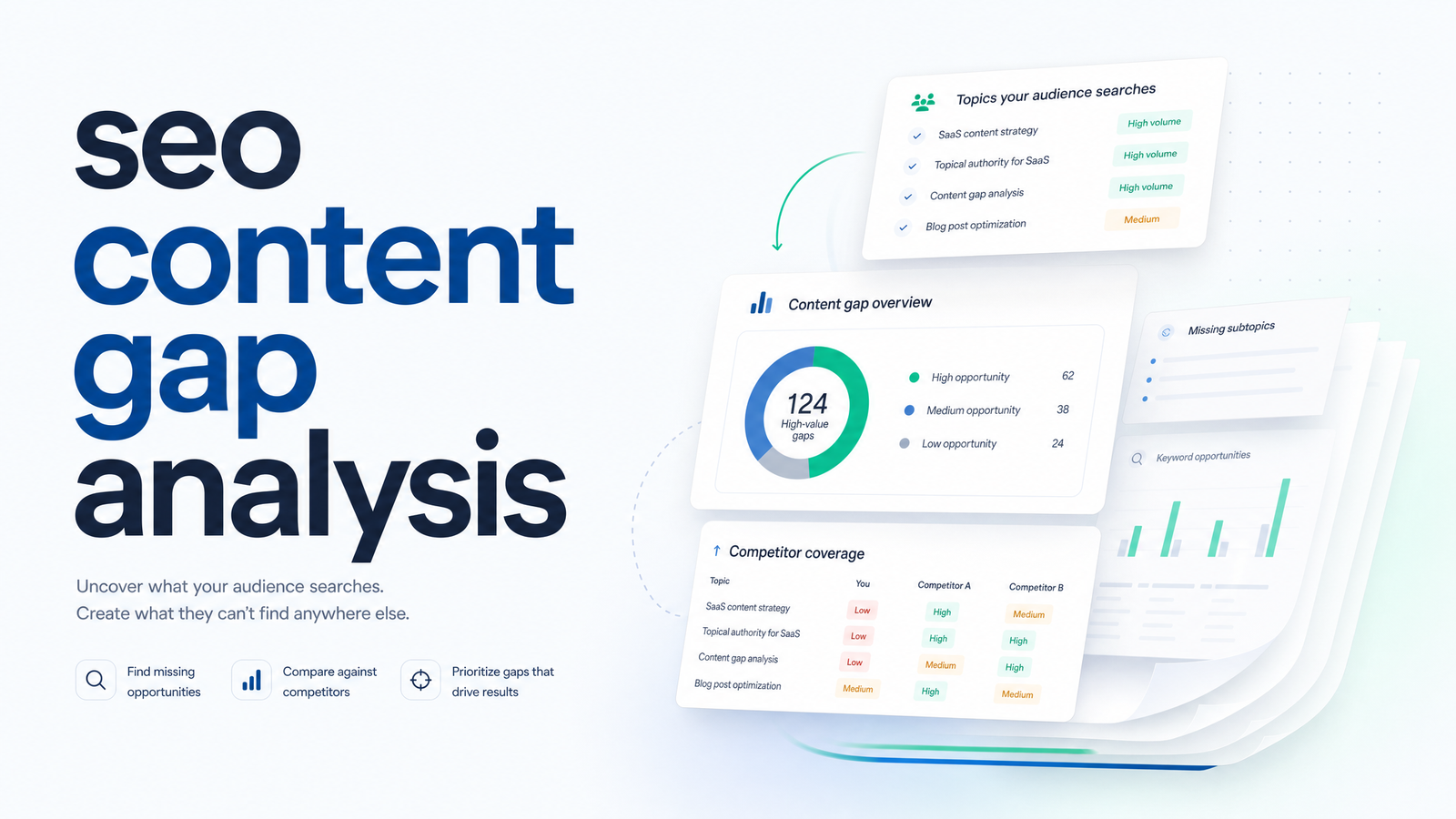
What Is SEO Content Gap Analysis (and How It Differs From Keyword Gap Analysis)
Most guides that promise to teach content gap analysis actually teach keyword gap analysis: export your rankings, export a competitor's, subtract one list from the other, and call the leftover rows "gaps." That's a legitimate exercise — our keyword gap analysis process walks through the five-step mechanic — but it answers a narrower question than most teams think.
SEO content gap analysis is the broader discipline. It asks not just "which keywords do they rank for that I don't," but which topics haven't I covered, which subtopics am I covering shallowly, which formats does the SERP expect that I'm not producing, and which stages of the buyer journey am I ignoring entirely. This content gap vs keyword gap distinction matters because keyword lists only capture what's already been typed into a search box and tracked by a tool. They miss the subject a competitor covers with no single obvious head-term, the comparison table winning a featured snippet, and the awareness-stage explainer that feeds your bottom-of-funnel page with topical context.
Treat keyword gap analysis as one input into content gap analysis, not a synonym for it. The rest of this guide covers the types of gaps a keyword list can't show you, a repeatable process for finding them, and why the AI Overviews era makes closing them differently more valuable than closing more of them.
The 4 Types of Content Gaps You're Probably Missing
Topic gaps are whole subjects your site never addresses. A competitor has built out an entire subcategory of content — pricing guides, use-case pages, integration docs — that you've never attempted because no single keyword report flagged it as urgent. These are the most damaging gaps because they signal to Google (and to AI systems building topical maps) that a competitor has broader domain expertise than you do.
Depth gaps live inside topics you already cover. You have a page on the subject, but a competitor's top-ranking page answers eight subordinate questions and yours answers three. This content depth gap explains why a page can be "about the right topic" and still underperform: it's thin relative to what's already satisfying searchers. Depth gaps are usually invisible in keyword tools because you technically rank for the head term — just not well, and not for the dozens of related questions clustered underneath it.
Format gaps show up in the SERP itself. If competitors' top results include comparison tables, embedded calculators, video walkthroughs, or FAQ blocks that trigger rich results, and your equivalent page is a wall of text, you have a format gap regardless of how complete your writing is. SERP features are a strong signal of expected format — ignore them and you're competing with one hand tied behind your back.
Intent and funnel gaps are missing stages of the customer journey. Maybe you've built strong bottom-of-funnel comparison and pricing content but nothing for the top-of-funnel searcher who's still defining their problem. This search intent gap means you're invisible during the research phase, so competitors capture the relationship early and you're only fighting for the same shopper's attention at the point of purchase — the hardest and most expensive place to compete. These four categories together form your topical authority gaps: the combined picture of where a competitor's site is structurally more complete than yours.
How to Run a Content Gap Analysis: A 5-Step Process
1. Inventory your existing content. Before you can find gaps, you need an honest map of what you already have — every published URL, its target topic, and roughly how it's performing in Google Search Console. Skipping this step is why so many teams re-discover "gaps" they already half-filled two years ago.
2. Identify true SEO competitors, not business competitors. The company you compete with for customers is often not the one you compete with for rankings. A software company selling enterprise contracts might find that a mid-market blog or a review aggregator owns the SERPs for their target terms. Pull the actual domains ranking on page one for your priority topics, not your mental list of rivals.
3. Analyze their top-ranking pages for subtopics, questions, and formats. For each competitor page, note the H2s and H3s, the questions they answer, whether they include tables, videos, calculators, or FAQ schema, and roughly how comprehensive the piece feels. An AI-assisted keyword research tool speeds this up by clustering subtopics and questions automatically instead of you reading twenty pages by hand. Google Trends is also worth checking here — it surfaces emerging subtopics that haven't shown up in competitor content yet, which is exactly the kind of topic gap a static keyword list can't reveal.
4. Cross-reference against your site to list the gaps. For every subtopic, question, or format found in step 3, mark whether you have equivalent coverage. What's left is your gap list — but unlike a raw keyword export, it's organized by topic, depth, format, and funnel stage, not just by search volume.
5. Score and prioritize by traffic potential, ranking difficulty, and business relevance. Not every gap deserves a new page. Weigh estimated traffic against how entrenched the current top-ranking pages are, and against whether the topic connects to something you sell or a topic cluster you're building authority around. A gap that's technically fillable but irrelevant to your business, or dominated by pages you have no realistic chance of outranking soon, is a distraction — log it and move on. Once you've identified real gaps, organizing them into clusters rather than one-off pages compounds their effect on topical authority.
Why Content Gap Analysis Matters More With AI Overviews
Google's AI Overviews change what "covering a topic" means. These summaries are built by pulling from sources that demonstrate topical authority — sites that answer a question comprehensively and, increasingly, sources that offer something the rest of the SERP doesn't: original data, a distinct angle, first-hand experience. That's the concept of information gain, and it's becoming a bigger factor in both AI Overviews SEO and classic organic rankings.
This is why the broader definition of content gap analysis matters more now than when keyword gap spreadsheets were sufficient. Publishing a page that just fills a keyword slot with the same information ten competitors already have doesn't create information gain — it creates the eleventh version of the same page. Closing a depth gap, format gap, or intent gap with something genuinely additive — an original comparison, a more current data point, a clearer explanation of a nuance competitors gloss over — improves your odds of being the source an AI Overview cites, not just the tenth blue link on the page. Topical authority and information gain reinforce each other: the more comprehensively you cover a subject with unique value at each layer, the more likely both traditional rankings and AI summaries treat you as the reference point.
Turning a Gap List Into Published, Ranked Content
Here's the part almost every team gets stuck on: the analysis produces a spreadsheet, the spreadsheet gets reviewed in a meeting, and three months later most of the rows are still unaddressed. The bottleneck isn't finding gaps — it's the manual handoff between finding a gap, writing a brief for it, drafting the content, publishing it, and then remembering to check whether it actually moved rankings. Every one of those steps historically lived in a different tool, and every handoff is where momentum dies.
This is the case for treating content gap analysis as a continuous workflow rather than a quarterly audit, and for automating the handoffs rather than the analysis alone. Rankevra is built around exactly that loop: once a gap is identified, it can generate the brief, draft the content with the subtopics and depth the gap analysis flagged, publish it, and start tracking rankings — all inside one workflow instead of four separate tools and three exported files. If you already have a gap that lives on an existing page rather than needing a new one, pairing this with a content optimization framework closes the same kind of gap without a net-new URL. For gaps that clearly need new pages, an SEO content generator built for this exact handoff turns the brief into a draft without you re-typing your findings into another tool. The result: content gap analysis tools and AI content gap analysis workflows stop being a research exercise and start being a publishing pipeline, one that keeps running instead of resetting every audit cycle.
Frequently Asked Questions
What's the difference between a content gap analysis and a keyword gap analysis?
Keyword gap analysis compares ranking keyword lists between you and a competitor to find terms they rank for that you don't. Content gap analysis is broader — it also examines whole topics you haven't covered, subtopics you've covered shallowly, missing content formats or SERP features, and missing funnel stages, treating the keyword comparison as just one input rather than the whole answer.
How often should I run a content gap analysis?
Run a full gap analysis when planning a new content cluster or quarterly at minimum, but treat gap-finding as an ongoing process rather than a one-time audit. Competitors publish continuously, so a gap list from six months ago is already stale; automating the discovery-to-publishing workflow keeps it current without repeating manual work.
What tools do I need to find content gaps?
At minimum you need a way to see competitor rankings, a way to analyze their top pages' subtopics and formats, and Google Search Console to understand your own current coverage. AI-driven platforms like Rankevra consolidate competitor analysis, brief creation, drafting, and rank tracking into one workflow instead of requiring separate tools for each step.
Does content gap analysis still matter now that Google shows AI Overviews?
Yes, arguably more than before. AI Overviews favor topically comprehensive sources that demonstrate information gain, so closing content gaps with unique depth or perspective — not just matching existing coverage — improves both traditional rankings and your odds of being cited in an AI-generated summary.
How do I prioritize which content gaps to fill first?
Score each gap on estimated traffic potential, how entrenched the current top-ranking pages are, and how closely the topic connects to your business or existing topic clusters. A gap with decent volume that's irrelevant to what you sell, or dominated by pages you can't realistically outrank soon, should be deprioritized in favor of gaps that build on topics where you already have some authority.
Can content gap analysis find gaps that aren't tied to any keyword?
Yes — format gaps and funnel-stage gaps often exist independent of any single keyword. A missing comparison table, video, or FAQ block that competitors use to win a SERP feature, or an entire awareness-stage topic your funnel skips, won't necessarily show up as a distinct row in a keyword export, but both directly affect whether you compete for a searcher's full journey.
Running this analysis manually gets you a gap list. Turning that list into live, ranking pages is the part that stalls most teams at the brief-writing and publishing stage. Rankevra automates that handoff — from gap identification to a published page with rankings tracked — so you can close gaps continuously instead of once a quarter.
Keep reading
- Crawl Budget Optimization: A Diagnostic Framework for 2026Learn whether crawl budget optimization actually applies to your site, how to diagnose crawl waste in GSC, and a prioritized fix list for 2026.
- Multilingual SEO Strategy: Skip the Hreflang TrapA practical multilingual SEO strategy that treats hreflang as insurance, not a growth lever — plus how to automate audits, content, and tracking per locale.
- Will Google Penalize AI Content in 2026? The Real AnswerDoes AI content detection SEO actually affect rankings? Here's what Google's spam policies and the March 2026 core update really show.