Rankevra Blog
Content Decay SEO: How to Detect and Fix It Before Rankings
September 10, 2026
What Content Decay Actually Is (and Isn't)
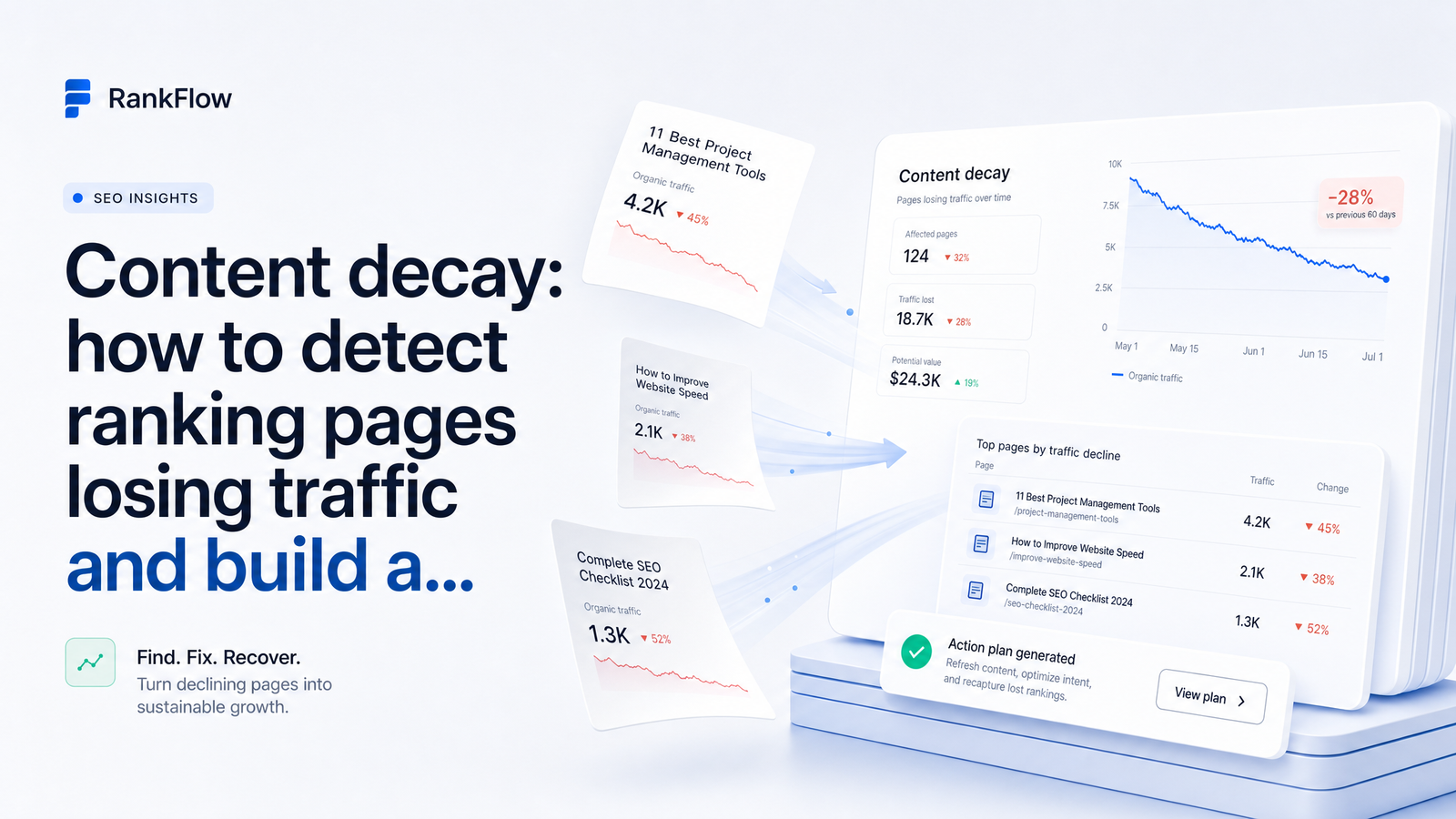
Content decay SEO refers to a measurable, sustained decline in organic clicks to a page over an 8-to-12-week window, with no corresponding drop in search demand for the topic. If searches for a topic dry up, that's demand loss, not decay. If your page's clicks fall while overall demand and ranking position stay roughly flat, that's the signature of decay: the page is losing relevance, freshness, or competitive edge even though nothing catastrophic has happened.
This differs from a decline caused by a broken template, a botched migration, or a manual penalty — those show up as sharp, page-wide or site-wide drops tied to a specific date. Decay is slower and quieter — a page that was a top-5 result a year ago sliding to position 8, or a page holding position 4 but losing a third of its clicks because a competitor's snippet, an AI Overview, or a fresher piece of content is siphoning the click.
The scale of this problem is easy to underestimate because it never shows up as one alarming event. Ahrefs' large-scale study on content decay found that a substantial share of ranking pages lose meaningful traffic over time even without any external shock — decay is the default trajectory for content, not the exception. Left unaddressed across a few hundred URLs, that "nothing happened" pattern compounds into a real revenue problem: no single page trips an alert, but the sum of quiet, individually-small losses is often the majority of a site's traffic erosion. SiteGuru's breakdown of small monthly losses compounding over time illustrates this well — a 3-4% monthly drop looks like noise in a weekly report but adds up to a halved traffic number within a year.
The Early Warning Signals: Detecting Decay Before It's Obvious
The mistake most teams make is watching the wrong window and the wrong metric. Week-over-week Google Search Console data is dominated by noise — indexing lag, crawling variance, and normal SERP volatility. To detect content decay reliably, compare rolling 3-to-6-month windows against the equivalent prior period, not day-to-day or month-to-month snapshots.
The second mistake is treating position and clicks as the same signal. A page can hold its exact ranking position while clicks fall 20-40% because a new AI Overview box, a featured snippet, or a richer competitor result absorbs the click before the user ever scrolls to your listing. If you only watch average position in your rank tracker, this kind of decay is invisible; if you watch clicks and impressions, it's obvious.
Practically, this means building a GSC declining-pages filter: pull the Performance report for pages with meaningful clicks in the trailing 12 months, split it into two 3-month blocks, and flag any page where clicks fell but impressions stayed flat or grew. Flat impressions with falling clicks usually means CTR drift — often because your title/snippet is stale relative to what's now ranking around you. Falling impressions with flat clicks points to a different problem: you're being pushed out of the eligible result set for some queries entirely, closer to a relevance or indexing issue than classic decay. Google Search Console's Performance report is the right lens for this comparison, but doing it by hand across hundreds of URLs every quarter is exactly the bottleneck this article eventually addresses.
Scoring Pages: Real Decay vs. Normal Noise
Not every dip is worth acting on, and not every page deserves the same attention. A lightweight scoring model separates real decay signals from statistical noise and tells you where to spend your limited refresh capacity.
Score each flagged page on four dimensions:
- Lost clicks, in absolute terms — a page that dropped from 40 to 20 monthly clicks lost the same percentage as one that dropped from 4,000 to 2,000, but the second is the actual business problem. Prioritizing by lost clicks vs. percentage prevents you from spending a week rewriting a low-traffic page while a real revenue leak sits untouched.
- Traffic value — weight lost clicks by conversion relevance. A decaying commercial or comparison page is worth more attention than a decaying top-of-funnel definition page with the same click loss.
- Duration of the trend — a decline sustained across three consecutive months is structural. A one-month dip that's already recovering is noise, often seasonal.
- Competitive displacement — pull the current SERP for the target query and check who's above you now versus a year ago. If newer, more comprehensive, or more authoritative pages have moved in, that's a competitive cause, not a content problem you can necessarily out-optimize with a light edit.
Run this scoring pass quarterly and rank the output by lost-clicks score. That ordered list is your refresh queue — not a gut-feel guess about which pages "seem old."
The Refresh Decision: Refresh, Rewrite, Merge, or Prune
Once a page is confirmed as genuinely decaying and prioritized by lost-clicks impact, the next question is what to do about it. This is where most teams default to "refresh everything," which wastes effort on pages that should be merged or removed instead.
Refresh when the core structure and intent match are still correct but the information is stale — outdated statistics, old screenshots, pricing that's changed, or missing recent developments. This is the cheapest fix and the right default for high-value pages where competitive displacement isn't severe.
Rewrite when search intent for the query has shifted since you published — for example, a query that used to want a definition now wants a comparison or a tool. If the page's format no longer matches what's ranking above it, editing paragraphs won't fix that; the structure itself needs to change.
Merge when keyword cannibalization is the real cause — two or more pages on your site competing for the same query, splitting authority and confusing Google about which one to rank. Consolidate the weaker page into the stronger one and use a 301 redirect to pass its equity forward instead of leaving both to decay in parallel.
Prune when the page has low traffic value, no realistic path to recovery, and no cannibalization or merge target — content pruning removes dead weight that dilutes topical authority and wastes crawl budget without giving anything back. This is also the right call for pages built around outdated intent nobody searches for anymore.
Tie every decision back to page value, not just cause. A high-value page suffering from competitor displacement might still deserve a rewrite investment; a low-value page with the same cause is a prune candidate.
Building the Refresh Pipeline: From One-Off Fixes to a Repeatable System
A single refresh round fixes today's decay but doesn't stop next quarter's. The goal is a content refresh pipeline — a recurring system, not a one-time cleanup project.
A workable cadence looks like this: run the detection-and-scoring pass every quarter, not annually — annual audits let decay compound for up to twelve months before anyone notices, long enough for a page to fall out of the top 10 entirely. Assign each flagged page an owner and a due date in a queue, rather than a shared spreadsheet nobody's accountable for. After a refresh ships, set a watchlist period — typically 4-6 weeks, matching Google's typical re-crawl and re-ranking timeline — before judging results. Pages that don't recover in that window get looped back into the next quarter's triage rather than marked "done" and forgotten.
This loop — detect, score, triage, refresh, watch, reassess — turns content decay management from an occasional fire drill into a maintenance habit, the same way you'd treat technical SEO monitoring or rank tracking. It also builds topical authority over time: consistently keeping your best pages current signals to Google — and increasingly to AI Overviews pulling source material — that your site is an actively maintained, trustworthy reference, reinforcing E-E-A-T rather than letting it erode page by page.
Why This Is Hard to Sustain Manually — and How Automation Changes It
The mechanics above are straightforward individually. The problem is stitching them together at scale. Detecting decay means exporting GSC data. Scoring it means cross-referencing traffic value and SERP position changes. Triage means manually opening competitor pages to check displacement. Verification means remembering to check back in six weeks per page. Across a handful of URLs, a spreadsheet works. Across a few hundred, it collapses — exports go stale, someone forgets the watchlist check, and the queue quietly stops being maintained by month two.
This is precisely the gap automation closes. Instead of quarterly manual exports, continuous monitoring flags declining pages as the trend emerges, using the same clicks-vs-position and lost-clicks logic described above, but running constantly instead of once a quarter. An AI SEO tool that automates content refresh doesn't just flag the problem — it can draft the updated content against the current top-ranking pages for that query, route it for review, and republish directly to your CMS, closing the loop between detection and action in days instead of the weeks a manual process takes.
Rankevra is built around exactly this workflow: continuous rank and traffic monitoring, decay scoring, AI-assisted refresh drafting, and direct publishing, so content decay automation replaces the spreadsheet triage most teams eventually abandon. Rankevra — the end-to-end AI SEO workflow, on autopilot is designed to keep this detect-to-republish loop running without a human having to remember to run it.
Frequently Asked Questions
How is content decay different from a Google algorithm update hit?
Content decay is a gradual, page-specific decline in clicks over 8-12 weeks with stable ranking position and stable search demand, while an algorithm hit is a sudden, often site-wide drop tied to a specific update date. Decay happens because the content itself is aging relative to competitors; an algorithm hit happens because Google changed how it evaluates sites generally. Checking whether the drop lines up with a documented SERP volatility event is the fastest way to tell them apart.
How much of a traffic drop counts as content decay versus normal fluctuation?
A drop is worth treating as decay when clicks fall meaningfully across a sustained 8-to-12-week comparison against the prior equivalent period, with position and impressions staying roughly flat. A single week or month of lower clicks that recovers on its own is normal fluctuation, not decay. The key filter is duration and consistency, not the size of any one week's dip.
How often should I audit my site for content decay?
Quarterly is the practical minimum for most sites, since an annual cadence lets decay compound for up to a year before detection. Sites with large content libraries or fast-moving topics benefit from continuous monitoring rather than fixed audit dates, since decay can start well before a scheduled quarterly check.
Should I refresh, rewrite, merge, or delete a decaying page?
The choice depends on root cause, not just traffic loss: refresh stale-but-structurally-sound pages, rewrite pages where search intent has shifted, merge pages competing against each other via keyword cannibalization, and prune low-value pages with no recovery path. Matching the fix to the actual cause avoids wasting effort — refreshing a page that really needs a full rewrite rarely recovers lost traffic.
Can content decay happen to pages that are less than a year old?
Yes — decay is driven by competitive and relevance shifts, not page age. A six-month-old page can decay quickly in a fast-moving topic if competitors publish more comprehensive or fresher content, or if a new SERP feature like an AI Overview changes how clicks are distributed.
What's the difference between ranking decay and click decay?
Ranking decay means a page's average position is genuinely dropping in the SERP, while click decay means clicks are falling even though position stays flat — usually due to CTR drift from stale titles/snippets or new SERP features absorbing attention. Click decay is more common and easier to miss, since most rank trackers only surface position changes.
Running this detect-score-triage-refresh-verify loop by hand across dozens or hundreds of pages every quarter is the kind of repetitive, data-stitching work that doesn't scale with spreadsheets and manual GSC exports. Rankevra continuously monitors rank and traffic signals, scores decaying pages automatically, and connects the fix directly to publishing — so content decay gets caught and corrected on a loop, not rediscovered every year by accident.
Keep reading
- Visual Search SEO: The Complete Framework for 2026A practical visual search SEO framework covering image access, alt text, filenames, and video schema — plus how to audit it all at scale.
- SEO Audit Workflow: Merge Crawl, GSC & Rank DataA repeatable SEO audit workflow that joins crawl data, GSC, and rank tracking into one prioritized fix list — instead of three disconnected reports.
- JavaScript SEO: Diagnose & Fix Rendering Indexing IssuesJavaScript SEO issues explained by symptom: empty indexed pages, missing content, wrong meta tags. Framework-specific fixes for React, Vue/Nuxt, Next.js.