Rankevra Blog
Best SEO Rank Tracker in 2026: How to Actually Choose
July 26, 2026
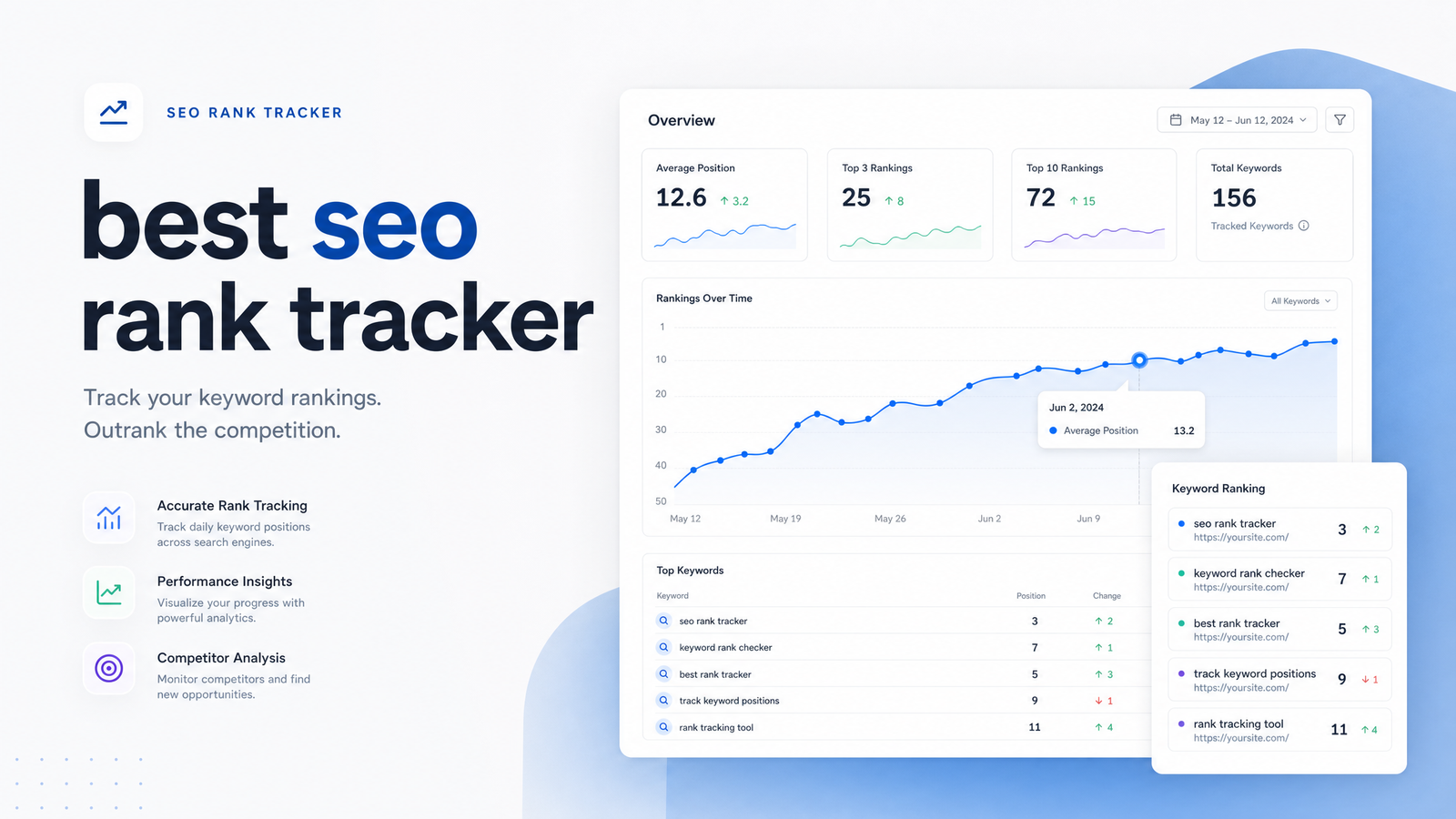
Picking the best SEO rank tracker used to be simple: whichever tool refreshed positions fastest and covered the most search engines won. That test doesn't hold up anymore. Rankings now sit alongside AI Overviews, zero-click answer boxes, and shifting pixel depth on mobile, so a "position 3" result can drive real traffic on one query and almost none on another. This article sets a sharper bar for what "best" means in 2026, compares the main categories of tools by use case, and explains why rank data that lives in its own dashboard — disconnected from your audits and content — is a workflow problem, not just a reporting inconvenience.
What Makes a Rank Tracker 'Best' in 2026 (Not Just Accurate)
Rank tracking accuracy is still table stakes — you need a tool that pulls real, localized SERP data rather than modeled estimates. But accuracy alone doesn't tell you whether a ranking actually matters. According to Rank Tracking In 2026: 10 Tips For The AI-First Era, AI Overviews and other SERP features now occupy a growing share of mobile screen space, pushing organic listings further down even when the reported position hasn't changed. A tool that only reports "you're #4" without showing what sits above that spot is giving you half the picture.
A genuinely capable tracker in 2026 needs to cover four things:
- Update frequency that matches how volatile your keywords are — daily for competitive commercial terms, weekly is fine for long-tail content.
- Location and device granularity, since a national average position can mask big swings in specific cities or on mobile versus desktop.
- SERP feature and AI Overview tracking — flagging when a featured snippet, AI Overview, or shopping carousel is present, and ideally whether your domain is cited inside it.
- Integration with the rest of your SEO workflow, so a drop in position connects to the audit issue or content gap causing it, instead of sitting as an isolated alert.
8 Best Rank Tracking Tools for SEO in 2026 - SEOptimer is a useful benchmark — it lays out the location coverage, SERP feature counts, and device-tracking depth that separate the top tier from the rest. Use it as a checklist, not a leaderboard: the "best" tool is the one that hits all four criteria for your setup, not the one with the longest feature list.
The Top SEO Rank Trackers, Compared by Use Case
Rather than reviewing fifteen near-identical tools, it's more useful to think in three categories.
All-in-one suites — Semrush and Ahrefs are the default choice for teams that want rank tracking bundled with backlink analysis, keyword research, and site audits in one login. Semrush is strong on competitor position comparisons and SERP feature visibility; the Ahrefs rank tracker pairs well with its keyword database for spotting new opportunities as positions shift. Both are solid if you already live in one of these platforms — the rank data is a feature, not the core product, so tracking depth (update frequency, hyper-local data) can lag dedicated tools.
Specialist trackers — SE Ranking and AccuRanker exist because some teams need tracking deeper and faster than what a suite offers. AccuRanker is built for scale and speed, popular with agencies tracking large keyword sets across many client sites with near-real-time updates. SE Ranking sits in between — more affordable than the enterprise specialists, with solid local and device-level granularity, aimed at agencies and mid-size teams that need precision without an all-in-one price tag. If your primary need is pure position accuracy at volume, this is the category to shop in.
AI-native workflow tools — Rankevra sits apart from both categories because rank tracking isn't a standalone module bolted onto a suite; it's one input feeding a connected system that also audits, writes, and publishes. This matters most for teams without the bandwidth to manually correlate a ranking drop with a crawl error or content gap — the tool does that correlation for them. It's the right fit for site owners and lean marketing teams who want fewer dashboards, not more data points to reconcile by hand.
None of these categories is universally "best" — the right pick depends on whether you're optimizing for raw tracking depth, bundled research features, or a workflow that closes the loop automatically.
The Problem With Treating Rank Tracking as a Standalone Tool
Most SEO tool stacks look the same: a rank tracker flags that a page dropped from position 4 to 11, and that's where the tool's job ends. Nobody's alerted to why. Was it a technical issue — a broken canonical tag, a slow-loading template? Did a competitor publish deeper content? Did an AI Overview absorb the click-through that used to go to your listing? The tracker doesn't know, and it doesn't try to.
This is the core weakness of running rank tracking as an isolated line item in your SEO tool stack. It generates an alert, someone exports the data into a spreadsheet, cross-references it against a separate audit tool, maybe checks Google Search Console for click and impression trends, and only then starts investigating. That's hours of manual triage per week for teams managing more than a handful of pages — and it's exactly the kind of disconnected SEO tools problem that compounds as a site grows. Our technical SEO site audit guide walks through the audit side of this gap — worth reading alongside your rank data, since a ranking drop without an audit trail is just a symptom without a diagnosis.
The fix isn't a better spreadsheet. It's not treating rank tracking as a standalone product at all.
How Rankevra Ties Rank Tracking to the Rest of the Workflow
Rankevra rank tracking is built to answer "why," not just "what changed." When a keyword's position drops, the system checks it against the same audit engine already scanning your site — so a fall that correlates with a new crawl error, a broken internal link, or a slow page gets flagged as a likely cause automatically, rather than requiring a separate audit.
The same connection works on the content side. If a drop lines up with a competitor's fresher, more comprehensive page rather than a technical fault, Rankevra can surface the content gap and route it into its content creation workflow — turning a ranking alert directly into a brief for the page that needs updating or building. Once that content is ready, publishing happens from the same system, and the rank tracker keeps watching the keyword to confirm whether the fix worked.
That's the practical meaning of an AI SEO tool built as an automated workflow rather than a bundle of separate features: audits, content, and publishing all reference the same rank data, so a drop triggers a diagnosis and a next step instead of just a notification. It won't replace judgment on strategic calls, but it removes the manual stitching-together that eats up hours in a typical disconnected setup.
Quick Decision Guide: Which Rank Tracker Fits Your Situation
Choosing a rank tracker gets easier once you frame it around team size, keyword volume, and primary goal rather than feature checklists.
Solo site owner or very small team, under a few hundred keywords, goal is fixing technical issues and steady traffic growth. Look for a tracker paired with an audit tool — you need diagnosis, not just data. An integrated option like Rankevra earns its keep here, since you likely don't have a dedicated SEO hire to manually connect rank drops to root causes.
In-house marketing team, a few hundred to a few thousand keywords, goal is building topical authority across a content hub. You need SERP feature and AI Overview visibility alongside standard position tracking, so you can tell whether a "stable" ranking is quietly losing clicks to an Overview box above it. A tool that ties tracking to content planning saves the step of manually mapping which topics need deeper coverage.
Agency managing multiple client accounts, high keyword volume, goal is scalable reporting and fast reaction to client-visible drops. This is squarely agency territory — AccuRanker or SE Ranking's scale and update speed matter more here than an all-in-one bundle, especially if client reporting is a heavy part of the job. Our SEO reporting software buyer's framework is a useful companion read if reporting output matters as much as tracking itself.
Enterprise team already invested in a suite for backlinks and keyword research. Semrush or Ahrefs make sense if the rank tracker just needs to slot into tools you already pay for and use daily — the switching cost of a specialist tool likely isn't worth it unless tracking accuracy is actively costing you decisions.
Whatever you choose, cross-check tracker data against first-party numbers. Google Search Console Tips That Actually Drive Action covers how to use Search Console's click and impression data as a sanity check against any third-party tracker, since it's the only source showing what Google itself recorded for your site. And if the end goal is broader organic growth rather than just rank movement, Organic Traffic Growth in 2026: What Actually Works Now frames how tracking fits into that bigger picture. For a deeper look at evaluation criteria, the 2026 evaluation framework is worth bookmarking.
Frequently Asked Questions
Is Google Search Console enough for rank tracking, or do I need a separate tool?
Search Console gives accurate first-party click and impression data, but it doesn't show competitor positions, SERP features, or location-specific rankings the way a dedicated tracker does. Most teams use both: Search Console to verify what Google actually recorded, and a rank tracker for competitive context and daily monitoring. Relying on Search Console alone leaves you blind to what's happening above your listing in the SERP.
How often should keyword rankings be checked — daily or weekly?
Daily checks make sense for competitive, high-value commercial keywords where small position shifts affect revenue, while weekly tracking is sufficient for long-tail or informational content that moves less often. Checking too infrequently means missing the early signal of a technical issue or a competitor's new content. Match the frequency to keyword volatility rather than checking everything on the same schedule.
Do rank trackers actually show accurate AI Overview appearances?
Top-tier trackers now flag when an AI Overview, featured snippet, or other SERP feature appears for a tracked keyword, though detection accuracy and citation-level detail vary by provider. Treat AI Overview tracking as directional rather than perfectly precise, and prioritize tools that at least confirm the feature's presence alongside your position. This context matters more than the raw rank number, since an Overview above your listing can suppress clicks even at position one.
What's the difference between a rank tracker and an SEO audit tool?
A rank tracker monitors keyword positions over time, while an SEO audit tool scans your site for technical issues like broken links, slow pages, or crawl errors that could be causing those position changes. The two are complementary, not interchangeable — a rank drop tells you something changed, but an audit tells you why. Tools that connect the two automatically save you from manually cross-referencing separate dashboards.
Can a free rank tracker be trusted for real business decisions?
Free rank trackers can work for casual monitoring of a small keyword set, but they typically update less frequently and offer less location or device granularity than paid tools. For decisions tied to revenue or client reporting, the update frequency and accuracy gaps in free tools become a real risk. Use free tools for spot checks, not as the sole source for strategic calls.
How many keywords should a small business track at once?
Most small businesses get solid signal from tracking their top 50 to 200 keywords — covering primary service or product terms, top blog topics, and a handful of competitor comparison terms. Tracking thousands of keywords with no strategy behind them adds noise without insight. Start narrow, focused on terms tied to actual business goals, and expand as you identify new content gaps worth monitoring.
Stop exporting rank data into a spreadsheet just to figure out what to fix next. When audits, content, publishing, and rank tracking live in one system, a ranking drop already comes with a diagnosis attached. See how it works at Rankevra.
Keep reading
- E-E-A-T SEO: A Checklist for Scaling Content With AIA practical E-E-A-T SEO checklist for teams scaling content with AI — what triggers scaled content abuse, and how to gate every page before it publishes.
- Schema Markup for SEO in 2026: What Still WorksSchema markup for SEO in 2026: which types still earn rich results after FAQ's removal, what's hype for AI Overviews, and how to stay current.
- How to Improve Core Web Vitals: A Measure-Fix-Verify LoopLearn how to improve Core Web Vitals with a repeatable measure-diagnose-fix-verify loop covering LCP, INP, and CLS — no developer required.