Rankevra Blog
Google Algorithm Update Recovery: A Diagnostic Framework
September 30, 2026
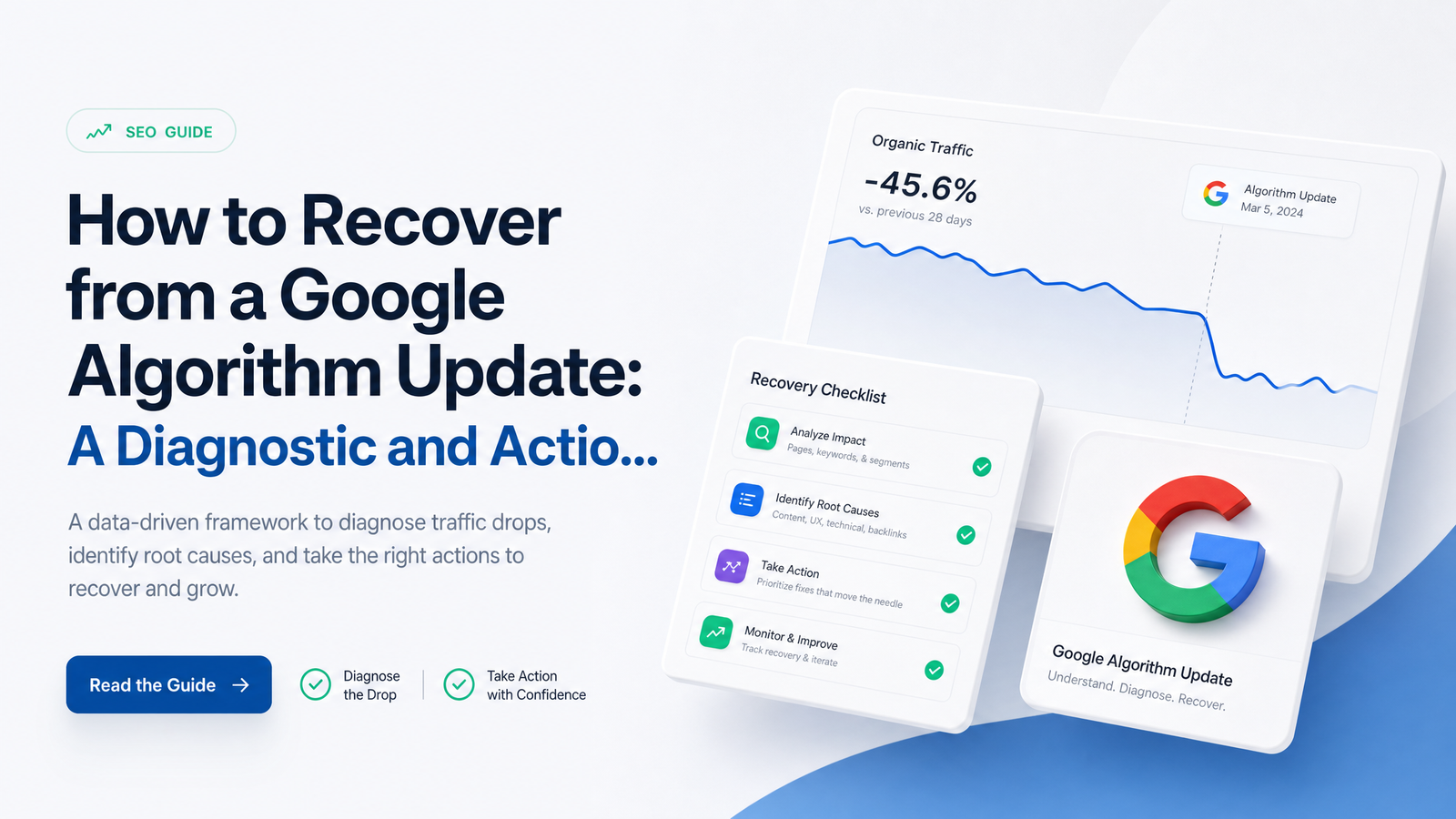
Traffic falls off a cliff, someone screams in Slack, and within an hour there are three competing theories: it's a core update, it's a bug from Tuesday's deploy, or Google just hates you now. Real google algorithm update recovery starts by refusing to act on any of those theories until you've confirmed which one is true. Panic-editing pages that never needed editing wastes weeks and can make things worse. This is a diagnostic problem before it's an action problem — treat it like one.
Was It Really an Algorithm Update? Confirm Before You Act
Before touching a single page, confirm the timing. Check the Google Search Status Dashboard and cross-reference the date your traffic moved against any announced rollout. Core updates typically take one to two weeks to fully roll out, and drops that start mid-rollout and stabilize afterward signal an algorithmic shift rather than a fluke.
Next, rule out a manual action. Open Google Search Console's Manual Actions report — a two-minute check that settles the manual action vs algorithm update question immediately. A manual action names a specific violation and requires a reconsideration request; an algorithmic drop won't appear there at all, because nothing was "actioned" against you — the ranking systems simply reassessed your relative value.
Then rule out yourself. Did a deploy ship around the same date? Did someone add a stray noindex, break canonical tags, or migrate URLs without redirects? Did Core Web Vitals crater after a template change? These self-inflicted causes produce drops that look identical to an algorithm hit in Analytics but have completely different fixes — often fixable in days once found. Only once the timing matches a known rollout, no manual action exists, and no technical mistake explains it, should you conclude it was genuinely an update.
Diagnose the Type of Drop: A Decision Tree
With the basics confirmed, classify the drop properly — each category needs a different playbook.
- Whole site, coincides with a core update date, no manual action → likely a core update reassessment of overall quality and relevance.
- Specific pages/sections only, coincides with a spam-focused update → likely a spam update targeting scaled content, doorway pages, or manipulative link patterns rather than your whole domain.
- Manual action flag present → not algorithmic at all; follow Search Console's stated violation and file reconsideration once fixed.
- No date correlation with any announced update → probably technical: a deploy, indexing issue, or Core Web Vitals regression. Start with the technical SEO priority action plan rather than rewriting content.
This google algorithm update checklist — timing, breadth, manual action status — is usually enough to diagnose a ranking drop correctly within an afternoon, instead of a week of guessing.
Segment the Damage: Pages, Queries, Templates, Intent
"The whole site dropped" is rarely true on inspection — usually a handful of templates or intents drag the average down while other sections hold steady or grow. Pull your Search Console data and segment by URL pattern, query intent, and page template rather than looking at the aggregate.
Ask specifically: which pages lost rankings, and what do they have in common? Are they all thin category pages, aging blog posts, or a specific content type like listicles or comparison pages? Did informational queries drop while transactional queries held? Is one template (say, product pages missing structured data) disproportionately affected? Template-level drops point straight at the fix — if every affected page shares a thin author bio or missing schema, that's your lead, not a coincidence. For the mechanics of pulling and slicing this data efficiently, the Search Console tips guide covers the execution details worth applying here.
Run Google's Self-Assessment Against the Pages Now Outranking You
Once you know which pages dropped, don't guess at "better content" in the abstract — benchmark against whoever gained the rankings you lost. Google publishes self-assessment questions for exactly this purpose, covering originality, depth, first-hand experience, and whether content demonstrates E-E-A-T — experience, expertise, authoritativeness, trust.
Pull up three or four competitors now outranking your affected pages and score both sides against the same questions: Does this page show evidence the author actually did the thing they're writing about? Is there original data, testing, or a point of view, or is it a reshuffle of what's already ranking? Would someone reading this walk away satisfied, or need to search again? Is authorship and expertise clear, or anonymous? John Mueller has repeatedly reiterated that these questions aren't a checklist to game superficially — they describe the actual signals Google's systems try to approximate, so the gap you find here is usually the real gap.
This comparative exercise turns "our content needs to be better" into something concrete: your competitor has a practitioner byline and a proprietary benchmark table, yours has neither. That's a specific, fixable gap. For a structured way to run this comparison at scale across many pages, the content gap analysis framework is built for exactly this diagnostic step.
Sequence the Fixes by How Fast They Can Actually Move
Not every fix moves the needle on the same timeline, and sequencing them wrong is how teams burn three months on a content rewrite when a crawlability bug was the bigger lever. A workable core update recovery checklist prioritizes by speed of impact:
Days to weeks — technical fixes. Broken canonicals, accidental noindex tags, crawl budget waste, and Core Web Vitals regressions are fast to fix and fast to register once Google recrawls. These won't drive a core-update-sized recovery on their own, but they remove noise from your diagnosis and are table stakes regardless. Route execution to the technical SEO action plan.
One to three months — content depth and E-E-A-T rebuilds. Adding genuine first-hand experience, tightening authorship signals, and closing the specific gaps found in your competitor benchmark take longer because they require real work and then reassessment time from Google's systems.
Weeks to months — structural consolidation. Merging thin, overlapping, or cannibalizing pages into stronger consolidated ones is a medium-speed lever — the technical merge is quick, but the ranking signal needs to accumulate on the surviving URL.
Prioritizing technical fixes first isn't about them being more important — it's about clearing confounding variables so your content work gets a clean read on whether it's working.
Set a Realistic Recovery Timeline
This is the section to screenshot for your stakeholders. Technical fixes can show partial recovery within days to a few weeks, since they mostly require Google to recrawl and reprocess. Content and E-E-A-T improvements take longer to register — realistically one to three months — because Google's systems need to reassess quality signals across enough of your site, not just the one page you edited.
Full recovery from a core update reassessment is often tied to the next broad core update rather than a continuous drip of improvement in between. Google's own documentation and third-party framing — including Search Engine Land's core update recovery guide — describe recovery in phases rather than a single event, and note that meaningful re-ranking for improved pages often waits for the next core update to fully process. With core updates and related rollouts landing roughly every three to four months recently — Search Engine Land's update tracker has documented a cadence including a March core update and expectations of further updates through the year — a site that fixes real issues in April might not see the full reward until the next broad update, even though the underlying pages were already better.
That's an uncomfortable answer for a stakeholder wanting a date, but it's the honest one: don't promise recovery by next month, and don't conclude a fix "didn't work" after three weeks of silence. Track rankings consistently across this whole window rather than checking sporadically — a rank tracker built for this kind of monitoring makes it obvious whether you're trending up before the next update even lands.
Automate the Diagnose-Rebuild-Reassess Loop
Here's the part generic advice skips: this entire cycle — confirm, diagnose, segment, benchmark, fix, wait, reassess — doesn't happen once. It repeats every time Google ships a core update, and at three-to-four-month intervals, that's several full diagnostic cycles a year, on top of spam updates and Discover-related shifts in between. Doing this manually across every page, template, and competitor set each time doesn't scale for most in-house teams, which is exactly why so much "recovery" work stalls after the first pass. The SEO automation workflow guide is a useful gut-check on which parts of this loop genuinely benefit from automation versus needing a human judgment call.
Rankevra was built around this exact loop instead of one slice of it. It runs the audit that flags technical and Core Web Vitals issues, uses AI to draft content fixes aligned with the gaps you'd otherwise find manually by benchmarking competitors, publishes those fixes, and keeps tracking rankings afterward — so the next time an update lands, you're not starting the diagnosis from zero with five disconnected tools.
Frequently Asked Questions
How long does it take to recover from a Google algorithm update?
Technical fixes can show partial improvement within days to a few weeks once Google recrawls affected pages. Content and E-E-A-T improvements typically take one to three months to register, and full recovery from a core update reassessment is often tied to the next broad core update, which recently has landed roughly every three to four months.
How do I know if a traffic drop was caused by an algorithm update or something else?
Check the Google Search Status Dashboard for a rollout date matching your drop, check Search Console's Manual Actions report for a penalty flag, and rule out self-inflicted causes like deploys, noindex tags, or migrations. If the timing lines up with a known update, no manual action exists, and no technical mistake explains it, it's likely algorithmic.
Is a core update ranking drop the same as a Google penalty?
No. A manual action is a specific penalty applied by a human reviewer for a named violation, visible in Search Console, and requires a reconsideration request to reverse. A core update ranking drop is algorithmic — no violation is named because none occurred; Google's systems simply reassessed your pages' relative quality and relevance against everything else being reevaluated.
Should I rewrite or delete pages that lost rankings after an update?
Only rewrite or delete pages you've confirmed have a real, specific gap versus the competitors now outranking you — not every page that dropped. Panic-editing or deleting pages without segmenting the damage and benchmarking against winners wastes effort and can remove pages that didn't actually need it.
Can I recover before the next core update rolls out?
Partially — technical fixes and some content improvements can show gains between updates since Google recrawls and reprocesses signals continuously. But a full re-ranking that reflects deeper content and E-E-A-T improvements often doesn't fully materialize until the next broad core update processes those changes at scale.
Do Core Web Vitals and technical SEO matter in core update recovery?
Yes, but as a supporting factor rather than the primary lever behind most core update drops, which are more often about content quality and relevance. Core Web Vitals issues are worth fixing early because they're fast to resolve and remove confounding variables from your diagnosis — see the detailed evidence breakdown for how much weight they actually carry.
Once you've confirmed the cause, segmented the damage, and named the specific gap against competitors, the real bottleneck isn't knowing what to fix — it's doing the audit, the rewrite, and the re-tracking by hand every single time Google ships another update. Rankevra automates that loop end to end: audit, AI-drafted content fixes, publishing, and ongoing rank tracking, so the next update is a checkup instead of a fire drill.
Keep reading
- Content Decay SEO: How to Detect It and Fix It for GoodLearn to detect content decay SEO issues early, rule out false positives, and build a refresh pipeline that scales — plus how to automate the whole loop.
- Headless CMS SEO: Fixing the Gaps Generic Tools MissHeadless CMS SEO breaks in three predictable places: rendering, metadata, and sitemaps. Here's the diagnostic framework to find and fix each gap.
- SEO for Product-Led SaaS: The Free-Tool Page PlaybookA repeatable framework for SEO for product-led SaaS: which features to turn into free-tool pages, how to structure them, and how to track what works.