Rankevra Blog
Keyword Gap Analysis: The 5-Step Process That Works
July 21, 2026
What Is Keyword Gap Analysis?
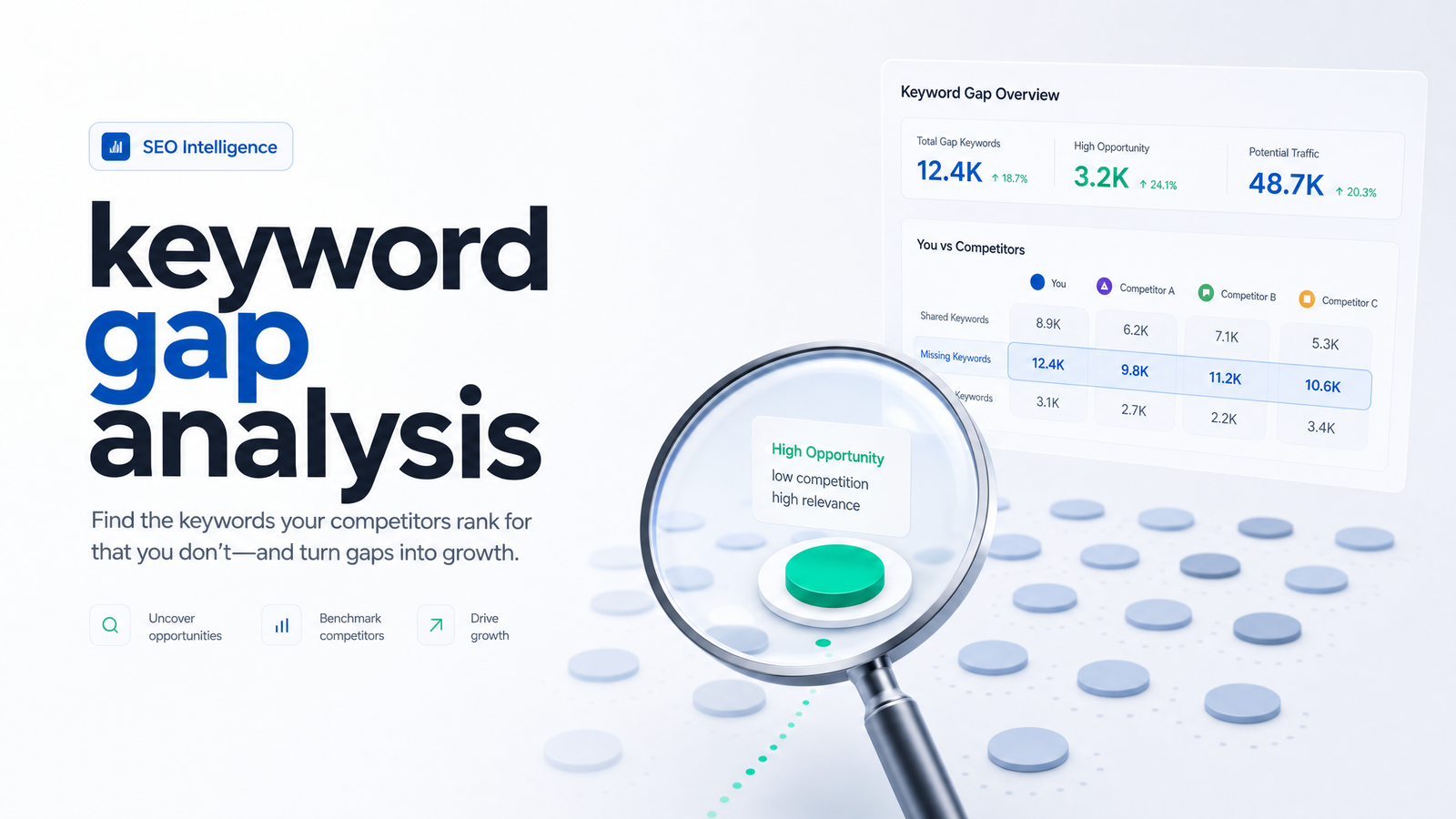
A keyword gap analysis compares the queries your competitors rank for against the queries you rank for, surfacing terms they own and you don't. It's a query-level exercise: specific search terms, who ranks where, and how much traffic each could realistically send your way.
That's narrower than a content gap analysis, though the two get used interchangeably. Content gaps live at the topic, format, and depth level — a competitor has a comprehensive guide and you have a thin blog post, or they cover a subtopic you haven't touched. Keyword gaps are more surgical: you can cover a topic thoroughly and still have a keyword gap, because your page targets a slightly different phrasing or intent than what people actually type.
Most guides stop at "run a report, export the missing keywords." That's step one below. Picking the right competitor set, filtering out noise, scoring what's worth building, and turning survivors into a content queue you'll actually execute is where this guide spends most of its time.
Why It's Worth Doing (Beyond "Find Missing Keywords")
A well-run gap analysis feeds two goals: organic traffic growth and topical authority. Every gap you close is either new search visibility or reinforcement of a topic cluster search engines already associate with your site — coverage that compounds into topical authority rather than a pile of disconnected pages.
The common failure mode isn't picking the wrong tool. It's running the analysis once, generating a spreadsheet of a few hundred keywords, and never opening it again. Competitors publish new content, SERPs reshuffle, and the gap list goes stale within a quarter. Treating this as a recurring workflow rather than a one-time audit is the difference between a document that sat in a drive and a strategy that moved rankings.
How to Run a Keyword Gap Analysis: 5 Steps
Here's how to do a keyword gap analysis in a way that survives contact with a real content calendar, whether you're using a dedicated tool or piecing it together from free data.
Step 1: Pick the Right Competitors
The most common mistake happens before you pull any data: choosing perceived business rivals instead of search competitors. The company you consider your biggest rival might not rank for a single query you care about, while a niche blog or marketplace listing you've never heard of dominates the exact terms you're targeting.
Find search competitors by looking at who actually shows up in the SERPs for your 15–20 most important target queries, not who you'd name if asked "who's your competition?" A local service business might find that a national directory site, not another local business, owns most of the relevant keyword real estate. Pull this list manually by searching your priority terms yourself, or let a keyword gap analysis tool identify recurring domains across your target query set automatically.
Step 2: Pull and Compare Keyword Sets
Once you have 3–5 genuine search competitors, compare their ranking keyword sets against yours. Ahrefs and Semrush both offer dedicated gap-analysis reports for this — feed in your domain plus competitor domains, and the tool returns keywords they rank for that you don't, or where they outrank you significantly.
Without a paid subscription, Google Search Console gets you partway: it shows queries you already rank for, including ones with impressions but weak click-through, flagging underperforming pages worth strengthening. It won't show competitor data directly, but cross-referencing your GSC query list against manual SERP checks for target terms approximates the same output at smaller scale. Either way, this step produces a raw list — often hundreds or thousands of rows — that is not yet a content plan. It's just the input.
Step 3: Filter by Intent and Business Fit
This is where most spreadsheets go wrong: they're mostly noise. A raw gap export includes branded competitor terms you'll never rank for, keywords whose intent doesn't match your business (informational queries when you sell a premium product, transactional queries when you're a media site), and near-duplicate variations of terms you already cover adequately.
Filter aggressively. For each keyword, ask what search intent it reflects — informational, navigational, commercial, or transactional — and whether that matches what your page or business can credibly serve. Drop anything where the searcher's underlying need doesn't align with what you offer, no matter how attractive the volume looks. A Google Trends check is a useful gut-check too, confirming a term isn't declining or seasonal before you invest in it. What survives is a shorter list reflecting actual opportunity rather than everything the tool exported.
Step 4: Prioritize by Traffic Potential and Effort
Not every surviving gap deserves the same urgency. Score each keyword on four factors: search volume, ranking difficulty, how closely intent matches a page you can realistically build or improve, and whether you already have a page that partially covers the topic. A high-volume, high-difficulty term with no existing page overlap is a long-term bet; a moderate-volume term where you already rank on page two with a relevant post is often the fastest win available.
Weight difficulty against your domain's current authority rather than treating every hard keyword as off-limits — a gap unreachable for a brand-new site might be achievable for one with established rankings nearby. This is also where SERP analysis earns its place: look at what's actually ranking in the top five results before committing, because a keyword's difficulty score doesn't always reflect what it takes to outrank the specific pages sitting there today.
Step 5: Map Gaps to Content and Track Results
Every surviving gap needs a decision: new page or update to existing content. If you have nothing addressing the topic, and the intent doesn't fit naturally into an existing page, it's a new-page candidate. If you already rank for a close variant or cover the topic partially, an update — expanding depth, adding sections, tightening the title and headers around the target phrase — is usually faster and lower-risk than starting from scratch.
Group related gaps into clusters rather than treating each keyword as its own isolated brief; this is where keyword clustering turns a list of terms into a structured plan that builds topical authority instead of a pile of one-off pages. Once content is live or updated, track rank changes over time — this is the step teams skip most often, and it's the only way to know whether the analysis actually worked. Re-run the full process quarterly at minimum, since competitor content and SERP rankings shift continuously.
Common Mistakes That Waste a Keyword Gap Analysis
The volume trap is the most expensive one: chasing every high-search-volume keyword in the export regardless of intent fit or realistic ranking odds. A keyword with impressive volume and zero business relevance is a distraction, not an opportunity.
The wrong competitor set is a close second — comparing yourself against companies you compete with commercially but not in the SERPs produces a gap list full of keywords you were never going to rank for anyway. And the most common failure of all: the spreadsheet dies. Teams do the analysis, feel productive, and never convert the surviving rows into briefs, assignments, or a calendar. A content strategy template is one way to force that conversion — turning a static list into commitments with owners and dates attached.
How Rankevra Automates Keyword Gap Analysis
Running this process manually means stitching together a paid keyword tool for the pull, a spreadsheet for filtering and prioritization, and a separate content brief tool once you're ready to write — three systems, constant exporting, and a plan that's only as current as the last time someone updated the sheet.
Rankevra collapses that into one workflow. It pulls competitor keyword sets automatically, filters the raw list by search intent so you're not manually eyeballing hundreds of rows for relevance, and prioritizes the survivors using traffic potential and existing page overlap. From there, it generates a content brief directly for each prioritized gap — no separate brief tool required — and tracks rank movement afterward so you can see whether the resulting content actually closed the gap. Because it runs on a schedule rather than as a one-time pull, the competitor drift problem that kills most manual gap analyses stops being an issue.
If you're ready to replace the spreadsheet-and-three-tools routine with one system that pulls, filters, briefs, and tracks automatically, start with Rankevra and run your first automated gap analysis without leaving the platform.
For readers who want to see where this fits into a full program, keyword gap analysis is one piece of a larger system — see The Complete SEO Checklist for the other 24 steps, and Organic Traffic Growth in 2026 for how this work compounds over time.
Frequently Asked Questions
What's the difference between a keyword gap analysis and a content gap analysis?
A keyword gap analysis works at the query level — which specific search terms competitors rank for that you don't. A content gap analysis works at the topic, format, and depth level — whether you've covered a subject thoroughly, in the right format, with enough depth compared to competitors. You can have a keyword gap without a content gap, or vice versa.
How often should I run a keyword gap analysis?
At minimum quarterly, since competitor content and SERP rankings shift continuously between checks. Fast-moving or highly competitive niches often warrant a monthly refresh. Running it once and treating the output as permanent is the most common reason gap analyses stop delivering value.
Which competitors should I actually include in a keyword gap analysis?
Include search competitors — domains that actually rank for your target queries — rather than the businesses you consider rivals commercially. Check who shows up for your 15–20 most important terms and use that list, since perceived competitors often don't overlap with who's actually occupying the SERPs.
Can I do a keyword gap analysis for free without Ahrefs or Semrush?
Yes, using Google Search Console as a starting point, though it won't show competitor data directly. Pair your GSC query data with manual SERP checks on target terms to approximate which competitors rank where you don't, then filter and prioritize manually the same way you would with a paid export.
How do I know if a keyword gap is actually worth targeting?
Score it on search volume, ranking difficulty relative to your domain's current authority, how well the intent matches what your business can serve, and whether you already have a page with partial overlap. A moderate-volume term where you already rank nearby is often a faster win than a high-volume term with no existing foothold.
Should every keyword gap become a new page, or can I update existing content instead?
Not every gap needs a new page — if you already have content covering a close variant of the topic, updating it is usually faster and lower-risk than building from scratch. Reserve new pages for gaps where nothing on your site addresses the topic or intent, and update existing pages when there's meaningful overlap already in place.
Keep reading
- Hreflang Setup Guide: Fix International SEO for GoodA complete hreflang setup guide covering syntax, x-default, canonical conflicts, and how to validate your international SEO cluster over time.
- XML Sitemap Errors: Diagnose and Fix Every Type FastA diagnostic guide to XML sitemap errors: why they happen, whether they block indexing, and a repeatable checklist to fix them before traffic drops.
- Keyword Cannibalization: Find It, Fix It, Prevent ItLearn how to detect keyword cannibalization, tell real conflicts from harmless overlap, and choose the right fix — merge, redirect, or canonicalize.