Rankevra Blog
Keyword Rank Tracker Software: How It Actually Works
September 20, 2026
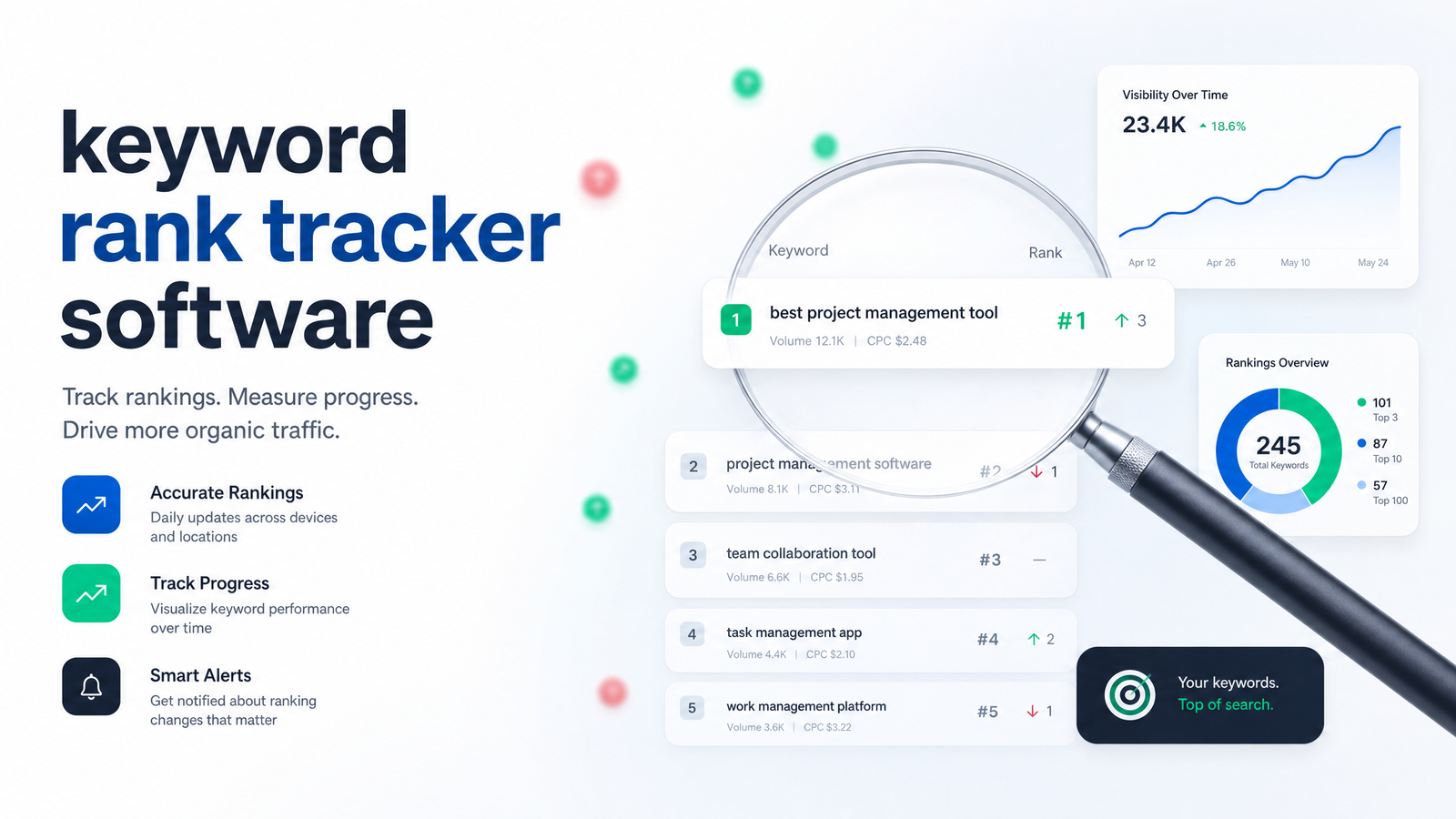
Two tools check the same keyword on the same day. One says you're ranking #4. The other says #7. A manual Google search from your laptop shows something else entirely. None of them are lying — they're measuring different things, and understanding why is the first step to using this category of software properly.
Keyword rank tracker software isn't a single objective camera pointed at Google. It's a simulation engine, and its output depends on the conditions you set. Here's what it actually does under the hood, why "true rank" is a bit of a myth, and how to stop treating position numbers as the whole story.
What Keyword Rank Tracker Software Actually Does
At its core, rank tracking software automates a search. Instead of you typing a keyword into Google and scrolling to find your site, the software does it programmatically — repeatedly, on a schedule, at scale — and records where a specified URL lands in the results.
A rank tracker sends a search request configured with a specific location, device type, and language, then parses the returned results page to find your domain's position among organic listings. It logs that position, timestamps it, and stores it so you can see the trend over days, weeks, or months instead of a single snapshot.
This is fundamentally different from manually Googling a term. When you search from your own browser, Google factors in your location, search history, logged-in account, and sometimes device in ways invisible to you. Rank tracking software strips most of that away by design, running searches from controlled, repeatable conditions so the comparison from one day to the next is fair. That's the entire value proposition of rank tracking software: not a perfect mirror of what every user sees, but a consistent, comparable measurement over time.
Why the Same Keyword Can Show Different Rankings
This is where most confusion starts: there is no single "true" rank for a keyword. Google's own documentation on how search ranking works confirms that results are shaped by context — including location, language, and past interactions with Search — not generated identically for every user who types the same query.
That's why rank trackers show different rankings from each other, and from what you see yourself. A few compounding factors:
- Geo-targeting. A tracker set to simulate a search from Chicago will return different local and organic results than one simulating Denver, even for an identical keyword. If your tracker's location setting doesn't match your actual target market, the numbers it reports are almost meaningless for that market.
- Device. Google runs mobile-first indexing, and mobile and desktop SERPs frequently show different orderings, different SERP features, and sometimes different winning pages entirely.
- Personalized search results. Even with personalization dialed back for logged-out, incognito-style tracking, Google's systems still weigh signals that vary by session and region.
- SERP layout differences. One search might trigger a local pack, a shopping carousel, or an AI Overview above the organic listings, pushing your "position 3" further down the visible page than a competing tool's rendering shows.
None of this means your tracker is broken. It means two tools measuring from different assumed locations, devices, or personalization settings will legitimately disagree — and neither is more "correct" in an absolute sense, only more or less aligned with the audience you actually care about.
The Data Points a Good Tracker Should Capture
Raw position is the headline number, but it's not the only thing worth capturing if you want keyword position tracking to actually inform decisions. A setup that only stores "position: 5" leaves you unable to explain why anything changed.
Beyond position, useful rank tracking data typically includes:
- SERP features present at the time of the check — featured snippets, People Also Ask, local packs, AI Overviews, image carousels — since these change how much visibility a given rank actually delivers.
- Historical trend, not just today's number, so a one-day dip doesn't trigger a false alarm.
- Competitor movement on the same keyword, so you can tell whether your drop is a you-problem or a market-wide reshuffle.
- Mobile vs. desktop split, tracked separately rather than blended into one average, since a page can rank well on one and poorly on the other.
This isn't a full buying checklist — that comparison work is already handled in Best Keyword Rank Tracker: A 2026 Evaluation Framework and Best SEO Rank Tracker in 2026: How to Actually Choose if you're at the tool-selection stage. The point here is simpler: position alone is a thin slice of what a tracker should be showing you.
When Rank Position Stops Telling the Whole Story
Here's a scenario that trips up a lot of teams: a keyword holds position #3 for months, completely stable, while organic traffic to that page quietly drops. The rank tracker shows nothing wrong. So what happened?
Increasingly, the answer is an AI Overview sitting above the organic results, answering the query directly and satisfying the searcher before they ever scroll to position #3. Large-sample data on AI Overviews' impact on Google CTR shows organic click-through rates dropping even when ranking position is completely unchanged — the position stayed the same, but fewer people had a reason to click past the AI-generated answer.
This is the broader shift toward zero-click search, and it's exactly why rank tracking versus traffic needs to be treated as two related but separate measurements, not one proxy for the other. A flat or even improving rank can coexist with declining sessions, declining conversions, and a page that's technically "performing" by the tracker's logic while functionally losing. If you want to understand how to compete for visibility inside AI-generated answers rather than just below them, SEO for AI Overviews: Winning Citations, Not Just Rankings goes deeper into that strategy. For now, the practical takeaway is this: rank tracking software tells you where you appear, not how much of the available attention you're actually capturing. You still need traffic and click data to know the difference.
Why Rank Tracking Alone Isn't Enough
A dashboard full of position numbers is only useful if it connects to something you can act on. Watching a keyword slide from #4 to #9 tells you that something changed — it says nothing about why, and "why" is the only actionable part.
The drop could be a technical issue: a slow page, a broken canonical tag, an accidental noindex introduced in a recent deploy. It could be content decay — a competitor publishing a more comprehensive update while yours sits untouched. It could be a Google algorithm update reshuffling an entire vertical, unrelated to anything on your site. A rank number by itself can't distinguish between these, and teams that keep tracking data in one tool, technical audit data in another, and content publishing in a third end up guessing.
This is the core argument laid out in SEO Data Silos: The Hidden Cause of Bad Rank Tracking: disconnected tools create disconnected answers. When ranking data, audit findings, and content history all live separately, nobody on the team can quickly answer "why did this page drop" without manually cross-referencing three dashboards and hoping the timestamps line up.
The fix isn't a better spreadsheet. It's a closed-loop rank tracking workflow, where a position change automatically sits next to the technical audit for that URL and the content's last update date, so the likely cause is visible immediately instead of investigated after the fact. Google Search Console remains a useful, free complement here too — it shows impressions, clicks, and query-level data your tracker won't capture on its own, and Google Search Console Tips That Actually Drive Action covers how to use it well alongside rank data.
Choosing and Using Rank Tracker Software Going Forward
If you're now evaluating specific tools, that comparison work belongs in the two evaluation guides referenced above rather than repeated here — they walk through what separates a mediocre tracker from a genuinely useful one across accuracy, update frequency, and reporting depth.
But the more important shift, regardless of which tracker you land on, is thinking about rank data as one input into a workflow rather than a destination in itself. An AI SEO tool that pairs tracking with audits and content decisions closes the loop that standalone dashboards leave open.
Rank Tracking Is a Starting Point, Not an Answer
A position number, on its own, will always leave you asking "so what do I do about it?" The teams that get real value out of rank tracking are the ones who can see that number next to the technical fix, the content gap, or the competitor move that explains it — in the same place, without switching tools.
That's the gap Rankevra is built to close: rank tracking that sits inside the same workflow as your audits, content generation, and publishing, so a ranking change comes with context instead of a mystery. See your rankings next to the fixes that move them — try Rankevra's built-in tracker as part of the full audit-content-publish-track loop.
Frequently Asked Questions
Why do two rank tracking tools show different positions for the same keyword?
Because each tool simulates a search using its own assumptions about location, device, and personalization settings, and Google's results genuinely vary based on those factors. A tracker checking from a different city, device type, or with slightly different SERP-parsing logic will legitimately produce a different number — neither reading is "wrong," they're measuring different conditions.
How often should keyword rank tracker software check my rankings?
Daily checks work well for most active SEO campaigns, catching meaningful trends without overreacting to hour-to-hour noise. Checking too infrequently (weekly or less) can hide volatility that explains traffic swings, while checking multiple times a day mostly surfaces normal SERP fluctuation rather than real signal.
Can rank tracker software track mobile and desktop rankings separately?
Yes, and it should — quality rank trackers let you segment tracking by device because Google frequently returns different results for mobile and desktop searches. Blending the two into a single average position can mask a real problem on one device that's being offset by strong performance on the other.
Does keyword rank tracking still matter now that AI Overviews affect clicks?
Yes, but it needs to be paired with traffic data to mean anything. Rank position still shows whether you're visible for a query, but AI Overviews can suppress click-through even at a stable or improved position, so tracking rank alongside actual sessions and clicks is now essential rather than optional.
What's the difference between a rank tracker and Google Search Console?
A rank tracker simulates searches under controlled conditions to report where you rank for chosen keywords, while Google Search Console reports actual impression, click, and average-position data pulled from real user searches on your property. They're complementary: the tracker gives you controlled, comparable trend data, and Search Console gives you real-world query and click behavior you can't get any other way.
Is keyword rank tracker software accurate for local SEO rankings?
It can be, but only if it's configured with geo-targeted rank tracking that matches your actual service area, down to the city or even zip-code level for local pack visibility. A tracker set to a generic national or default location will misrepresent local pack and map-based rankings, which are highly sensitive to the searcher's precise location.
Keep reading
- Best Rank Tracking Software in 2026: Top Tools ComparedCompare the best rank tracking software by use case — budget, agency, enterprise, AI visibility, and all-in-one — and shortlist a tracker in five minutes.
- Search Motor vs Search Engine: What It Really Means"Search motor" isn't a different tool than a search engine — here's the real terminology, how crawling/ranking works, and how to optimize for both.
- Ahrefs Explained: What It Does, Costs, and Where It StopsA plain-English breakdown of what Ahrefs does, 2026 pricing, who it's worth it for, and why research tools like Ahrefs still leave the fixing to you.