Rankevra Blog
Local SEO Software: A 2026 Buying Framework
September 26, 2026
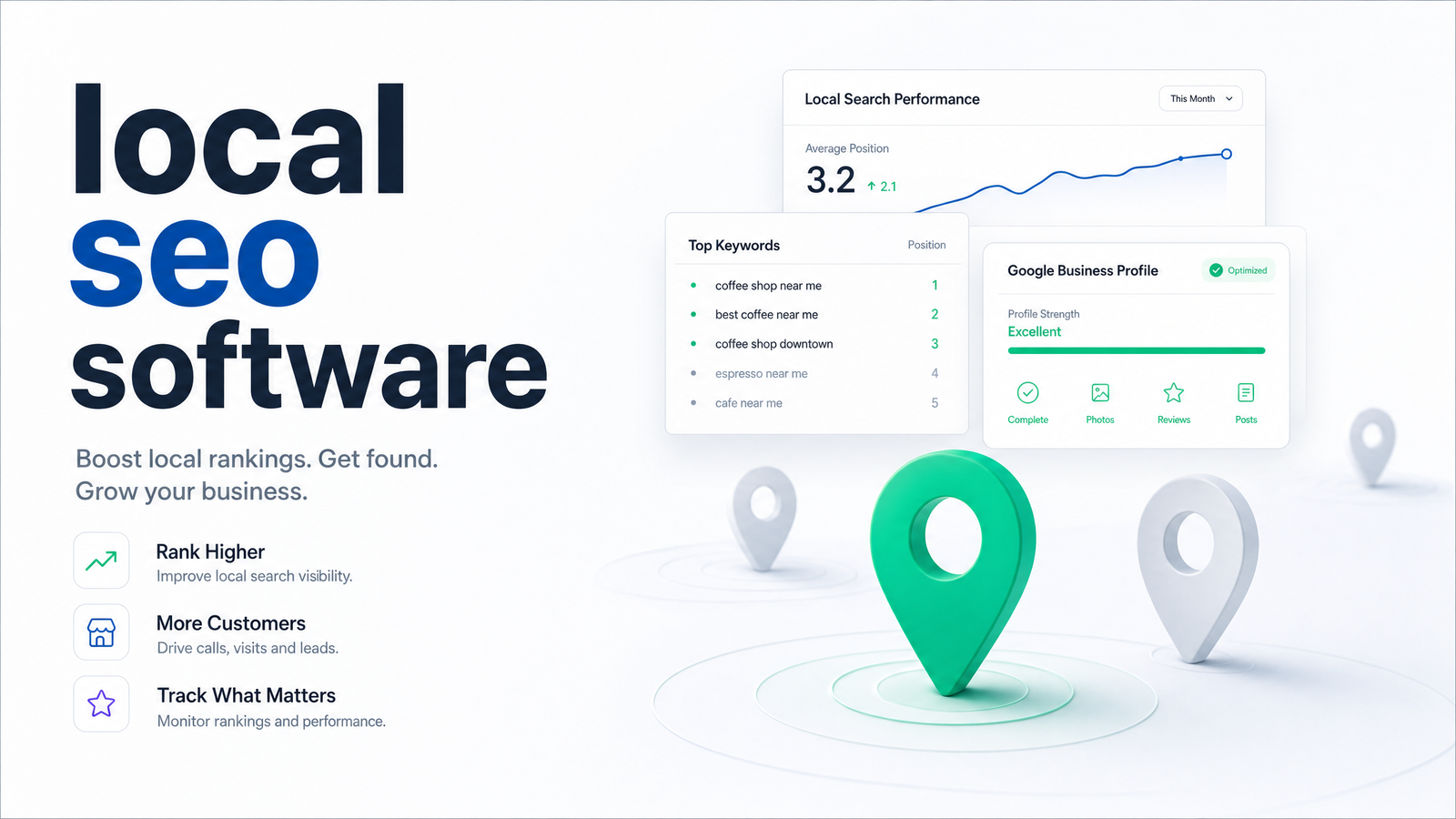
Most guides to local SEO software are written for agencies juggling forty client accounts. If you're a single-business owner or in-house marketer trying to get your own location found on Google, you don't need a client-management dashboard — you need results, without becoming a full-time SEO technician.
This article defines what local SEO software actually is, explains why the 2026 shift in ranking factors changes what you should demand from it, and gives you a practical way to decide between tool sprawl and a single consolidated workflow.
What Makes Software 'Local' SEO Software (Not Just SEO Software)
Generic SEO platforms are built around keywords, backlinks, and site-wide crawl audits. That doesn't answer what a nearby customer is actually asking Google: "which business, near me, right now, should I trust?" Local SEO software centers on Google Business Profile optimization, map-pack and proximity visibility, citation accuracy, and content tied to specific service-area locations.
A standard rank tracker tells you where a keyword sits in organic results. Local SEO software tells you where you sit in the Local Pack, how your Google Business Profile compares to nearby competitors, and whether your name, address, and phone number (NAP) are consistent everywhere they're listed. Google Business Profile software is the core layer — it's the primary data source Google uses to decide who appears in local results, which is why treating it as a bolt-on feature undersells its importance.
Why the Software You Choose Matters More in 2026
According to the Whitespark 2026 Local Search Ranking Factors survey, Google Business Profile signals now make up the single heaviest-weighted ranking category, with reviews alone contributing roughly half of total ranking weight when combined with profile signals — a shift away from the citation-volume tactics that dominated local SEO advice for years.
At the same time, behavioral and engagement signals — clicks, calls, direction requests — are rising in influence alongside static profile completeness. Google isn't just checking whether your profile is filled out; it's watching whether real people act on it. Layer AI Overviews on top of that, changing how and where local results surface, and you get a landscape where 46% of all Google searches now carry local intent, but the rules for winning that intent have moved.
Software that only tracks where you rank, without helping you act on GBP optimization, review generation, and engagement, is measuring a problem it can't fix — which is why this category needs re-evaluating in 2026 rather than assuming last decade's factors still apply.
The 6 Features That Actually Matter
Most local SEO tools try to cover the same six jobs. Here's what separates a feature that moves rankings from one that just looks good in a demo.
GBP audit and optimization. Good software checks categories, service areas, attributes, posting cadence, and Q&A activity against what's actually correlated with ranking, then tells you what to fix first. For a deeper look at how a proper weighted audit should be structured, see this 5-layer local SEO audit framework.
Local rank tracking. This means map-pack and geo-grid tracking — checking your position from multiple points around your service area, not just one search from headquarters. Proximity is a real ranking signal, so a single rank number is close to meaningless. This rank tracker buying guide and this keyword tracker framework both apply directly to the local case.
Citation consistency checks. NAP accuracy across directories still matters as a trust signal, even if it's no longer the primary lever. Good software actively monitors for drift, not just a one-time scan.
Review monitoring. Given how heavily reviews now weigh into GBP ranking factors, software should track review velocity, sentiment, and response time — not just alert you that a new review exists.
Local content generation and publishing. This means service-plus-location pages and GBP posts that are actually differentiated, not templated pages that swap out a city name.
Unified reporting. One view showing whether your fixes actually correlate with ranking or visibility movement — not four exports you reconcile in a spreadsheet.
Single Business vs. Agency: Buying the Right Tier
A single-location or small multi-location business needs software built around depth on one profile, not breadth across dozens of clients. Agency-oriented platforms are priced and designed for portfolio management — white-label reports, client permission tiers, bulk location imports. If that's not your situation, you'll pay for complexity you'll never use, and often get shallower per-location optimization as a tradeoff for that scale.
If you're managing local SEO for multiple client accounts, this article isn't the right fit — Local SEO Software for Agencies: What Actually Matters covers that buying decision directly. For everyone else — the owner-operator, the in-house marketer with one brand and maybe a handful of locations — the right software goes deep on your specific market rather than wide across many.
Where AI Actually Changes the Equation
"AI-powered" gets attached to almost every SEO tool right now, and it's worth being skeptical of the label. The meaningful question is whether AI is automating actual work or just summarizing data you'd have found anyway.
AI earns its place in local SEO automation when it does four things: drafts and schedules GBP posts so profiles stay active without daily manual input; writes local content tied to specific service-and-location combinations, informed by what's already ranking nearby; prioritizes audit findings by likely ranking impact rather than dumping an undifferentiated list of issues; and closes the loop by showing whether a change you published actually correlated with a rank or visibility shift. That last point matters most — plenty of tools can generate content or flag issues; far fewer can tell you whether it worked. On the technical side, prioritization matters just as much as detection — see this technical SEO action plan for how that logic should work in practice.
The Real Cost of Juggling Multiple Tools
Walk through a typical setup: a GBP management tool, a separate rank tracker, a citation builder, and a reporting layer to stitch it all together — often four subscriptions, four logins, and four exports someone has to reconcile manually every month. The dollar cost adds up, but the bigger cost is usually labor: someone on your team spends hours each month copying numbers between tools just to answer "is this working?"
There's also a data-integrity cost. When your citation tool and rank tracker don't talk to each other, you can't easily tell whether a citation fix caused a ranking change or whether it was something else entirely — a review, a GBP post, seasonal demand. An all-in-one local SEO software approach isn't just cheaper on paper; it's the only way to see cause and effect clearly, which is the entire point of tracking in the first place.
A Simple Framework for Choosing
Before committing to any tool, run it through these questions:
- Does it treat Google Business Profile as a core, continuously monitored asset — not a one-time setup checklist?
- Does its rank tracking use geo-grid or map-pack methodology, not a single generic keyword position?
- Does it monitor citation consistency on an ongoing basis rather than a single audit snapshot?
- Can it generate and publish local content, or does it stop at recommendations you still have to execute?
- Does it show a single view connecting fixes to ranking outcomes, instead of siloed reports per feature?
- Is it priced and designed for a business managing itself, not for an agency's client roster?
If you answer "no" to two or more, you're likely looking at a partial solution that will need supplementing — putting you right back in the multi-tool trap this framework is meant to help you avoid.
Where Rankevra Fits
Most local SEO software falls into one of two camps: tools that track rankings and profile health, or tools that help you act — post, publish, respond — with little connection between the two. Few do both in one continuous workflow, which is exactly the gap that leaves business owners exporting spreadsheets between platforms every month.
Rankevra is built as an audit-to-content-to-tracking workflow for teams without a dedicated local SEO specialist on staff: it audits your GBP and site, prioritizes what to fix, drafts and helps publish local content, and tracks whether the changes actually move your visibility — in one place.
The checklist above already tells you what to look for: continuous GBP monitoring, real geo-grid tracking, ongoing citation checks, actual content publishing, and one unified view of results. If you're managing local SEO without a specialist on your team and want that whole loop automated instead of stitched together by hand, Rankevra is worth a look.
Frequently Asked Questions
Is local SEO software worth it for a single-location business, or is Google Business Profile alone enough?
GBP alone gives you a listing, but it doesn't tell you how you compare to nearby competitors, whether your citations are consistent, or whether your content is structured to rank for service-plus-location searches. Local SEO software adds the tracking, prioritization, and content layer that GBP's native tools don't provide. For a single location, the value is less about scale and more about not missing fixable issues that are actively costing you Local Pack visibility.
What's the difference between local SEO software and a general rank tracker?
A general rank tracker reports organic keyword position from one location; local SEO software tracks map-pack and geo-grid visibility from multiple points around your actual service area, alongside GBP health, citations, and reviews. Proximity is a core local ranking signal — a single national rank number can hide big variation across your service area.
Can AI tools actually write and publish local content, or do they just suggest keywords?
Genuinely capable tools now draft and publish service-and-location content and GBP posts, not just suggest keywords. The differentiator is whether the AI ties content to what's actually working in your specific local market and then tracks whether it moved rankings — that closed loop separates real automation from a glorified keyword suggestion box.
How much should a small business expect to pay for local SEO software?
Costs vary widely by feature set, but running separate GBP, citation, rank-tracking, and reporting tools typically costs more in aggregate — and in staff time reconciling them — than a single consolidated platform covering the same ground. The real comparison isn't tool A versus tool B; it's four subscriptions plus manual labor versus one workflow.
Do I need separate citation-building software, or should that be built into the main tool?
Citation consistency should be built into your core local SEO software as ongoing monitoring, not purchased as a standalone product. Since citation volume matters less than it used to relative to GBP and behavioral signals, it makes more sense as one monitored layer within a broader platform than as a dedicated tool you manage separately.
How long does it take to see ranking movement after switching to better local SEO software?
Most businesses start seeing measurable shifts in Local Pack visibility within four to eight weeks, though this depends on how stale your GBP and citations were beforehand. Fixes tied to profile completeness and review response tend to show impact faster than content-driven changes, which take longer to be crawled, indexed, and factored into rankings.
Keep reading
- Zero-Click Search SEO Strategy: A Framework That WorksRankings up, traffic down? Learn a zero-click search SEO strategy built around impressions, AI citations, and the clicks that still convert.
- Google Search Console Logo PNG: Where to Get It SafelyFind the official Google Search Console logo PNG and SVG, learn the 2025 redesign, and see Google's trademark rules before using it anywhere.
- How to Add Users to Google Search Console (Full Guide)Learn how to add users to Google Search Console the right way—correct permission levels, owner eligibility, and what to do when someone leaves.