Rankevra Blog
Zero-Click Search SEO Strategy: A Framework That Works
September 26, 2026
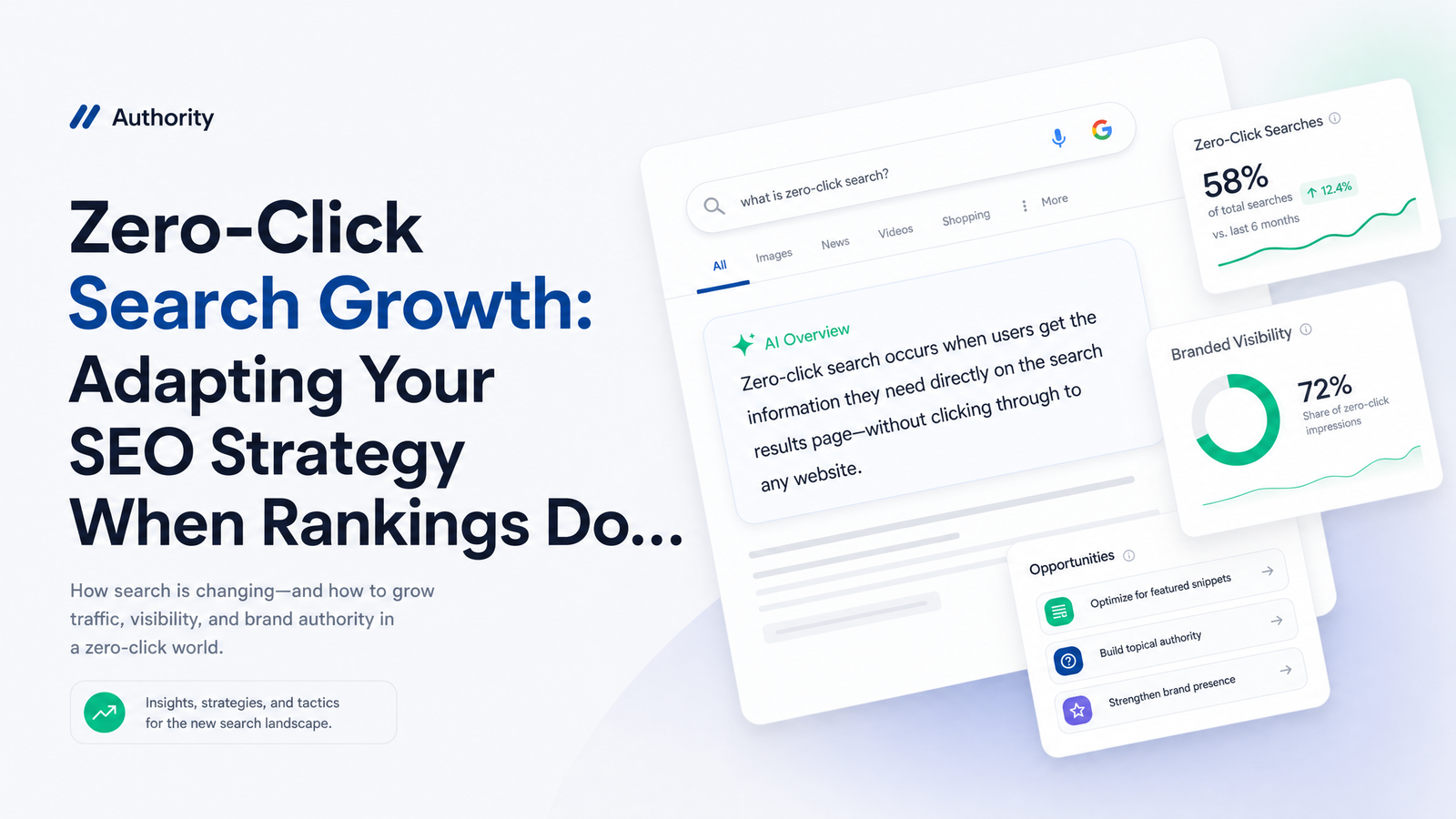
Why Your Rankings Are Fine But Your Traffic Isn't
You check your rank tracker and everything looks right — position 3, maybe 1 on a good day. Then analytics shows sessions flat or sliding. That gap is the most common complaint from SEOs right now, and it isn't a tracking bug. It's a structural shift in how search results work.
Rankings don't equal traffic anymore, not the way they did five years ago. A growing share of searches now end without anyone clicking a link, because the answer already sits on the results page. Search Engine Land's early-2026 analysis of SparkToro and Similarweb data puts the zero-click search rate at 68%, up sharply from 2024. Separately, a randomized field study from ISB and Carnegie Mellon researchers found that AI Overviews cut organic clicks by 38% for the queries where they appear — a causal number, not just correlation.
So if you're building a zero-click search SEO strategy for 2026, the starting assumption has to change: ranking well is necessary, but no longer sufficient. This piece lays out what actually shifts — the metrics you track, the content structure you use, and the queries worth defending — plus what shouldn't change.
What a Zero-Click Search Actually Is (And Why It's Growing)
A zero-click search is any query where the searcher gets an answer directly on the results page and never visits a website. That's a broader category than most assume: weather and unit conversions, but also featured snippets, knowledge panels, local packs, and — increasingly — AI-generated summaries.
Worth separating AI Overviews from older zero-click mechanisms, since they behave differently. Featured snippets pull a single passage from one page and still show a link. Knowledge panels aggregate structured facts, often from Wikipedia or a knowledge graph, with minimal need for a click-through. AI Overviews and AI Mode are different again: they synthesize an answer from multiple sources in real time, sometimes citing several pages, sometimes none clearly enough for a user to click through.
The AI Overviews SEO impact is driving most of the recent growth in zero-click volume. Seer Interactive's study, also covered by Search Engine Land, found organic CTR dropping as much as 61% on queries where an AI Overview appears above the fold — a redesign of the page real estate that organic listings used to own outright.
Rankings Still Matter — Here's Why
None of this makes rankings irrelevant. Ranking position is still the primary input determining whether you're eligible to be cited inside an AI Overview in the first place. Google isn't inventing new sources for its summaries; it's pulling from pages that already rank well for the underlying query.
The Seer Interactive data also found that pages cited inside an AI Overview see a meaningful CTR lift compared to pages ranking in the same position without a citation. AI Overview citations function like a new, higher-value SERP feature — one you can only compete for if your page is strong enough to rank in the first place. Treat ranking as the entry ticket, not the finish line. Nail the technical fundamentals — a fast, clean site as covered in the Core Web Vitals evidence review — and you keep your seat at the table where citations get decided.
4 Ways to Adapt Your SEO Strategy for Zero-Click Growth
Adapting doesn't mean abandoning rankings work — it means adding a second layer on top. Here's the practical version of a zero-click search SEO strategy, in four moves.
1. Shift your primary KPI from clicks to visibility. If clicks are shrinking industry-wide, judging content solely on sessions will make good work look like failure. Track impressions and share of voice SEO — your estimated visibility across the full result, including snippet ownership and AI citations — as the leading indicator, with clicks and conversions as the lagging one you still care about but no longer treat as the whole scoreboard.
2. Restructure content to be answer-first and extractable. This is the core of learning how to optimize for AI Overviews: put the direct answer in the first two sentences under a heading that matches the question, then expand with supporting detail. Use clear H2/H3 structure that mirrors how people actually search, and mark up content with structured data so machines can parse entities, steps, and facts cleanly — the validator workflow for structured data testing is worth running on any page you want cited. Answer fast, structure clearly, mark up precisely.
3. Prioritize query types that still convert. Not every query deserves the same content investment. Put heaviest effort into transactional, comparison, local, and branded queries — the categories least likely to be fully satisfied by a summary box, covered in more depth below.
4. Build topical authority around clusters, not single pages. AI Overviews and snippets reward sources that appear consistently credible across a topic, not just one well-optimized post. A cluster of interlinked, well-structured pages signals depth in a way a single article can't, compounding your odds of citation across dozens of related queries rather than one.
Which Queries Still Send Clicks (So You Don't Abandon Them)
The mistake teams make after seeing zero-click stats is pulling back on SEO broadly — wrong move, since the drop isn't evenly distributed. Some query types that still get clicks reliably, and deserve continued investment:
- High commercial intent and transactional queries. Someone searching "buy," "price," or "book" wants to complete an action a summary box can't finish for them. Transactional queries SEO remains one of the highest-ROI areas precisely because AI Overviews can't check out a cart or fill a form.
- Comparison and review queries. "X vs Y" and "best [category] for [use case]" searches involve nuance and trust-building that pushes users to click through, especially when money is on the line.
- Local queries. "Near me" and service-area searches still route heavily to maps, listings, and individual business sites once someone's ready to call or visit.
- Niche, long-tail, and technical queries. The more specific the question, the less likely a generic AI summary confidently answers it in full, and the more likely a searcher clicks through to verify against a real source.
Branded queries round out the list — if someone searches your company name, they're already past the awareness stage and want your site specifically, not a summary of it.
Measuring What Actually Matters Now
Measuring SEO success beyond clicks means building a small stack of new metrics alongside the old ones, not replacing them outright. At minimum: impression volume and trend by query cluster, AI citation tracking (are you named or linked inside AI Overviews for your priority terms), SERP feature ownership (snippets, knowledge panels, local packs you currently hold), and branded search volume as a proxy for the awareness your content and PR generate upstream of any click.
These SEO visibility metrics matter more when tracked in one place alongside technical health and content output, not scattered across five dashboards nobody checks weekly. If you're choosing a tool for this, the criteria to prioritize are covered in how to actually choose a rank tracker in 2026 — look for SERP feature and AI Overview presence tracking, not just position numbers. This is exactly the gap Rankevra is built to close: automated audits that keep your technical foundation solid, content workflows that produce answer-first, structured pages by default, and rank tracking that reports on visibility and citations, not just where your blue link sits.
Frequently Asked Questions
Why is my organic traffic dropping even though my rankings are stable or improving?
Because a majority of searches now resolve on the results page itself, without a click, through featured snippets, knowledge panels, or AI Overviews. Your rankings measure where you appear; they no longer reliably predict how many people click through, especially on queries where Google or an AI Overview can answer directly. Traffic and rank have effectively decoupled for a large share of query types.
Does SEO still matter if most searches end without a click?
Yes, because ranking position is still the gate that determines whether your content is even eligible to be cited inside an AI Overview or featured snippet. Pages that rank well and get cited see a real CTR lift over pages that rank but aren't cited. SEO's job has expanded to include earning visibility and citations, not just clicks — it hasn't become optional.
How do I optimize content to get cited in Google's AI Overviews?
Structure content to answer the core question in the first sentence or two under a matching heading, then expand with specifics, and back it with clean structured data markup. Content that reads clearly to a human and parses cleanly to a machine is what AI Overviews tend to pull from. Building topical depth across a cluster of related pages, rather than one isolated article, also improves citation odds.
What metrics should I track instead of just clicks and traffic?
Track impressions and share of voice by query cluster, AI citation tracking, SERP feature ownership (snippets, panels, local packs), and branded search volume. These measure visibility and authority even when a click doesn't happen, giving you a truer picture of whether your SEO work is compounding.
Are some keywords or query types safe from zero-click search?
Largely, yes — transactional, comparison/review, local, and long-tail or technical queries still generate clicks reliably because they require action, trust-building, or specificity that a summary box can't fully deliver. Branded searches also stay click-heavy since the searcher already wants your specific site.
Will zero-click search keep growing, or will it plateau?
The trend has moved consistently upward, with zero-click search 2026 estimates around 68% based on recent SparkToro and Similarweb analysis, up from lower 2024 levels. There's no strong signal it's plateauing yet, since AI Overviews and AI Mode continue expanding into more query types rather than retracting.
Treat this as an operational problem, not a mindset adjustment: your team now needs to track impressions, AI citations, and SERP feature presence right alongside rankings and clicks, and it needs to produce content that's built to be cited and still convert the smaller share of clicks that remain. Rankevra unifies the audit, content, and tracking work this requires into one automated workflow, so you're measuring and acting on the reality of search in 2026 instead of chasing a version of SEO that stopped matching the results page.
Keep reading
- Local SEO Software: A 2026 Buying FrameworkA clear, non-agency framework for choosing local SEO software in 2026 — what to look for, what AI actually automates, and where Rankevra fits.
- Google Search Console Logo PNG: Where to Get It SafelyFind the official Google Search Console logo PNG and SVG, learn the 2025 redesign, and see Google's trademark rules before using it anywhere.
- How to Add Users to Google Search Console (Full Guide)Learn how to add users to Google Search Console the right way—correct permission levels, owner eligibility, and what to do when someone leaves.