Rankevra Blog
Long Tail Keyword Research Tool: A Full Workflow Guide
July 27, 2026
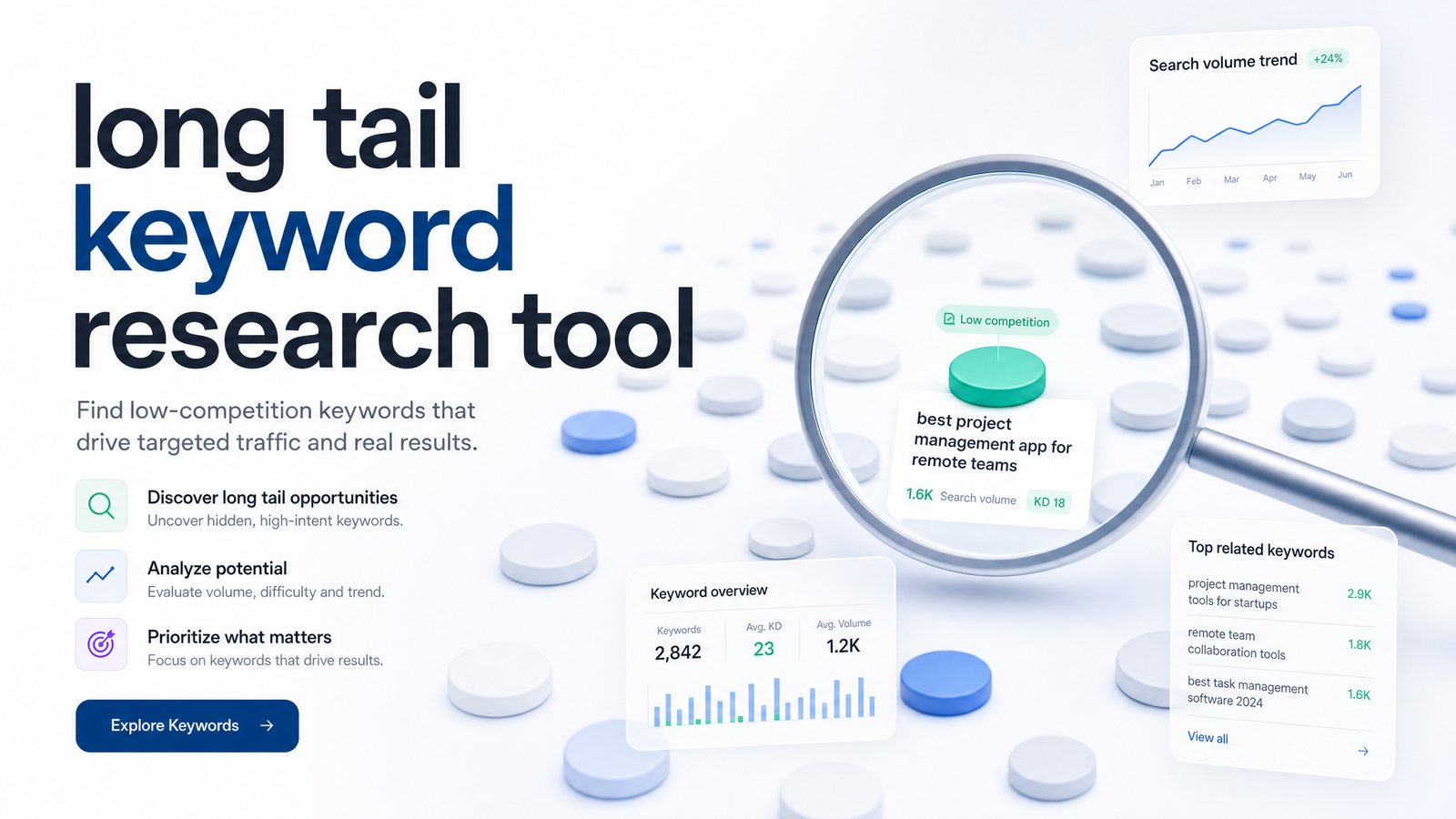
Search "long tail keyword research tool" and you'll get listicles ranking the same five apps. None answer the real question: once you've found a long-tail keyword, what do you do with it? This guide treats research as step one, not the finish line — defining long-tail correctly, giving you a validation process that works with any tool, and showing why keyword lists so often die in a spreadsheet instead of becoming ranked pages.
What Actually Makes a Keyword "Long-Tail" in 2026
The long tail keyword definition most people learned is incomplete. A long-tail keyword isn't "four or more words" — it's a query specific enough to signal a narrow, identifiable intent. "Running shoes" is short-tail: broad and impossible to satisfy with one page. "Best running shoes for flat feet and overpronation" is long-tail — not because it's longer, but because the searcher knows exactly what problem they're solving.
Word count is a side effect of specificity, not the cause. A three-word query like "vegan protein powder" can behave like a long-tail term in a narrow niche, while a seven-word query can still be generic if phrased vaguely. The real distinction between long-tail vs short-tail keywords is intent resolution: short-tail terms serve many intents under one query; long-tail terms serve one.
This matters more now, not less. Long-tail queries have historically made up the majority of total search volume and convert at a higher rate because the searcher has already narrowed down what they want. Under AI Overviews, that gap widens. Broad, informational short-tail queries are exactly what Google's AI is built to answer directly on the results page, siphoning clicks before a user reaches a website. Specific, multi-qualifier, intent-heavy queries are harder for an AI Overview to fully resolve — especially anything involving personal circumstances, comparisons, or local nuance — which keeps organic listings relevant. Long-tail SEO isn't a legacy tactic being replaced by AI search; it's becoming the more defensible half of the keyword universe.
What a Long-Tail Keyword Research Tool Should Actually Do
Before comparing products, know what separates a genuinely useful long tail keyword research tool from one that just dumps a wordlist on you:
- Autocomplete and People Also Ask mining — pulling real query variations from Google Autocomplete and PAA boxes, not just a thesaurus-style expansion of your seed term.
- Intent tagging — labeling results as informational, commercial, transactional, or navigational, so you're not mixing "how to fix a leaky faucet" with "buy faucet repair kit" in the same list.
- SERP-weakness or difficulty scoring — a real keyword difficulty score based on who's actually ranking (thin content, weak domains, forums outranking brands), not a generic 0–100 number pulled from backlink counts alone.
- Keyword clustering — grouping semantically related long-tail variants into one content target, so you don't write five thin pages for what should be one comprehensive one.
- Freshness — data recent enough to reflect current SERP volatility, particularly where AI Overviews or new competitors have shifted rankings in the last few months.
A tool that only scrapes autocomplete hands you volume and nothing else. A tool that tags intent and clusters but skips SERP analysis hands you a tidy list you still can't rank for. You need all of it, from one source or several, before writing a single word of content.
How to Find and Validate Long-Tail Keywords: A 5-Step Process
A repeatable process for finding long-tail keywords and confirming they're worth targeting — independent of which tool sits behind it.
1. Expand from seed terms. Start with core topics and expand using Google Autocomplete, PAA questions, and long tail keyword modifiers — "best," "for beginners," "vs," "near me," "without," "cheap," "how to." Layer in adjacent question phrasing ("why does," "what happens if") since these mirror both typed queries and voice search patterns, which skew even more conversational and specific.
2. Check search intent. For every candidate, ask what the searcher wants to do next — read, compare, or buy. A mismatch here is the single biggest reason pages don't rank: writing a blog post for a query Google treats as commercial, or a product page for a query that's really informational.
3. Check competition and SERP weakness. This is where most DIY keyword research collapses. A high word count doesn't mean low competition — you have to look at who's actually ranking. Pull up the top 10 results and check for thin content, outdated pages, low-authority domains, or forum threads outranking brands. That's a real signal of low-competition keywords. A generic difficulty score, without checking the actual SERP, will mislead you as often as it helps — one of the well-documented gaps in Google Keyword Planner, which was built for ad bidding, not organic competition analysis.
4. Cluster into content groups. Group validated keywords by shared intent and topic rather than treating each as a separate page. Topical clustering is also how you build topical authority — a cluster of ten related long-tail pages linked around a pillar signals depth to Google in a way ten disconnected posts never will.
5. Prioritize by effort vs. potential. Rank each cluster by estimated traffic potential against realistic ranking effort, and sanity-check demand direction before committing — a keyword with fading interest isn't worth six hours of writing time, which is exactly what Google Trends is useful for confirming. For competitor-driven ideas you might have missed in seed expansion, a keyword gap analysis against sites already ranking in your space fills in the blind spots this process alone won't catch.
The Gap Most Long-Tail Keyword Tools Leave Open
Here's what almost nobody addresses: teams that do all five steps correctly still end up with research that doesn't translate to rankings. Not because the keywords were wrong — because the workflow stopped at validation.
The pattern is familiar. A marketer spends a week finding and validating fifty long-tail keywords, drops them into a spreadsheet organized by cluster and priority, and then... life happens. Briefs need writing. Someone has to draft the content. It needs to go into the CMS, get formatted, published, and tracked over weeks to see if it moved. Each step usually lives in a different tool, with a different login, and a manual handoff in between. The spreadsheet becomes a graveyard of good research nobody acted on.
This is a keyword research to content workflow problem, not a research problem. Why keyword lists don't rank has nothing to do with keyword quality and everything to do with the gap between finding a keyword and publishing a page around it. Every day a validated keyword sits unclaimed in a spreadsheet is a day a competitor can claim it instead. Turning a validated long-tail term into a ranking page still requires a properly structured brief and genuinely optimized content — the kind of process outlined in content optimization frameworks — and that step is where most keyword research efforts quietly die.
Closing the Loop: How Rankevra Turns Long-Tail Keywords Into Ranked Pages
Rankevra was built around a simple observation: keyword research, content creation, publishing, and rank tracking shouldn't be four separate tools with four separate exports. As an AI SEO tool, Rankevra runs the entire process described above inside one workflow — autocomplete and PAA-based long-tail discovery, intent tagging, SERP-weakness scoring, and clustering — and then does the part most tools skip.
Once a long-tail keyword or cluster is validated, Rankevra turns it directly into a content brief, drafts an SEO-optimized page around it using the same AI writing logic covered in SEO writing assistant approaches, and publishes it — no export, no copy-paste into a separate CMS, no second tool for formatting. That's keyword research and content automation working as one continuous pipeline instead of four disconnected steps with manual handoffs between them.
Then it tracks what happens. Rankevra's rank tracking monitors how each published page performs against the long-tail terms it targeted, following the same rank tracker evaluation logic laid out for comparing rank tracking tools — so you can see, cluster by cluster, which validated keywords actually turned into ranking pages and which need a second pass.
Stop exporting keyword lists into a doc that never becomes a published page. Try Rankevra on your own site, run an on-page audit alongside your keyword research, and turn validated long-tail terms into optimized, tracked content in one workflow instead of four.
Frequently Asked Questions
What counts as a long-tail keyword vs. a short-tail one?
A long-tail keyword is a specific query reflecting one clear intent, while a short-tail keyword is broad and could match several intents at once. "Running shoes" is short-tail because it could mean research, price comparison, or a purchase; "best running shoes for flat feet" is long-tail because the intent is narrow. The defining factor is specificity, not length.
How many words does a keyword need to be considered long-tail?
There's no fixed word count — specificity matters more than length. A three-word niche term can behave like a long-tail keyword if it resolves to one clear intent, while a longer phrase can still be generic. Judge a keyword by how narrowly it defines what the searcher wants, not by counting words.
Are long-tail keywords still worth targeting now that AI Overviews answer more queries directly?
Yes — arguably more so. AI Overviews tend to fully resolve broad, informational short-tail queries directly on the results page, but specific, multi-qualifier long-tail queries involving comparisons, personal circumstances, or niche use cases are harder for AI summaries to fully satisfy, which keeps organic listings relevant for those terms.
What's the fastest free way to find long-tail keywords without a paid tool?
Mine Google Autocomplete and People Also Ask boxes using your core seed terms plus modifiers like "best," "vs," "near me," and "for beginners." This surfaces real phrasing searchers use, though tools like Google Keyword Planner won't give you reliable organic difficulty data — you'll still need to manually check the SERP for weak competitors.
How do I know if a long-tail keyword is actually easy enough to rank for?
Check who's actually ranking in the top 10 results, not just a generic difficulty score. If you see thin content, outdated pages, low-authority domains, or forum threads outranking established brands, that's a genuine sign of low competition — a high word count alone doesn't guarantee an easy ranking opportunity.
Can one AI tool handle long-tail keyword research and the content/publishing that follows it?
Yes — that's the workflow gap Rankevra is built to close. Instead of exporting a validated keyword list into a separate writing tool, CMS, and rank tracker, Rankevra connects long-tail keyword discovery directly to brief creation, AI drafting, publishing, and rank tracking in one continuous system.
Keep reading
- Visual Search SEO: The Complete Framework for 2026A practical visual search SEO framework covering image access, alt text, filenames, and video schema — plus how to audit it all at scale.
- Content Decay SEO: How to Detect and Fix It Before RankingsLearn the statistical definition of content decay SEO, how to detect it early with GSC, and a triage framework to refresh, merge, or prune pages.
- SEO Audit Workflow: Merge Crawl, GSC & Rank DataA repeatable SEO audit workflow that joins crawl data, GSC, and rank tracking into one prioritized fix list — instead of three disconnected reports.