Rankevra Blog
AI Content Brief Generator: What Actually Makes One Work
July 27, 2026
What an AI Content Brief Generator Actually Is
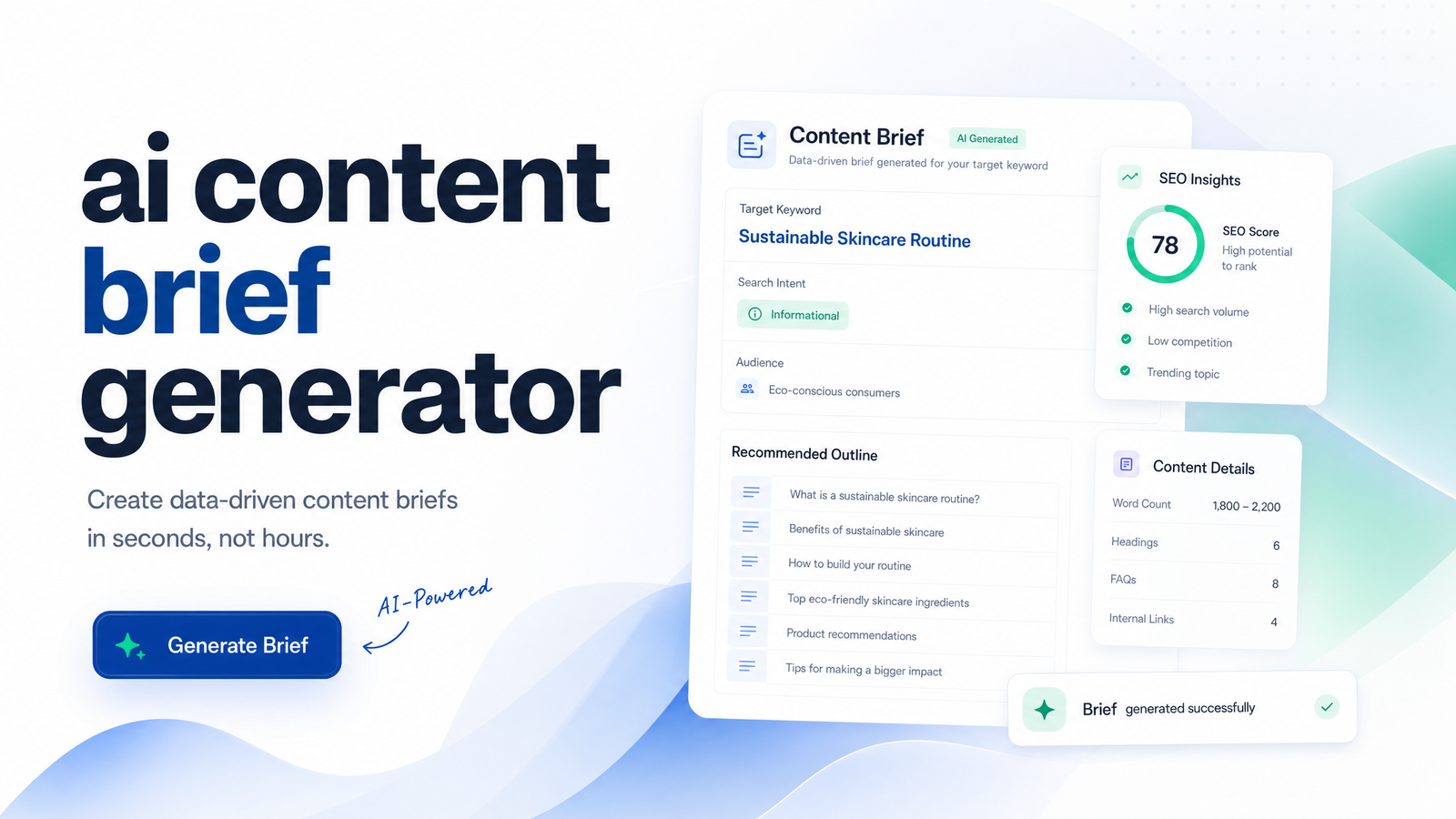
An AI content brief generator takes a target keyword and topic, analyzes the ranking landscape, and produces structured instructions for what a piece of content needs to cover, why, and for whom. That's a different job than an outline tool. A content brief vs outline distinction matters here: an outline is just a header structure — H2s and H3s in a sensible order. A brief is the reasoning behind that structure — the search intent it satisfies, the reader it's written for, the angle that differentiates it from the pages already ranking, and the keywords it needs to earn relevance for.
Keyword grids get confused with briefs constantly. A tool that spits out "include these 40 related terms at this density" is doing keyword clustering, not briefing. It's useful input, not a finished product. The standard this article uses throughout: a brief is only as good as its specificity about intent and angle, and only as valuable as its connection to what happens after it's written. A brief that dead-ends in a Google Doc, however detailed, is half a solution.
That's the lens for judging any AI content brief generator for SEO — not how many fields it auto-fills, but whether those fields change what gets written and whether the brief moves forward into drafting rather than sitting as a reference document nobody opens twice.
The 7 Elements a Real Brief Needs (Not Just Keywords)
Strip away the branding on most SEO content brief templates and you'll find some version of the same seven components. Use this as a checklist against any tool or manual process:
- Primary and secondary keywords — not just the head term, but the supporting phrases and long-tail variants that signal topical completeness to search engines.
- Search intent — is the searcher comparing options, looking for a definition, ready to buy, or troubleshooting a problem? Misreading intent is the single most common reason a well-written page underperforms.
- Target reader — a content brief for writers should name who's reading: a technical SEO manager, a solo founder, a content team lead. Tone and depth follow directly from this.
- Angle — the specific stance or structure that differentiates this piece from what's already ranking. Without an angle, a brief just describes a topic; with one, it describes an argument.
- Outline with headers — the logical sequence of sections, mapped to sub-intents the audience actually has, not a generic template stretched to fit.
- Sources and benchmarks — competitor pages worth referencing, word count ranges pulled from actual SERP data, and any statistics or claims that need grounding.
- Internal link and CTA guidance — which existing pages this content should link to, and what action the reader should take next.
Most standalone brief tools nail the first two or three items and treat the rest as optional extras. That's the gap worth watching for.
Where Most Brief Generators Stop Short
Tools like Frase, Clearscope, and Surfer SEO are genuinely capable at the front half of this problem. They pull SERP analysis, compare top-ranking pages, and surface the keyword clusters and questions a topic needs to cover. For research and structure, they do real work.
Where they consistently stop short is the handoff. The brief gets exported — a doc, a PDF, a shareable link — and someone still has to draft the piece, decide where it links internally, format it for the CMS, and publish it. That's not a minor step; it's a second bottleneck sitting right where the first one just got solved. Teams end up with better research and the same production lag they had before, because an automated content brief tool that stops at the brief just moves the friction one stage downstream instead of removing it.
This is the core failure mode worth naming plainly: a genuinely useful AI content brief tool should be judged on what happens after the brief is generated, not just how thorough the brief itself looks. A beautifully detailed document that still requires a full manual drafting and publishing cycle hasn't automated the workflow — it's automated one research task inside it. For a closer look at how standalone brief tools stack up against a connected pipeline, see this comparison of a content brief generator against a full workflow.
How to Evaluate an AI Content Brief Generator
Anyone shortlisting tools should run a short evaluation framework rather than comparing feature lists line by line. Three questions do most of the work:
Does it capture intent and angle specifically, or just keywords? A brief that lists forty related terms but never states who the reader is or what makes this page different isn't specific enough to hand a writer without further conversation. The best content brief generator for content teams should produce a brief a writer could work from without a follow-up meeting.
Does it connect to drafting and publishing, or end at the document? If the output is a static file that needs to be copied into another tool, that's a workflow gap, not a convenience. Ask what happens immediately after the brief is generated — does a draft start forming, or does a human have to pick up from scratch?
Does it update with audit and rank data, or freeze at creation? Search intent shifts, competitors update their pages, and rank tracking reveals what's actually working. A brief generated once and never revisited goes stale the same way an old keyword list does. An AI SEO content workflow that treats briefing as a one-time event misses this — briefing should respond to new data, not just produce a first draft of assumptions.
Run any tool you're evaluating — Rankevra included — through those three filters before comparing surface-level features like template variety or integrations.
Turning a Brief Into a Published, Ranking Page
The meaningful upgrade isn't a better brief. It's removing the manual handoffs between the brief and a published, ranking page. That means the workflow needs to run in one continuous line: audit and keyword data feed the brief, the brief feeds a draft, the draft gets published, and rank tracking feeds back into what gets briefed next.
Rankevra is built around that sequence rather than around the brief as an isolated deliverable. A technical and content audit surfaces where a site is weak — thin pages, missing topics, structural issues — and that data, combined with keyword and competitor input, generates the brief automatically: intent, reader, angle, outline, and internal linking guidance included, not bolted on afterward. From there the brief moves directly into drafting rather than waiting in a queue. Content gets published through the connected workflow, and rank tracking closes the loop, showing which briefs turned into real organic movement so the next round is sharper.
This is what content brief to published content should mean in practice — not a document that requires reassembly across four different tools, but a single AI content workflow where research findings on the front end and ranking results on the back end shape the same pipeline. Feeding that pipeline well matters too: a brief is only as good as the keyword and competitor data behind it, which is why keyword gap analysis is worth doing properly before briefing starts. Once a draft exists, the work isn't finished — see what an SEO writing assistant actually contributes at the drafting stage, and how content optimization tightens a draft before it goes live. And for teams thinking beyond single articles toward topical authority across a whole site, a content strategy template helps map where each brief fits into the bigger picture.
Frequently Asked Questions
What's the difference between a content brief and a content outline?
An outline is a structure — headers in order. A brief includes the reasoning behind that structure: search intent, target reader, competitive angle, keyword targets, and internal linking guidance. An outline tells a writer what sections to write; a brief tells them why those sections matter and for whom.
Can an AI content brief generator replace an SEO strategist?
Not fully — it automates research and structure, but strategic decisions about site-wide topical authority, prioritization, and business alignment still benefit from human judgment. The tool handles the repetitive analysis (SERP comparison, keyword clustering, intent classification) so a strategist can focus on which topics to pursue and how they fit the broader plan.
How long should an SEO content brief be?
Long enough to cover all seven core elements — keywords, intent, reader, angle, outline, sources, and linking guidance — without padding. For most articles that's one to two pages; more complex, competitive topics may need more benchmark detail and source references, but length should follow the topic's complexity, not a fixed template.
Do AI content briefs work for AI search (GEO) as well as traditional SEO?
Yes, with adjustments — briefs for AI search and generative engine optimization still need clear intent and angle definition, but should also prioritize direct, quotable answers and well-structured facts that AI systems can extract cleanly. The core discipline of specificity over keyword-stuffing matters even more, since AI answer engines favor clear, well-supported claims over generic coverage.
What information should I feed an AI content brief generator to get a usable result?
Feed it the target keyword, known competitor URLs, any existing keyword gap or audit data, and a clear sense of the intended reader. The more specific the input — actual SERP competitors and real audience context rather than just a topic name — the more specific and usable the resulting brief will be.
How do I know if a content brief is actually good before handing it to a writer?
Check whether it names a specific reader and angle, not just a topic and keyword list. A good brief should let a writer start drafting immediately without needing a clarifying conversation about who it's for or what makes it different from existing top-ranking pages.
A brief only earns its place in the workflow if it turns into a published page that actually ranks — not a document that sits waiting for someone to draft, link, and publish it manually. Rankevra builds the brief directly from your audit and keyword data, then carries it straight through drafting and publishing, with rank tracking feeding back into what gets briefed next.
Keep reading
- Visual Search SEO: The Complete Framework for 2026A practical visual search SEO framework covering image access, alt text, filenames, and video schema — plus how to audit it all at scale.
- Content Decay SEO: How to Detect and Fix It Before RankingsLearn the statistical definition of content decay SEO, how to detect it early with GSC, and a triage framework to refresh, merge, or prune pages.
- SEO Audit Workflow: Merge Crawl, GSC & Rank DataA repeatable SEO audit workflow that joins crawl data, GSC, and rank tracking into one prioritized fix list — instead of three disconnected reports.