Rankevra Blog
Schema Markup for SEO in 2026: What Still Works
August 29, 2026
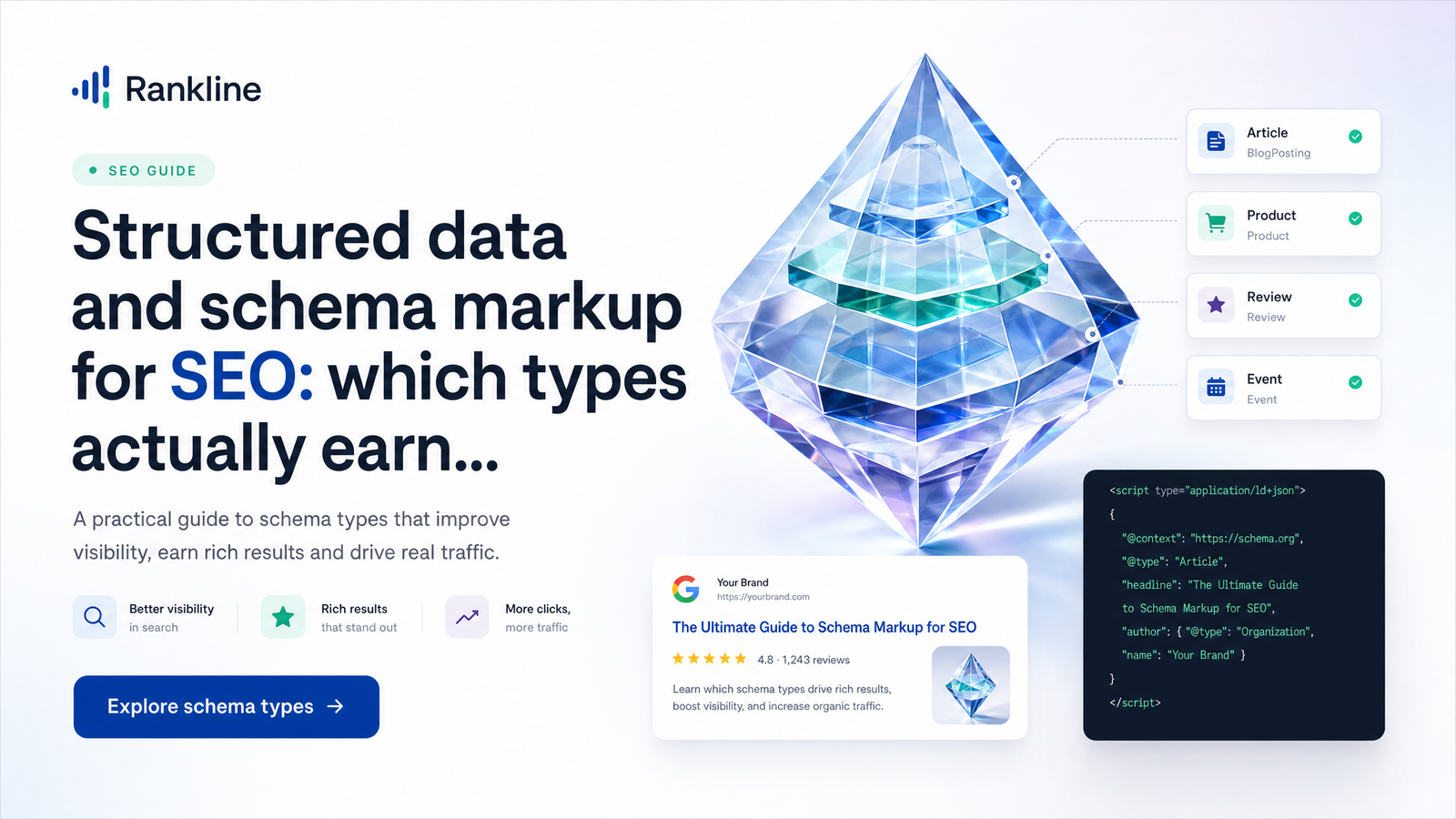
Schema Markup Isn't Dead — But Most of the Advice About It Is Outdated
Schema markup for SEO still matters. What's changed is which types actually produce something a searcher can see. Since 2023, Google has quietly stripped rich-result eligibility from several schema types that used to top every "SEO checklist" — and most published guides haven't caught up. Search "FAQ schema for rich results" today and you'll still find dozens of articles telling you to add FAQPage markup for extra SERP real estate. That advice is now wrong.
This article answers a simple question: which schema types still generate visible rich results in Google Search after the 2025–2026 deprecations, and how do you check that structured data works across an entire site instead of one URL at a time? We'll also cover the distinction that trips up most teams — passing a validator is not the same as earning structured data rich results — and where an automated audit workflow fits into keeping schema correct as you publish.
Valid Schema vs. Rich-Result-Eligible: Why They're Not the Same Thing
A page can have flawless JSON-LD, zero validation errors, and still never show a rich result. This is the single most common misunderstanding in structured data work.
Validity means your markup is syntactically correct and matches schema.org vocabulary — right properties, correctly nested, no typos. Rich-result eligibility is separate and narrower: Google has to currently support a visual treatment for that schema type, your content has to meet its quality and completeness requirements, and sometimes your site category has to qualify at all. A recipe site and a SaaS blog can both implement identical Review schema correctly, but only one sits in a content category Google treats as review-eligible.
Structured data SEO in 2026 makes this point clearly: correct markup is a prerequisite, not a guarantee. FAQPage is the clearest cautionary example — sites can implement it with zero errors, and as of the May 2026 change, it produces no rich result display for the overwhelming majority of sites regardless of code quality. Eligibility depends on Google's current feature support far more than on implementation quality, which is why a validator passing is a floor, not a finish line.
The Schema Types That Actually Earn Rich Results Right Now
Here's the current, narrowed list of schema types confirmed to trigger visible rich results in Google Search:
- Product, Review, and AggregateRating — star ratings, pricing, and availability directly in the SERP, still one of the strongest CTR levers in organic search.
- Article / BlogPosting — enables enhanced presentation in Top Stories and certain content carousels, plus author and date signals Google uses for freshness.
- BreadcrumbList — replaces the raw URL with a readable page hierarchy, improving scan-ability and perceived site structure.
- Organization — feeds knowledge panel details like logo, social profiles, and official name, supporting brand-level search presence.
- LocalBusiness schema — powers map pack details, hours, and address display for location-based queries, still one of the highest-value types for service businesses.
- Event — surfaces date, venue, and ticket information directly in search for time-bound content.
- VideoObject — enables video thumbnails and key-moment markers inside search results and video carousels.
These seven are worth spending implementation time on in 2026. Product and Review schema in particular remain high-priority because ratings and pricing snippets have a disproportionate effect on click-through relative to the engineering effort required.
What Got Cut — and What to Do With FAQ and HowTo Schema Now
The shrinkage didn't happen all at once. HowTo schema lost rich result support back in 2023, when Google removed the step-by-step visual treatment from most search results. Then in June 2025, Google retired rich result support for seven additional schema types in one pass. The most consequential change landed most recently: FAQ rich results were fully retired from Google Search on May 7, 2026, closing out a restriction process Google had rolled out gradually. Search Engine Journal's coverage confirms the date and Google's own documentation describing the change as a permanent removal, not a temporary rollback. Passionfruit's breakdown adds the fuller timeline, including tooling changes to Search Console and the Rich Results Test that followed in June and August 2025.
So is it worth ripping FAQPage and HowTo markup out of your templates? No — and yes, in different senses. The markup won't cause errors or penalties by existing; Google simply ignores it for display purposes now. There's no cleanup emergency. What should change is where you spend new effort: stop building content strategy around "we'll add FAQ schema so this gets a rich snippet," because that outcome no longer exists for the vast majority of sites. If you're already maintaining FAQ blocks for genuine user value — real questions people ask, positioned to help the reader rather than bait a rich result — keep the content and let the schema sit dormant. Redirect remaining implementation hours toward the seven types above, where the display payoff still exists.
How to Validate Schema Markup at Scale (Not Just One URL at a Time)
Checking one page in Google's Rich Results Test tool works fine when debugging a single template. It breaks down once you're managing a site with hundreds of URLs across different content types — nobody pastes 300 pages into a browser tool one at a time, which is exactly how broken or missing schema ships silently on new pages.
A workflow that actually scales looks like this:
- Crawl the site and extract JSON-LD in bulk. Rather than opening pages manually, a crawler should pull every
<script type="application/ld+json">block site-wide so you have a full inventory of what schema exists — and, just as importantly, where it's missing entirely. - Cross-reference against Search Console's Enhancement reports. Search Console will tell you at a domain level which schema types Google has actually detected and whether it's flagging any items with errors or warnings, the closest first-party signal to real-world eligibility.
- Batch-validate against schema.org requirements, not just syntax — checking that required and recommended properties are present for each type, since a technically valid Product schema missing price or availability won't perform the same as a complete one.
- Build a recurring check into the publishing workflow, not a one-time audit. New pages, template updates, and CMS changes are the most common source of schema regressions — a field gets renamed, a plugin update strips a property, and nobody notices until traffic on that page type quietly drops.
This is the same logic that applies to broader technical SEO work: one-off fixes don't hold, recurring checks do. If you're building a prioritization framework for technical issues generally, this priority action plan for technical SEO covers how to triage fixes beyond schema specifically, and a full site audit tool explains where structured data checks sit inside a broader crawl-based audit.
It's also worth asking whether this effort matters outside classic blue-link results. Structured data does inform AI Overviews and AI-driven search summaries, but differently than it does classic rich results — Google's generative systems use structured data as a clarity signal about what a page is and what it offers, helping with accurate extraction and attribution, even when no visual rich result ever appears. Clean, complete schema is one of the more efficient ways to make a page machine-readable for both a crawler and a language model doing summarization, tying structured data work into the broader topical authority goal, not just SERP appearance.
Where Rankevra Fits In
Manually re-running the Rich Results Test across a growing site isn't a process, it's a bottleneck — exactly the kind of repetitive, easy-to-skip task that stops getting done once publishing volume increases. Rankevra's automated audit workflow runs structured data checks as part of its continuous site monitoring, extracting JSON-LD across every page, flagging missing or malformed schema on new content the moment it publishes, and surfacing it alongside other technical SEO findings like the Core Web Vitals issues that also affect ranking and rich result eligibility. Instead of remembering to spot-check schema after every content sprint, the check runs on its own schedule — the difference between validation as a one-time project and validation as infrastructure.
Frequently Asked Questions
Should I remove FAQ schema from my site now that Google dropped FAQ rich results?
No, removal isn't necessary — the markup won't cause errors or penalties, Google simply no longer displays it as a rich result for most sites. Keep FAQ content if it genuinely helps readers, but stop treating FAQ schema as a rich-result strategy and redirect new implementation effort toward types like Product, Review, and BreadcrumbList that still show visually.
Does schema markup directly improve rankings, or just how results look?
Schema markup primarily affects how a result looks and how machine-readable a page is, not rankings directly. The indirect ranking benefit comes from improved click-through rate on rich results and better content clarity for both search crawlers and AI summarization systems.
What's the easiest schema type to start with if I have no structured data yet?
Article/BlogPosting and BreadcrumbList schema are the easiest starting points because they require few properties, apply to nearly every page type, and are usually available as built-in options in most CMS platforms. From there, Organization schema for brand-level details is a quick, low-effort addition.
Can I use multiple schema types on the same page?
Yes, multiple schema types on one page is standard practice and often necessary — a product page, for example, commonly combines Product, Review/AggregateRating, BreadcrumbList, and Organization schema simultaneously. Each type should be complete and correctly nested rather than partially filled out across several blocks.
Do AI Overviews and AI search tools use structured data differently than classic Google Search?
Yes — AI Overviews and generative search features use structured data more as a content-clarity and extraction signal than as a trigger for a specific visual display. A page can have zero classic rich results and still be more accurately summarized or cited in an AI Overview because its schema clearly defines what the content is about.
How often should I re-validate schema markup after publishing new pages?
Structured data should be checked every time new pages go live or templates change, not just during periodic audits, since CMS updates and plugin changes are common causes of silent schema breakage. A recurring, automated check catches these regressions immediately rather than after they've already affected a page's search appearance.
Schema validation is exactly the kind of task that looks manageable at ten pages and becomes unmanageable at ten thousand — much like manual content audits or spreadsheet-based rank tracking. Rather than re-running the Rich Results Test by hand every time you publish, Rankevra automates that check continuously across your whole site, catching missing or broken schema before it costs you a rich result you didn't know you'd lost.
Keep reading
- Content Decay SEO: How to Detect It and Fix It for GoodLearn to detect content decay SEO issues early, rule out false positives, and build a refresh pipeline that scales — plus how to automate the whole loop.
- Headless CMS SEO: Fixing the Gaps Generic Tools MissHeadless CMS SEO breaks in three predictable places: rendering, metadata, and sitemaps. Here's the diagnostic framework to find and fix each gap.
- Google Algorithm Update Recovery: A Diagnostic FrameworkA step-by-step google algorithm update recovery framework: confirm the cause, segment the damage, benchmark against winners, and set a real timeline.