Rankevra Blog
SEO A/B Testing: How to Prove a Change Actually Worked
September 22, 2026
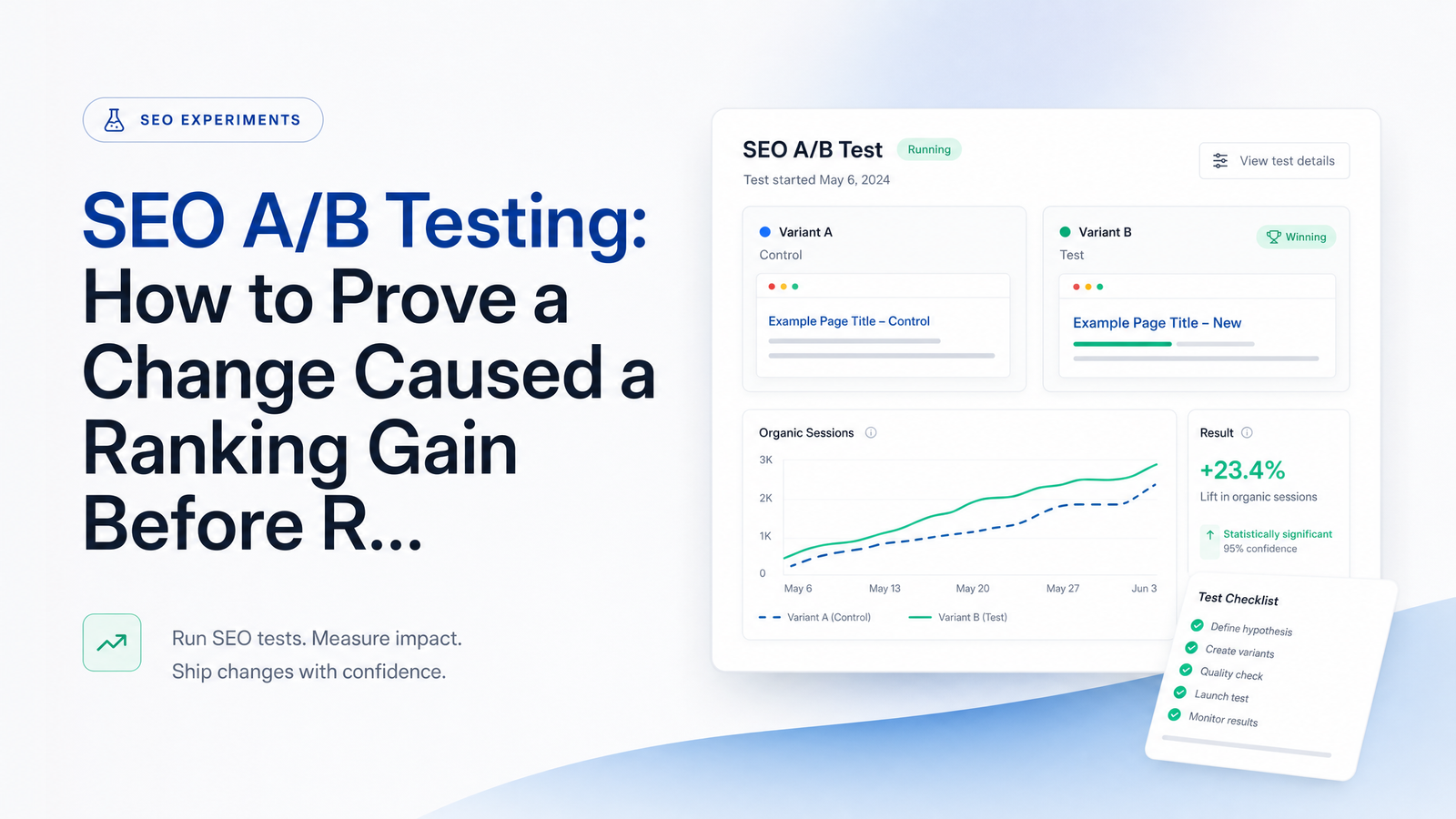
Why 'I Changed It and Traffic Went Up' Isn't Proof
You rewrote twenty title tags, traffic climbed 12% over the next month, and you told your boss the rewrite worked. But that same month Google rolled out a core update, a competitor lost a featured snippet, and seasonal demand ticked up anyway. Any of those could explain the lift. This is the trap of before-and-after SEO comparisons: they measure correlation, not causation, and correlation collapses the moment someone asks "how do you know it wasn't something else?"
A single-page before/after test can't isolate cause. Search visibility moves constantly — algorithm updates, seasonality, backlink changes, competitor refreshes — all on top of whatever you changed. Without a comparison point, you can't separate your signal from the noise. That's the problem SearchPilot's breakdown of the math behind SEO A/B testing tackles: proving causation requires a baseline of pages that didn't change, running in parallel with pages that did.
That baseline is a control group. Real SEO A/B testing splits your pages into two groups — one gets the change, one doesn't — and compares how each performs relative to its own historical trend. If the changed group outperforms the unchanged group by a statistically defensible margin, you have evidence. Without that comparison, you have a story that happens to fit the data.
The Anatomy of a Valid SEO Test: Control Groups, Variant Groups, and Templates
SEO testing borrows its logic from CRO A/B testing but works differently in execution. In CRO, you split users — half see version A, half see version B, and the same URL serves different content depending on who's asking. You can't do that in SEO: Google indexes exactly one version of a URL. Instead, you split pages.
Pick a set of similar pages, randomly assign some to a control group (untouched) and some to a variant group (gets the change), then track both over time. Because the two groups share the same template and general traffic patterns, whatever gap opens between them afterward is much harder to attribute to anything except the change itself.
Templated pages make this workable — product pages, category pages, blog posts, or any URLs built on a consistent structure. You need enough pages doing similar jobs, at similar traffic levels, so grouping them behaves like a fair coin flip rather than cherry-picking. Testing two random pages with nothing in common — different intent, backlink profiles, age — tells you little, since you can't tell if the difference came from the change or from pre-existing differences.
On sample size: general guidance from SearchPilot's guide to SEO split testing and Crazy Egg's beginner's guide to SEO A/B testing suggests dozens of pages per group, not two or three, and those pages should already pull meaningful organic traffic — pages getting five visits a month will never generate a readable signal, no matter how long you wait.
Setting Up the Test Without Triggering Guideline Problems
Marketers often shy from SEO split testing, worried that serving different variants looks like cloaking. It won't, as long as you follow a few rules:
- Test one variable at a time. Title tag wording, heading structure, internal linking, schema markup — pick one, not a bundle. Change five things at once and you won't know which one did the work.
- Never show different content to Googlebot than to users. Cloaking is about deception, not experimentation — serving the same variant to everyone, bots included, and comparing groups of real, fully indexed pages is not a violation. Optibase's guide to A/B testing and SEO documents Google's stance clearly: the risk isn't testing itself, it's showing crawlers something different from what visitors see.
- Handle canonical tags and redirects correctly. If a variant lives at a different URL, make sure canonicals point where they should, and never rely on 302 redirects to swap in test content — that creates indexing confusion that can muddy results and rankings alike.
- Write the hypothesis before you launch, not after. "Adding FAQ schema to product pages will increase organic clicks by improving SERP appearance" is testable. "Let's see what happens if we change stuff" is not.
- Set a success metric and an end date up front. Decide what "win" looks like — organic sessions, clicks from Search Console, rankings for target terms — and commit to a review date before starting, so you're not tempted to stop the moment the number looks good.
This checklist matters as much for internal credibility as for compliance. A documented hypothesis, a single changed variable, and clean technical handling make a result hard to dismiss as an accident of bad setup.
How Long to Run It and What 'Statistically Significant' Actually Means
Most sources converge on a similar window: SearchPilot's guide and Crazy Egg both point to roughly two to four weeks as the practical range for a trustworthy read, assuming sufficient traffic. Shorter, and normal day-to-day fluctuation swamps any real effect. Longer, and you risk contamination from external events — an algorithm update, a seasonal shift, a competitor's redesign — unrelated to your change.
The most common mistake is peeking early and calling it. Check results after four days, see the variant up 8%, and ship the change site-wide right then, and you've likely reacted to noise, not signal. Statistical significance guards against this: it asks "how likely is it I'd see a gap this size purely by chance, if my change did nothing?" A low likelihood — conventionally under 5% — means the gap probably reflects a real effect rather than random variation.
More sophisticated approaches, like the Bayesian structural time-series modeling behind Causal Impact (the technique underpinning tools like SearchPilot), go further. Instead of a single threshold, they generate a confidence or credible interval — a range of plausible effect sizes, like "this change likely produced somewhere between a 4% and 11% lift." That range tells you more than a bare percentage, because it shows both the size of the effect and how confident you should be in it. A tight interval that excludes zero is a real win. A wide interval straddling zero means you don't have an answer yet — you have noise dressed up as a result.
Reading the Result: When to Roll Out, Kill, or Re-Test
Once your test window closes, you're choosing between three outcomes:
Clear win. The variant group outperforms the control by a statistically credible margin, sustained across the full test period. Roll the change out site-wide and keep monitoring afterward — a win on fifty pages doesn't guarantee identical performance across five hundred, so treat rollout as a larger, lower-risk continuation of the test rather than a finished project.
Inconclusive. The groups moved similarly, or the confidence interval straddles zero. This isn't failure — it's information. Extend the test if traffic was borderline, or redesign it with a sharper hypothesis or a larger page group. Rolling out an inconclusive test site-wide is how teams end up unable to explain why a change that "worked" on a handful of pages does nothing everywhere else.
Negative. The variant underperforms the control. Kill it, revert, and document why. A negative result written down saves you from re-testing the same idea eighteen months later.
Every outcome, including the boring ones, belongs in a running internal record: what you tested, on which template, over what period, with what result. That record becomes your SEO testing playbook — accumulated, site-specific knowledge of what actually moves your rankings, as opposed to generic best practices that may or may not apply to your site's audience, backlink profile, or content history.
Where Most Teams Get Stuck (And How to Fix It Without Extra Tools)
None of this methodology is exotic. Most teams don't fail at SEO A/B testing because they misunderstand control groups — they fail because tracking control versus variant performance over three or four weeks turns into a mess of Search Console exports, rank-checker CSVs, and spreadsheet formulas someone has to update by hand every few days. By week two, half the team has stopped checking, and by week four nobody's sure which numbers are current.
This is the real bottleneck, and it's an infrastructure problem, not a statistics problem. You need a way to tag pages into control and variant groups, track their rankings and traffic in parallel, and see the comparison update automatically — without stitching together three disconnected tools every time you want a status check.
That's the layer Rankevra is built to handle. Its rank tracking covers both groups continuously, so you're watching real movement instead of stale exports, and its reporting turns that raw data into a dashboard you can read at a glance — control trend on one side, variant trend on the other, without opening a spreadsheet. Once a test proves out, the same reporting layer helps you carry the story forward into revenue-focused KPI reporting, so a validated ranking gain doesn't stop at "traffic went up" — it connects to the business outcome that justified running the test in the first place.
Frequently Asked Questions
Is SEO A/B testing the same as CRO A/B testing?
No. CRO A/B testing splits users, showing different versions of the same URL to different visitors at the same time. SEO A/B testing splits pages instead, because Google indexes only one version of a URL — so you assign whole pages to a control or variant group and compare their performance over time.
How much traffic do I need before I can run a valid SEO A/B test?
Enough organic traffic per page that normal fluctuation doesn't swamp the effect you're measuring — pages getting only a handful of visits a month rarely produce a readable signal. Both SearchPilot and Crazy Egg point to needing solid existing organic sessions across your page groups before significance testing becomes meaningful.
How long should an SEO A/B test run before I trust the result?
Roughly two to four weeks, assuming adequate traffic volume. Shorter tests get drowned out by normal ranking noise, while much longer tests risk contamination from algorithm updates, seasonality, or competitor changes unrelated to your test.
Can A/B testing hurt my SEO if Google sees different versions of a page?
Not if set up correctly — the risk is cloaking, showing Googlebot something different from what real users see, and that's not what a proper SEO split test does. As long as every visitor and crawler sees the same variant for a given page, plus correct canonical and redirect handling, testing itself doesn't violate Google's guidelines.
What's the minimum number of pages I need for a control and variant group?
There's no universal number, but you need enough templated, similar pages in each group that random assignment behaves fairly rather than being skewed by one or two outliers. Practically, that usually means dozens of pages per group, drawn from a consistent template like product, category, or blog pages.
How do I know if a traffic increase was caused by my change or by something else, like seasonality or an algorithm update?
You can only separate the two with a control group running in parallel — pages left unchanged that experience the same external conditions as your variant pages. If the variant group moves meaningfully more than the control during the same window, external factors are far less likely to explain the gap, since both groups were equally exposed to them.
Keep reading
- Topical Authority Mapping: The Complete Buildable ProcessLearn how to build a topical authority map with a real pillar-cluster structure, internal linking that works, and how automation keeps it current.
- JavaScript SEO Rendering Issues: A No-Dev Diagnostic GuideLearn how JavaScript SEO rendering issues hide content from Google, how to diagnose them in 15 minutes without a developer, and how to fix them fast.
- SEO KPI Reporting: Translating Rankings Into RevenueLearn a repeatable SEO KPI reporting framework that turns rankings and traffic into revenue language executives actually trust and fund.