Rankevra Blog
Topical Authority Mapping: The Complete Buildable Process
September 22, 2026
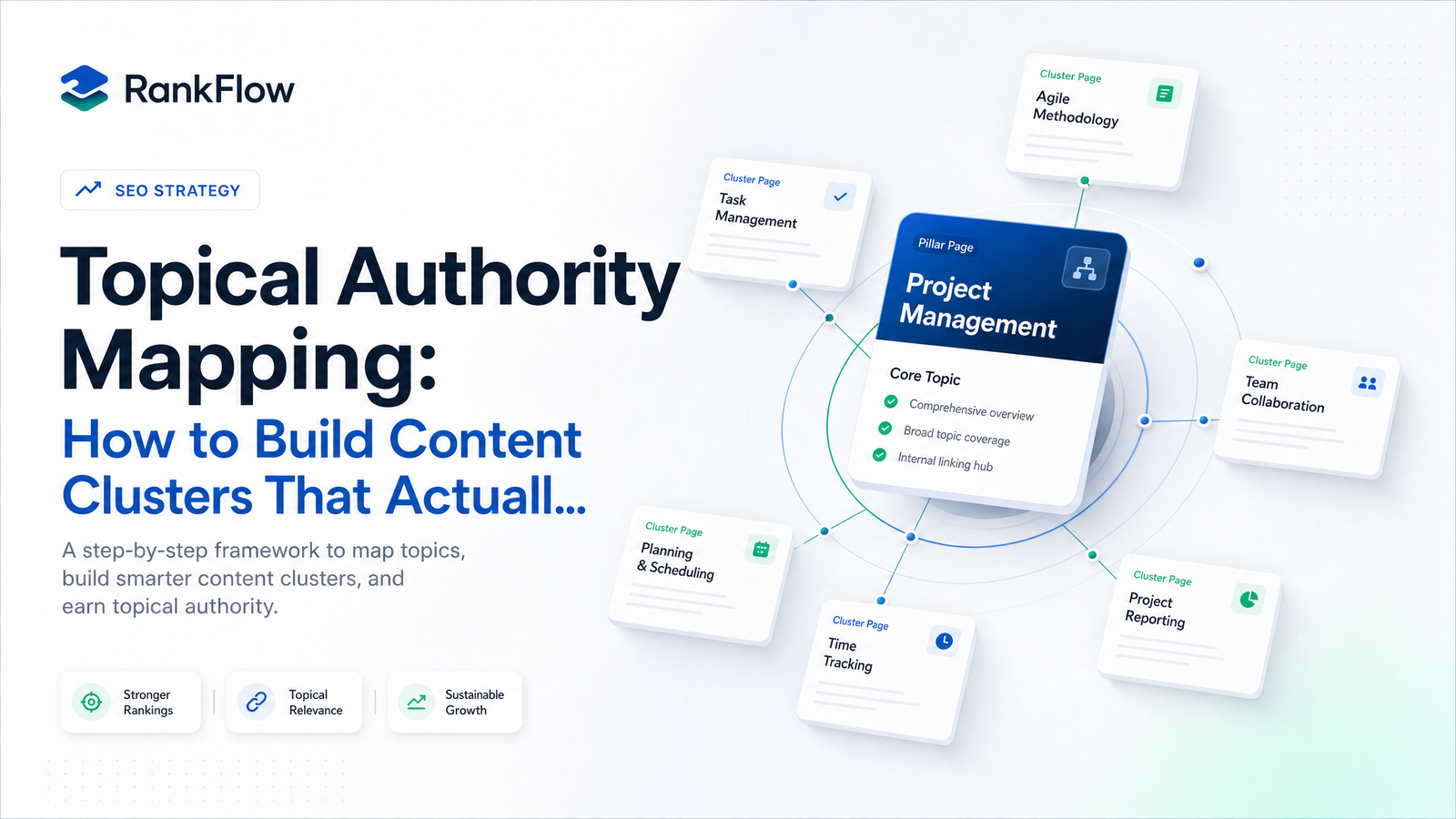
Most sites don't lose rankings because their content is bad. They lose because their content has no relationship to anything else they've published. One post targets a keyword, the next targets an adjacent one, and six months later there's a pile of loosely related articles with no shared structure — and rankings stall despite a steady publishing cadence. Topical authority mapping is the fix, and it's more concrete than most guides make it sound.
What Topical Authority Mapping Actually Means (and Why Isolated Pages Lose)
Topical authority mapping is the process of deliberately charting every subtopic, question, and entity that belongs to a topic, then assigning each one a specific page with a specific role in a hierarchy. It's not a content calendar (which just schedules output) and it's not a keyword list (which just tells you what to target). A map defines relationships: which page is the pillar, which pages are clusters, and how they connect.
This is also distinct from domain authority, a general, backlink-driven measure of a whole site's strength. Topical authority is narrower and earned differently — through depth and breadth of coverage on one subject. As Search Engine Land's guide to topical authority explains, a site can have modest domain authority but still outrank stronger domains on a specific topic if it demonstrates more complete, better-connected coverage of that subject.
SEO analyst Kevin Indig frames it similarly in his piece on how to measure topical authority: it's a function of depth of expertise, entity coverage, and the mentions and links a topic earns — not a single named ranking factor, but a pattern search engines reward because it correlates with genuinely useful, comprehensive resources. That's the throughline connecting topical authority to Google's Helpful Content Update and to E-E-A-T more broadly: systems built to identify content written by people who actually understand a subject, not content assembled keyword by keyword. Isolated pages, no matter how well-optimized individually, don't send that signal. A structured map does.
The Anatomy of a Topical Map: Pillar, Clusters, and Entities
A working map has three layers.
The pillar page covers the topic at a broad level — comprehensive enough to satisfy a reader who wants the overview, but not so deep on any one subtopic that it duplicates what a cluster page should do. Good pillar page strategy means writing for breadth and linking out for depth, not trying to cram everything into one page.
Cluster pages each own one subtopic, question, or use case related to the pillar, going deeper than the pillar does on that specific angle. This is the hub-and-spoke content model in practice: the pillar is the hub, clusters are the spokes, and every spoke links back to the hub.
Supporting entities are the named concepts, tools, processes, and terms that need to appear across the map for search engines to recognize full semantic SEO coverage of the topic — not necessarily separate pages, but ideas that should show up consistently where relevant.
The hardest part of building content cluster architecture isn't drawing boxes — it's scoping the topic's boundaries before you start. Ask what a reader researching this topic would consider "the same subject" versus "a related but separate one." If a subtopic could stand alone as its own pillar with its own clusters, it probably belongs on a different map, linked to this one rather than folded into it. Get this wrong and you end up with two pillars competing for the same intent, or a single pillar so broad its clusters overlap and blur into each other.
How to Build Your Topical Map, Step by Step
Once the boundary is set, the build itself follows a repeatable sequence.
- Pick the pillar topic — broad enough to support 10–20+ subtopics, narrow enough that a single page can credibly introduce all of them.
- List every subtopic question and entity a thorough resource on this topic would need to address. Pull from search intent patterns, "people also ask," competitor coverage, and internal knowledge of what your audience actually asks.
- Cluster those questions by intent, not just by keyword similarity — two keywords with different search intent shouldn't share a page even if they look related on the surface. This is where keyword clustering for SEO earns its keep: grouping by what the searcher wants to do, not just what words they typed.
- Assign one page per cluster node. Every node on the map gets exactly one owner page. If two nodes seem to need the same page, they're probably not two nodes — merge them or split the difference in scope.
- Audit existing content against the map before writing anything new. Some nodes are likely already covered, just not labeled as part of a structure. Flag those pages for a link-in rather than a rewrite.
This step — finding where coverage is thin, missing, or duplicated — is exactly what a structured gap analysis process is for. The SEO content gap analysis framework is worth running once your map's nodes are listed, since it turns "we should probably cover this" into a ranked list of specific gaps to close first.
Wiring the Internal Links So Authority Actually Flows
A pillar and its clusters can be perfectly scoped and still underperform if the linking isn't done correctly. This is the step that gets skipped most often, and it's the one that actually signals topical depth to search engines.
The model needs to run in both directions. Every cluster page links up to the pillar, and the pillar links down to every cluster — not just a handful of "related posts" at the bottom, but contextual links placed where the pillar naturally introduces that subtopic. Beyond that, cluster pages should link sideways to each other where the content genuinely overlaps: a page on cluster node A referencing a concept covered fully in cluster node B should link there, not repeat the explanation.
Missing links are what break the hub-and-spoke model in practice. A cluster page with no inbound link from the pillar is functionally orphaned — it might rank on its own merits, but it won't contribute to or benefit from the pillar's authority. Content cluster internal linking strategy is less about volume of links and more about making sure no node in the map is unreachable from the pillar in one click. If you're evaluating tools to help manage this at scale, the internal linking tool evaluation framework covers what actually matters versus what's just a dashboard feature.
Keeping the Map Alive: Maintenance, Gaps, and Scale
A topical map built once and never revisited degrades the same way an unweeded garden does — not through one dramatic failure, but through slow drift. New pages get published ad hoc because they seemed relevant at the time, nobody checks them against the existing structure, and within a year you've got two pages quietly competing for the same query. That's classic keyword cannibalization, and it's almost always a maintenance failure rather than a planning one.
The practical fix is a recurring gap re-check — not a full rebuild, but a periodic pass asking: has a new subtopic emerged that deserves a node? Has an existing cluster page gone stale and lost rankings it used to hold? Are any two pages now targeting overlapping intent? Weak or outdated nodes should be refreshed or merged, not left to compete with newer content on the same subject. Publishing cadence matters here too — a content publishing workflow built to scale safely makes it much easier to slot new pages into the existing map instead of bolting them on afterward.
Be cautious about scaling clusters purely by volume. Programmatic approaches can fill out a map's remaining nodes quickly, but only if each page still earns its place with real depth. The guide to scaling programmatic SEO without getting penalized is worth reading before mass-producing cluster pages — thin, templated content undermines the exact depth signal a topical map is supposed to build.
Why Manual Topical Mapping Breaks Down (and Where Automation Helps)
Everything above is straightforward in principle and genuinely hard to sustain by hand. Mapping a topic's boundaries, clustering by intent, auditing existing coverage, wiring bidirectional links, and re-checking all of it periodically for gaps and cannibalization is a lot of coordinated work — and it usually happens across four or five disconnected tools: one for keyword research, another for briefs, a CMS for publishing, a separate rank tracker, maybe a spreadsheet trying to hold the map together. Nothing in that stack actually knows about the map as a system. Each tool sees its own slice, and the connective structure lives only in someone's memory or an aging spreadsheet — which is exactly how orphaned pages and duplicate clusters happen in the first place.
This is the gap an AI SEO workflow is built to close. Rankevra runs audits, keyword and gap research, content briefs, publishing, and rank tracking inside one system, so the topical map isn't a static diagram that goes stale after the initial build — it's a live structure the tool can check new content against before it gets published. As a topical authority tool, it flags where a new page would overlap an existing cluster node before cannibalization happens, and surfaces gaps in real time rather than during an annual audit.
If you're managing this by hand today, the map you drew at the start of the year probably doesn't match the site you actually have now. Rankevra closes that gap by keeping mapping, gap-finding, and publishing in the same workflow instead of five disconnected ones.
Frequently Asked Questions
What's the difference between a content cluster and a topical map?
A content cluster is a single pillar page and its supporting subtopic pages. A topical map is the larger system: every cluster for a given subject area, the entities each one covers, the boundaries between adjacent topics, and the internal linking structure connecting all of it. A cluster is one piece; the map is the full blueprint.
How many cluster pages do I need before a pillar page starts ranking better?
There's no fixed number, but pillars generally need enough clusters to demonstrate real depth — often somewhere in the 8–15 range for a moderately broad topic before search engines and readers treat the pillar as comprehensive. What matters more is whether the clusters cover the topic's genuine subtopics without gaps and are properly linked to the pillar.
Can a small website build real topical authority, or is this only for big sites?
Small sites can build topical authority by choosing a narrower, well-bounded topic rather than competing across a broad subject area. Depth and complete coverage of a tightly scoped topic outperforms shallow coverage of a wide one, regardless of overall site size or domain authority.
Does topical authority mapping replace keyword research?
No, it builds on it. Keyword research tells you what people search for; topical authority mapping organizes those keywords by intent and relationship into a pillar-cluster hierarchy so pages support each other instead of competing for the same rankings.
How do I know if my existing content already covers a cluster node?
Audit existing pages against your list of mapped subtopics before writing anything new — check title, headings, and target intent against each node rather than relying on memory. A structured gap analysis process is the fastest way to see this clearly, since it compares what you've published against what the topic actually requires.
Will AI-generated cluster content hurt my topical authority?
Not inherently — what hurts topical authority is thin, generic content, regardless of whether a person or a tool produced it. AI-assisted content built from a real map, addressing a specific node with genuine depth, and properly linked into the cluster structure can support topical authority just as well as manually written pages.
Keep reading
- SEO A/B Testing: How to Prove a Change Actually WorkedLearn how to run rigorous SEO A/B testing with control groups, sample sizes, and significance checks — so you can prove a ranking gain, not guess at it.
- JavaScript SEO Rendering Issues: A No-Dev Diagnostic GuideLearn how JavaScript SEO rendering issues hide content from Google, how to diagnose them in 15 minutes without a developer, and how to fix them fast.
- SEO KPI Reporting: Translating Rankings Into RevenueLearn a repeatable SEO KPI reporting framework that turns rankings and traffic into revenue language executives actually trust and fund.