Rankevra Blog
AI Tool for SEO Keyword Research: What Actually Works
July 27, 2026
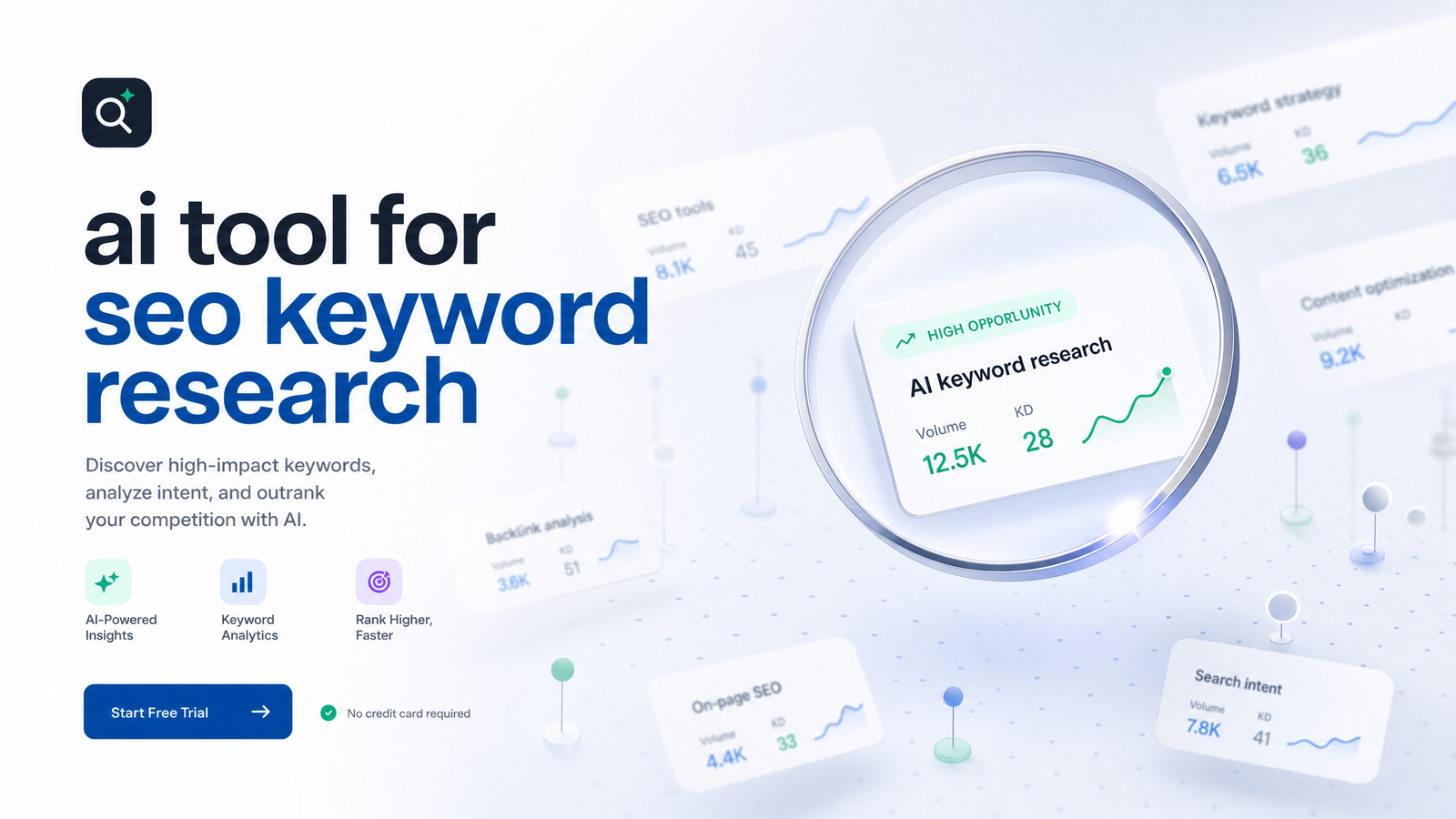
Most teams researching an AI tool for SEO keyword research hit the same wall: every product claims to be "AI-powered," but outputs range from genuinely useful clusters to reheated keyword lists with a chatbot bolted on. The difference isn't marketing copy — it's whether the tool grounds its reasoning in real search data or just pattern-matches on what a language model thinks a keyword should look like.
That distinction matters more now than two years ago. Search results have gotten messier — AI Overviews, zero-click answers, and shifting intent mean a keyword list sorted purely by volume is often useless. What you need is a tool that combines AI's real strength (reasoning about topics and intent) with verified data, then hands the result straight into content production instead of leaving it to rot in a spreadsheet.
What Makes a Keyword Tool 'AI' Instead of Just Automated
Automation and AI get used interchangeably in SEO software marketing, but they're not the same thing. A simple automated tool pulls numbers from a database, applies a filter, and spits out a spreadsheet — that's scripting, not intelligence. An actual AI-powered keyword research tool reasons about the relationships between terms.
That reasoning shows up in three places. First, expansion — generating adjacent terms and question variations a human researcher would take hours to brainstorm. Second, clustering — grouping keywords by shared intent and topic rather than alphabetical or volume order. Third, labeling — tagging each term or cluster with likely intent (informational, commercial, transactional, navigational) based on patterns in phrasing and SERP structure.
None of that requires inventing facts — it requires pattern recognition across language, which is exactly what large language models are built for. Judge an ai tool for seo keyword research by how well it reasons and organizes, and separately, by how well it's grounded in real data. Tools that blur those two jobs — claiming AI insight while quietly relabeling an old keyword database — are the ones to be skeptical of.
Where Plain AI Chat Breaks Down for Keyword Research
Asking ChatGPT or Gemini to "give me keyword ideas for [topic]" feels productive, and it is — for brainstorming. It is not a substitute for an ai keyword research tool built for SEO, and the failure points are specific rather than vague.
Large language models don't have live access to search volume, click-through data, or current SERP results unless explicitly connected to that data. Ask a plain chat model for monthly search volume, and it will often produce a plausible-looking number that isn't measured from anything — a hallucination dressed up as a stat. Hubstic's breakdown of the 2026 AI keyword workflow makes this point directly: AI is excellent at ideation and clustering but weak on live data, and the two need to be paired rather than treated as one capability.
The practical risk is repetition and staleness. Because a chat model generates from training patterns rather than current search behavior, prompts tend to produce the same handful of obvious variations no matter how you rephrase the request — the "10 best X for Y" template, over and over. Digital Applied's guide to AI-powered keyword research makes a similar case: general-purpose LLMs need to be paired with tools that carry real search-volume and SERP data, because the model alone can't tell you what people are actually typing into Google this month, let alone which long-tail queries are trending toward zero measurable volume but real traffic.
5 Things a Real AI Keyword Research Tool Should Do
Before evaluating a specific product, it helps to have a checklist that separates genuine AI-powered keyword research from a database with an AI label slapped on the pricing page.
- Validated search data, not guesses. The tool should pull volume, difficulty, and trend data from real search sources, then let AI interpret it — not generate numbers from a language model with no data connection.
- Intent classification per keyword or cluster. A search intent ai tool should tell you whether a term is informational, commercial, or transactional, because that changes what content format you build, not just what keyword you target.
- Keyword clustering AI that groups by topic, not just list order. You should get topic maps — clusters representing pages or content types — instead of a single flat spreadsheet of 500 rows sorted by volume.
- Long-tail and question discovery at scale. The tool should surface question-based and long-tail variants automatically, since these often carry clearer intent even with lower raw volume. For a deeper look, see this long-tail keyword research guide.
- Direct handoff into content briefs. If the keyword list can't move into a brief or draft without manual re-entry, the tool has only automated half the job.
Run any "AI SEO tool" candidate through those five checks before signing up. A tool that fails two or more is closer to a spreadsheet generator than a research assistant.
Why Search Intent Now Matters More Than Raw Volume
Ranking for a high-volume keyword used to guarantee traffic. That link is weaker every quarter. Search intent now determines whether a ranking actually produces a click, and AI Overviews are a big reason why.
When a query is purely informational — "what is," "how to," definitional lookups — AI Overviews frequently answer it directly in the results page, and the user never clicks through. That's the zero-click pattern reshaping search behavior heading into 2026: high volume no longer means high opportunity if the intent behind the query is one Google itself can satisfy without sending traffic anywhere. Meanwhile, a lower-volume but commercially-intended query — someone comparing tools, evaluating pricing, or ready to sign up — still reliably converts to a click and a visit, because that intent requires a real page with real substance, not a summary box.
This is precisely where AI's intent-labeling strength earns its place in the workflow. An ai-powered keyword research tool that can distinguish "best project management software" (commercial investigation) from "what is project management" (informational, likely to trigger an AI Overview) is doing the strategic filtering that used to require a human analyst reading twenty SERPs by hand. Prioritizing by intent, not just volume, is the actual 2026 shift — and it's a job language-model reasoning is well suited to, provided it's working from real SERP signals rather than guessing at phrasing alone.
From Keyword List to Published Content: Closing the Loop
A keyword list that sits in a spreadsheet has done nothing yet. The real measure of an ai tool for seo keyword research isn't how many terms it can generate — it's whether those terms turn into a content workflow that produces published, ranking pages.
This is where the multi-tool problem shows up most painfully. A team researches keywords in one tool, exports them into a doc, manually briefs a writer or another tool, drafts separately, then publishes through a CMS with no connection back to the original research. Each handoff loses context — intent labels get flattened, clustering gets ignored, and the writer ends up guessing at structure anyway.
A properly connected workflow keeps clusters intact from research through to the published page. Keyword groups map to specific content briefs — not one brief per keyword, but one per cluster, since that's how keyword gap analysis and topical planning actually work in practice. Each brief should carry the intent label and supporting long-tail variants straight into drafting, which is the core argument behind a well-built AI content brief generator: the brief tool is only as good as the keyword research feeding it.
Done consistently, this is also how topical authority gets built — not by publishing isolated pages targeting isolated keywords, but by covering a cluster comprehensively enough that search engines recognize the site as a credible source on the topic. That requires the keyword, brief, and publishing stages to share the same underlying map, not three disconnected tools each doing their own thing.
How Rankevra Handles AI Keyword Research
Rankevra applies the criteria above as one stage in a single workflow rather than a standalone keyword tool competing on list size. Keyword expansion and clustering are generated with AI reasoning, but grounded against real search and SERP data — so intent labels and difficulty scores reflect actual conditions, not a model's best guess. Clusters map directly to content briefs inside the same platform, and briefs flow into drafting and publishing without a re-export or a second subscription.
That's the practical difference between an ai seo tool that stops at research and one built for teams managing SEO themselves: audits identify technical issues, keyword research feeds briefs, briefs become drafts, drafts get published, and rank tracking closes the loop — all inside Rankevra rather than stitched across four vendors. If you're currently comparing category-specific tools like Helium 10 or checking whether Google Keyword Planner still covers your needs, the honest answer is that both are useful for narrow tasks — but neither connects keyword data to a finished, published page the way an integrated workflow does.
Try Rankevra's keyword research as part of the full audit-to-rank-tracking workflow: AI-driven ideas, backed by real data, handed straight to content — not another list to export. Rankevra is built for that exact gap.
Frequently Asked Questions
Can I just use ChatGPT for SEO keyword research instead of a dedicated tool?
Not reliably. ChatGPT and similar chat models are strong for brainstorming and grouping ideas, but they have no live connection to search volume or current SERP data, which means volume figures they produce can be invented rather than measured. Use plain LLM chat for ideation, and a dedicated tool for validation and prioritization.
What's the difference between an AI keyword research tool and a regular keyword tool?
A regular keyword tool automates database lookups — pulling stored volume and difficulty numbers with filters and sorting. An AI keyword research tool adds reasoning on top: clustering terms by topic, labeling intent, and generating long-tail and question variants a plain database can't produce.
Do AI keyword tools show accurate search volume?
Only if they're pulling from real, validated search data sources rather than generating estimates from a language model alone. A tool that pairs AI reasoning with grounded search and SERP data will show accurate volume; one relying purely on LLM output for numbers risks hallucinated figures.
How does AI figure out search intent for a keyword?
AI models classify intent by analyzing phrasing patterns, common query structures, and — in well-built tools — actual SERP results for that term, such as whether Google returns product pages, comparison articles, or definitional snippets. That combination of language pattern recognition and real SERP signals is far more reliable than phrasing analysis alone.
Is AI keyword research good enough for competitive niches, or only long-tail terms?
It works for both, but the value differs. In competitive niches, AI is most useful for intent classification and gap-finding against ranking competitors; for long-tail terms, it excels at discovering question-based variants and low-volume queries that still carry strong, specific intent.
How does AI keyword research fit into a full content workflow?
It should be the first stage of a connected pipeline, not a standalone deliverable — keyword clusters feeding directly into content briefs, which feed into drafts, which get published and then tracked for ranking performance. When those stages are disconnected across separate tools, intent labels and clustering context typically get lost between handoffs.
Keep reading
- Visual Search SEO: The Complete Framework for 2026A practical visual search SEO framework covering image access, alt text, filenames, and video schema — plus how to audit it all at scale.
- Content Decay SEO: How to Detect and Fix It Before RankingsLearn the statistical definition of content decay SEO, how to detect it early with GSC, and a triage framework to refresh, merge, or prune pages.
- SEO Audit Workflow: Merge Crawl, GSC & Rank DataA repeatable SEO audit workflow that joins crawl data, GSC, and rank tracking into one prioritized fix list — instead of three disconnected reports.