Rankevra Blog
SEO Dashboard Software: The Command Center vs. Reports
August 8, 2026
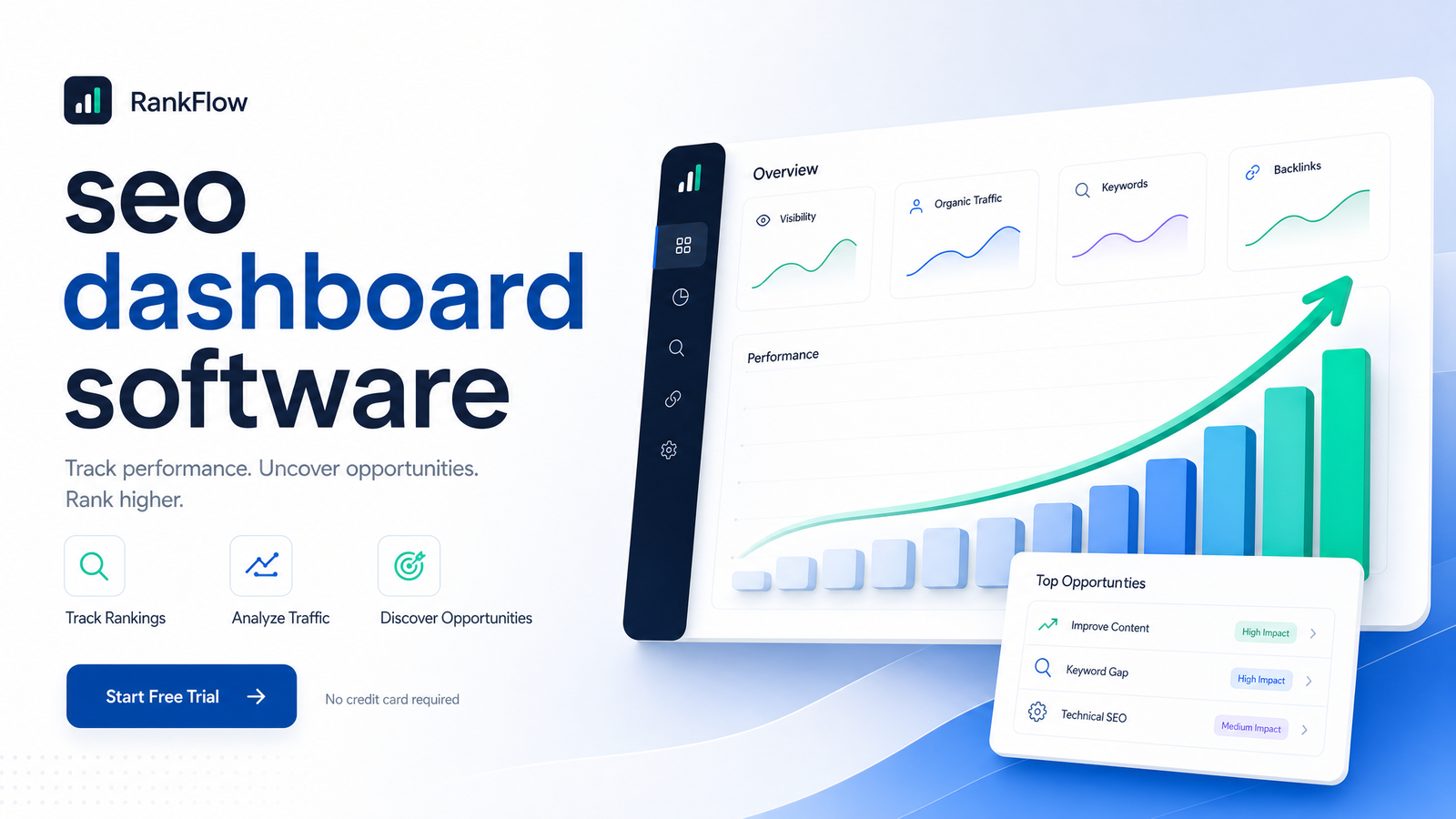
Most teams think they own SEO dashboard software when what they actually have is a reporting dashboard — a pretty screen that pulls numbers from Google Search Console and Analytics and arranges them into charts for a client meeting. Confusing the two is why so many in-house teams and agencies stay stuck juggling five subscriptions to do the job one platform should handle.
A reporting dashboard answers "what happened last month?" SEO dashboard software answers "what do I need to fix, write, publish, and track right now?" One is a rearview mirror. The other is a cockpit. If your organic traffic goals depend on catching technical issues fast, shipping content consistently, and building topical authority over time, you need the cockpit — not another chart generator.
What Makes SEO Dashboard Software a Different Category
Reporting tools are built for visibility after the fact. They connect to data sources, visualize trends, and export PDFs. They're useful for stakeholder updates, but they don't do the underlying SEO work — they just describe it.
True SEO dashboard software is operational. It runs site audits, flags crawl errors and indexation problems, tracks keyword rankings, helps produce and publish content, and ties all of that activity back to performance in one connected workspace. The distinction matters because reporting-only tools create a gap: someone still has to manually run the audit in one tool, draft content in another, schedule publishing through a CMS plugin, and track rankings in a fourth system before reporting on all of it in a fifth. Every handoff is a place where things get missed, delayed, or duplicated.
When people search for "SEO dashboard software," many land on tools built for agencies to impress clients. That's a legitimate need, but it's a different buying decision than what a working content team or website owner actually needs day to day: a command center that does the SEO, not just displays it.
The Feature Checklist: What an Operational SEO Dashboard Should Include
Before evaluating any platform, use this as your baseline. If a tool is missing more than one or two of these, it's a reporting layer wearing a dashboard's clothes.
- Automated technical audits — recurring crawls that surface broken links, missing meta tags, slow pages, duplicate content, and indexation issues without manually triggering a scan every time.
- Rank tracking with context — not just position numbers, but movement history tied to the pages and keywords driving your topical authority strategy.
- Content creation tools — briefs, drafts, or AI-assisted writing informed by the same keyword and gap data the audits surface, not a separate disconnected feature.
- Direct publishing — the ability to push content live (or to a CMS) from inside the platform, removing the copy-paste-format step.
- Issue prioritization — technical and content problems ranked by impact, so teams fix what actually moves rankings first instead of working a flat, unordered list.
- Cross-functional visibility — one place where audits, content status, and rank movement live together, so cause and effect is visible instead of stitching together exports.
- Alerting — notification when rankings drop, crawl errors spike, or a page loses indexation, rather than discovering it during a monthly review.
Reporting dashboards typically cover rank tracking and maybe basic audits. They almost never handle content creation or publishing, because that's not what they're designed for. That gap is exactly where most SEO stacks become fragmented.
Build vs. Buy: A Decision Framework
Once you know what operational SEO dashboard software should do, the next question is whether to assemble it yourself from point solutions or buy a unified platform.
Consider building your own stack (stitching tools together) if:
- You have a dedicated ops or engineering resource to manage integrations and keep them working as APIs change.
- Your team is small enough that manual handoffs between tools aren't creating real delays yet.
- You need a highly specific feature from a niche tool that no all-in-one platform currently offers.
Consider buying an all-in-one platform if:
- You're currently paying for three or more separate tools (audit tool, rank tracker, content tool, publishing plugin) and reconciling data between them manually.
- Content velocity is a bottleneck — briefs and drafts sit in one tool while technical fixes sit in another, and nobody has a single view of both.
- You want to build topical authority systematically, which requires seeing keyword gaps, existing content, and technical health together rather than in isolation.
- Time spent on tool administration is taking hours away from actual SEO strategy and execution each week.
For most website owners, marketers, and content teams managing SEO themselves, stitched-together stacks feel cheaper individually but cost more in aggregate — subscription overlap, context-switching, and the labor of manually connecting insights across tools. An operational SEO dashboard consolidates that cost into one system and one workflow.
How an AI-Driven Dashboard Replaces the Stitched-Together Stack
This is where the category shift becomes practical rather than theoretical. An AI-driven SEO dashboard doesn't just centralize the same manual tasks — it automates the connective tissue between them.
Take a typical fragmented workflow: an audit tool flags a thin content page, someone manually pulls that URL into a keyword research tool to find related terms, drafts a content brief in a document, writes or assigns the piece, formats it for the CMS, publishes it, and then checks a rank tracker weeks later to see if it worked. Each step lives in a different tool, requiring someone to carry context between them by hand.
Rankevra is built to collapse that sequence. The audit surfaces the thin-content issue and the underlying keyword opportunity in the same view. Content generation is informed directly by that gap data rather than a separate research pass. Publishing happens from within the platform instead of a manual export-and-upload step. Rank tracking then closes the loop automatically, showing whether the new or updated content actually improved position — inside the same dashboard where the issue was first identified.
That loop — audit, create, publish, track — is what separates SEO dashboard software from a reporting dashboard, and it's the specific gap Rankevra is designed to close for teams who don't have a dedicated ops person to babysit five integrations. The AI layer doesn't replace judgment; it removes the repetitive manual work of moving information between tools so the people running SEO can spend more time on strategy and less on data entry.
For teams focused on topical authority, this consolidation matters even more. Building authority around a topic cluster means constantly cross-referencing what you've already published, what's ranking, and where the gaps are. Doing that across four disconnected tools is slow and error-prone. Doing it inside one dashboard, where content status and ranking data sit next to each other, makes it a weekly habit instead of a quarterly project.
Getting Started Without Overhauling Everything at Once
Switching from a patchwork of tools to a single operational dashboard doesn't need to happen in one leap. Start by running a full technical audit inside the new platform and comparing its findings against what your current tools report — this alone usually reveals gaps in your existing setup. From there, move rank tracking over so you have one canonical source of position data. Content creation and publishing can migrate last, once the team trusts the audit and tracking data as accurate.
The goal isn't to throw out every tool overnight. It's to stop treating SEO as a series of disconnected tasks reported on after the fact, and start running it as one continuous, visible workflow.
Frequently Asked Questions
What is the difference between SEO dashboard software and a reporting dashboard?
A reporting dashboard visualizes SEO data after work has been done — it pulls in metrics and displays them for review or client presentations. SEO dashboard software is operational: it runs audits, tracks rankings, helps create content, and publishes it, actively driving the SEO work rather than just summarizing it.
Do I need SEO dashboard software if I already use Google Search Console?
Google Search Console gives you raw performance data but doesn't run recurring audits, generate content, or publish for you. SEO dashboard software builds on that same underlying data but adds the operational layer — automated issue detection, content creation, and publishing — that Search Console isn't designed to provide.
Is it cheaper to build my own SEO tool stack instead of buying an all-in-one platform?
It often looks cheaper per tool but usually costs more overall once you factor in subscription overlap, the time spent manually connecting data between tools, and the labor of managing integrations. An all-in-one platform consolidates that cost into a single subscription and workflow.
How does an AI-driven dashboard help build topical authority?
It keeps audit findings, existing content, and keyword gaps visible in one place, making it easier to spot where a topic cluster is thin and needs new or updated content. Because content creation and rank tracking live in the same system, teams can see whether new content actually closes the gap instead of guessing.
Can SEO dashboard software actually publish content, or just recommend it?
Platforms built as true operational dashboards, like Rankevra, can publish content directly from the platform rather than only generating a draft you then have to move manually. That removes the export-and-upload step that slows down many content teams using separate tools.
What size team benefits most from switching to an all-in-one SEO dashboard?
Teams currently juggling three or more separate tools — an audit tool, a rank tracker, a content tool, and a publishing process — see the biggest benefit, since that's where manual handoffs cause the most delay. Solo website owners and small marketing teams without a dedicated ops resource typically gain the most time back.
Rankevra brings audits, rank tracking, content creation, and publishing into a single AI-driven dashboard, so you can stop stitching tools together and start running SEO as one connected workflow. Rankevra is built for exactly the operational gap this article describes — see it applied to your own site.
Keep reading
- Content Decay SEO: How to Detect It and Fix It for GoodLearn to detect content decay SEO issues early, rule out false positives, and build a refresh pipeline that scales — plus how to automate the whole loop.
- Headless CMS SEO: Fixing the Gaps Generic Tools MissHeadless CMS SEO breaks in three predictable places: rendering, metadata, and sitemaps. Here's the diagnostic framework to find and fix each gap.
- Google Algorithm Update Recovery: A Diagnostic FrameworkA step-by-step google algorithm update recovery framework: confirm the cause, segment the damage, benchmark against winners, and set a real timeline.