Rankevra Blog
SEO Writing Assistant AI: What It Really Does in 2026
July 25, 2026
What an SEO Writing Assistant AI Actually Is (and Isn't)
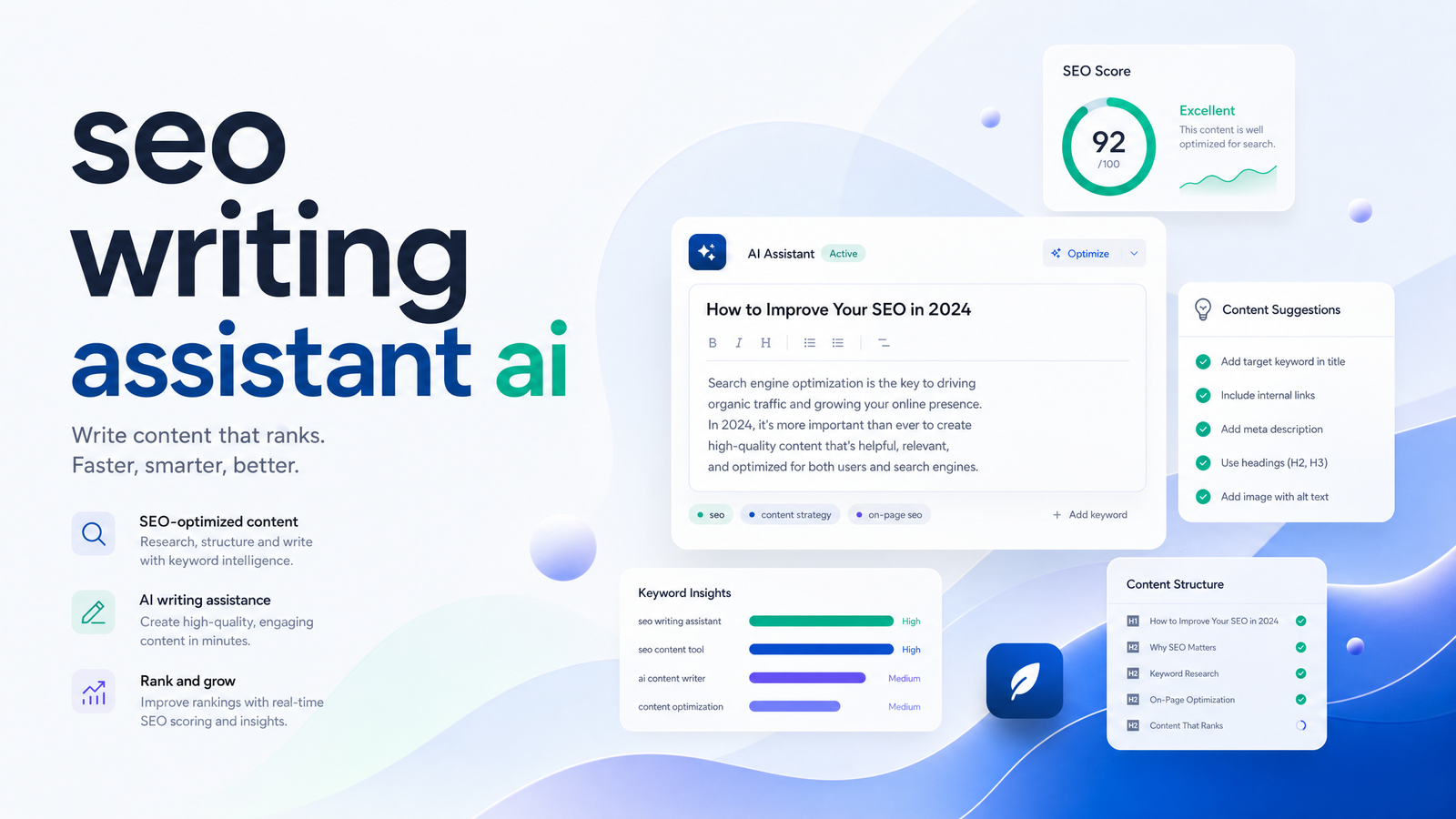
Search "seo writing assistant ai" and you'll find a flood of tools that are really just a chatbot with a keyword box bolted on. A genuine SEO writing assistant is software that understands what a specific SERP is rewarding right now, builds a structured brief around that intent, scores your draft against on-page ranking factors while you write, and hands the finished piece to publishing and rank tracking — all in one loop.
A generic AI content writing assistant only knows what was in its training data. Ask it to write about "best project management software" and it produces a competent, generic article with no idea whether the current top-ranking pages are listicles, comparison tables, or in-depth guides — because it never looked. That's the line that matters: an AI SEO writing tool researches the live SERP before it drafts; a plain chatbot drafts from memory. Everything else in this article — safety, features, workflow — depends on that distinction.
Search intent shifts by keyword and by month; a tool that isn't checking current results is guessing.
Is AI-Written Content Actually Safe for SEO?
Yes — Google does not penalize content simply because it was produced with AI. Google's own guidance on AI-generated content states that its systems reward quality content regardless of how it was produced, and that appropriate use of AI is not against its guidelines. The anxiety many teams carry about an AI content Google penalty is based on an outdated read of the rules.
What Google's Helpful Content System and SpamBrain actually target is scaled content abuse: mass-producing pages primarily to manipulate rankings, with little regard for who reads them. That applies whether the text came from a human freelancer or an AI model — production method isn't the trigger, intent and value are. Google's documentation on generative AI content reinforces this: it doesn't ban AI assistance, but expects content to serve people first and hold up under E-E-A-T scrutiny — experience, expertise, authoritativeness, trustworthiness.
So is AI content safe in practice? Yes, under three conditions. First, a human reviews for accuracy, brand voice, and anything the model got subtly wrong. Second, the piece adds something — original analysis, clearer structure, first-hand detail — rather than repackaging the top five results. Third, it's published as part of a normal editorial cadence, not blasted out in bulk with no differentiation between pages. Google's content policy rewards that pattern and penalizes the opposite one, no matter which tool typed the words.
5 Things a Real SEO Writing Assistant Should Do
Marketing copy for these tools tends to blur together. Here's a concrete checklist — five things a real AI writing assistant should do, not just claim to do.
1. Research against live SERP intent, not just training data. It should pull current top-ranking pages for your target query and identify the dominant format — guide, comparison, tool roundup — before a single sentence is drafted.
2. Build briefs from keyword gaps and competitor structure. You should get a brief informed by what ranking pages cover that yours doesn't, plus subtopics competitors are missing — the raw material for topical authority. Our 6-step content optimization framework breaks this stage down in more tactical detail.
3. Score on-page optimization as you write. Real-time feedback on headings, keyword placement, internal linking opportunities, and readability — not a report generated after the fact when changes are more expensive to make.
4. Publish directly to your CMS. A finished draft that still needs to be copy-pasted into WordPress, reformatted, and manually tagged isn't finished — it's a to-do list.
5. Feed rank-tracking data back into the next brief. This is the step almost everyone skips. If your tool doesn't know how last month's article performed, it can't tell you whether your next one should target a different angle, keyword cluster, or format.
Use this list — not vendor claims — as your SEO content generator checklist. Any AI writing tool for blogs that fails two or more of these is a drafting tool wearing an SEO costume.
Why Most "AI Writing Assistants" Stop Halfway
Here's the pattern behind the reader complaint we hear most often: teams publish content at real volume, optimization scores look fine, and rankings still don't move — and nobody can tell whether the writing or the workflow is at fault. Usually it's the workflow.
Most tools in this category handle steps one through three of that checklist reasonably well. They research a bit, draft competently, and hand you an optimization score. Then the loop breaks. Publishing is a manual export. Indexing is checked separately in Search Console. Rank verification happens in a third tool, days or weeks later, disconnected from the piece that produced it. The AI SEO content workflow you were promised turns back into the exact multi-tool juggling act you bought the software to avoid — chatbot for drafting, one tool for keyword data, another for scoring, a CMS login for publishing, a rank tracker for results.
Content optimization AI that stops at "here's your score" gives you a static snapshot. It can't tell you that the article you published three weeks ago is stuck at position 14 because it's missing a subtopic your top competitor added last month. Without that feedback loop, every new brief is written blind to the performance of everything that came before it. Teams end up with a content calendar full of published posts and no reliable signal about which ones are actually working — precisely the "producing volume, not seeing movement" problem this category exists to solve.
How Rankevra Closes the Loop
Rankevra was built around that missing connection rather than around any single step in isolation. The writing assistant sits inside the same platform as site audits, publishing, and rank tracking — so research, drafting, optimization scoring, going live, and measuring results all happen in one continuous workflow instead of five disconnected tools stitched together with exports and copy-paste.
In practice: a brief is built from real SERP intent and competitor structure, the draft is scored against on-page factors as you write it, technical and site-health issues surfaced by the audit engine are flagged before they undermine an otherwise strong piece, and the finished article publishes straight to your CMS. From there, rank tracking picks it up automatically and reports back on movement — data that feeds directly into how the next brief gets built. That's the difference between an AI SEO software suite and a text generator with a plugin: the system remembers what happened last time.
This is also where technical SEO and content quality stop being separate conversations. An audit that flags crawl issues or thin on-page signals feeds the same optimization scoring the writing assistant uses, so a piece isn't judged as "good" in isolation from whether the rest of the site can support it ranking. For the publishing side, our guide on building a publishing workflow that scales safely covers how to avoid the scaled-content pitfalls Google's spam policies target, even as volume increases. For measurement, our rank tracker evaluation framework lays out what "closing the loop" should look like once content goes live — useful if you're comparing Rankevra's approach against a standalone tracker. For the bigger picture on organic growth this year, see what's working in organic traffic growth for 2026.
None of this replaces editorial judgment — a person still reviews what goes out. What it replaces is the manual busywork of moving a piece of content through five separate systems and hoping the handoffs don't lose signal along the way.
Frequently Asked Questions
Will Google penalize content written by an AI writing assistant?
No, not for the fact that it was AI-assisted. Google's official guidance says it rewards helpful content regardless of how it was produced and only targets low-value, mass-produced content under its scaled content abuse policies. Content written with AI assistance but reviewed, accurate, and genuinely useful is treated the same as human-written content.
What's the difference between an SEO writing assistant AI and a tool like ChatGPT?
ChatGPT drafts from its training data with no awareness of current search results, while a true SEO writing assistant researches live SERP intent, builds a brief from competitor gaps, and scores the draft against on-page ranking factors as you write. ChatGPT stops at the text; an SEO writing assistant connects that text to research, optimization scoring, publishing, and tracking.
Can an AI writing assistant actually improve my search rankings?
It can, but only if it's built around real SERP intent and connected to feedback on what actually ranks — a text generator alone won't move rankings. Improvement comes from the combination of intent-matched briefs, on-page optimization, and rank data that informs each subsequent piece, not from AI drafting in isolation.
Do I still need a human editor if I use an AI SEO writing tool?
Yes. Human review remains essential for factual accuracy, brand voice, and adding original expertise or first-hand experience that satisfies E-E-A-T expectations. Google's guidance explicitly expects a human layer of oversight even where AI assists the drafting process.
What features should I look for in an AI writing assistant for SEO?
Look for live SERP research, briefs built from keyword and competitor gaps, real-time on-page optimization scoring, direct CMS publishing, and a feedback loop from rank tracking back into future briefs. A tool missing the publishing or rank-tracking piece will leave you manually stitching the workflow together yourself.
Can one tool handle writing, publishing, and rank tracking together?
Yes — that's the closed-loop model Rankevra is built around, combining audits, an AI writing assistant, publishing, and rank tracking in a single platform. This avoids the common gap where drafting tools hand off to separate, disconnected systems for going live and measuring results.
Stop stitching together a chatbot, a keyword tool, and a rank tracker just to get one article published and measured. Rankevra puts research, writing, publishing, and rank tracking in one closed loop, so every piece you publish makes the next one smarter. See it on your own content at Rankevra.
Keep reading
- Wordcount for SEO: Benchmarks by Page Type (2026)How many words should your page be? Get real wordcount benchmarks by page type and a repeatable method to set your own target — no guessing.
- Word Counters for SEO: What Content Teams Actually NeedMost word counters just count. Here's what an SEO-aware word counter needs to do for content teams — and why standalone tools break down at scale.
- Count the Words: Fast Methods + Does It Matter for SEO?Learn to count the words in any document in seconds, then discover what the Backlinko 11.8M study actually says about word count and SEO rankings.