Rankevra Blog
7 Fundamentals Every Link Building Strategy Needs
August 3, 2026
Why Most Link Building Strategies Fail Before They Start
Most link building efforts collapse for a boring reason: teams pick tactics before locking in fundamentals. Someone reads about guest posting, HARO, or broken link building, launches outreach, and three months later has forty new backlinks and no movement in rankings. The tactic wasn't wrong — the strategy underneath it was missing.
A link building strategy isn't a list of link-acquisition methods. It's the set of standards that decide which links are worth pursuing, how they're structured, and how you know whether they're working. Skip that layer and every tactic becomes a guess. Link building statistics for 2026 show referring domain quality and topical relevance correlate with ranking improvements far more consistently than raw backlink volume. Sites with fewer, more relevant referring domains routinely outrank sites with more total links from unrelated or low-value sources.
That's the case for treating fundamentals as a prerequisite, not an afterthought. Before touching a single outreach template, you need answers to seven questions. Get those right, and almost any reasonable tactic will work reasonably well. Get them wrong, and no tactic — no matter how clever — will save the campaign.
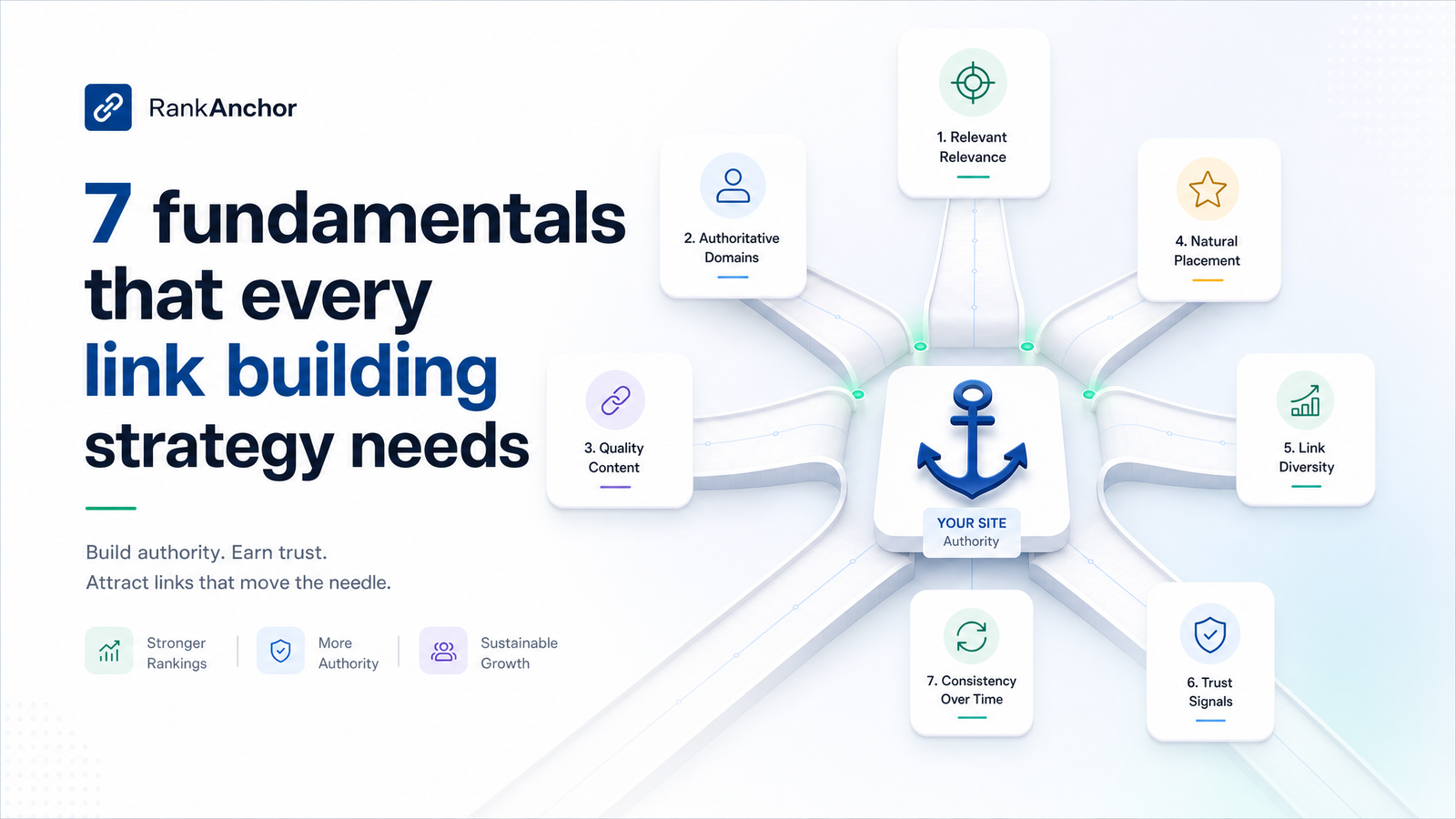
The 7 Fundamentals Every Link Building Strategy Needs
These aren't ranked by importance so much as by sequence — each one filters or shapes the next. Treat this as the checklist you run before committing budget or hours to any campaign.
1. Relevance Before Authority
A topically relevant link from a mid-authority site almost always outperforms an irrelevant link from a high-authority one. Google's systems evaluate links partly by contextual fit: does the linking page's subject matter connect logically to yours? A link from a well-known but generic authority site, dropped into unrelated content, carries a weaker relevance signal than a link from a smaller site that genuinely covers your niche.
This is the crux of link relevance vs domain authority — and why domain rating shouldn't be your first filter. Run relevance first: does this site's audience and content overlap with your topic? Only once that's confirmed should authority metrics factor into prioritization. Teams that reverse this order end up with a backlink profile full of high-DR, zero-relevance placements that do little for rankings and can look unnatural in aggregate. For a structured way to weigh relevance against authority, see this prioritization framework.
2. Referring Domain Diversity, Not Link Count
Ten links from ten different referring domains carry more weight than fifty links from the same five sites. Search engines discount repeated signals from a single source, so diversity across unique domains matters more than total link count. The 2026 link building data reinforces this: referring domain count correlates more strongly with ranking position than total backlink volume.
Practically, this means outreach should chase new relevant domains rather than repeat placements on sites that already link to you. A content team that scores three guest posts on the same publication has made less strategic progress than one that earns single mentions across three distinct, relevant domains.
3. Editorial Placement Over Manufactured Links
Editorial links — added because your resource genuinely improves a publisher's content — behave differently than manufactured ones. Link farms, private blog networks, and excessive reciprocal exchanges create patterns that are structurally easy to detect: unnatural anchor clustering, suspicious linking-domain networks, sudden velocity spikes.
Google's spam systems have gotten better at spotting these patterns, and manufactured schemes carry real risk of manual action or algorithmic devaluation. The safer, more durable path is earning placements because content merits inclusion — which ties directly to fundamental six. A strategy built on manufactured volume is a strategy built on borrowed time.
4. Correct Link Attribution (Sponsored, UGC, Nofollow)
Attribution is the fundamental most teams skip, and it's become more consequential, not less. Google treats nofollow, sponsored, and UGC attributes as hints rather than strict directives — meaning it may still consider these links contextually, even though it typically won't pass full link equity through them. What hasn't changed is the compliance requirement: paid placements must carry rel="sponsored" or rel="nofollow", and user-generated content should carry rel="ugc". Google's current backlink policy is explicit that mislabeling paid links as organic, editorial links is a violation that can trigger manual action, regardless of how well the placement performs.
So nofollow/sponsored/UGC tagging isn't a technicality to worry about later — it's a fundamental to get right before running a single paid or guest-content campaign. If you're negotiating placements, disclose the arrangement and use the correct attribute. It protects the site and contributes to a link profile that looks natural to both users and algorithms.
5. Anchor Text That Looks Natural
Healthy anchor text distributions lean heavily toward branded terms, naked URLs, and generic phrases like "this guide" or "read more" — with exact-match keyword anchors making up a small minority. When exact-match anchors dominate, it reads as manipulative, because natural linking behavior rarely produces that pattern; people link using brand names, URLs, or descriptive phrases far more often than precise target keywords.
Before launching outreach, decide your anchor mix in advance rather than letting each individual negotiation decide it ad hoc. A rough target — majority branded/generic, a modest share of partial-match, a small slice of exact-match — keeps the profile looking like something that happened naturally over time rather than engineered in a spreadsheet.
6. Content Worth Linking To
No outreach template compensates for a page nobody wants to cite. Editors and site owners link to things that make their own content better: original data, genuinely useful tools, deep explainers that fill a gap competitors haven't addressed. If your linkable asset is a thin rewrite of what's already ranking, outreach becomes a numbers game of persistence rather than genuine merit.
This is where topical authority and content strategy intersect with link building. Running a structured content gap analysis surfaces the subtopics your site hasn't covered and where competitors are earning links you aren't — turning content planning into a link-earning exercise rather than a separate workstream.
7. Ongoing Monitoring and Pruning
A link profile isn't a project you finish; it's a living asset you maintain. Links get lost when pages are removed or redesigned. Toxic links appear from spam networks scraping your brand name. And critically, you need to know whether the links you're building are actually correlating with ranking movement — not just accumulating in a report.
Auditing on a regular cadence catches all three problems early: lost links you can reclaim, toxic links worth disavowing, and a feedback loop between new links and ranking changes. Without that loop, you're building links on faith. Knowing how to read a backlink report — not just run one — matters here; see how to interpret a backlink checker report for the difference between collecting data and acting on it. If you're still deciding which tool to trust for that audit, this backlink analysis tool evaluation framework breaks down what actually matters versus vanity metrics.
Turning the 7 Fundamentals Into a System, Not a Checklist
None of these seven fundamentals are one-time decisions. Relevance has to be re-evaluated with every new opportunity. Referring domain diversity has to be tracked as it changes. Attribution has to be checked on every negotiated placement. Anchor distribution shifts with every new link and needs periodic rebalancing. Content gaps evolve as competitors publish. And monitoring, by definition, is continuous.
That's why link building strategy so often degrades into a scattered checklist: enforcing these fundamentals manually means juggling a backlink audit tool, a separate rank tracker, a spreadsheet for anchor text distribution, and a content calendar living somewhere else entirely. Each fundamental gets checked in isolation, if at all, and nobody's connecting new links to actual ranking outcomes.
A workflow that holds together needs those data sources talking to each other — audit data informing which content gaps to fill, content performance informing which anchor text and outreach targets make sense next, and rank tracking closing the loop on whether any of it worked. Rankevra's AI-driven workflow was built around exactly that connection: audits, content creation, publishing, and rank tracking run inside one system instead of four disconnected tools, so the fundamentals above get enforced automatically rather than checked sporadically when someone remembers to open a spreadsheet.
If you've internalized these fundamentals and want a concrete execution timeline for a new site, the 90-day link building plan walks through sequencing outreach, content, and monitoring in practice.
Frequently Asked Questions
How many backlinks do I actually need for a link building strategy to work?
There's no fixed number — referring domain quality and relevance matter more than volume. A handful of relevant links from distinct, topically aligned domains typically outperforms dozens of links from low-relevance or repeated sources, so the right target is a growing count of unique, relevant referring domains rather than a total backlink number.
Is link building still worth it in 2026 with AI search and AI Overviews?
Yes — backlinks remain a core signal for both traditional rankings and the sources AI systems draw on to establish credibility. Referring domain quality still correlates strongly with ranking performance, and topical authority built partly through earned links continues to influence which sites get cited in AI-generated answers.
What's the difference between a link building strategy and just doing outreach?
Outreach is a tactic; strategy is the framework that decides which outreach is worth doing. A strategy defines relevance thresholds, anchor text distribution targets, attribution rules, and monitoring cadence — without it, outreach becomes volume-driven guesswork instead of a targeted, measurable process.
Do nofollow links still help SEO at all?
Yes, indirectly. Google treats nofollow, sponsored, and UGC attributes as hints rather than absolute directives, meaning it may still consider these links contextually for discovery and relevance signals even though they typically don't pass full link equity. They also drive referral traffic and contribute to a natural-looking, diverse link profile.
How often should I audit or clean up my backlink profile?
Most sites benefit from a backlink audit at least quarterly, with more active link-building campaigns warranting monthly checks. Regular audits catch lost links, flag toxic or spammy backlinks before they cause harm, and let you correlate new links with ranking changes rather than building blind.
Should a new website focus on link building before or after fixing technical SEO?
Technical SEO issues should be resolved first, or at minimum in parallel. Links pass less value to a site that's slow, poorly indexed, or riddled with crawl errors, so fixing foundational technical health ensures the link equity you earn actually translates into ranking improvement.
Every fundamental above depends on continuously cross-referencing audit data, content performance, and ranking movement — coordination that breaks down when spread across separate tools and spreadsheets. Rankevra keeps audits, content creation, publishing, and rank tracking inside one AI-driven workflow, so these seven fundamentals stay enforced automatically instead of depending on someone remembering to check them.
Keep reading
- SEO Content Refresh Strategy: Update, Rewrite, or MergeA data-backed SEO content refresh strategy: diagnose decay, score priority, and decide whether to update, rewrite, or merge each underperforming post.
- Duplicate Content SEO: A Framework to Find and Fix ItDuplicate content SEO isn't one problem — it's three. Learn to diagnose parameter, syndication, and scaled-content overlap, then fix each correctly.
- Best Tool for Backlink Analysis in 2026: A Use-Case GuideThe best tool for backlink analysis depends on your job: Ahrefs, Semrush, Majestic, Moz, or an AI SEO platform. Here's how to pick in 2026.