Rankevra Blog
Best Rank Tracking Tool 2026: A Fast, Use-Case Shortlist
August 8, 2026
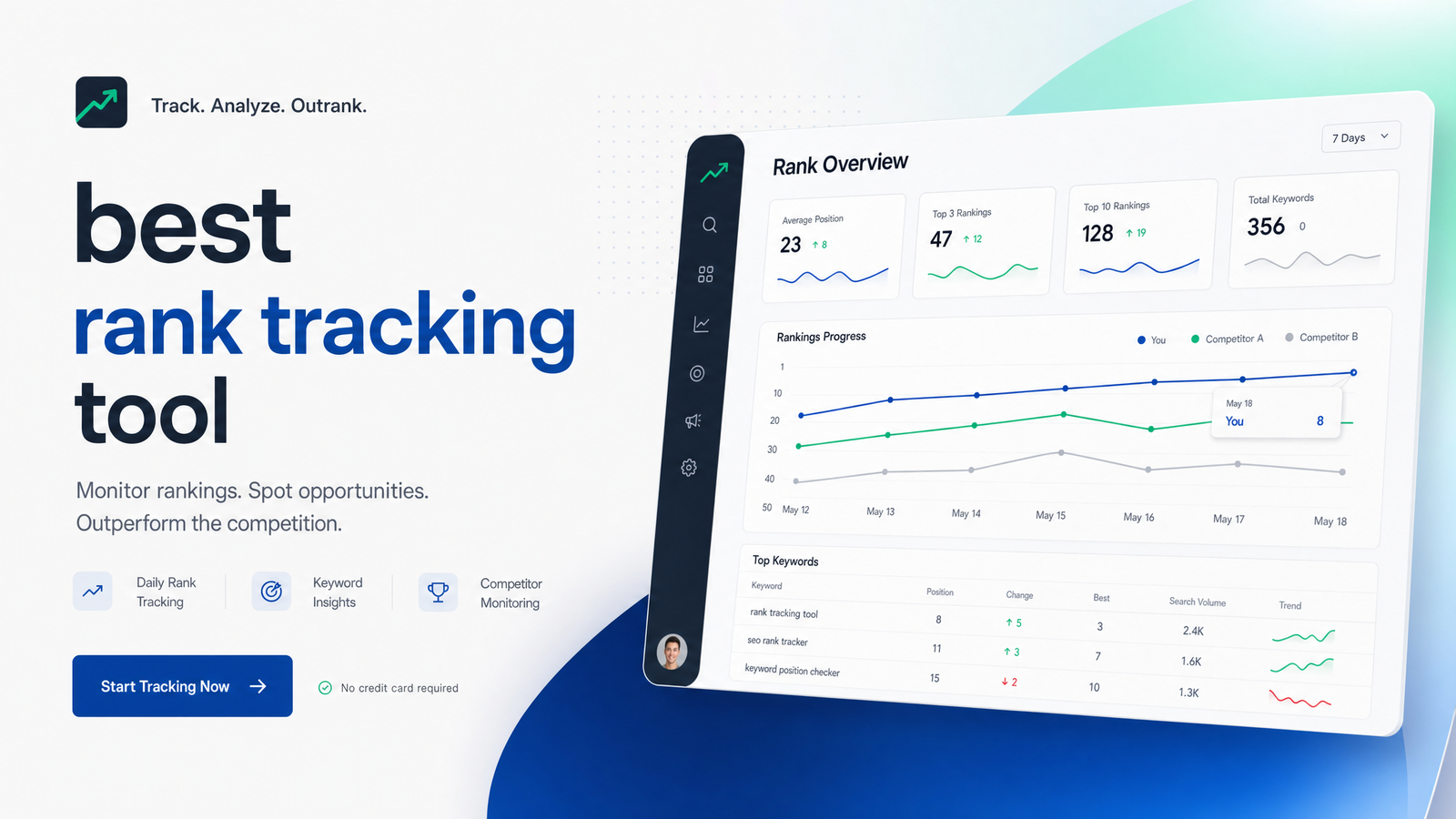
Every "best rank tracker" listicle ranks the same ten tools in a slightly different order, buries you in a scoring table, and leaves you no closer to an answer. You don't need another framework. You need to know which tool fits your actual situation — and what to do once your rankings start moving, because that's the part most of these tools quietly skip.
This is a shortlist, organized by use case, with trade-offs named plainly. Then we'll get into the bigger issue: even the best rank tracking tool only tells you that something changed, not why, and not what to fix.
What "Best" Actually Means for a Rank Tracker Right Now
"Best" used to mean daily position accuracy plus decent SERP feature visibility — featured snippets, local packs, image results, video carousels. That's still table stakes. A best rank tracking tool in 2026 needs accurate daily refreshes, granular location and device data, and enough SERP feature detail to explain why a position moved even when your content didn't.
What's new is the AI layer. Google's AI Overviews now sit above traditional blue links for a huge share of queries, and a growing slice of research and buying behavior happens inside ChatGPT search and Perplexity instead of a search bar. A tool that reports your position 4 ranking while ignoring whether your brand gets cited inside an AI Overview or Perplexity answer for that same topic is measuring half the picture.
That's why there's no single "best" tool — only a best fit per scenario. An agency reporting to 40 clients has different needs than a solo consultant tracking 150 keywords for one site. The rest of this article treats it that way.
The Shortlist: Best Rank Tracking Tool by Use Case
Here's the fast version — named picks, one-line verdicts, honest trade-offs. No scoring matrix. For the deeper decision process, the companion guide on how to actually choose a rank tracker in 2026 walks through it in full, and the 2026 evaluation framework covers the scoring criteria we're deliberately skipping here.
Best Overall / All-in-One: When You Want Rankings in Context
Semrush and Ahrefs are the default picks when you want rank tracking sitting next to keyword research, backlink data, and site audits inside one login. The win is context — you can see a keyword's ranking history alongside its search volume trend and your backlink profile in the same tab. The trade-off is cost and focus: you're paying for an entire all-in-one platform when tracking is just one module, and dedicated trackers still out-refresh them on pure tracking depth. If your team wants tracking plus keyword research bundled rather than stitched together, this is the lane.
Best Dedicated Tracker: When Rankings Are the Whole Job
AccuRanker and Nightwatch are built for teams whose core deliverable is the rank report — agencies juggling many client accounts, in-house teams reporting weekly to leadership. A dedicated tracker wins on fast SERP refresh speed, deeper tag-based segmentation, and cleaner white-label reporting than a bolted-on module in a bigger suite. The catch: you get little else — no real keyword research engine, no backlink index, no audit tool — so you'll pair it with something else for the rest of your SEO stack.
Best Budget Pick: When Cost Per Keyword Matters Most
SE Ranking and Serpstat consistently come up as cheap rank tracker options that don't feel gutted — solid daily tracking at a cost per keyword well below the AccuRanker/Semrush tier, according to pricing breakdowns from Konabayev's 2026 comparison. The trade-off is depth: fewer SERP feature categories, thinner API access on lower plans, and less generous local-pack granularity. Fine for a solo site owner or small team tracking a few hundred keywords; not built for enterprise-scale reporting.
Best for AI Search Visibility: When Google Isn't the Only Surface
This category barely existed a couple of years ago. AI Overviews tracking and ChatGPT visibility monitoring are now showing up as dedicated modules or standalone tools, because brand mentions inside an AI-generated answer don't map cleanly to a traditional SERP position. Worth a look specifically if a meaningful share of your traffic or brand awareness runs through AI-mediated search rather than the classic ten blue links — recent roundups of AI-era tracking tools are a good place to see who's moving fastest here. The honest trade-off: this category is young, coverage is inconsistent across AI platforms, and you'll likely need it as a supplement to Google-position tracking, not a replacement.
Best for Teams Who Need Tracking Tied to Fixes: Rankevra
If your actual problem isn't "which tool has the nicest dashboard" but "I keep seeing drops and I don't know what caused them or what to do next," that's the gap Rankevra is built to close. Rank changes show up next to the audit finding that likely caused them — a broken internal link, a slowed page, a thin section that lost relevance — and next to the content fix and republish action that addresses it, inside one AI SEO workflow tool instead of three disconnected ones. Fair trade-off to name: it's not the deepest pure-play tracker for agencies running hundreds of white-labeled client reports, and it's newer than the decade-old incumbents. It's built for teams who'd rather close the loop than just monitor it.
Why Rank Data Alone Won't Grow Your Traffic
Here's the honest limitation every dedicated tracker shares: a dashboard showing a keyword dropped from position 6 to 14 is only useful the moment you know why. Rank tracking limitations show up right there — most tools stop at the notification. Did a competitor publish a stronger piece? Did Google roll out an update? Did a technical issue quietly tank crawlability on that page? The tracker doesn't know, and it doesn't tell you.
That gap is where teams lose weeks. Someone sees the drop, opens a ticket, someone else runs a manual audit, someone else drafts a content revision, and by the time it's republished the SERP has moved again. Fixing ranking drops fast requires the diagnosis and the fix to live next to the alert — not three tools and two calendar invites away from it.
This is also why Google Search Console, while free and genuinely useful for query-level click data, isn't a substitute for a real tracker or a fix workflow: it shows you what happened, not what caused it or what to change. A proper site audit tool identifies the technical or content cause behind a movement, and a structured technical SEO fix priority plan tells you which issues to resolve first. Rank tracking is the smoke alarm. It was never the fire extinguisher.
A 5-Minute Checklist Before You Start a Trial
Before you sign up for another 14-day trial and forget about it in a browser tab, check these five things — this is deliberately short; the full rank tracker trial checklist and choosing guide goes deeper if you want it.
- Keyword volume ceiling. Does the plan you'd actually pay for cover your real keyword count, or only the trial tier's inflated allowance?
- Update frequency. Daily refresh, or does "real-time" quietly mean weekly on the plan you can afford?
- Location and device coverage. If local pack rankings or mobile-vs-desktop splits matter, confirm granularity before you commit, not after.
- Export and API access. If you report to stakeholders or clients, check whether raw data export and API access are gated to a higher tier.
- AI visibility coverage. If AI Overviews or chatbot citations matter to your traffic mix, ask now whether that's tracked at all — most legacy tools still bolt it on as an afterthought, if at all.
Run through those five in the trial's first session, and you'll know within a day whether the tool fits — not two weeks and a wasted trial later.
Frequently Asked Questions
What is the best rank tracking tool overall in 2026?
There isn't one universal winner — it depends on your use case. Semrush and Ahrefs suit teams wanting tracking bundled with keyword research and audits; AccuRanker and Nightwatch suit agencies needing pure tracking depth; SE Ranking and Serpstat suit budget-conscious teams; and Rankevra suits teams who want ranking changes tied directly to audit findings and fixes.
Is a free rank tracker like Google Search Console good enough?
Google Search Console is useful for query-level clicks and impressions but isn't a real substitute for a dedicated rank tracker. It doesn't give you competitor position data, SERP feature visibility, or reliable daily rank history across your full keyword set, and it offers no diagnosis of why a ranking moved.
What's the difference between a dedicated rank tracker and an all-in-one SEO platform?
A dedicated rank tracker focuses purely on tracking — faster refreshes, deeper segmentation, cleaner reporting — but leaves keyword research, audits, and backlink data to other tools. An all-in-one platform bundles tracking alongside those functions in one login, trading some tracking-specific depth for convenience and context.
Do I need a tool that tracks AI search visibility, not just Google rankings?
If a meaningful share of your audience uses AI Overviews, ChatGPT search, or Perplexity to research topics in your niche, yes — traditional blue-link position tracking won't show whether your brand is being cited in those AI-generated answers. This category is still maturing, so treat it as a supplement to Google position data, not a full replacement.
How many keywords should a rank tracker cover for a small business site?
Most small business sites need coverage in the low hundreds of keywords — enough for core service pages, location variants, and top blog content, not enterprise-scale tracking in the thousands. Check the plan's keyword ceiling against your actual site structure before you buy, since trial tiers often overstate what the paid plan realistically covers.
Why do my rankings drop even when I'm using a good rank tracker?
A rank tracker reports that a drop happened; it doesn't diagnose why. Common causes include algorithm updates, a competitor publishing stronger content, or a technical issue like slow load times or broken internal links quietly hurting crawlability — none of which a tracker alone will surface or fix for you.
The real question isn't which tracker has the nicest dashboard — it's what happens the moment a keyword drops. Most tools stop at the alert. Rankevra connects that alert to the audit finding behind it, the content fix that addresses it, and the republish step that closes the loop, all in one workflow. If you're tired of watching rankings move without knowing why, that's worth trying.
Keep reading
- Content Decay SEO: How to Detect It and Fix It for GoodLearn to detect content decay SEO issues early, rule out false positives, and build a refresh pipeline that scales — plus how to automate the whole loop.
- Headless CMS SEO: Fixing the Gaps Generic Tools MissHeadless CMS SEO breaks in three predictable places: rendering, metadata, and sitemaps. Here's the diagnostic framework to find and fix each gap.
- Google Algorithm Update Recovery: A Diagnostic FrameworkA step-by-step google algorithm update recovery framework: confirm the cause, segment the damage, benchmark against winners, and set a real timeline.