Rankevra Blog
Best SEO Reporting Software in 2026: A Buyer's Framework
July 20, 2026
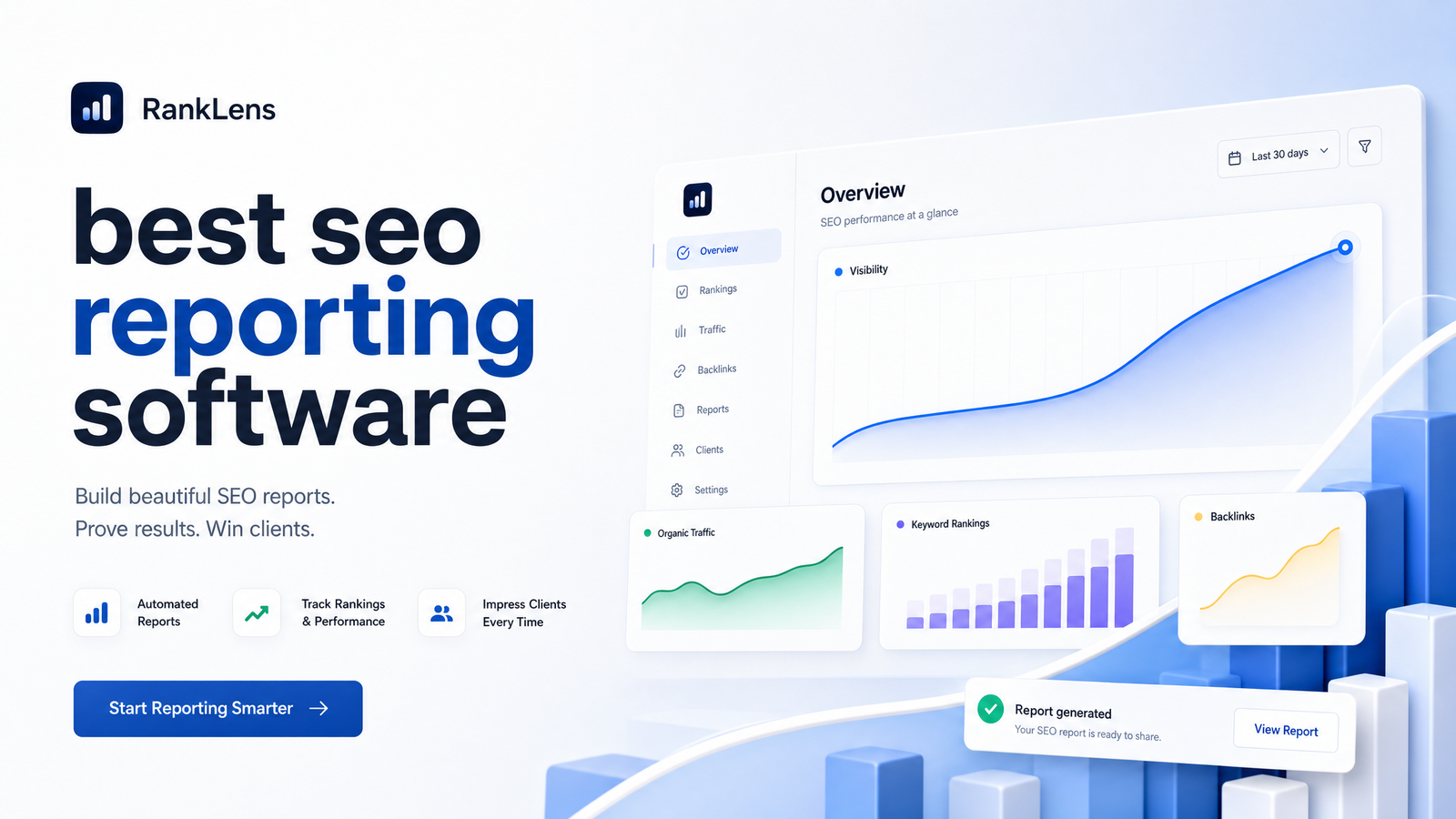
Most roundups of the best SEO reporting software are written for agencies juggling 20 to 100 white-labeled client dashboards, which is why they obsess over per-client pricing and logo-swapping. If you're a single website owner, an in-house marketer, or a lean content team building your own reports, that framework doesn't fit — and it's led self-managed teams to buy features they'll never touch. This guide reframes the decision around what actually matters when reporting on your own site: honesty, speed, and a direct line from "here's a problem" to "here's the fix."
What Counts as "SEO Reporting Software" in 2026?
The category has gotten blurry. Some tools are really just rank-tracking dashboards with a PDF export button. Others are full audit-to-report platforms that pull crawl data, Core Web Vitals, backlinks, and keyword positions into one view. A true SEO dashboard sits in the middle: it aggregates data from multiple sources — Google Search Console, GA4, a crawler, a rank tracker — and presents it in a way a human can act on, not just admire.
For an agency, buying criteria center on scale: how many client logos can you swap in, how cheap is each additional seat, how fast can an account manager copy last month's template. For a solo site owner or in-house team, none of that matters. You need one clean, recurring answer to "is my SEO working, and what should I do next" — without paying for a system built to manage other people's clients.
7 Features That Separate Good Reporting Tools From Great Ones
Not every feature marketed on a pricing page earns its place. Here's what to actually weigh when comparing seo reporting tools:
- Data source integrations — Native, reliable pulls from Google Search Console and GA4 are non-negotiable. If a tool requires manual CSV exports to reconcile data, it's not really automating anything.
- Automated scheduling — Automated seo reports should run on a cadence you set once (weekly, monthly) and land in your inbox or dashboard without you clicking "generate" every time.
- White-label/branding options — Genuinely useful for agencies managing client relationships; largely irrelevant if you're reporting to yourself or an internal stakeholder. Don't pay a premium for white label seo reporting you'll never use.
- AI-generated summaries — Useful when they translate raw numbers into plain-language takeaways ("organic clicks dropped 12% due to a Core Web Vitals regression on mobile"). Fluff when they're just a chatbot restating the chart.
- Technical health + Core Web Vitals data — Reporting that ignores site health is reporting half the picture. Rankings and traffic move because of crawl errors, indexation issues, and page experience — the report needs to show that link.
- Rank tracking accuracy — Check update frequency and how the tool handles SERP volatility, localization, and visibility in AI Overviews, not just the traditional ten blue links.
- Actionability — The single most overlooked feature. Does the tool tell you what to fix, or just that something's wrong?
That last one is where most tools quietly fail, and it's the thread running through the rest of this article.
The 4 Categories of SEO Reporting Software (and Who Each Fits)
The market roughly sorts into four buckets, each with a real trade-off worth naming honestly.
Free/DIY dashboard builders — Google Looker Studio connected to GSC and GA4. Free, flexible, and a real workhorse for teams comfortable building their own queries. The trade-off: you're the engineer, the analyst, and the report-writer, with no automated fix layer at all.
All-in-one SEO suites with built-in reporting — Tools like Semrush, Ahrefs, and SE Ranking bundle rank tracking, audits, and reporting modules into one subscription. The trade-off: broad and capable, but reporting is often secondary to a research-first tool, and pricing scales with keyword and project limits a single site doesn't need.
Dedicated white-label agency dashboard tools — Platforms like AgencyAnalytics exist specifically for agencies managing many clients. The trade-off: excellent for client-facing polish and multi-account management, overbuilt and overpriced for anyone reporting on one site or a few internal properties. If you're running client accounts, see our breakdown of local SEO software for agencies.
AI-driven execution platforms — A newer category that treats reporting as one stage in a loop that also audits, drafts content, publishes, and re-tracks. Less mature, but built around the idea that a report should trigger action automatically rather than sit in an inbox. This is where Rankevra operates, and it's the gap the rest of this article addresses directly.
If you're an agency, category three deserves serious attention. If you're managing your own site or a small in-house portfolio, categories one, two, and four are the real contest — and the deciding factor shouldn't be logo customization, it should be what happens after the report lands.
The Problem With Most "Best SEO Reporting Software" Picks: Reports Without Fixes
Here's the pattern almost every reporting tool falls into: it shows you a ranking drop, a spike in 404 errors, or a Core Web Vitals regression, and then stops. You get a chart, maybe a red arrow, maybe an AI-generated sentence summarizing the decline. What you don't get is a next step baked into the same system.
That gap is expensive in a specific way — not in dollars, but in time and momentum. A crawl error flagged on the 1st of the month often doesn't get fixed until someone remembers to open a different tool, file a ticket, or brief a writer, sometimes weeks later. By the time the fix ships, you've lost a reporting cycle and possibly rankings you didn't need to lose. Reporting that's disconnected from action isn't really seo automation — it's seo observation.
Rankevra was built around closing that loop. Instead of a standalone dashboard, it runs the audit that finds technical seo issues, generates or updates the content needed to address a content gap or thin page, publishes the fix, and then re-tracks rankings — all inside one system, so the same platform that reported the problem is the one that resolves it. For what a proper audit layer should check before it ever reaches a report, see our guide on what a site audit tool checks and how to use one. If the underlying goal is traffic growth rather than a prettier chart, it's worth grounding reporting metrics in what's actually driving results — see what actually works for organic traffic growth in 2026.
None of this means every team needs to abandon manual reporting overnight. If you're not ready to change tools, a structured SEO audit report template or the 25-step SEO checklist can get you disciplined reporting without new software — they just won't close the fix-it gap automatically. For teams weighing whether to outsource technical fixes or handle them internally, our piece on hiring a technical SEO audit service versus automating it walks through that trade-off directly.
How to Choose: A 5-Minute Decision Checklist
Skip the spreadsheet comparison. Answer these five questions honestly and you'll land in the right category fast — this is how to choose seo software when you don't have weeks to evaluate vendors.
- Team size — Solo or under 5 people: prioritize simplicity and automation over customization. Larger in-house teams: automation still wins, but you'll want more granular access controls.
- Number of sites — One site or a handful: avoid per-client pricing models entirely; they'll always feel like overpaying. Managing dozens: a dedicated agency dashboard tool starts to make sense.
- Technical debt level — High debt (frequent crawl errors, migration history, Core Web Vitals issues): weight actionability and audit depth heavily. Low debt: a simpler rank-tracking-plus-reporting setup may suffice.
- Content velocity — Publishing weekly or more: you need a tool that connects reporting insights to content production, not just flags gaps. Publishing occasionally: a lighter reporting tool works fine.
- Budget — If you're pricing per keyword or per client and you're a single site, you're in the wrong tier of software. Reporting for small teams should scale with your site count, not an agency's client roster.
If your answers point toward "small team, real technical debt, need to actually ship fixes," that's the exact profile an AI-driven execution platform is built to serve, rather than another report generator you still have to act on manually.
Frequently Asked Questions
What's the difference between SEO reporting software and a rank tracker?
A rank tracker only monitors keyword positions over time, while SEO reporting software aggregates rank data alongside traffic, technical health, and often backlink metrics into a single recurring report. Rank tracking is one input into a report, not a substitute for one. If a tool only shows rankings with no traffic or technical context, it's a tracker, not a reporting platform.
Is Google Looker Studio good enough for SEO reporting, or do I need paid software?
Looker Studio, paired with Google Search Console and GA4, is genuinely capable for teams willing to build and maintain their own dashboards, and it's free. Where it falls short is automation and action: it won't flag a technical issue and fix it, and it requires manual setup that paid tools automate out of the box. Independent guides like Backlinko's roundup of reporting tools confirm it's a strong free-tier baseline, not a full replacement for automated, action-connected reporting.
Do I need white-label reporting if I'm not an agency?
No — white-label branding exists to reassure agency clients that the report came from their agency, not a third-party tool, and it adds no value when you're reporting to yourself or an internal team. Paying extra for it as a solo site owner or in-house marketer is one of the most common wasted-budget mistakes in this category. Skip it and put that budget toward actionability features instead.
How often should SEO reports actually be generated?
Monthly is the standard cadence for strategic review, but technical health and ranking data benefit from weekly or even real-time monitoring so issues get caught before they compound. The report you present to stakeholders can stay monthly while the underlying data refreshes continuously. Automated scheduling makes this split practical without manual effort.
Can AI-generated SEO reports be trusted, or do they need manual review?
AI-generated summaries are reliable for surfacing patterns and translating metrics into plain language, but they still warrant a quick human sanity check, especially around causation claims. The 2026 trend, as noted in resources like Airefs' look at AI-driven ranking reporting, is that AI-visibility and AI Overview tracking are becoming standard reporting expectations rather than novelties — but the underlying data pull still needs to be accurate for the summary to mean anything.
What's the real cost of SEO reporting software once you add rank tracking and audit add-ons?
Once you stack a base reporting subscription with rank-tracking tiers and audit or crawl add-ons, many popular suites push a single-site budget well past what the base plan advertised, since pricing is typically built around keyword counts or client seats rather than a flat per-site fee. That's precisely the pricing model that penalizes solo owners and small teams the most. Look for platforms priced around your actual site count rather than an agency's keyword volume.
Stop reporting on problems separately from fixing them. Rankevra pairs automated, honest reporting with the audits, content, and publishing needed to actually close the gaps it finds — one system instead of another dashboard bolted onto your stack.
Keep reading
- Structured Data Testing Tool Guide: Stop Silent Rich ResultA structured data testing tool won't catch everything. Learn the 3-stage workflow and 7 JSON-LD errors that pass validation but kill rich results.
- Page Experience Report SEO: What to Fix FirstLearn how to cross-reference the page experience report SEO data with rank tracking to prioritize fixes that actually move rankings, not just scores.
- AI Meta Description Generator: A System for Metadata atWhy AI meta description generators create duplicate tags at scale, the 2026 pixel-width limits that matter, and a template system that actually fixes it.