Rankevra Blog
E-Commerce Category Page SEO: The Faceted Nav Framework
September 25, 2026
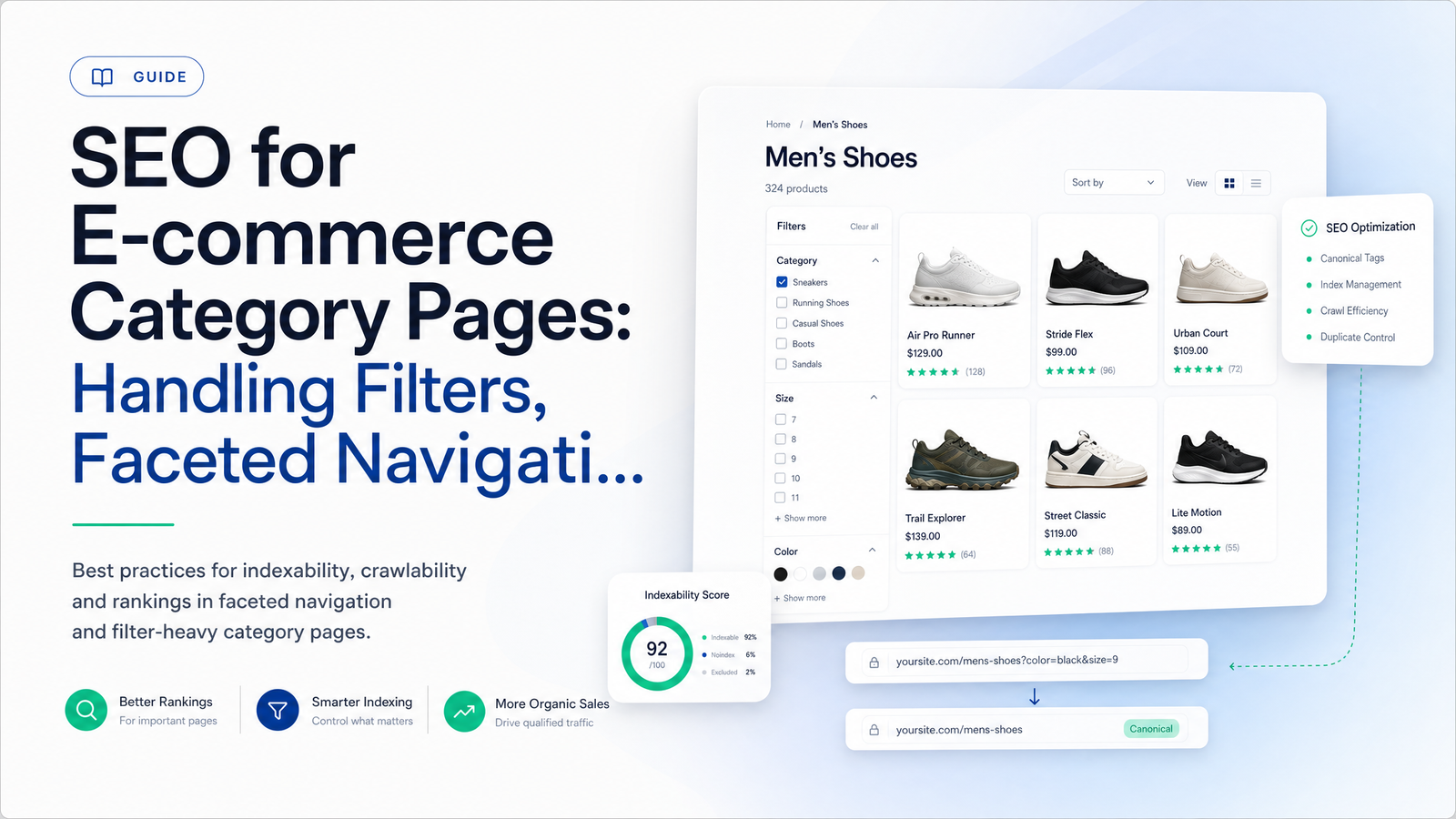
Category pages are usually the highest-traffic, highest-revenue real estate on an e-commerce site — and the most fragile from an SEO standpoint. A single "shoes" category can spin off thousands of crawlable URLs once you factor in size, color, brand, price, and sort combinations. Get e-commerce category page SEO wrong, and you're actively diluting the rankings your best pages could otherwise have.
This article gives you a decision framework, because "block everything" and "index everything" are both wrong for most catalogs. You'll get a three-bucket test for facets, a clear canonical-vs-noindex rule, a fix path for thin and out-of-stock categories, and a way to keep it from decaying the moment your merchandising team adds a new filter.
Why Category Pages Break Under Their Own Filters
Faceted navigation — the filter and sort options on category pages — exists to help shoppers narrow results. The SEO problem is that most platforms turn every filter combination into its own crawlable, sometimes indexable URL. "Dresses," "dresses + blue," "dresses + blue + size M," "dresses + blue + size M + sorted by price" can all resolve to separate pages with nearly identical product grids and boilerplate copy.
That multiplication has two costs. First, duplicate or near-duplicate content spreads your relevance signals across many URLs instead of consolidating them onto one strong category page, diluting rankings for terms that have real search demand. Second, crawlers spend their limited attention budget on low-value combinations instead of your money pages. Google's own guidance on managing crawling of faceted navigation URLs is explicit that uncontrolled facet URLs can waste crawl capacity and cause indexing problems — a mechanic explored further in Rankevra's crawl budget optimization framework.
This is specifically a category-page problem. Product pages are usually unique by nature (one SKU, one URL), and homepages rarely get faceted. It's the layer in between — where merchandising logic meets URL generation — where faceted navigation SEO issues concentrate, and where most audits find the biggest quick wins.
The Three-Bucket Facet Decision Framework
Rather than deciding indexability catalog-wide, evaluate it facet type by facet type. For every filter your platform generates, sort it into one of three buckets.
Index. Reserve this for facets that map to real, independent search demand. "Men's running shoes," "women's leather jackets," or "waterproof hiking boots" are searched on their own, often with commercial intent, and deserve a clean, indexable, well-linked URL with unique copy. If people type the combination into Google, it earns its own page.
Canonicalize. This is for legitimate variants that shoppers use but no one searches for independently — sort order (price low-to-high), pagination, or low-demand color/size combinations like "size 11.5 in mint green." These pages should still work for users, but their SEO value should roll up to the parent category via canonical tag rather than compete with it.
Block. Reserve this for combinations that add no unique value and multiply almost infinitely — multi-filter stacks (three or more facets combined), session- or user-specific parameters, internal search result pages, and filter combinations that return zero or near-zero products. Disallow these in robots.txt or handle them with parameter controls so crawlers never waste time on them.
Applying this framework consistently turns faceted navigation from a liability into an asset — the difference between a filter system that quietly builds long-tail rankings and one that cannibalizes your main category pages. Google's own documentation and the practical breakdown in Search Engine Land's faceted navigation guide both walk through similar bucketing logic and the conflicting-canonical scenarios that show up when it's applied inconsistently.
Canonical vs. Noindex: Picking the Right Tool
These two tools solve different problems, and mixing them up is one of the most common faceted-navigation mistakes. A canonical tag tells search engines "consolidate ranking signals into this other URL," but the tagged page can still be crawled and, in some cases, still appear in search results if Google disagrees with your canonical choice. A noindex tag tells search engines "don't index this page at all" — it removes the page from search results but doesn't pass its signals anywhere; those signals are simply dropped.
The rule of thumb: use canonical when the page has real content overlap with a preferred version and you want to consolidate authority (your "canonicalize" bucket). Use noindex when a page has essentially no standalone value and shouldn't appear in search at all, even if someone lands on it directly — empty filter results, for instance. John Mueller has confirmed publicly that combining canonical and noindex on the same page is sometimes appropriate for thin or duplicate e-commerce pages, as summarized in Search Engine Journal's breakdown of when to use rel=canonical or noindex, or both. If rankings are ignoring your canonical directives, check implementation details in Rankevra's canonical tag troubleshooting guide — conflicting canonicals, canonical chains, and self-referencing errors are common on faceted URLs specifically.
Fixing Thin and Low-Inventory Category Pages
A related problem: categories that deserve to exist but currently have too few products to justify a standalone page. Seasonal categories, niche subcategories, and anything gone heavily out-of-stock fall into this trap — and the instinct to just delete them is usually wrong.
Three fixes handle most cases:
Merge into a parent category. If "kids' rain boots size 4" only has two products left, folding it into "kids' rain boots" (with a filter, not a dedicated URL) consolidates thin pages into one that can actually rank.
Add durable on-page content. Rather than treating a category page as just a product grid, give it a genuine reason to exist independent of current stock levels — a buying guide, a size/fit comparison, FAQs specific to that category. This separates thin content category pages from legitimately useful ones, and also protects the page when inventory dips temporarily. Not every thin category is worth this investment; use a framework like Rankevra's content prioritization scoring model to decide which pages earn the effort versus which should simply be merged or deindexed.
Handle empty results without hard 404s. Out of stock category page SEO is often mishandled by returning a 404 or generic error for categories that are only temporarily empty. Better options: show a "currently unavailable" state with related or substitute products, keep the page live with a 200 status if restocking is expected soon, and only 404 or redirect if the category is permanently discontinued. This preserves existing rankings and backlinks instead of throwing them away over a temporary stock gap.
For readers managing catalogs at scale, templated content across many low-inventory categories can work well if built to avoid duplication — see Rankevra's guide to scaling programmatic SEO without getting penalized for the guardrails.
Avoiding Duplicate Content Across Similar Categories
Faceted navigation isn't the only source of near-duplicate category content — overlapping subcategory structures cause the same problem. "Blue dresses" as a standalone subcategory and "dresses" filtered by color: blue often show the same products with nearly identical copy, competing against each other instead of each doing distinct work.
Decide up front which structure is the "real" indexable page for that intent — usually whichever one search demand data supports — and treat the other as a canonicalized facet, per the three-bucket framework above. This is the practical answer to the subcategory vs. facet page question: one becomes the destination, the other becomes a filtered view that consolidates back into it.
The second common source is near-identical intro paragraphs and meta descriptions repeated across dozens of category pages with only the product noun swapped. Search engines can treat this as duplicate content ecommerce categories at scale, even when the product grids differ. Fixing it doesn't require a full rewrite of every page — differentiate the first 100–150 words with category-specific detail (material, use case, sizing notes), and use internal linking deliberately: link from broader categories to their genuinely distinct subcategories, and avoid linking every color and size variant from the main navigation. Internal links are one of the strongest signals you control for telling search engines which pages you consider distinct and worth ranking separately.
Keeping It Fixed: Monitoring Faceted Navigation Over Time
None of this is a one-time cleanup. Every new promotion, seasonal collection, or merchandising filter your team adds can quietly generate a fresh batch of thin or duplicate category URLs, and every stock fluctuation can turn a healthy category page into an empty one overnight. A faceted navigation audit that was accurate in January can be meaningfully out of date by March.
That's why ongoing SEO audit ecommerce processes need to be automated rather than calendar-based. You need something that continuously crawls your site the way search engines do, flags new low-value URLs before they get indexed, catches canonical and noindex conflicts as soon as they appear, and tracks whether your indexable category pages are actually holding or gaining rank. For a broader look at how to sequence fixes once issues are found, Rankevra's technical SEO priority action plan is a useful companion piece, and Rankevra's site audit tool guide walks through what a proper crawl should check for on category-heavy catalogs.
Monitoring faceted navigation manually across a large catalog isn't realistic — the URL count grows faster than any team can spot-check. Rankevra was built to close that gap: it audits your site continuously, flags new thin, duplicate, and indexation-conflict pages as they appear, and tracks rankings so you see drift before it costs traffic, all without hopping between a separate crawler, canonical checker, and rank tracker. If category-page SEO is an ongoing maintenance job rather than a project you finish once, Rankevra is built to run that maintenance for you.
Frequently Asked Questions
Should I noindex all my faceted navigation URLs?
No — blanket noindexing throws away pages that could capture real search demand, like "men's running shoes" or "waterproof hiking boots." Apply the three-bucket test instead: index facets with independent search demand, canonicalize legitimate variants with no unique demand, and block or noindex low-value combinations like multi-filter stacks or empty results.
How many products does a category page need to avoid being flagged as thin content?
There's no fixed product count Google publishes, because thinness is about value, not inventory numbers alone. A category with only a handful of products can avoid a thin-content flag if it includes durable content like a buying guide or comparison copy; a category with dozens of products but only boilerplate text can still read as thin.
What should happen to a category page when all products are out of stock?
Avoid a hard 404 for temporary stock gaps — instead, keep the page live with a "currently unavailable" message, show substitute or related products, and preserve the URL so existing rankings and links aren't lost. Only 404 or redirect the page if the category is permanently discontinued rather than just temporarily empty.
Can faceted navigation actually help SEO instead of hurting it?
Yes, when specific filter combinations match real search demand, such as "women's leather jackets" or "blue running shoes." The problem isn't faceted navigation itself, it's leaving every combination crawlable and indexable by default instead of deliberately choosing which ones deserve to rank.
Do I need a developer to fix faceted navigation issues, or can I do it through my platform's settings?
Many fixes — canonical tags, noindex rules, robots.txt parameter blocks — can be configured through platform or plugin settings on most modern e-commerce systems without custom development. More complex cases, like conflicting canonicals across templates or URL parameter handling at scale, typically need developer involvement to implement correctly and avoid new errors.
How do I know which filter combinations are worth making indexable?
Check actual search demand for the combination — if people search "men's running shoes" but not "men's running shoes size 10.5 in olive," only the first deserves an indexable page. Combine that demand data with a content prioritization framework to decide which high-demand combinations are worth building unique content for versus canonicalizing back to a parent category.
Keep reading
- SEO Automation Workflow: What to Automate vs. Keep HumanA practical SEO automation workflow framework: what's safe to automate, what needs a human checkpoint, and what should never run unsupervised.
- Redirect Chain Audit: Find, Fix & Prevent Link LeaksRun a precise redirect chain audit: spot chains vs. loops, learn Google's real hop limits, and flatten redirects for good with this step-by-step method.
- AI Content Detection & SEO: Is There a Penalty in 2026?No, Google doesn't penalize AI content for being AI-written in 2026 — but scaled, unedited output still gets filtered. Here's the checklist that matters.