Rankevra Blog
Featured Snippet Optimization: A Reverse-Engineering Guide
September 15, 2026
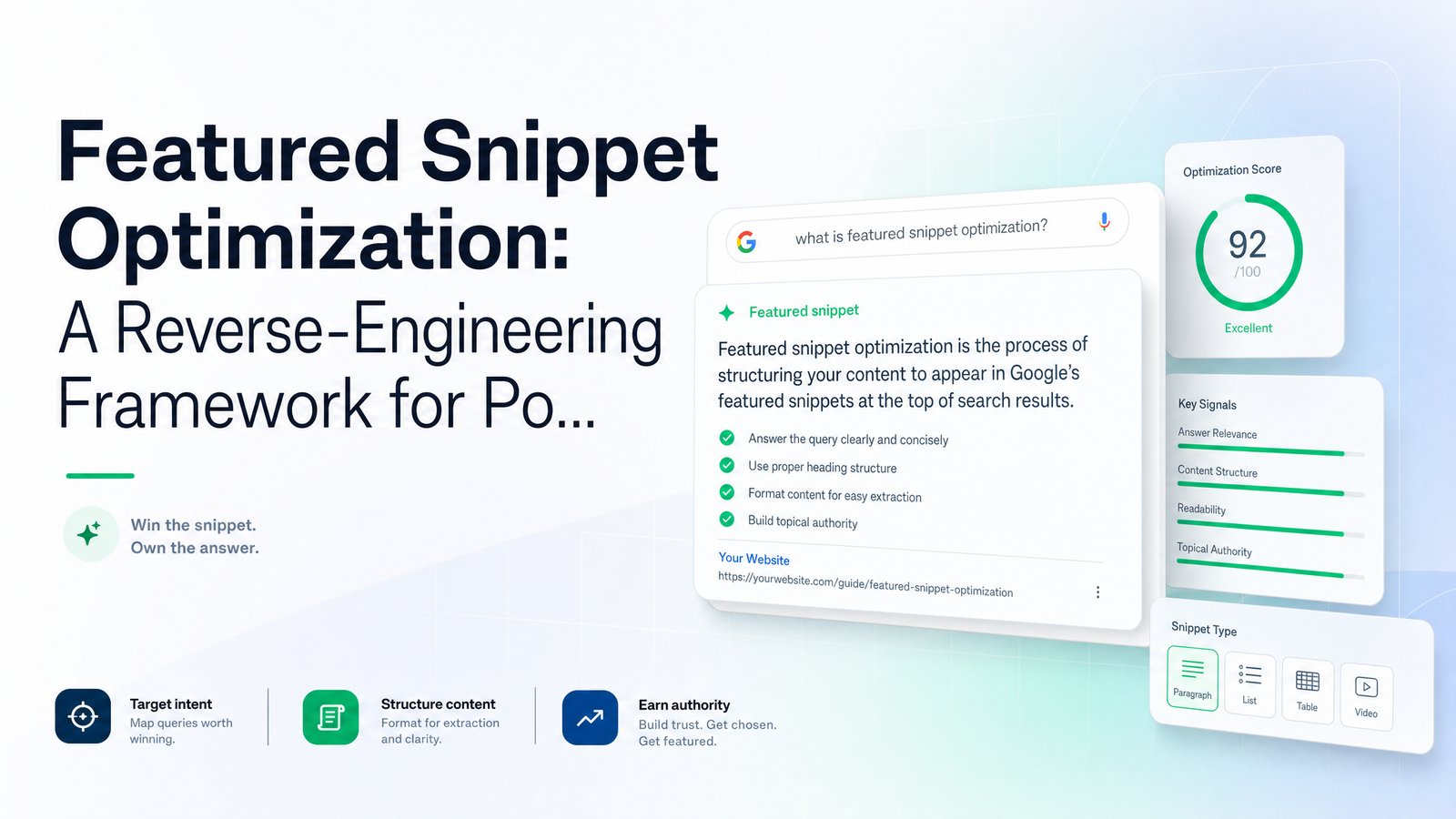
Most advice on featured snippet optimization reads like a checklist: keep answers short, use headers, add schema. Teams follow it, win a snippet occasionally, lose it a month later, and have no idea why. Snippets aren't won by following generic rules — they're won by reverse-engineering what Google has already validated for that specific query, then building something tighter than the current answer.
This article walks through that process as a four-step diagnostic: find the query, decode what's already winning, rebuild a better version, and monitor it — because position zero is never permanently yours.
What Featured Snippet Optimization Actually Means
A featured snippet is the boxed answer Google shows above the standard organic results, often called "position zero" because it appears before the #1 ranking page — even when it's pulled from a page ranking lower down. Google generates it by extracting a passage, list, or table directly from a page it already considers a strong match for the query's intent.
There are four featured snippet types, and the type Google chooses depends almost entirely on the query's phrasing:
- Paragraph snippets — a direct text answer, typically for "what is," "why," or "who" queries.
- List snippets — ordered or unordered lists, common for "how to," "steps," or "best" queries.
- Table snippets — comparison or data-driven queries, like pricing, specs, or "vs" searches.
- Video snippets — process-based or visual queries where a video timestamp answers the question.
The core idea behind featured snippet optimization isn't a formatting trick applied universally — it's diagnosing which of these four formats Google has already decided suits the query, then matching it more precisely than whoever currently holds it. Skip the diagnosis and you're just guessing at structure while a competitor keeps the box.
Step 1: Find Queries You Can Actually Win
Before touching formatting, shortlist queries where you have a realistic shot: ones you already rank for on page one — ideally positions 2 through 5 — where a competitor currently holds the snippet.
Page-one presence is close to a hard requirement. Ahrefs data cited by Triomize found that 99.58% of featured snippets are pulled from pages already ranking in the top 10 for that query. Stackmatix makes the same point: Google pulls snippets almost exclusively from page-one results, and reformatting an existing page that's already ranking well outperforms building new content from scratch. If a page isn't in the top 10, fix the ranking first before formatting for a snippet.
To build this shortlist, pull your query list from Google Search Console filtered to positions 2–10, then check the SERP for each to see which ones currently trigger a featured snippet — not every query does. Prioritize question-based or comparison-based queries, since those phrasings reliably trigger snippets. If you're still building out question-keyword coverage, an AI tool for SEO keyword research can surface those variants faster than manual brainstorming.
The output should be a short, ranked list: query, your current position, snippet type currently shown, and who holds it. That list is your target list — not your whole site.
Step 2: Decode the Incumbent's Format
For every query on your list, open the current snippet and treat it as an answer key Google has already tested and rewarded. Don't guess at what "good formatting" looks like — read exactly what's there.
Record four things about the incumbent snippet:
- Format type — paragraph, list, or table.
- Word count — count the extracted text; snippets are almost always short and specific.
- Heading phrasing — is it phrased as a question, a statement, or a command? Does it match the query almost verbatim?
- HTML structure — is the source page using an actual
<ol>/<ul>or<table>tag, or plain paragraph text that Google reformatted?
This is how to reverse-engineer a featured snippet: instead of assuming a paragraph format works for every query, confirm it by inspecting the page currently holding it. If the incumbent is a list snippet with eight numbered steps averaging six words per line, that's your target structure — not a 300-word narrative paragraph. If it's a table comparing four plans across three columns, your rebuild needs an actual <table> element with matching columns, not a bullet list describing the same data.
RG Digital Marketing confirms this pattern across all four snippet types: each has format-specific HTML and structural requirements, and Google is consistent about matching the extracted format to the query's underlying intent. Decoding the incumbent tells you which requirements apply before you write a word of the rebuild.
Step 3: Rebuild a Tighter Version
Once you know the format, word count, and structure Google already rewarded, build a version that's clearer and more complete — not a copy, but a tighter, more precise answer using the same shape.
Paragraph snippets perform best as a 40 to 60 word answer placed directly under a question-based heading that closely mirrors the query. Avoid burying the answer under paragraphs of preamble — Google extracts the sentence or two closest to the heading, so the direct answer needs to lead, not conclude.
List snippets require real HTML list markup — an actual <ol> or <ul>, not paragraph text with numbers typed inline. Match the incumbent's item count where reasonable, and keep each item short enough to read cleanly when extracted out of context.
Table snippets need genuine <table> markup with clear column headers, mirroring the columns Google is already pulling. If the incumbent compares "Plan / Price / Storage," restructure your data to match that shape rather than inventing a different comparison angle.
Across all three, the goal is a heading phrased as the question itself, followed immediately by the answer in the matching format. Don't strip out useful detail to hit a word count — the 40-to-60-word rule applies to the extractable answer, not the whole section. Add supporting context and depth below it for readers who need more, and for topical authority beyond the snippet itself.
Step 4: Monitor, Because Snippets Don't Stay Won
Winning a snippet isn't the end state — it's a temporary win that needs defending. Scale Growth Digital reports that roughly 30% of featured snippets change hands monthly, meaning a static "optimize once" approach guarantees you'll lose ground you don't notice losing.
Snippet volatility comes from a few sources: competitors reformatting their pages after seeing you take the box, Google re-evaluating which page best matches evolving search intent, or content updates elsewhere on the SERP that shift relevance signals. Whatever the cause, the fix is the same — you need ongoing featured snippet tracking, not a one-time audit.
Practically, that means checking snippet ownership and format for every query on your target list on a recurring basis, not just once after publishing. This is rank tracking with SERP feature visibility, not standard position tracking — you need to know not just where you rank, but whether the box changed hands, format, or word count. If you're evaluating tools for this, the criteria in choosing the best SEO rank tracker apply directly here — SERP feature and snippet-level monitoring matters as much as raw ranking data.
Where Schema and AI Overviews Fit In
Structured data has a supporting role in featured snippet optimization, not a decisive one. Adding FAQ schema or HowTo schema doesn't guarantee a snippet — Google extracts content based on relevance and format match, and plenty of pages without schema hold snippets today. What schema does reliably do is improve how your content is understood and potentially surfaced across other SERP features, making it worth adding as good practice, just not a silver bullet you can substitute for steps 1 through 3.
The relationship between featured snippets and AI Overviews is closer than most people assume. Both draw on the same underlying signal: a page that answers a specific query clearly, concisely, and in a well-matched format. Content already structured to win a traditional snippet — direct answer, clear heading, clean markup — is well-positioned to get cited in AI-generated overviews too, which is part of why Generative Engine Optimization and snippet optimization increasingly overlap rather than compete. If you're weighing whether pursuing snippets is worth it given the rise of zero-click results, the revenue-first framework for zero-click SEO covers the CTR and business-case side of that question directly.
Running This Framework Without the Manual Grind
Steps 1, 2, and 4 are where this framework breaks down manually. Finding every page-2-to-5 query across a full site, checking who holds each snippet and in what format, and re-checking that same list every month for ownership changes is exactly the kind of repetitive, detail-heavy work that doesn't scale by hand — especially across dozens or hundreds of queries.
This is where an AI SEO workflow earns its place. Rankevra's audit engine identifies your near-miss queries automatically, its content workflow helps rebuild pages to match the exact format and word count Google is already rewarding, and its rank tracking layer watches snippet ownership continuously so you know the moment a competitor takes it back — all without switching between a rank tracker, a keyword tool, and manual SERP checks.
Checking snippet ownership, incumbent format, and word count across dozens of queries every month by hand is slow and error-prone, and it's the reason most snippet wins quietly get lost. Rankevra runs this entire framework — audit, rebuild, and monitor — as one connected workflow instead of a spreadsheet you have to babysit.
Frequently Asked Questions
What is the ideal word count for a featured snippet?
Most paragraph snippets extract 40 to 60 words of direct answer text placed immediately under a question-based heading. List and table snippets don't follow a strict word count but should match the incumbent's item or row count, keeping each entry short enough to read cleanly out of context. The safest approach is checking the current snippet holder's exact word count rather than assuming a fixed number applies to every query.
Can a page rank #5 and still win the featured snippet above position #1?
Yes — featured snippets are pulled from any page in the top 10, not just the #1 result, which is why position zero can display above the actual first-ranked page. Ahrefs data shows 99.58% of snippets come from top-10 pages, so positions 2 through 5 are realistic snippet targets as long as the page is already on page one.
Does adding FAQ schema guarantee a featured snippet?
No, FAQ schema does not guarantee a snippet on its own. Google awards snippets based on content relevance and format match to the query, and many snippet-holding pages have no schema at all. Structured data supports visibility and understanding but can't substitute for matching the format, word count, and structure Google already rewards.
How often do featured snippets change ownership?
Featured snippets change hands roughly 30% of the time on a monthly basis, according to data reported by Scale Growth Digital. This volatility means snippet wins require ongoing monitoring rather than a one-time optimization pass, since a competitor reformatting their page can displace you without warning.
Do featured snippets still matter now that AI Overviews are common?
Yes, because the content structure that wins a traditional snippet — a clear, direct answer matched to query intent — is the same structure that tends to get cited in AI Overviews. Rather than competing formats, snippet optimization and Generative Engine Optimization largely reinforce each other, so investing in one supports visibility in the other.
Why did I lose a featured snippet I previously held?
Snippets are typically lost when a competitor reformats their page to more precisely match the format, word count, or heading phrasing Google rewards, or when Google re-evaluates intent and shifts which format it prefers for that query. Because roughly 30% of snippets change hands monthly, losing one is often about a competitor's update rather than any error on your original page. Regular monitoring is the only reliable way to catch the change and rebuild quickly.
Keep reading
- SEO Cannibalization Audit: Find and Fix It at ScaleLearn to run a real seo cannibalization audit: separate harmless overlap from true ranking loss, then merge, redirect, or canonicalize at scale.
- 301 Redirect Mapping: The Build-Test-Monitor FrameworkLearn how to build, validate, and monitor a 301 redirect map so URL changes preserve rankings and link equity — without a spreadsheet mess.
- Zero-Click Search SEO: A Revenue-First KPI FrameworkZero-click search is now the majority outcome. Learn which KPIs to replace, how to track them, and how Rankevra automates the whole picture.