Rankevra Blog
Zero-Click Search SEO: A Revenue-First KPI Framework
September 15, 2026
What a Zero-Click Search Actually Is (and Why It's Now the Majority Outcome)
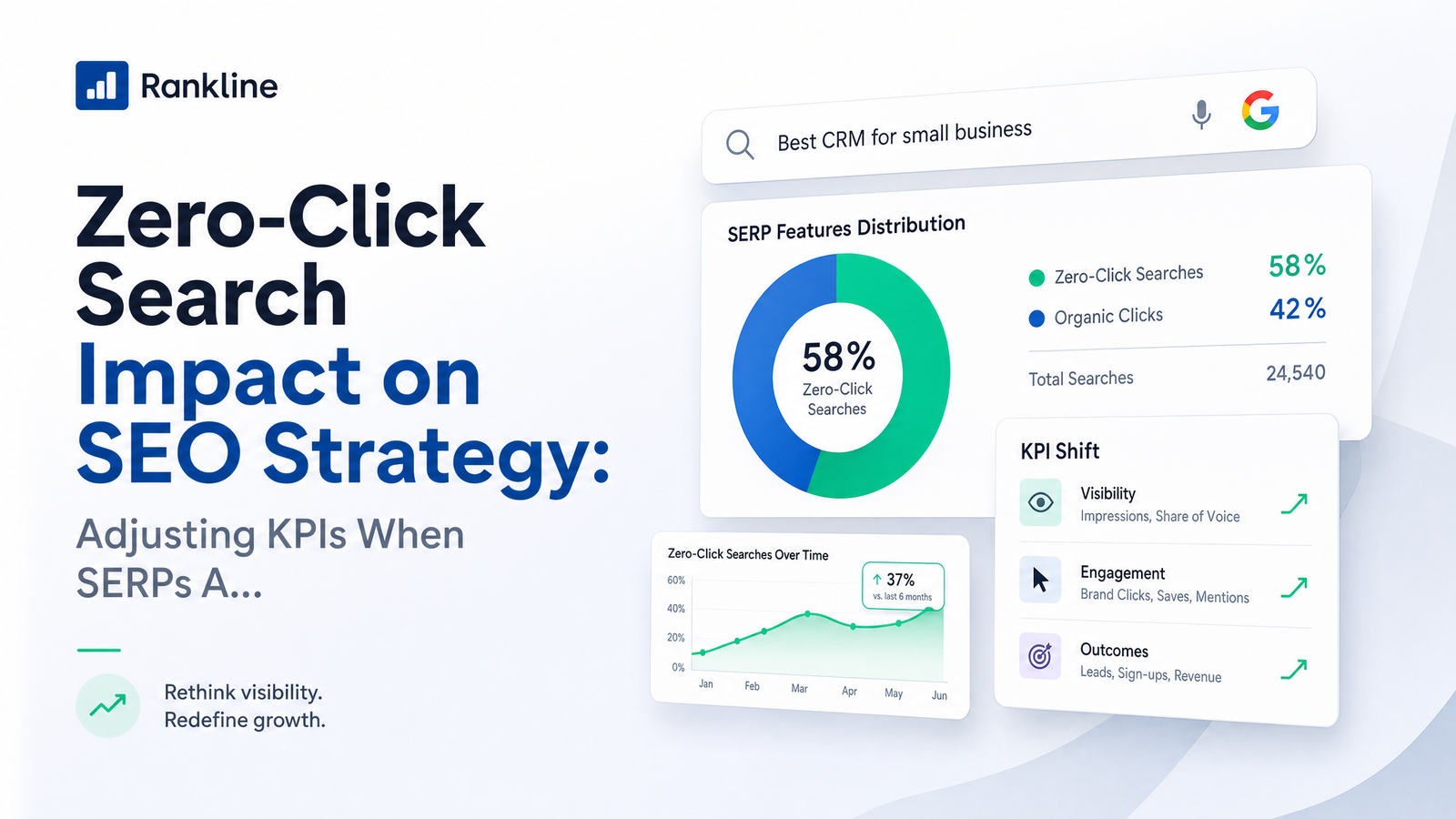
A zero-click search happens when a searcher gets their answer directly on the results page and never clicks through to any website. Featured snippets, knowledge panels, local packs, and now AI Overviews all pull an answer out of a page and present it inline, satisfying intent before a single blue link gets tapped.
This isn't fringe behavior. Depending on the study, roughly 58-68% of US searches now end without a click, and that share climbs higher on queries where an AI Overview appears. SparkToro's Rand Fishkin has tracked this shift for years, and more recent data compiled in Zero-Click Search Statistics 2026: Complete Data Guide and Zero-Click Search Statistics 2026: Sourced & Updated shows the trend accelerating as Google rolls AI Overviews and AI Mode into more query types. Bain & Company's research adds a related warning: as generative answers get embedded into search, user trust in the answer itself — rather than the source — is what's shifting behavior.
The mechanism is simple. Google would rather keep a searcher on Google. Every SERP feature that answers a question in place reduces the need to leave the page. That's the structural reality behind zero-click search seo today: your content can win the ranking and still lose the visit.
Why Clicks and Impressions Are Diverging in Your Search Console Data
If you've noticed impressions climbing in Search Console while clicks stay flat or slide, you're watching zero-click search play out in your own data. Your pages are being served, sometimes prominently, as the source behind an AI Overview or snippet. Google counts that as an impression. The searcher gets their answer without visiting, so no click follows.
The mistake most teams make is treating this pattern as a tracking bug or a temporary ranking dip, then burning time debugging a problem that isn't one technically — it's a structural change in how the SERP hands out attention. Organic CTR decline isn't necessarily a signal that your content got worse; it can just as easily mean your content got good enough to be quoted verbatim.
Still, the divergence is worth watching closely. A sudden CTR drop on a query that used to convert well is different from a gradual industry-wide CTR compression. Segmenting Search Console data by query, and layering in position and SERP feature context, is the only way to tell the difference — a process covered in more depth in Google Search Console Tips That Actually Drive Action.
Not All Queries Are Equal: Tiering Keywords by Click Potential
The fastest way to waste effort in a zero-click world is treating every keyword like it deserves the same click-focused optimization. A practical fix is sorting target queries into three tiers based on how likely they are to trigger an on-SERP answer.
Tier 1 — High zero-click risk (informational, definitional, single-fact queries). Think "what is," "how many," "when did." These are prime AI Overview and featured snippet territory. Informational query optimization here should focus less on pulling a click and more on winning the citation — being the source Google quotes.
Tier 2 — Mixed-intent queries. Comparison posts, "best X for Y," early-funnel research terms. These sometimes trigger AI Overviews but often still send clicks because the answer requires nuance, personal judgment, or a table Google won't fully replicate. Worth optimizing for both citation and click.
Tier 3 — Transactional and navigational queries. Pricing pages, product comparisons, brand-name searches, "near me" queries with commercial intent. Transactional queries SEO still behaves the way it always has — these searchers want to land on a page, not read a summary, and they remain your highest-value click traffic.
Mapping your keyword set against these tiers tells you where to keep fighting for the click and where that fight is no longer winnable — or worth it.
The KPI Shift: What to Track Instead of (or Alongside) Clicks
Most zero-click advice stalls out at "focus on brand visibility" without saying how. Here's the substitution list that actually holds up for SEO KPIs 2026 planning:
| Old KPI | Why it's breaking | New KPI | What it tells you |
|---|---|---|---|
| Sessions | Doesn't count answer-page satisfaction | Impression share + SERP feature ownership | How much SERP real estate you control, clicked or not |
| CTR | Compressed by snippets/AI Overviews regardless of quality | AI Overview citation rate | Whether you're the cited source when an answer appears |
| Last-click conversions | Misses influence that happens pre-click | Branded search lift + assisted conversions | Whether content exposure drives people to search your brand or convert later |
| Rankings alone | Position #1 with a snippet above it can still get zero clicks | Share of voice across SERP features | Your visibility footprint across snippets, panels, AI Overviews, and organic combined |
Impression share matters because it's the closest thing to "reach" in a world where the click is optional. AI Overview citation rate matters because being cited is now a visibility outcome in its own right — Ansira's research on AI search measurement makes the case that marketers need outcome metrics that don't depend on the click at all. Branded search lift matters because someone who reads your answer in an AI Overview, remembers your name, and later searches your brand directly is a conversion event Search Console will never label as "organic."
Share of voice SEO — tracking your presence across every SERP feature type for a query set, not just blue-link position — is arguably the single best replacement for "rankings" as a headline metric.
How to Actually Track These New Metrics
None of this requires an enterprise martech budget, but it does require pulling from more than one place unless your tooling consolidates it.
- Impressions and position by query: Pull this straight from Search Console, filtered by query tier. Watch for pages with high impressions and low CTR — that's your zero-click-affected content, not necessarily underperforming content.
- SERP feature presence: A modern rank tracker should flag when your URL owns a featured snippet, appears in a knowledge panel, or shows up in local pack results, not just its numeric position. This is covered in detail in Best SEO Rank Tracker in 2026: How to Actually Choose.
- AI Overview citation tracking: Manually, this means running your priority queries and logging whether your domain appears in the cited sources. At scale, you want a tool that automates that check across your keyword list on a schedule, since AI Overview inclusion shifts week to week.
- Branded search volume: Track branded query volume in Search Console and a keyword tool over time. A steady rise, especially following content pushes on Tier 1 topics, is a solid proxy for zero-click brand exposure that never shows up as a session.
Answer Engine Optimization (AEO) and Generative Engine Optimization (GEO) are the emerging disciplines built around exactly this: optimizing to be the source an AI system cites, not just the page a human clicks. The same underlying principles show up in adjacent SERP-answer behavior — see Voice Search Optimization in 2026: What Actually Works Now for how answer-first optimization plays out on voice assistants too.
Reframing SEO Reporting for Stakeholders
Reporting SEO to stakeholders gets uncomfortable fast when the only number a boss or client understands is "clicks," and that number is flat while your actual visibility is growing. The fix isn't to hide the click data — it's to widen the report.
A workable script: "Traffic from this query set is flat, but our impression share went from X% to Y%, we now own the featured snippet on Z of our target terms, we're cited in the AI Overview for [topic], and branded search volume is up N% over the same period. That's demand we're capturing before the click, not demand we're losing." That sentence, backed by real numbers, reframes a flat-traffic quarter as a share-of-market win.
Proving SEO ROI now means showing the full funnel of visibility, not just the bottom of it. Build this into a standing dashboard rather than a one-off explanation — SEO Reporting Dashboard: What to Include and How to Build It walks through exactly what belongs on it.
Where Rankevra Fits
Everything above is doable by hand — pulling GSC exports, running a separate rank tracker for SERP features, manually checking AI Overviews query by query, and watching branded search volume in yet another tab. It's also exactly the kind of fragmented workflow that makes zero-click reporting take a full afternoon instead of five minutes.
Rankevra is built as a unified SEO dashboard specifically for this shift: it tracks rankings and SERP feature ownership, audits technical issues, and rolls impressions, share of voice, and citation presence into one view instead of three or four disconnected tools. As an AI SEO tool, it's designed for teams who need to prove visibility and revenue impact, not just clicks, without hiring a data analyst to stitch the reports together.
Frequently Asked Questions
Does zero-click search mean SEO is dying?
No — it means the definition of a "win" is expanding, not disappearing. SEO still drives visibility, brand recall, and conversions; it just increasingly happens through citations and SERP feature presence rather than a click every time. Sites that adapt their KPIs are seeing this as a share-of-voice opportunity, not a dead channel.
What percentage of searches are zero-click in 2026?
Current estimates put roughly 58-68% of US searches ending without a click, with the rate climbing higher on queries that trigger an AI Overview. These figures come from ongoing tracking by SparkToro-style research and are compiled in sourced guides like the Digital Applied and Arfadia zero-click statistics reports.
Should I stop targeting keywords that trigger AI Overviews?
No, but you should change what success looks like for those keywords. For Tier 1 informational queries, shift your goal from click volume to winning the AI Overview citation and owning the featured snippet, since the click was already unlikely regardless of ranking.
How do I track brand visibility if Google Search Console only shows clicks?
Search Console also reports impressions and average position by query, which reveal visibility even without clicks. Pair that with SERP feature tracking from a rank tracker, manual or automated AI Overview citation checks, and branded search volume trends to get the full picture GSC alone can't show.
What is the difference between zero-click SEO and answer engine optimization (AEO)?
Zero-click SEO describes the broader phenomenon of searches ending on the results page instead of your site. Answer Engine Optimization (AEO) is the practical discipline of structuring content so AI systems and answer engines choose to cite it — one is the trend, the other is the response to it.
How do I prove SEO value to stakeholders when clicks are flat but impressions are rising?
Report impression share, SERP feature ownership, AI Overview citation rate, and branded search lift alongside clicks, framing rising visibility as captured demand rather than lost traffic. This reframes a flat-traffic period as market share growth instead of a failing channel.
Manually tracking impressions, SERP feature presence, AI Overview citations, and branded search lift across dozens of queries in separate tools is the exact fragmentation problem that makes zero-click reporting so painful. Rankevra puts rank tracking, SERP visibility, audits, and reporting in one dashboard so you can prove SEO value without stitching together GSC, a rank tracker, and manual brand checks — try it and see your full zero-click picture in one place.
Keep reading
- SEO Cannibalization Audit: Find and Fix It at ScaleLearn to run a real seo cannibalization audit: separate harmless overlap from true ranking loss, then merge, redirect, or canonicalize at scale.
- Featured Snippet Optimization: A Reverse-Engineering GuideA 4-step framework for featured snippet optimization: find winnable queries, decode the incumbent's format, rebuild it tighter, and track ownership.
- 301 Redirect Mapping: The Build-Test-Monitor FrameworkLearn how to build, validate, and monitor a 301 redirect map so URL changes preserve rankings and link equity — without a spreadsheet mess.