Rankevra Blog
Google Algorithm Update Recovery: A Diagnostic Framework
September 16, 2026
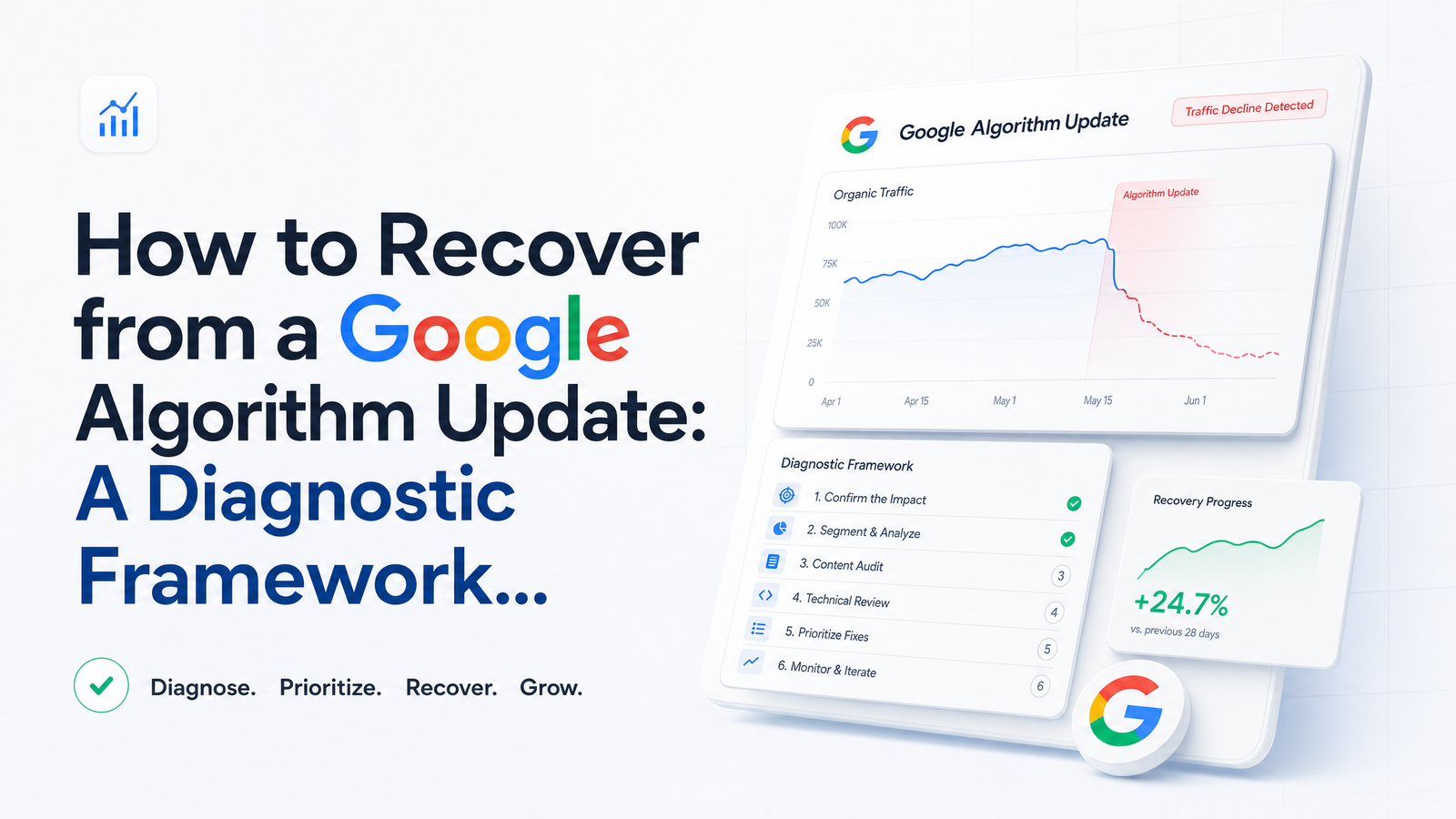
Traffic drops trigger panic, and panic produces bad decisions — mass content deletion, frantic date-stamping, rewriting pages that were never the problem. Before any of that, there's a diagnostic question most "recovery" advice skips: did a Google algorithm update actually cause this drop, or are you chasing a ghost? Real google algorithm update recovery starts with evidence, not assumption, and the sequence matters as much as the actions themselves.
This framework treats recovery as a diagnostic problem first and a content problem second. You'll confirm the update caused your drop, rule out the non-algorithmic culprits that mimic it, classify exactly what kind of loss you're dealing with, and only then decide what to fix — and in what order.
Is This Really an Algorithm Update? Confirm It First
The single most common mistake in recovery efforts is skipping correlation. A traffic graph drops, someone remembers reading about a Google update, and the two get linked without checking whether the dates actually align. That assumption can send a team down weeks of unnecessary content rewrites when the real cause was a broken canonical tag or a tracking code that stopped firing.
Start by pulling up the Google Search Status Dashboard and cross-referencing it against SEO news trackers that log confirmed rollout dates and durations. A confirmed google update typically has an official start date, a rollout window of one to two weeks, and — often — public commentary from Google's Search Liaison or engineers like John Mueller clarifying scope. If your traffic drop timing lines up with that window, day for day, you have a real correlation to investigate further.
If your drop happened two weeks before the update even began rolling out, it isn't the update. Most self-diagnoses go wrong here: teams anchor on the nearest named update rather than the actual date their analytics show the decline starting. Pull your daily traffic data in Google Search Console and mark the exact day impressions or clicks broke from trend — not the week, the day. Then check that day against the confirmed rollout window. Correlation isn't proof, but a mismatch is enough to redirect your entire investigation toward non-algorithmic causes.
Rule Out Non-Algorithmic Causes Before Blaming Google
Even when timing does line up, updates aren't the only thing that can produce a sudden drop, and several causes are far easier to fix.
Technical breakage is the most common false positive. A deployment that accidentally noindexed a template, a robots.txt change, a broken sitemap, or a migration that mishandled redirects can produce a drop that looks identical to an algorithmic hit. Run a crawl comparison against your last known-good state and check index coverage in Search Console before assuming quality is the issue. If you find broken canonicals, redirect chains, or crawl errors, a prioritized technical SEO action plan will get you further, faster, than any content rewrite.
Tracking and measurement errors are the second most common. A GA4 tag that stopped firing after a CMS update, a consent-mode change blocking measurement for a chunk of visitors, or a UTM parameter conflict can all produce a "drop" that never touched actual rankings. Check your raw server logs or Search Console impressions — if impressions and average position are stable but clicks and sessions cratered, you're looking at a measurement problem, not an algorithm problem.
Seasonality rounds out the list. Compare year-over-year, not just week-over-week. Retail, travel, education, and finance content all carry predictable seasonal cycles that can look alarming month-over-month but unremarkable next to the same period last year.
Only once you've eliminated technical breakage, tracking failure, and seasonal cycles — and confirmed timing correlation with a real update — should you treat this as a genuine algorithmic event.
Classify the Pattern: Sitewide, Page-Level, or SERP-Feature Loss
Not all algorithmic drops are the same shape, and the shape tells you where to focus.
Sitewide reassessment shows up as a broad decline across most templates and topics simultaneously — landing pages, blog posts, category pages all down together. This pattern is typical of core updates and the Helpful Content system, which evaluate overall site quality and E-E-A-T signals (experience, expertise, authoritativeness, trust) rather than individual pages. If your entire site trended down uniformly, the fix has to be structural: content depth, author credibility, site-wide trust signals — not a patch on one article.
Page-level loss looks different: specific URLs or a content cluster drop while the rest of the site holds steady. This often points to something narrower — thin or outdated content losing to a more comprehensive competitor, or two of your own pages competing for the same query and diluting both. If several of your own pages target overlapping keywords and rankings have been unstable across them, run a cannibalization audit before touching anything else. If the losing pages are simply thinner than what now ranks above them, a structured content gap analysis against the pages that displaced you will show exactly what's missing.
SERP-feature displacement is most often mistaken for a ranking loss when it's actually a visibility loss. Your position in the classic ten blue links might be unchanged, but an AI Overview, a new People Also Ask block, or an expanded featured snippet is now eating the clicks that used to reach you. Check average position alongside click-through rate in Search Console: stable position with falling CTR is a strong signal that the SERP layout changed, not your ranking.
Getting this classification right prevents the most wasted effort in recovery: applying a sitewide content overhaul to what was actually a two-page cannibalization issue, or rewriting content that never lost rank in the first place.
What Actually Moves the Needle (And What Doesn't)
Once you know the pattern, resist the instinct to do everything at once. A few actions consistently waste effort:
Mass deletion of "underperforming" pages rarely helps unless those pages are genuinely thin, duplicate, or off-topic — deleting content that's merely old but still useful just removes crawl equity and internal links for no quality gain. Date-stamping content without substantive updates is a cosmetic move Google's systems are well past being fooled by. And chasing every minor volatility spike shown by SERP volatility trackers is a distraction; those tools confirm rollout activity, not trigger points for a rewrite every time the needle twitches.
What actually works maps directly to your classification. For sitewide reassessment, invest in genuine expertise signals — author bios with real credentials, original data or first-hand experience, clearer sourcing — because Helpful Content evaluation weighs demonstrated experience heavily. For page-level thin content, close the specific gaps competitors cover that you don't, rather than padding word count. For cannibalization, consolidate or differentiate — don't just add more pages to the same topic. And if your diagnostic pointed to performance issues, know that 2026's core updates incorporate more holistic Core Web Vitals scoring than in past years, so a slow, layout-shifting page can be a genuine contributing factor even when the content itself is solid.
A Realistic Recovery Timeline for 2026
Recovery timing depends entirely on what caused the drop. Technical and tracking fixes can show results within two to six weeks once Google recrawls and reindexes the corrected pages. Genuine quality-based algorithmic recovery is slower and, critically, is gated by the update cycle itself rather than by calendar weeks of effort.
That distinction matters more in 2026 than it used to. Core updates now roll out roughly every six to twelve weeks, which means meaningful reassessment of your fixes often has to wait for the next confirmed rollout — not because Google is slow, but because core systems reevaluate quality signals in batches during named updates, not continuously in real time. Fixing your content in week one doesn't guarantee a bounce in week three; it means you're positioned to benefit whenever the next update cycle evaluates the web again. Plan your recovery work around that cadence rather than against a fixed number of weeks.
Keep Monitoring So the Next Update Doesn't Blindside You
The diagnostic work you did this time — checking the Search Status Dashboard, comparing timing, classifying the loss — has to become a standing habit, not a one-off. Continuous rank tracking that flags volatility as it happens, rather than a month later when the quarterly report lands, is what turns the next update from a crisis into a data point. A properly chosen rank tracker paired with regular Search Console review closes the loop between detection and diagnosis, so the next time a graph dips, you already know within a day or two whether it's algorithmic, technical, or seasonal.
Frequently Asked Questions
How do I know if my traffic drop was caused by a Google algorithm update or something else?
Check whether the exact day your traffic broke trend matches a confirmed rollout window on the Google Search Status Dashboard, then rule out technical breakage, tracking errors, and seasonality before concluding it's algorithmic. If the dates don't align, or a simpler cause explains the pattern, the update almost certainly isn't the source.
How long does it take to recover from a Google core update?
Technical and tracking-related drops can resolve within two to six weeks once fixes are crawled and reindexed. Genuine quality-based recovery is typically gated to the next core update cycle, which now rolls out roughly every six to twelve weeks, rather than a fixed number of weeks of effort.
Should I delete or rewrite pages that lost rankings after an update?
Only delete pages that are genuinely thin, duplicate, or off-topic — mass deletion of merely older content usually removes useful crawl equity without improving quality signals. Rewrite selectively, targeting the specific gaps competitors cover that your page doesn't, rather than padding length or date-stamping without real changes.
Can I recover before the next core update rolls out?
Partially — technical fixes, tracking corrections, and CTR improvements from SERP-feature issues can show gains between core updates. But quality-based reassessment tied to E-E-A-T and Helpful Content signals is usually only fully reflected when the next core update evaluates the web again.
Is a core update the same as a Google penalty?
No. A core update is a broad, algorithmic reassessment of quality signals across the web that affects sites without any manual review, while a penalty is a manual action applied to a specific site for violating guidelines, visible as a notice in Search Console. Core updates require no manual action notice; if you don't see one, you're not dealing with a penalty.
What's the first thing I should check after a suspected algorithm hit?
Compare the exact date your traffic dropped against confirmed update rollout dates on the Google Search Status Dashboard before anything else. This single check prevents wasted effort on content rewrites when the real cause turns out to be technical, tracking-related, or seasonal.
Recovery isn't a project you finish — it's a monitoring problem that never really closes, especially with core updates now landing every six to twelve weeks. Manual audit-and-wait cycles simply can't keep pace with that cadence. Rankevra automates the audit, content, and rank-tracking workflow in one place, so the next drop gets flagged and diagnosed within days instead of discovered a month later in a quarterly report.
Keep reading
- Headless CMS SEO: A Framework to Stop Silent Ranking LossesHeadless CMS SEO breaks in predictable ways. Get a three-layer audit framework for metadata, sitemaps, and rendering — plus a checklist to catch issues early.
- Meta Title & Description Optimization at ScaleA template-driven system for meta title description optimization across hundreds of URLs — pixel limits, page-type formulas, and a GSC CTR loop.
- International SEO Site Architecture: ccTLD vs Subdomain vsA business-first framework for choosing international SEO site architecture — ccTLD, subdomain, or subdirectory — before hreflang enters the picture.