Rankevra Blog
International SEO Site Architecture: ccTLD vs Subdomain vs
September 16, 2026
Why This Decision Comes Before Hreflang
Most teams planning international expansion start with hreflang tags, then work backward into a URL structure. That order is wrong, and it's why so many multi-country sites underperform despite technically correct implementation. Your international SEO site architecture — ccTLDs, subdomains, or subdirectories — is the structural foundation. Hreflang is a signal layered on top to tell Google which language or regional version to serve; it cannot repair a structure that fragments authority, exceeds your team's operational capacity, or misrepresents your commitment to a market.
Three variables should drive the decision, and they'll recur throughout this article:
- Authority consolidation — how much of your existing domain equity transfers to each new regional property.
- Operational capacity — how much infrastructure, content, and monitoring overhead your team can actually sustain per market.
- Market permanence — how committed and legally distinct your presence needs to be in a given country.
Get these three right, and hreflang does its job cleanly. Get the architecture wrong, and no amount of correct annotation fixes it.
ccTLD, Subdomain, or Subdirectory: What Each Signal Actually Tells Google
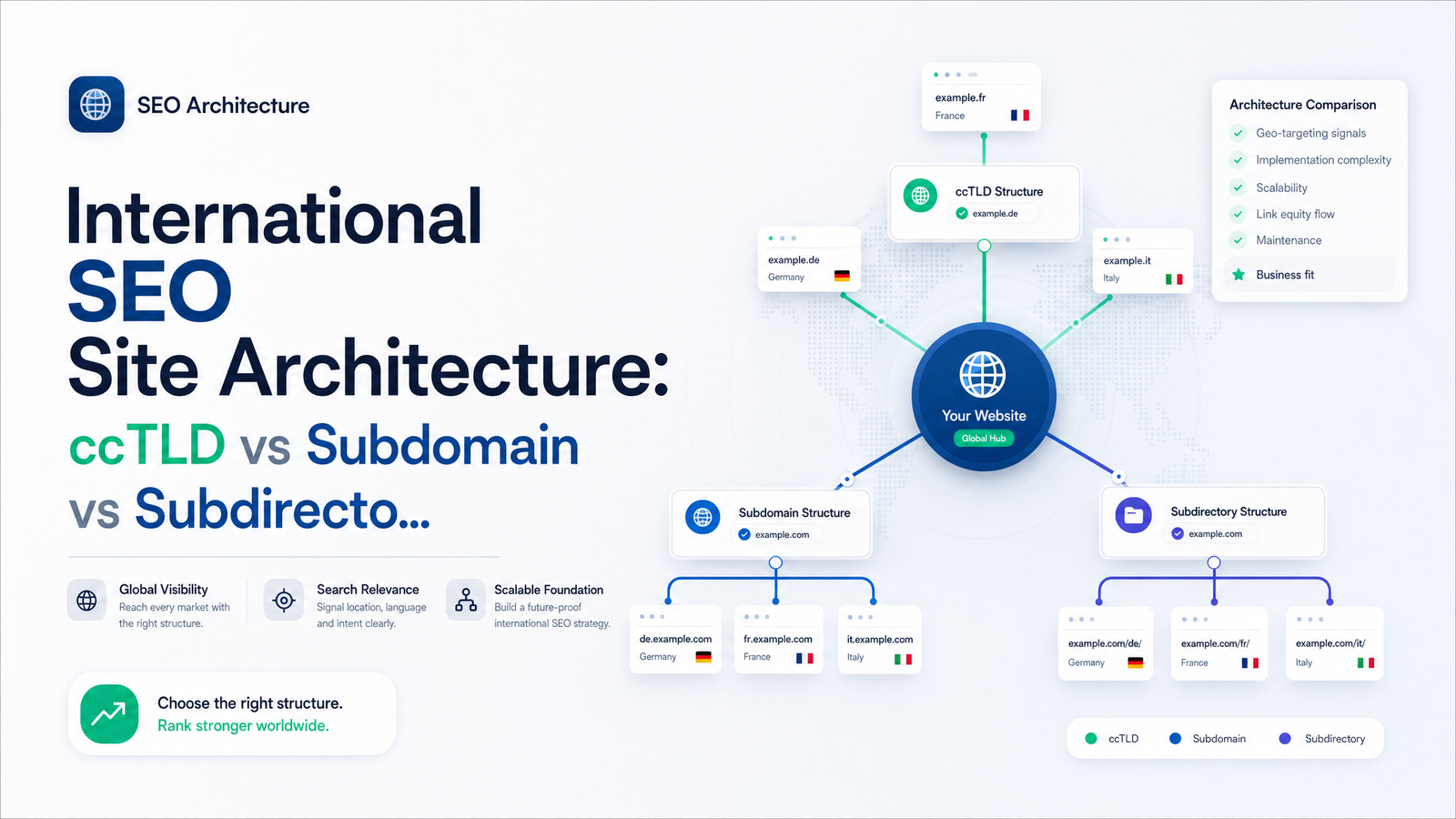
The ccTLD vs subdomain vs subdirectory comparison starts with what each structure literally is:
- A ccTLD (country-code top-level domain) is a fully separate domain —
example.de,example.fr— treated by Google as a distinct site with its own crawl budget, backlink profile, and authority. - A subdomain —
de.example.com— sits on the root domain but is often crawled and evaluated with a degree of independence, depending on hosting and content separation. - A subdirectory —
example.com/de/— lives entirely within the main domain, sharing its crawl equity, backlink profile, and domain-level trust signals by default.
Google's own guidance on managing multi-regional and multilingual sites confirms ccTLDs are the clearest geotargeting signal because the country association is unambiguous and can't be reassigned. Subdirectories and subdomains rely on Search Console's geotargeting settings, server location, local backlinks, and content language as supporting signals rather than a built-in guarantee. That's the core of geotargeting URL structure: a ccTLD tells Google something structurally; other formats have to earn the same clarity through secondary evidence.
The Real Tradeoffs: Authority, Cost, and Control
Strip away the folklore and three factors actually decide this:
Domain authority consolidation. Subdirectories win decisively here. Every backlink, every piece of ranking content, every year of domain history feeds one root domain. A subfolder vs ccTLD SEO comparison almost always favors subfolders early on, because a new ccTLD starts at zero — no backlink history, no accumulated trust, nothing search engines can use to judge quality until it earns its own signals from scratch. Subdomains sit in between: some authority passes through, but Google has been inconsistent about how much, and the safer assumption is "less than a subfolder, more than a brand-new domain."
Cost and maintenance overhead. This is where ccTLDs get expensive in ways that don't show up in a pros/cons table. Each ccTLD typically means separate hosting, a separate SSL and DNS setup, its own backlink acquisition strategy, its own technical SEO maintenance, and its own content team or workflow to keep it from going stale. A domain strategy for multilingual sites that spans ten ccTLDs is effectively ten mini-websites to run, monitor, and defend against drift. Subdirectories consolidate this into one technical stack, one crawl budget, one audit process.
Geotargeting strength. ccTLDs win outright, particularly where local relevance, government perception, or regulatory positioning matters — a .de domain simply reads as more locally credible to both users and search engines than a subfolder ever will, independent of content quality.
The tradeoff, stated plainly: subdirectories consolidate authority and minimize cost; ccTLDs maximize geotargeting clarity and market credibility at a steep operational price. There's no version of this decision that gets you all three advantages at once.
A Decision Framework: Match Structure to Market Reality
Generic advice fails here because the right answer depends entirely on scale and market type. Map your situation to one of these:
Testing 1–3 new markets, limited team. Use subdirectories. You preserve domain authority, keep everything on one technical stack, and can validate demand before committing to per-market infrastructure. This is the lowest-risk entry point for international SEO site structure and the one most SMBs should default to.
Regulated or legally distinct markets — finance, healthcare, gambling, or any country requiring a local business entity, local data residency, or local currency/legal disclosures. Here, a ccTLD often isn't optional; local law or market expectation makes a country-specific domain necessary regardless of the authority cost. Treat this as a compliance decision that happens to have SEO consequences, not the reverse.
Enterprise-scale, multi-country, multi-brand. Once you're operating in a dozen-plus countries with dedicated local teams, sales operations, and budget for ongoing per-market content and links, ccTLDs become sustainable because you have the operational capacity to maintain them properly. This is the scenario Google's international site architecture guidance implicitly assumes when it discusses server location and local hosting as geotargeting signals — it's written for organizations that can staff that infrastructure.
Hybrid approach. Many multinational sites run subdirectories for smaller or emerging markets and reserve ccTLDs for their two or three most strategically important countries. This isn't indecision — it's matching structure to market permanence on a market-by-market basis instead of forcing one architecture across every region.
What Changes (and Doesn't) When You Add Hreflang
Whatever structure you choose, hreflang's job doesn't change: it tells Google which URL to serve to which language-and-region combination, preventing duplicate-content confusion between, say, your UK and US English pages. What changes is how much weight hreflang carries.
With ccTLDs, hreflang is confirmatory — the domain has already made the geotargeting case; hreflang just refines language variants within it. With subdirectories or subdomains, hreflang is load-bearing, because it's one of the few explicit signals distinguishing /de/ from /at/ beyond content and Search Console settings. In a multi-regional website structure of any kind, hreflang tags that are broken, missing return links, or inconsistently implemented can silence the geotargeting signal you're depending on entirely. The takeaway: hreflang supports the architecture decision, it doesn't substitute for it.
The Migration Trap: Switching Structures Later
The most expensive mistake in this entire decision isn't picking the "wrong" structure initially — it's switching later without treating it as a full site migration. Teams that start with subdirectories, gain traction, then decide to move high-value markets to ccTLDs, often underestimate what that transition costs.
Switching site architecture carries real SEO risk: backlinks pointing to /de/ don't automatically transfer their equity to a new example.de, even with clean redirects — some link value is lost in the transition regardless of execution quality. Redirect chains break if not mapped meticulously. Crawl signals reset as Google treats the ccTLD as a new property needing to re-earn trust. And content that isn't perfectly mirrored during the move creates duplicate-content confusion at exactly the moment you need clean signals.
The ccTLD vs subdirectory for international SEO question gets harder, not easier, once you have existing rankings to protect. Grounded operational accounts of subfolder-to-ccTLD transitions consistently flag neglected ccTLDs — domains stood up with enthusiasm, then left to stagnate once the initial launch push ends — as a bigger practical risk than the migration itself. If you're planning this move, treat it as a formal migration project: map every URL, audit every redirect, and follow a structured migration checklist rather than improvising.
Keeping Multi-Region Architecture Healthy After Launch
Choosing the right international SEO site architecture is a decision you make once; keeping it healthy is a job that never ends. The failure modes are predictable and almost always slow-building rather than sudden:
- Duplicate content across regions — near-identical product or blog pages in
/uk/and/us/competing against each other instead of hreflang cleanly separating them, often traced back to canonical tag misconfigurations that basic crawls miss entirely, as detailed in this breakdown of canonical tag failures. - Orphaned ccTLDs — country domains launched with initial investment, then starved of new content and links while the core domain keeps growing, quietly turning a geotargeting asset into a liability.
- Crawl inconsistencies — regional properties getting crawled at different rates or depths than expected, often invisible until you examine server log data directly rather than relying on Search Console summaries alone.
None of this is a one-time audit problem — it's a monitoring problem, and it compounds across every additional ccTLD, subdomain, or subfolder you add. A prioritized approach to technical SEO fixes helps you triage what's found, but finding it consistently across five, ten, or twenty regional properties by hand isn't realistic for most teams. This is precisely the gap Rankevra's automated audit and rank-tracking workflow is built to close — continuously checking hreflang integrity, canonical consistency, and crawl behavior across every regional property from one dashboard, instead of a manual audit that's outdated the week after you run it.
Frequently Asked Questions
Does a ccTLD actually help you rank better in that country?
A ccTLD provides the clearest possible geotargeting signal to Google, which can support rankings in that country, but it doesn't guarantee them. Content quality, local backlinks, and relevance still matter more than domain format alone — a ccTLD earns you signal clarity, not automatic ranking authority.
Can I switch from subdirectories to ccTLDs later without losing rankings?
You'll likely lose some ranking momentum during the transition, even with careful execution, because backlink equity and crawl trust don't transfer perfectly to a new domain. Treat it as a full site migration with mapped redirects and a structured checklist rather than a quick domain swap.
Is a subdomain treated as part of my main domain's authority or separately?
Google treats subdomains with partial independence — some authority passes from the root domain, but generally less than a subdirectory would retain. The exact degree varies by case, which is why subdirectories are the safer default when authority consolidation is the priority.
What's the cheapest way to start international SEO if I only have one or two target markets?
Subdirectories are the lowest-cost, lowest-risk starting point for one or two markets. They keep all authority on your existing domain, require no separate hosting or infrastructure, and let you validate demand before investing in country-specific domains.
Do I still need hreflang if I use ccTLDs?
Yes — ccTLDs strengthen the geotargeting signal but don't replace hreflang's role in managing language variants within or across those domains. Hreflang carries less weight than it does on subdirectories, but skipping it still risks duplicate-content confusion between language versions.
How many countries or languages justify moving from subdirectories to ccTLDs?
There's no fixed number — the decision depends more on operational capacity and market permanence than country count. If you have dedicated local teams, budget for ongoing local content and links, and legal or regulatory reasons to establish local presence in several markets, ccTLDs become sustainable; without that capacity, subdirectories remain the safer structure regardless of how many markets you enter.
Architecture is only the first decision — the harder, ongoing challenge is catching drift before it costs you rankings: an hreflang tag that breaks silently, a ccTLD that goes stale, a subfolder quietly duplicating another region's content. Rankevra automates the audits and monitoring that keep every regional property honest, so international structure stays an asset instead of a slow-motion liability.
Keep reading
- Headless CMS SEO: A Framework to Stop Silent Ranking LossesHeadless CMS SEO breaks in predictable ways. Get a three-layer audit framework for metadata, sitemaps, and rendering — plus a checklist to catch issues early.
- Meta Title & Description Optimization at ScaleA template-driven system for meta title description optimization across hundreds of URLs — pixel limits, page-type formulas, and a GSC CTR loop.
- Google Algorithm Update Recovery: A Diagnostic FrameworkA step-by-step google algorithm update recovery framework: confirm the cause, rule out technical issues, classify the loss, and time your fixes right.