Rankevra Blog
SE Ranking On-Page SEO Checker: What It Does and Misses
July 30, 2026
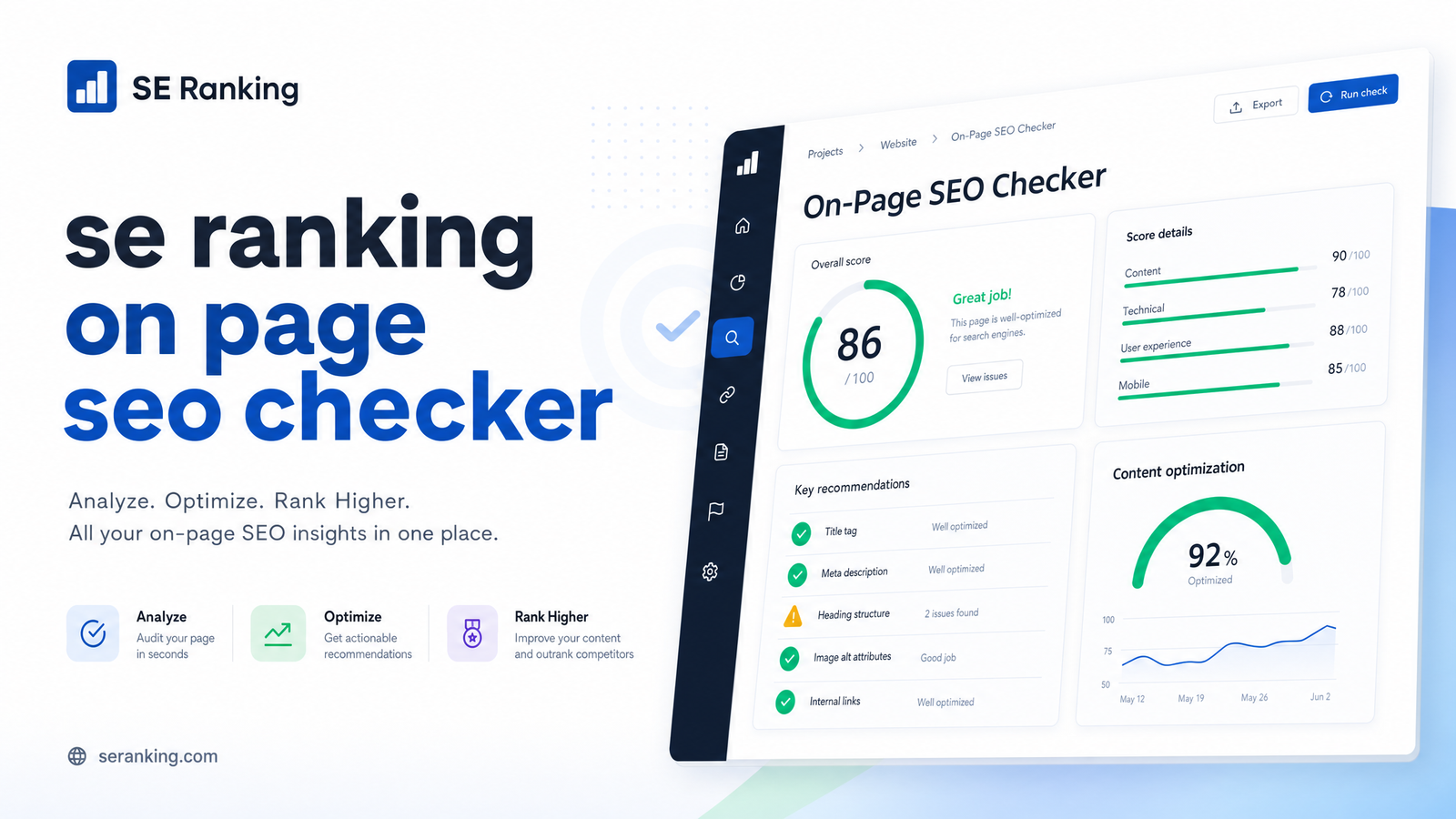
Anyone researching an on-page audit tool eventually runs into SE Ranking's On-Page SEO Checker, and for good reason — it's one of the more thorough single-page scoring tools on the market. But "thorough" and "complete" aren't the same thing. This breakdown covers exactly what the SE Ranking on-page SEO checker scores, how its scoring logic works, and the practical gaps that show up once you're managing more than a handful of pages.
What SE Ranking's On-Page SEO Checker Actually Does
The tool audits a single URL against a target keyword you specify, then benchmarks that page against the top-ranking competitors for the same term. You get an overall optimization score, a ranked list of issues, and side-by-side comparisons showing where your page underperforms versus what's already ranking. It's built as an on-page audit tool in the truest sense — it doesn't crawl your entire site by default, it evaluates one page at a time against one keyword's competitive landscape. That focus is a strength for isolated audits and a limitation for anyone trying to manage on-page health across dozens or hundreds of URLs, which we'll get to later. According to SE Ranking's own product page, the checker also factors in page experience signals, including Core Web Vitals, as part of the broader scoring picture.
The Factors It Scores
SE Ranking's on-page SEO checker evaluates more than 30 individual factors, grouped roughly into content, technical, and user-experience categories. On the content side, it checks title tag structure and keyword placement, meta description quality, header (H1–H6) usage and hierarchy, keyword usage and density relative to competitors, and overall content length benchmarked against top-ranking pages for that query. On the technical and page-experience side, it looks at image alt text, page load speed, mobile responsiveness, and HTTPS/SSL implementation. The Scribe breakdown of SE Ranking's features confirms this 30+ factor model and notes that the tool also generates a content brief alongside the audit, giving writers a structural target before they even touch the page. This is a genuinely useful combination — most on-page SEO factors that matter for search visibility are represented somewhere in the scoring model, from title tags down to Core Web Vitals. If you want a more general reference for how these factor categories map onto a full audit methodology independent of any single vendor, our on-page SEO audit checklist covers the seven categories that matter regardless of which tool you use.
How Issues Are Categorized and Scored
SE Ranking sorts every flagged issue into one of four buckets: errors, warnings, notices, and items requiring no action. Errors are the highest-priority problems — things like missing title tags or broken heading structure that are likely to hurt rankings directly. Warnings are secondary issues worth fixing but less urgent. Notices are minor suggestions, and the no-action category simply confirms what's already correct. This four-tier system, documented in SE Ranking's Help Center article on the on-page checker, gives users a triage order rather than a flat, undifferentiated list — which matters when a single audit returns 40 or more line items.
Layered on top of the errors/warnings/notices system is the SE Ranking Content Score, which uses NLP-based analysis (commonly associated with TF-IDF-style term-frequency comparison) to measure how well your content's vocabulary and topical coverage match what's already ranking. Rather than just counting keyword occurrences, the content score looks at related terms and semantic coverage relative to competitor pages, then tells you which terms or topics you're underusing. It's a reasonably sophisticated way to catch thin or narrowly focused content that a simple keyword-density check would miss — but it's still a diagnostic score, not an editor. It tells you what's missing; it doesn't write the missing content for you.
Where It Falls Short
The most consequential limitation isn't in what SE Ranking's checker measures — it's in what happens after the audit finishes. The tool produces a detailed, accurate list of errors, warnings, and content gaps, but every fix from there is manual. You still have to rewrite the title tag, restructure the headers, expand the content to cover the missing terms, compress the images, and republish — one page at a time, using whatever CMS or dev workflow you already have. For a single landing page, that's a minor inconvenience. For a content team managing topical clusters across dozens of URLs, it becomes the actual bottleneck.
There are also structural account limits worth knowing before you commit to a plan. SE Ranking's lower tiers cap the number of pages you can crawl and the number of active projects you can run simultaneously, which matters for agencies or in-house teams managing multiple sites or larger domains. The Ecommerce Paradise pricing breakdown details how keyword tracking is priced as a multiplier of keywords times search engines tracked, which can inflate the effective cost well beyond the advertised base price once you're tracking rankings across multiple regions or search engines for the same keyword set. Combine that with per-project and per-seat pricing, and teams often end up paying for capacity they didn't realize they'd need until they hit the ceiling mid-project.
Finally, there's no path from "issue flagged" to "issue resolved" inside the tool. SE Ranking doesn't generate optimized replacement copy, doesn't auto-write meta tags, and has no publishing integration to push a fix live. It's an audit and reporting layer, not an execution layer — and if you're evaluating it against a comparable tool, it's worth reading our companion breakdown of Semrush's on-page checker, since the two products share this same diagnose-only architecture despite differing on specific factor weighting.
On-Page Checking vs. On-Page Fixing: The Real Gap
Step back from SE Ranking specifically and the pattern is industry-wide: every on-page checker on the market, including SE Ranking's, stops at reporting. It tells you the title tag is too short, the H2s are missing target terms, or the content underperforms on topical coverage by comparison to three competitor URLs — and then hands the problem back to you. Someone still has to write the corrected copy, adjust the internal linking, update the meta description, and physically republish the page. Multiply that across a site with genuine topical breadth — the kind needed to build real authority in a niche — and the audit-to-fix gap turns into a full-time workload, regardless of how accurate the underlying scoring model is.
This is precisely the gap AI-driven on-page automation is built to close. Rankevra runs the same class of on-page analysis — scoring content against competitors, flagging technical and structural issues — but doesn't stop at the report. It generates the corrected copy, rewrites meta tags and headers, and can publish the fix directly, closing the loop between diagnosis and implementation instead of leaving that work to a human editor working through a spreadsheet of flagged issues. For teams trying to fix technical SEO issues and build topical authority at the same time, that automation is the difference between an audit tool and a working system. If you want a structured method for turning a content score into actual improved copy before you commit to any tool, our content optimization framework walks through the six steps; and for broader context on how site-wide audits differ from single-page checks, see our guide to site audit tools.
Frequently Asked Questions
Is SE Ranking's on-page SEO checker free to use?
SE Ranking offers limited free access to on-page analysis, but full functionality — including unlimited audits, content score comparisons, and integration with rank tracking and project management — requires a paid plan. The free tier is generally useful for a one-off check on a single page rather than ongoing team use.
How many on-page factors does SE Ranking check per page?
SE Ranking's checker evaluates more than 30 individual on-page factors per audit, spanning content elements (titles, headers, keyword usage, content length), technical elements (HTTPS, page speed, mobile responsiveness), and image optimization (alt text). This factor count is documented across both SE Ranking's own product page and independent reviews of the tool.
Does a high on-page SEO score in SE Ranking guarantee better rankings?
No — a high score indicates strong on-page optimization relative to competitors, but rankings also depend on backlink profile, domain authority, search intent match, and off-page factors the checker doesn't measure. Treat the score as a strong on-page benchmark, not a ranking guarantee.
Can SE Ranking's on-page checker fix issues automatically, or just report them?
It only reports issues; every fix — rewriting copy, adjusting headers, updating meta tags, republishing — has to be done manually outside the tool. This diagnose-only model is standard across on-page checkers, which is the specific gap AI-driven tools like Rankevra are designed to close by generating and publishing the fix directly.
What's the difference between SE Ranking's on-page checker and its full Website Audit?
The on-page checker analyzes a single URL against one target keyword and competitor set, while the Website Audit crawls an entire site to surface site-wide technical issues like broken links, duplicate content, and crawlability problems. They're complementary tools within the same platform, not substitutes for each other.
How does SE Ranking's on-page checker compare to Semrush's on-page tool?
Both tools score on-page factors against top-ranking competitors and use NLP-based content comparison, with broadly similar diagnose-only architecture. The main practical differences are in specific factor weighting, UI, and pricing structure — for a detailed side-by-side, see our Semrush on-page checker breakdown.
Once you've seen what SE Ranking's checker flags — the errors, the content gaps, the missing terms versus competitors — the real work is still ahead of you: rewriting, restructuring, and republishing every one of those pages by hand. Rankevra runs that same on-page analysis but goes further, auto-generating the optimized copy, meta tags, and internal links, and publishing the fix directly instead of leaving you with another list to work through manually.
Keep reading
- Voice Search Optimization in 2026: What Actually Works NowVoice search optimization in 2026 means conversational AI search, not 2016 tricks. Here's what changed, what to skip, and what to actually do.
- Competitor Content Tracking SEO: A Continuous SystemLearn a repeatable competitor content tracking SEO system: weekly checks, monthly reviews, quarterly deep-dives, and how to automate it with Rankevra.
- Fix 404 Errors SEO: A Priority Framework That WorksLearn to fix 404 errors SEO teams actually need to worry about. A triage framework for finding, prioritizing, and resolving broken pages fast.