Rankevra Blog
Voice Search Optimization in 2026: What Actually Works Now
September 13, 2026
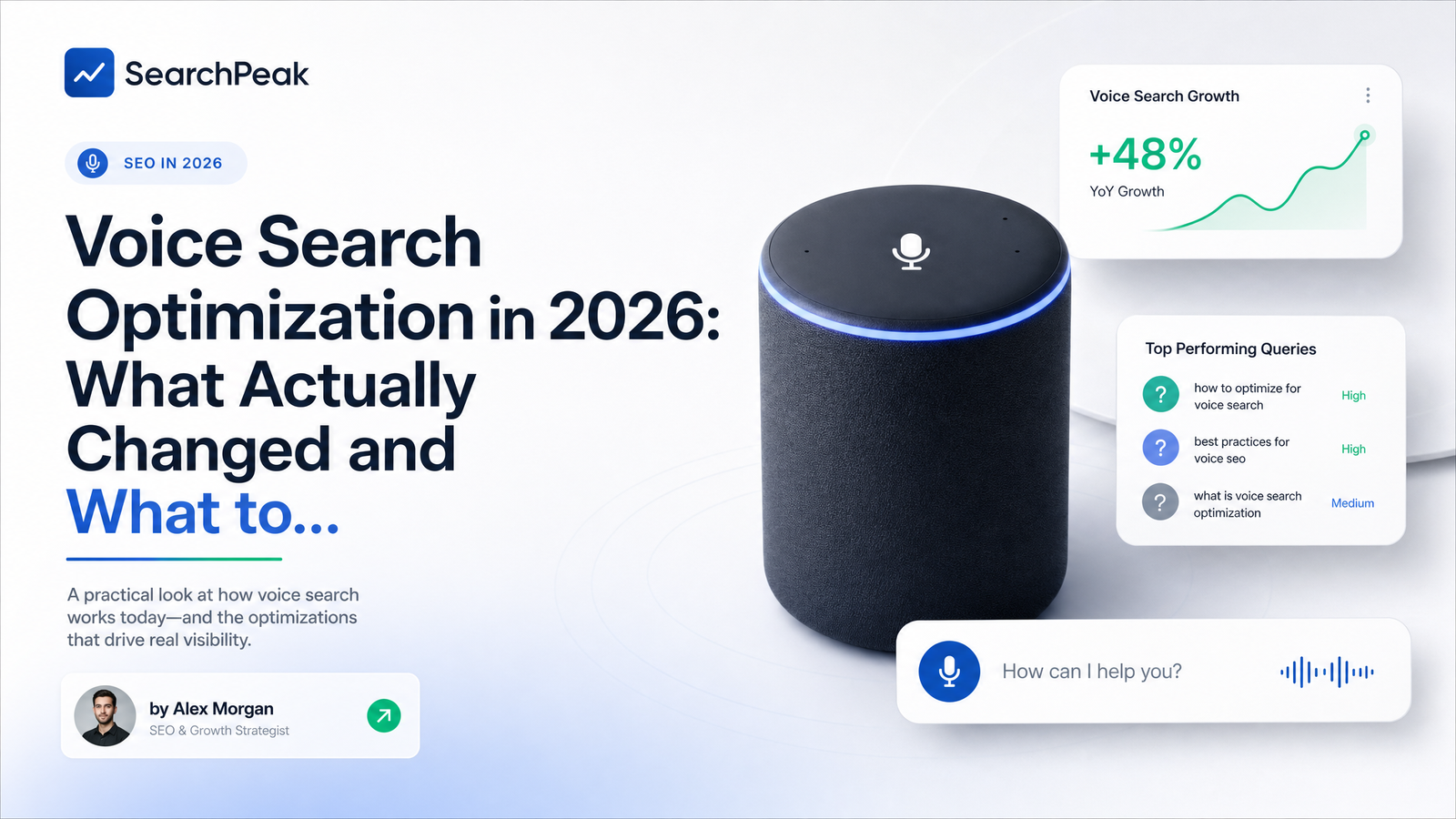
Voice Search Hasn't Disappeared — It's Merged Into Something Bigger
Ask ten marketers whether voice search optimization still matters in 2026 and you'll get ten answers, mostly to a question from 2018. Voice search hasn't gone away — voice search adoption continues to climb, with a meaningful share of searches now starting as spoken queries across phones, cars, and smart displays. What's changed is the plumbing underneath it.
There is no longer a distinct "voice search algorithm" separate from everything else Google, Bing, or an AI assistant does. Siri, Alexa, and Google Assistant now lean on the same large language models and conversational AI search layers that power AI Overviews and chat-based answer engines. A spoken query and a typed query increasingly get resolved by the same underlying system, just packaged differently at output — read aloud versus displayed as text. Treating voice search optimization as its own isolated discipline, with a separate strategy, budget, and vendor, is the outdated part. The queries are still real; the idea that they need a dedicated playbook is what needs retiring.
What Actually Changed in 2026
Three shifts explain most of the confusion around voice search optimization right now.
First, assistants have largely moved from reading a single featured snippet aloud to synthesizing an answer from multiple sources. Where a 2019-era smart speaker would parrot back one crawled paragraph, today's assistants pull from AI-generated overviews and blend information across several ranking pages before speaking a response. Being "the one snippet" matters less than being one of the sources an AI system trusts enough to draw from.
Second, query patterns have gotten longer, more conversational, and increasingly multimodal. Someone might ask a question by voice, get a spoken answer, then follow up with a typed refinement or a photo, all in one session. Optimizing for a rigid "who/what/where" format misses how people actually talk to assistants now — in follow-ups, clarifications, and carried-over context.
Third, more processing happens on-device. Phones and smart speakers increasingly handle query interpretation locally before hitting a server, which speeds up response times and shifts some ranking signals toward pages that are lightweight and fast to parse. This reinforces something technical SEO has argued for years: page performance is an input signal, especially when quick, extractable answers benefit from a page that resolves fast (see the Core Web Vitals fix-it playbook for the technical side of this).
What to Skip: Outdated Voice SEO Tactics Still Being Sold
A lot of agencies still sell "voice search optimization" as a standalone package. Most of what's inside is recycled basic SEO with a new label, or advice that stopped mattering years ago. Skip these:
- Standalone voice search packages. If a vendor sells voice optimization separately from your core technical and content SEO, you're paying twice for overlapping work. Voice search doesn't function as a separate ranking system anymore — it draws from the same content and technical signals as everything else.
- Near-me keyword stuffing. Cramming "plumber near me Chicago emergency 24/7" into headers and alt text was never how local intent got matched, and it's even less relevant now that location context comes from device signals and Google Business Profile data rather than exact-match phrase repetition.
- Obsessing over exact question-form headers. Writing every H2 as "What is X?" or "How do I Y?" to mimic spoken queries is a myth from early snippet-hunting days. Assistants now parse meaning and context, not literal string matches between a header and a query.
- Chasing smart-speaker optimization in irrelevant industries. A B2B software company selling enterprise contracts doesn't need to worry about being read aloud on a kitchen speaker. Not every business has a voice-search audience worth chasing.
- Treating voice as separate from conversational/AI search. This is the umbrella myth under all the others. Once you stop budgeting for "voice SEO" as its own line item and fold it into how you already optimize for AI Overviews and answer engines, most of the outdated tactics fall away on their own.
What Still Works: A Practical Voice-Readiness Checklist
Strip away the recycled advice and a short list of genuinely useful practices remains — mostly because they're just good SEO that happens to double as voice-readiness.
Lead with a direct, extractable answer. Put the core answer to the likely question in the first sentence or two of a section, then expand with context and nuance. This is what assistants and AI Overviews lift, and what a human skimming on their phone wants too.
Keep structured data clean and current. Schema markup still helps machines understand what a page is about and how its parts relate — product details, FAQs, reviews, business hours. It doesn't guarantee a voice answer, but it removes ambiguity that could otherwise get a page skipped over in favor of a clearer source.
Make pages fast and mobile-first. Speed correlates with both voice-answer selection and basic usability, and it's one of the few factors you fully control. That's worth treating as infrastructure, not a one-time fix.
Strengthen local entity signals. For location-based businesses, local voice search intent is disproportionately high, driven far more by accurate, consistent business data than by keyword phrasing. A structured local audit — covering listings, categories, reviews, and proximity signals — does more for voice visibility than any amount of "near me" copy. Rankevra's local SEO audit framework walks through exactly which layers matter most.
Monitor whether you're actually being surfaced. Featured snippets still correlate with voice-answer selection often enough to matter, but they're no longer the whole story now that AI Overviews synthesize across sources. Track visibility across both snippet positions and AI-generated answers rather than assuming a top-three ranking means you're the one getting read aloud. A modern rank tracker built for 2026's answer landscape is the practical way to check this instead of guessing.
How to Tell If Voice Search Optimization Is Worth Dedicated Effort
Not every business needs to think about this daily, and pretending otherwise is how "voice SEO" got oversold in the first place.
Prioritize it if you're a local or service business — plumbers, dentists, restaurants, auto shops — where "find me now" and "who's open near me" queries drive real revenue. Also prioritize it if you operate in a high-intent, question-based industry: recipes, health symptoms, product comparisons, troubleshooting guides. These are exactly the query types conversational assistants handle most, and where accurate, well-structured answers directly convert into calls, visits, or clicks.
Don't bother building a dedicated voice strategy if you're in enterprise B2B, niche technical software, or any business where purchase decisions happen through research-heavy sessions rather than quick spoken questions. For these businesses, keep core technical SEO solid and content genuinely clear — voice-readiness will show up as a side effect, not because you built anything voice-specific. Whether voice search optimization is worth it depends entirely on whether your customers ask short, spoken questions in the first place, not on generic industry hype.
Making Voice Readiness Part of One System, Not a Side Project
Every tactic that actually holds up — extractable answers, clean schema, fast pages, strong local data, visibility tracking — is also just core technical and content SEO. There's no unique voice-only signal left to chase. That overlap is the whole point: running audits, content, schema, and rank tracking through one connected workflow naturally produces voice-readiness, without anyone needing to run a parallel "voice SEO" initiative with its own budget and vendor.
This is where a fragmented toolstack starts costing you. If your technical audit lives in one tool, your content briefs get written in a separate doc (see how to write an AI SEO content brief that needs no rewrite for what a properly structured brief looks like), and your rank tracking sits in a third dashboard, nobody's watching how these signals interact — which is exactly how voice-readiness gets treated as an afterthought. Agencies managing several local clients feel this most acutely; the operational overhead of tracking near-me visibility, schema, and reviews across multiple accounts is a real problem, one that purpose-built local SEO software for agencies is designed to solve.
An automated SEO workflow that runs audits, drafts structured content, publishes it, and tracks rankings and AI-answer visibility in one place turns voice-readiness from a project into a byproduct.
Frequently Asked Questions
Is voice search optimization still relevant in 2026, or is it dead?
It's still relevant, but not as a standalone discipline. Voice queries have merged into the same conversational AI search systems that power AI Overviews and chat-based answer engines, so the underlying work — clear answers, clean structured data, fast pages, strong local signals — is just core SEO applied consistently.
Do I need a separate voice search SEO strategy, or does regular SEO cover it?
Regular SEO covers it, provided it's done well. There's no separate voice-ranking system left to optimize for; assistants draw from the same crawled, structured, fast-loading content that ranks in standard search and AI Overviews.
Does adding FAQ schema actually help my content get read aloud by voice assistants?
FAQ schema helps machines parse your content's structure clearly, which supports selection for both featured snippets and AI-generated answers, but it's not a guarantee on its own. It works best combined with genuinely concise, direct answers in the surrounding copy — the schema clarifies structure, the writing has to earn the citation.
How is optimizing for voice search different from optimizing for AI Overviews or ChatGPT answers?
There's very little practical difference left. Both rely on synthesized answers pulled from multiple trusted sources rather than a single ranked page, so the same extractable-answer, clean-schema, fast-page approach serves both voice assistants and AI Overviews simultaneously.
Should local businesses still prioritize 'near me' keywords for voice search?
Not through literal keyword stuffing. Local voice intent is real and significant, but it's matched through accurate Google Business Profile data, consistent listings, and proximity signals rather than repeating "near me" phrases in your copy.
How can I check if my content is actually being surfaced by voice assistants?
Track visibility across both featured snippet positions and AI-generated overview citations, since either can produce a voice answer today. A rank tracker built to monitor answer-engine visibility, not just traditional blue-link positions, is the most reliable way to verify this rather than assuming rankings translate directly.
Voice-readiness stops being a separate to-do list once your audits, content, and tracking run through one continuously maintained system. Rankevra handles that loop automatically — auditing technical issues, drafting structured, extractable content, and monitoring rank and visibility — so voice and AI-answer readiness show up as a natural result, not a side project.
Keep reading
- Competitor Content Tracking SEO: A Continuous SystemLearn a repeatable competitor content tracking SEO system: weekly checks, monthly reviews, quarterly deep-dives, and how to automate it with Rankevra.
- Fix 404 Errors SEO: A Priority Framework That WorksLearn to fix 404 errors SEO teams actually need to worry about. A triage framework for finding, prioritizing, and resolving broken pages fast.
- How to Write an AI SEO Content Brief That Needs No RewriteLearn how to structure an AI SEO content brief with intent, entities, and outline depth so AI drafts publish with minimal editing.