Rankevra Blog
Competitor Content Tracking SEO: A Continuous System
September 13, 2026
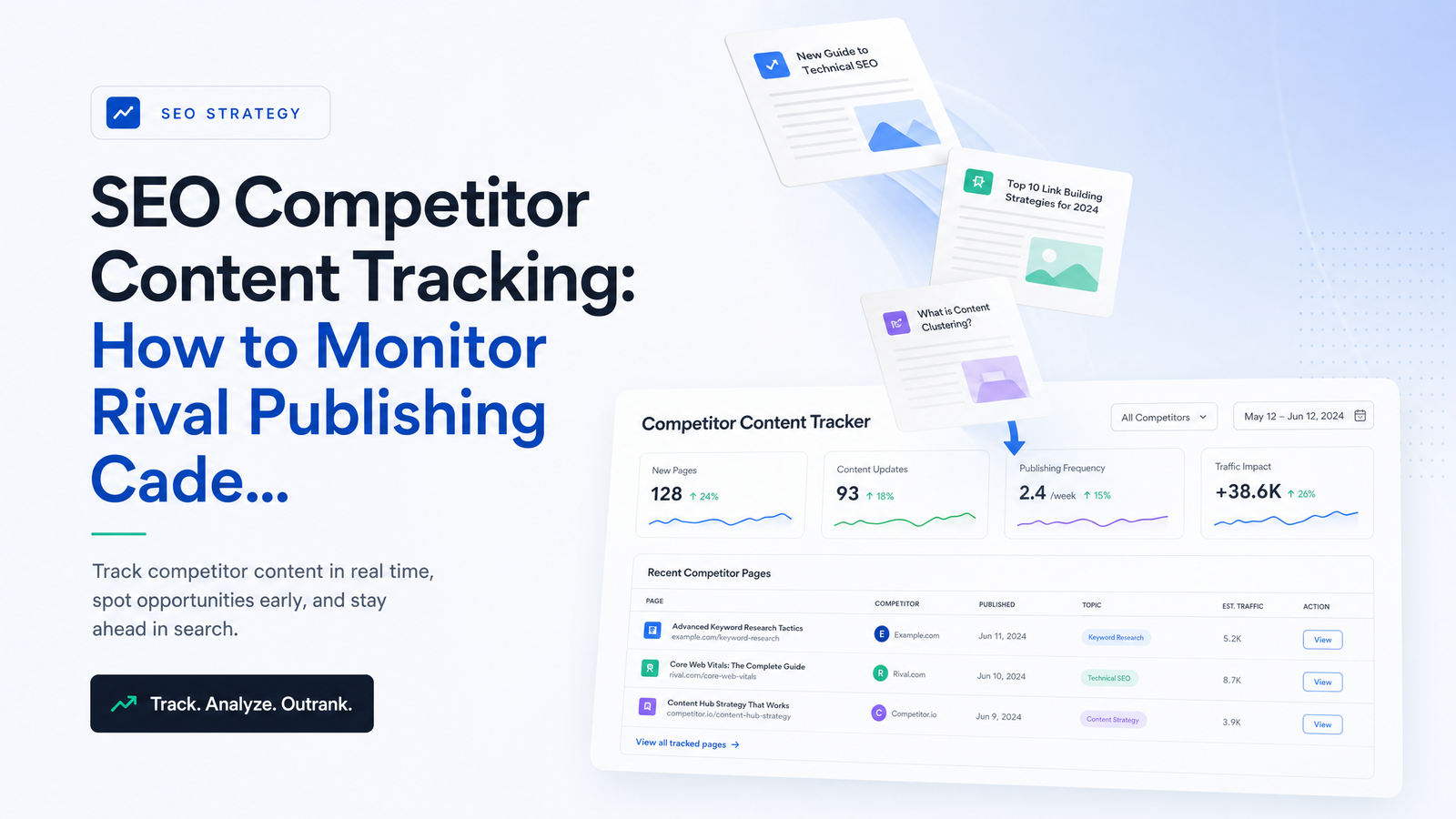
Most competitor research dies the same way: someone runs a thorough audit, builds a spreadsheet, presents it in a meeting — and then nobody opens it again. Three months later a rival has quietly outranked you for a whole topic cluster, and nobody noticed the buildup. Competitor content tracking SEO fixes this by treating competitor monitoring as an ongoing system, not a one-off project, so you catch shifts while they're still small enough to act on.
What Competitor Content Tracking Actually Means (And Why a One-Time Audit Isn't Enough)
A one-time competitor audit is a snapshot: it tells you what a rival has published up to today. It says nothing about direction — whether they're accelerating in a category that matters to you, or abandoning a topic you should now claim. A static audit can't answer that, because the value is in the trend, not the moment.
Ongoing competitor content tracking replaces that snapshot with two signals logged on a schedule: publishing cadence and topic coverage. Cadence tells you how fast a competitor is producing content and whether that pace is changing. Topic coverage tells you where they're investing that output and how deep their clusters are getting. Tracked together over weeks and months, these two signals reveal compounding effects — a competitor publishing three extra articles a month in one cluster doesn't look alarming in isolation, but six months of that pattern can mean they've built the topical authority you were planning to own. Missing that buildup is the single biggest reason self-managed SEO teams get blindsided by rivals who "came out of nowhere."
The Two Signals Worth Tracking Over Time
Publishing cadence covers how often a competitor publishes, when they publish, and what formats they favor. A sudden jump from two posts a month to eight is worth investigating immediately — it usually means new budget, a new writer or agency, or a deliberate push into a category they've decided matters. Timing patterns matter too: publishing clustered around a product launch or seasonal event tells you their strategy is tied to business priorities, not just an editorial calendar. Format shifts — moving from blog posts to comparison pages, or adding video and interactive tools — often precede a broader SEO strategy pivot.
Topic coverage is about where that output goes. Are they deepening an existing cluster (supporting articles, updated pillar pages, added FAQ content) or entering a brand-new topic entirely? Watch for topics they abandon too — a competitor that stops touching a keyword set it used to cover regularly may be deprioritizing it, which can be your opening. Content velocity — the rate at which a competitor adds new pages to a specific cluster — is the clearest early indicator of a deliberate authority play rather than opportunistic publishing. Research on monitoring competitor SEO rankings and keyword shifts backs this up: bursts of publishing velocity within a single cluster are one of the more reliable early signals that a competitor is investing in topical authority, well before rankings fully reflect it.
A Simple Cadence for Watching Competitors (Weekly, Monthly, Quarterly)
The most common reason teams give up on competitor tracking is not knowing how often to check without it becoming a part-time job. A tiered rhythm solves that.
Weekly (10–15 minutes): Scan for new URLs from your 3–5 core competitors. Don't analyze deeply — just note what's new and flag anything that looks like an unfamiliar format or topic.
Monthly (30–45 minutes): Review the accumulated weekly notes as a set. Count how many pieces each competitor published, compare against their prior month, and check whether the topic mix has shifted. This is where a cadence spike or a new cluster entry becomes visible.
Quarterly (half a day): Do a full topic coverage mapping — list every cluster each competitor is active in, estimate their depth (supporting pages per pillar), and check overlap with your own content plan. This is also the point to cross-check rankings and SERP volatility, since positions can shift even without new content, simply due to algorithm updates. HubSpot's guide to SEO competitor analysis recommends this kind of quarterly-minimum full review, particularly given how AI Overviews are reshaping click-through rates on the SERPs you're competing for. A practitioner methodology from Stridec on competitor content analysis similarly suggests quarterly checks for freshness and SERP overlap, with a deeper annual pass for topical gap review — a reminder that this system scales down to annual review for lower-priority competitors, not just up.
This tiered approach is proportionate for a self-managed team or small in-house group — a fraction of what an agency retainer would charge for the same visibility, and it fits inside normal weekly workflow rather than requiring a dedicated analyst.
Building a Lightweight Tracking Log (What to Record Each Cycle)
You don't need new software to start this system today — a shared spreadsheet works fine. Each time you review a competitor, log:
- URL of the new or updated page
- Publish or last-updated date
- Topic cluster it belongs to (match against your own taxonomy so comparisons are direct)
- Format (blog post, comparison page, tool, video, etc.)
- Estimated position or traffic, pulled from a rank tracker or estimated via search
- Cadence note — is this part of a burst, or business as usual for that competitor?
Reviewing Google Search Console data for your own overlapping keywords alongside this log lets you see both sides at once: what a competitor just published, and how your own visibility for the same terms is trending. Over several cycles, this structure lets you assign a rough score per competitor per cluster — rating cadence as accelerating, steady, or slowing, and coverage as expanding, stable, or shrinking. That two-axis score is often enough to prioritize which competitor-cluster combinations deserve real attention next quarter, without a complex model.
Turning Tracked Data Into Action
Logged data is only useful once it changes what you publish or fix. A few patterns and their typical response:
A competitor accelerating in one cluster usually means it's time to check whether your own coverage there is thin. This is exactly where a structured content gap analysis earns its keep — run the cluster where you've spotted acceleration through a full gap framework before deciding what to publish.
A competitor entering a genuinely new topic is worth a quick relevance check: does it overlap with your audience, or are they chasing a different segment? If it overlaps, get a pillar page live before they build out supporting content.
A competitor abandoning a keyword set it used to cover regularly is a signal to check whether that traffic is up for grabs — sometimes this reflects a genuine business shift, other times content decay they haven't noticed, where old pages lose rankings with nobody maintaining them.
Sudden ranking movement without an obvious cadence change often reflects SERP volatility from an algorithm update rather than a content strategy shift — cross-reference before you overreact. This is where dedicated rank tracking pays off: guides like Best SEO Rank Tracker in 2026: How to Actually Choose and the Best Keyword Rank Tracker 2026 evaluation framework help you separate noise from a genuine competitive threat. Feed the resulting priorities into your regular reporting — a good SEO reporting dashboard should carry a competitor-tracking section, not just your own metrics, so decisions get made with both sides of the picture in view.
Why Manual Tracking Breaks Down — and How Rankevra Automates It
The system above works — until you try to run it across more than two or three competitors by hand. Weekly URL checks turn into a dozen browser tabs. Monthly cadence counts require someone to actually remember to tally them. Quarterly deep-dives get pushed back because nobody has half a day free at the right moment. Spreadsheets drift out of date, alerts pile up unread, and tool logins multiply — a rank tracker here, a crawler there, a separate doc for notes. Rank data from any single source is also directional rather than absolute, as the Stridec methodology points out, which is another reason to keep tracking continuous rather than trusting one snapshot.
This is precisely the friction Rankevra is built to remove. As an AI SEO tool that combines automated audits, rank tracking, and content publishing in one workflow, Rankevra runs the watch-and-log cycle continuously instead of waiting for someone to remember it. Automated competitor tracking inside Rankevra surfaces cadence shifts and topic coverage changes as they happen, so the weekly scan, monthly tally, and quarterly deep-dive described above happen on autopilot rather than depending on a recurring calendar reminder someone eventually ignores.
Manual tracking is manageable for two or three competitors if you're disciplined. Past that, spreadsheets, scattered logins, and half-remembered alerts stop scaling — exactly where teams start missing the early signals this whole system is designed to catch. If you'd rather run this monitoring system without the manual overhead, try Rankevra to see the audit, rank tracking, and content workflow running continuously in one place.
Frequently Asked Questions
How often should I track competitor content publishing?
Run a lightweight weekly scan for new URLs, a monthly review to tally cadence and spot shifts, and a full quarterly deep-dive to map topic coverage in depth. This tiered rhythm catches early signals without turning competitor tracking into a full-time job, and it scales down to an annual pass for lower-priority competitors.
What's the difference between competitor content tracking and a content gap analysis?
Competitor content tracking is the ongoing monitoring system — logging publishing cadence and topic coverage over time to catch trends as they develop. A content gap analysis is a deeper, point-in-time exercise you run once tracking flags a cluster worth investigating, comparing your coverage against competitors' to find specific missing keywords and subtopics.
How do I track competitor topic coverage without expensive tools?
Start with a shared spreadsheet logging URL, publish date, topic cluster, format, and estimated position for each competitor each cycle. This costs nothing but time and is enough to spot cadence and coverage shifts before you need dedicated software.
What does it mean if a competitor's publishing cadence suddenly increases?
A sudden increase usually signals new budget, a new writer or agency, or a deliberate push to build topical authority in that cluster. It's an early warning sign worth investigating immediately, since these bursts often precede ranking gains that take months to fully show up in the SERPs.
Should I track every competitor or just a few?
Focus deep tracking on your 3–5 closest competitors and reserve less frequent, quarterly-or-annual checks for the rest. Tracking every competitor at full intensity isn't proportionate for a self-managed team and dilutes attention from the rivals actually threatening your rankings.
Can AI tools automate competitor content tracking?
Yes — AI SEO tools can continuously scan competitor sites for new URLs, cadence changes, and topic coverage shifts without manual spreadsheet upkeep. Rankevra automates this watch-and-log cycle alongside rank tracking and content publishing, replacing scattered tools and calendar reminders with one continuous workflow.
Keep reading
- Voice Search Optimization in 2026: What Actually Works NowVoice search optimization in 2026 means conversational AI search, not 2016 tricks. Here's what changed, what to skip, and what to actually do.
- Fix 404 Errors SEO: A Priority Framework That WorksLearn to fix 404 errors SEO teams actually need to worry about. A triage framework for finding, prioritizing, and resolving broken pages fast.
- How to Write an AI SEO Content Brief That Needs No RewriteLearn how to structure an AI SEO content brief with intent, entities, and outline depth so AI drafts publish with minimal editing.