Rankevra Blog
Search Engine Optimizer: Person, Process, or Software?
September 1, 2026
What Is a Search Engine Optimizer, Exactly?
Type "search engine optimizer" into Google and you'll get a confusing mix of results: job listings for SEO specialists, dictionary-style definitions of SEO as a practice, and product pages for software. That's because the phrase legitimately means three different things depending on context.
It can refer to a person — an SEO specialist hired to improve a site's visibility in search results. It can refer to a process — Search Engine Optimization itself. Or it can refer to a tool — software built to perform some or all of the tasks an SEO specialist would otherwise do by hand.
This article addresses the third meaning, because that's where the term is actively moving. A decade ago, "search engine optimizer" almost always meant a hired professional. Today, a growing share of searches for that exact phrase come from people evaluating software — specifically, an AI search engine optimizer that can audit a site, plan content, publish it, and track rankings without a human doing each step manually. If you're researching the term expecting to hire someone, you'll waste time on tool comparisons; if you're shopping for software, you don't want a page written for recruiters. We're writing for the second group, while giving the first enough context to know where they fit.
What a Search Engine Optimizer Actually Does
Whether the work is done by a specialist or a piece of software, the underlying tasks are the same. Six functions make up the core job:
- Technical audits. Crawling a site to find issues that block indexing or hurt performance — broken links, slow load times, duplicate content, poor site architecture. This is technical SEO, usually the first layer fixed before anything else matters.
- Keyword and content strategy. Deciding what topics to target, mapping search intent, and identifying gaps competitors haven't covered.
- On-page optimization. Structuring titles, headings, internal links, and body copy so pages are both readable and clearly relevant to a target query — the layer that connects strategy to execution.
- Content creation and publishing. Writing pages or briefs and getting them live, ideally without a separate export-and-upload step for every piece.
- Link building and off-page signals. Earning or acquiring links and mentions that signal authority to search engines.
- Rank tracking and reporting. Monitoring how pages perform over time and adjusting based on what's actually moving the needle.
A human SEO specialist typically handles these tasks across a patchwork of separate tools: one for audits, one for keyword research, a writing tool, a CMS, and a rank tracker. Software built to be a search engine optimizer tries to collapse that patchwork into a single workflow — one tool running many functions instead of one person coordinating many tools. That distinction is exactly what's driving the shift covered next.
Why the Role Is Shifting Toward AI-Driven Software
The SEO specialist role hasn't disappeared, but it's increasingly software-assisted rather than manual. Adoption data backs this up: current figures show a large majority of marketers now use AI-powered SEO tools in some part of their workflow, according to AI SEO statistics compiled by SEO.com. More tellingly, the Aira 2025 State of SEO Report, cited by SQ Magazine, found a sharp year-over-year jump in the share of SEO professionals who say they've integrated AI directly into their day-to-day workflow — not just experimented with it on the side.
That jump explains why "AI search engine optimizer" has become a searched term in its own right. It's not marketing fluff attached to old software; it reflects a real change in how the work gets done. Audits that once took a specialist hours of manual crawling and spreadsheet triage can now run automatically and flag priority fixes. Content briefs that used to require a strategist to research intent, competitors, and structure can be generated in minutes and refined by a human editor. Rank tracking that once meant checking positions weekly in a separate dashboard can now run continuously and feed straight back into what content gets prioritized next.
This shift is also tangled up with how search itself is changing. Google's AI Overviews and the broader move toward Generative Engine Optimization (GEO) — optimizing content to be cited by AI-generated answers, not just ranked in a list of blue links — reward sites that publish consistently and maintain clear topical structure. Software that executes continuously, rather than in the periodic bursts of a human working part-time on SEO, is naturally better suited to keeping up.
What to Look for in a Modern Search Engine Optimizer Tool
Not every tool labeled "AI SEO platform" actually functions as an all-in-one search engine optimizer. Before treating any product as a replacement for scattered point solutions, check for four things:
- Audit coverage that goes beyond surface issues. It should catch crawlability, indexation, site speed, and structural problems — the kind of prioritized technical fixes covered in this priority action plan for technical SEO — not just a generic health score.
- AI content that preserves E-E-A-T. Generated drafts need real experience, expertise, and accuracy signals built in, not templated fluff. The AI writer workflow from brief to ranking page is a useful reference for what a properly structured AI content pipeline looks like.
- Publishing integration. Content should be able to go live on your CMS directly from the platform, not sit as an export waiting on manual formatting.
- Rank tracking tied back to the content and technical work. Tracking that's disconnected from the rest of the workflow just becomes another dashboard to check; see how to actually choose a rank tracker for what meaningful tracking looks like.
For the fuller landscape of tool categories beyond these four — link builders, keyword research suites, competitor analysis tools — this map of SEO tools for 2026 covers it in more depth than a single article can.
Human Expertise Still Matters
None of this means a search engine optimizer tool eliminates the need for human judgment. AI handles execution and consistency well: running audits on schedule, drafting content at scale, publishing without delay, tracking rankings continuously. What it doesn't replace is strategy — deciding which markets or topics are worth pursuing, what your brand should sound like, and which trade-offs make sense for your specific business.
The AI vs. human SEO debate isn't really a contest; it's a division of labor. A human still needs to set direction, review AI-generated content for accuracy and brand fit, and make judgment calls about competitive positioning that no tool can infer on its own. The practical model emerging across most teams is a human steering strategy while software handles the repetitive, time-intensive execution that used to consume most of an SEO specialist's week. That combination is also what protects E-E-A-T at scale — the "experience" and "expertise" signals search engines look for are strongest when a knowledgeable person is still reviewing what ships.
How Rankevra Works as an AI Search Engine Optimizer
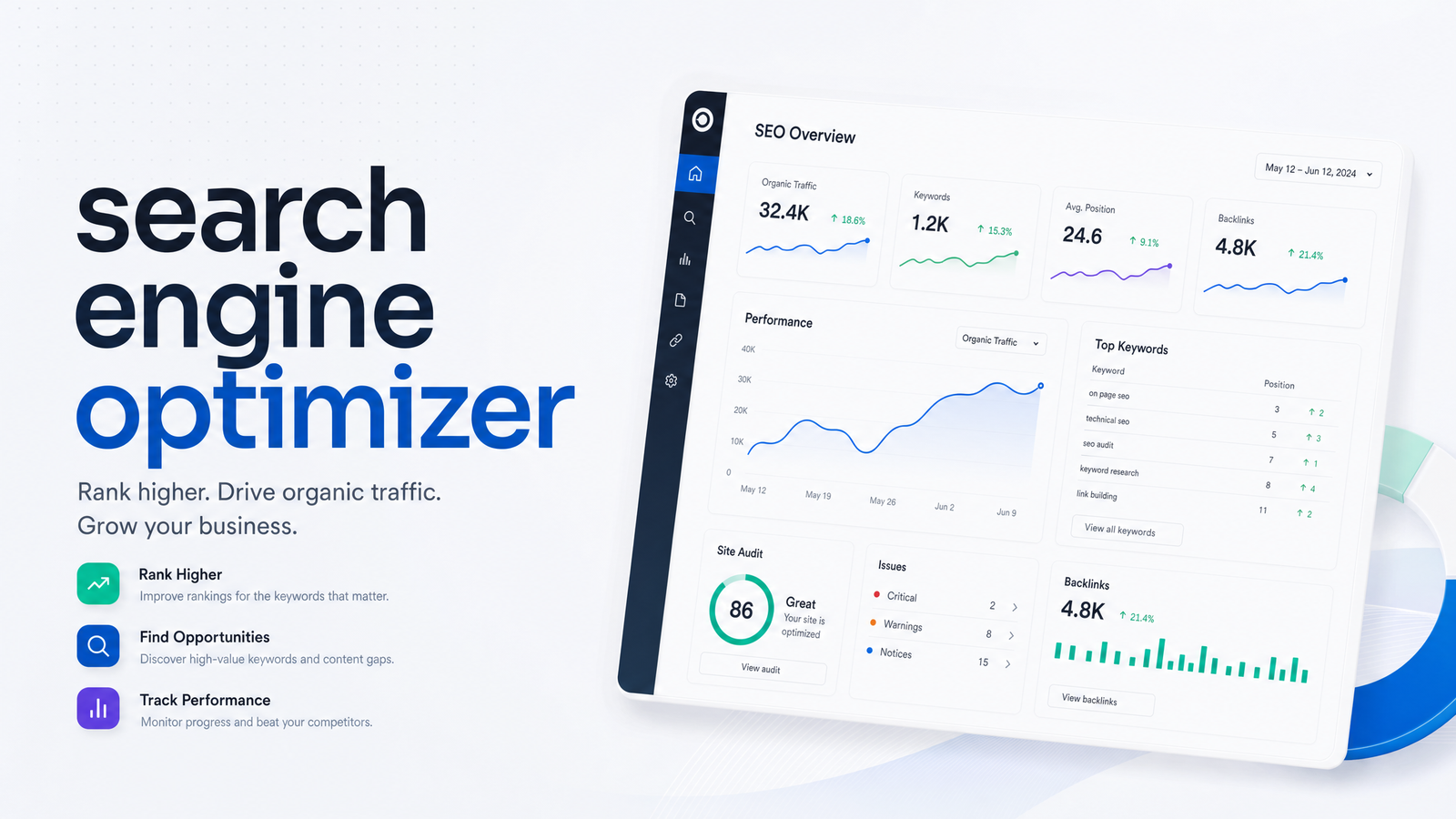
Rankevra is built around the premise that a search engine optimizer, in its modern form, should be one coherent piece of software rather than five disconnected ones. It runs technical audits to surface what's broken, generates content briefs and drafts informed by keyword and intent research, publishes that content directly, and tracks rankings afterward — all from a single dashboard instead of a chain of exports and logins between separate tools.
That end-to-end structure directly answers the juggling problem most self-managed SEO teams run into: audit tool here, writer there, a CMS plugin somewhere else, and a rank tracker nobody checks consistently because it's one more tab. Rankevra consolidates that workflow so the strategic decisions — what to prioritize, what tone to write in, which pages matter most — stay with you, while the repetitive execution runs on autopilot.
If you're managing SEO yourself and tired of stitching tools together, Rankevra is the search engine optimizer that runs audits, briefs, drafts, publishing, and rank tracking from one dashboard. Try it directly on the Rankevra homepage to see the full workflow in action.
Frequently Asked Questions
Is a search engine optimizer a person or a piece of software?
It can be either, depending on context — the phrase historically referred to a hired SEO specialist, but it increasingly describes software that performs SEO tasks like audits, content creation, and rank tracking. Search intent has shifted enough that many people using the term today mean the software, not the job title.
What does a search engine optimizer actually do day to day?
A search engine optimizer, human or software, handles technical audits, keyword and content strategy, on-page optimization, content publishing, link building, and rank tracking. The specific mix depends on the site's needs, but these six functions form the core of the role regardless of who or what performs them.
What's the difference between a search engine optimizer and an SEO tool?
An SEO specialist typically coordinates multiple separate tools to complete the SEO workflow, while a modern "search engine optimizer tool" aims to perform several of those functions itself within one platform. The distinction is less about capability and more about consolidation — one coordinator using many tools versus one tool running many functions.
Can an AI search engine optimizer replace a human SEO specialist?
Not entirely — AI tools handle execution and consistency well, such as running audits, drafting content, and tracking rankings, but strategic decisions, brand voice, and judgment calls still benefit from human oversight. Most effective setups combine AI-driven execution with a human directing strategy rather than removing people from the process.
How do I choose the right search engine optimizer software for my site?
Prioritize tools with thorough audit coverage, AI content generation that maintains E-E-A-T standards, direct publishing integration, and rank tracking connected to the rest of the workflow. Avoid tools that only handle one piece of the puzzle if your goal is to reduce the number of platforms you manage.
Do I still need separate tools if I use an all-in-one search engine optimizer?
Usually not for the core workflow — audits, content creation, publishing, and rank tracking can run from a single platform if it's built as a true all-in-one SEO tool. Some teams still supplement with specialized tools for niche needs like advanced link-building outreach, but day-to-day SEO execution can be consolidated.
Keep reading
- Content Decay SEO: How to Detect It and Fix It for GoodLearn to detect content decay SEO issues early, rule out false positives, and build a refresh pipeline that scales — plus how to automate the whole loop.
- Headless CMS SEO: Fixing the Gaps Generic Tools MissHeadless CMS SEO breaks in three predictable places: rendering, metadata, and sitemaps. Here's the diagnostic framework to find and fix each gap.
- Google Algorithm Update Recovery: A Diagnostic FrameworkA step-by-step google algorithm update recovery framework: confirm the cause, segment the damage, benchmark against winners, and set a real timeline.